
Embarking on an Ecological Transition through Permaculture Design

Ecological Transition through Permaculture Design: Before and After Permaculture Rain Garden USU Moab Photo Courtesy & © Roslynn Brain McCann, Photographer
Before and After
Permaculture Rain Garden
USU Moab
Photo Courtesy & © Roslynn Brain McCann, Photographer
Before installing our permaculture gardens at Utah State University, Moab, the only birds I observed from my office window were Eurasian Collared Doves and crows. The space is small. It used to consist of concrete and a mono-planted row of juniper bushes. Seven years ago, over 40 members of the Moab community helped us dream up a new vision for the space. We took out a few parking spaces that allowed my building’s roof rainwater runoff to run-in to our garden and into a rock-lined swale and a series of basins. In an area that receives an average of under 10 inches of rainfall per year, our USU Moab permaculture gardens now harvest an estimated 125,000 gallons of rainwater either directly into the garden soil, or into a series of rain tanks for later use.

Alongside planting the rain through water harvesting earthworks, we installed an ecological design with a fruit and shade producing overstory, and an understory of shrubs, plants, and grasses. The understory performs one or more of four functions: pollinator attractors, nitrogen fixers, nutrient accumulators (which pull nutrients deeper in soil layers towards the surface, becoming available through a chop and drop technique), and soil stabilizers. Now, broad-tailed hummingbirds, spotted towhees, rock wrens and more can be seen and heard as the garden bounty ripens each year. These birds bring color, song, and delight as they contribute to pest control, devouring aphids, grasshoppers and pesky plant eating beetle grubs.

What we have learned through our small urban campus is that with permaculture design, any landscape can undergo a complete ecological transition – even a landscape that is only a few feet wide and was previously partially covered in concrete.

If you are interested in applying permaculture design to your landscape, start by observing your site as it currently is. See how water flows in a rain event. Walk around during the hottest days of the year and feel where the hot and cool zones are. How does the sun move across the site during summer solstice. During winter solstice. What views do you want to take in and block? What species engage in your landscape and what ones are missing? These are the types of questions you can ask yourself. Then, as you begin to think about design ideas, here are some general tips:

    • Ask elders in your community about extreme weather events and other helpful historical information
    • Think about what your landscape is currently doing for you, and what you would like it to do. Then, develop your goals for the site. This will help you determine what is and is not currently working
    • In the desert, as a general rule, place your paths high and dry, plants low and wet (or at least wetter)
    • Discover what plants might work well together in what is called a guild. For example, if you have a nitrogen dependent shrub, plant nitrogen-fixing plants around it.
    • Harvest as much rainwater as possible through active systems like rain tanks, and passive systems like earthworks that slow, spread, and sink rainwater
    • Plant your high-maintenance plants in your most-frequented areas – alongside the pathway between your house and chicken coop, for example.
    • Birds and humans appreciate diversity in heights, species, and food-producing plants
    • Start small
    • See failures as opportunities for learning

    For Utah State University Extension Sustainability and the Department of Environment and Society, this is Roslynn Brain McCann and I’m wild about Utah!

    Credits:
    Images: Courtesy and copyright Roslynn G.H. Brain McCann, Photographer
    Audio: Courtesy and copyright Kevin Colver
    Text:     Roslynn G.H. Brain McCann, Utah State University Extension Sustainability
    Additional Reading: Lyle Bingham, Webmaster
    Additional Reading:

    Brain McCann, Roslynn G.H., Rainwater Harvesting, Wild About Utah, October 19, 2015, https://wildaboututah.org/rainwater-harvesting/

    Brain McCann, Roslynn G.H., Permaculture, Wild About Utah, May 23, 2016, https://wildaboututah.org/permaculture/

    Brain McCann, Roslynn G.H., Three-Leaf Sumac (Rhus trilobata), Wild About Utah, November 23, 2015, https://wildaboututah.org/three-leaf-sumac-rhus-trilobata/

    Brain McCann, Roslynn G.H., Dandelion, Friend or Foe?, Wild About Utah, April 4, 2016, https://wildaboututah.org/dandelion-friend-foe/

    Brain McCann, Roslynn G.H., Edible Weeds: Lambs Quarters and Purslane, Wild About Utah, March 27, 2017, https://wildaboututah.org/edible-weeds-lambs-quarters-and-purslane/

    Brain McCann, Roslynn G.H., Yellow-bellied Marmot, Wild About Utah, September 21, 2015, https://wildaboututah.org/yellow-bellied-marmot/

    YCC Team, Lush Utah garden makes the most of a small amount of rain, Yale Climate Connections, July 25, 2022, https://yaleclimateconnections.org/2022/07/lush-utah-garden-makes-the-most-of-a-small-amount-of-rain/
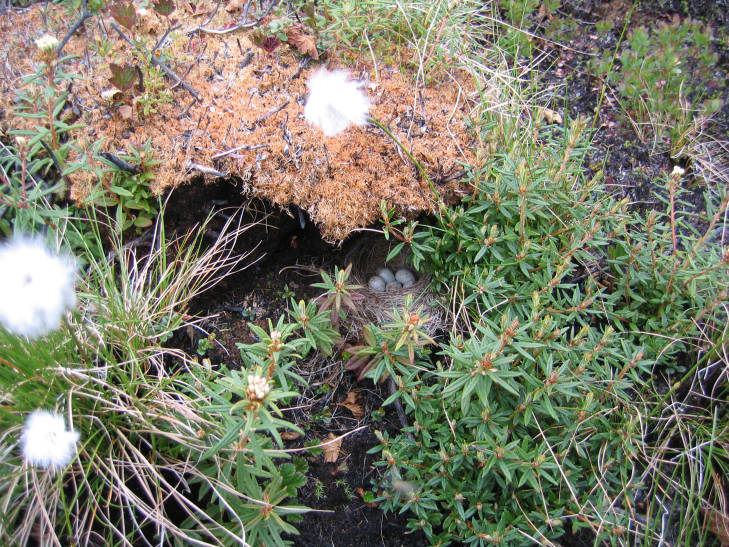
    Juncos

    Juncos: Junco Nest Courtesy US FWS Carla Stanley, Photographer
    Junco Nest
    Courtesy US FWS
    Carla Stanley, Photographer
    I first became aware of dark eyed juncos while doing fieldwork for the USFS in Montana. My young children discovered an active nest on the ground near a mountain stream. This was before my birding days. It occurred to me this was a strange place for a small, sparrow sized bird to build a nest, giving predators the advantage. Yet they flourish, and are among the most common and prolific songbirds in north America.

    Juncos: Dark-eyed 'Oregon' Junco Male, Junco hyemalis montanus, Courtesy and copyright 2008 Ryan P. O'Donnell, Photographer
    Dark-eyed ‘Oregon’ Junco Male, Junco hyemalis montanus, Courtesy and copyright 2008 Ryan P. O’Donnell, Photographer
    Now, many years later, I enjoy them at my feeder as they migrate down from the high country to winter in my backyard. I’ve found them to be very chatty with constant vocalizations being exchanged. A friend spent her PhD work on their chatter and discovered 23 sound variations representing different messages. I’m guessing there are many more if one includes nonverbal means of communicating and possible notes beyond our range of hearing.

    Another fascinating discovery was how different individual juncos were as I handled those captured in a mist net for banding purposes. Some were quite belligerent biting and struggling throughout the experience. Others were very docile. I imagined them to be smiling throughout the ordeal.

    The Dark-eyed Junco can be found across the continent, from Alaska to Mexico, from California to New York. A recent estimate set the junco’s total population at approximately 630 million individuals, about double the U.S. human population.

    Belonging to the sparrow family Passerellidae, Junco systematics are still confusing after decades of research, with various authors accepting between three and 12 species. There is a huge range of geographic variation in the Dark-eyed Junco. Among the 15 described races, six forms are easily recognizable in the field and five used to be considered separate species until the 1980s.

    Primarily ground feeders, in winter they become highly social often foraging in flocks, evident as masses attack my feeder, and each other! Their breeding habitat is coniferous or mixed forest areas, ranging from subarctic taiga to high-altitude mountain forests in Mexico and Central America south to Panama. The Oregon Dark-eyed Junco, along with the Slate-colored, are the two most widely known subspecies.

    The oldest recorded Dark-eyed Junco was at least 11 years, 4 months old when it was recaptured and rereleased during banding operations in West Virginia in 2001.

    Juncos are described as “happy, bubbly, little birds that are a joy to watch”. All races and species share a pink bill as well as pink legs, a reminder that no matter how different two things look, they are not all that different on the inside. Please enjoy your juncos and happy holidays!

    Jack Greene for Bridgerland Audubon Society, and I’m always wild about wild things in Utah!

    Credits:

    Nest Picture: Courtesy US FWS, Carla Stanley, Photographer
    Junco Picture: Courtesy & © Ryan P O’Donnell, Photographer
    Audio: Courtesy and Copyright Kevin Colver
    Text: Jack Greene, Bridgerland Audubon Society
    Additional Reading: Lyle W Bingham, Webmaster

    Additional Reading:

    Liberatore, Andrea, Dark-Eyed Juncos, Wild About Utah, January 12, 2012, https://wildaboututah.org/dark-eyed-juncos/

    Greene, Jack, Seasonal Changes and Amazing Adaptations, Wild About Utah, Nov 9, 2015, https://wildaboututah.org/seasonal-changes-amazing-adaptations/

    Atwell, J.W., O’Neal, D.M, and Ketterson, E.D. (2011) Animal Migration as a Moving Target for Conservation: Intra-species Variation and Responses to Environmental Change, as Illustrated in a Sometimes Migratory Songbird. Environmental Law. Vol. 41:289 p. 289-319, https://www.amazon.com/Animal-migration-moving-target-conservation/dp/B005C29H7I

    Alderfer, Jonathan (editor) (2005) National Geographic Complete Book of Birds. National Geographic Press. Dark-eyed junco information available online at: https://animals.nationalgeographic.com/animals/birding/dark-eyed-junco/

    Cornell Lab of Ornithology, All About Birds: Dark-eyed Junco. https://www.allaboutbirds.org/guide/Dark-eyed_Junco/id/ac

    History of Name Changes for Juncos. Cornell Lab of Ornithology. https://www.birds.cornell.edu/pfw/News/junco_taxonomy.pdf

    The Christmas Bird Count: Connecting to our ever changing natural world

    The Christmas Bird Count: Evening Grosbeak Courtesy US FWS George Gentry, Photographer
    Evening Grosbeak
    Courtesy US FWS
    George Gentry, Photographer
    My boots crunch loudly on the snow and we pause frequently to uncover a bundled-up ear from hats and hoods to listen. We are listening for birds like the high-pitched call of a cedar waxwing, clear trilling song of a ruby-crowned kinglet, or the incessant sounds of the red-breasted nut-hatch. The bright light from the rising winter sun sparkles brilliantly on the snow, which marks the start of a full day of birding ahead in the dead of winter. I, along with many others, make these winter birding treks annually to collect data for the Christmas Bird Count, which is the longest running community science project. This count began in 1900 as an effort by an Ornithologist, Frank M. Chapman, to start a new holiday tradition to encourage people to look at birds instead of hunt them. Fast forward to 121 years later and we are still collecting data instead of dinners. The first count in the State of Utah started not long after in Provo in 1903 with many other places following suit across the state as the years went on.

    The rules are simple; count all of the birds both seen and heard within a designated 15-mile diameter area over the entire day of the count which must be sometime between 14 December and 5 January. The result of these local and national counts now equates to a treasure trove of data. Every year since 1956 when the count started in Cache Valley, we observe around 90 species, though weather permitting we can see upwards of 100 species.

    Data from these counts are valuable in documenting species like the Evening Grosbeak, a large vibrantly yellow-colored finch which migrates in large flocks. In the early days of the Christmas Bird Count, Evening Grosbeaks would migrate south in large numbers every few years from the Boreal Forests of Canada and the Northern U.S., to the point that they were observed in over 50% of the Christmas Bird counts across the U.S. In the late 1980’s however, their population size and ranges suddenly decreased drastically. In our data from the Cache Valley Christmas Bird Count we see this trend echoed with just 3 Evening Grosbeak observed in 1980 jumping to 119 seen the following year. That record was broken again though 2 years later and then shattered in 1987 with 721 Evening Grosbeaks seen on the single count date. The very next year the numbers plummeted with only 5 individuals seen. Numbers have since remained low until 2017 when we saw 282 Evening Grosbeaks. One theory about these dramatic fluctuations in population size and ranges is thought that it mirrors the abundance of their prey, spruce budworms. It is also hypothesized that deforestation and climate change play a role in these fluctuations of their population as well as their prey.

    Observing these species and increasing this treasure of data is important for painting a picture of species movement and in addition, how species are responding to a changing climate locally and globally like the Evening Grosbeak. This massive data collection cannot be achieved by only scientists however, the participation of community members, like you and me, is necessary for not only the collection of more accurate data, but also for opening our own eyes to the natural world around us and getting to know the space that we occupy. Birding is a great way to connect to the outdoors and the Christmas Bird Count is the perfect excuse to get outside, especially this winter. Participation can be as simple as watching out your own window, joining a caravan, in separate vehicles this year to maintain social distance, or trekking through the snowy mountains from sunup to sun down. Visit Audubon.org to find a Christmas Bird Count near you to join this historic count.

    I am Makenna Johnson with the Bridgerland Audubon Society and I am Wild About Utah!

    Credits:
    Photos: Courtesy US FWS George Gentry, Photographer
    Audio:
    Text: Makenna Johnson, Bridgerland Audubon Society and Graduate Student, Quiney College of Natural Resources, Utah State University
    Additional Links: Makenna Johnson and Lyle Bingham, Bridgerland Audubon Society

    Additional Reading

    Info on Evening Grosbeaks received from:
    Evening Grosbeaks, Bird Watching Daily, https://www.birdwatchingdaily.com/news/species-profiles/species-profile-evening-grosbeak/
    Evening Grosbeaks, All About Birds, https://www.allaboutbirds.org/guide/Evening_Grosbeak/id

    Check to see if you live within the count circle, then sign up to count today: Bridgerland Audubon Society, https://bridgerlandaudubon.org/

    Greene, Jack, Christmas Bird Count 2019, Wild About Utah, December 9, 2019, https://wildaboututah.org/christmas-bird-count-2019/

    Greene, Jack, Cache Valley Christmas Bird Count (CBC) and Climate Change, Wild About Utah, December 11, 2017, https://wildaboututah.org/cache-valley-christmas-bird-count-cbc-climate-change/

    Liberatore, Andrea, Ruffed Grouse and the Christmas Bird Count, Wild About Utah, December 8, 2014, https://wildaboututah.org/ruffed-grouse-christmas-bird-count/

    Cane, James, Kervin, Linda, The Christmas Bird Count, Wild About Utah, December 9, 2010, https://wildaboututah.org/christmas-bird-count/

    Kervin, Linda, The Christmas Bird Count, Wild About Utah, December 16, 2008, https://wildaboututah.org/the-christmas-bird-count/

    Greene, Jack, Climate Change and the Christmas Bird Count, Wild About Utah, December 12, 2008, https://wildaboututah.org/climate-change-and-the-christmast-bird-count/

    How To Create a Bird Friendly Yard

    Male Western Tanager Courtesy Pixabay
    Male Western Tanager
    Courtesy Pixabay
    How To Create a Bird Friendly Yard
    Growing up in Smithfield Canyon in northern Utah, I heard birds singing every day. We had the incredible luxury of having variety of native plants and trees in our yard and the yards of our neighbors. The natural landscape of the canyon makes every yard bird friendly!

    When my husband Marc and I moved to downtown Logan, we realized we need to be more intentional about creating bird friendly yards. We purchased two feeders to attract birds to the yard. We started with a globe feeder filled with black oil sunflower seeds, a sock feeder filled with nyjer thistle, and a suet cage.

    I set up the feeders where I had the best line of sight from where I spent the most time at home. I was really disappointed that the birds weren’t coming to my feeders! After a bit of research, I learned that I need to place the feeders where the birds are most comfortable, near trees, bushes, and flowers where they can take cover and enjoy food from native plants.

    Taking note of this, I relocated the feeders near bushes and trees and rearranged the furniture in my home to allow me a better view. Because relocating the feeders took them farther from my home, I put a small pair of binoculars in the console of our couch so I could grab them quickly if a bird landed at the feeder.

    Black Oil Sunflower Seeds (Chickadees, Finches, Grosbeaks)
    Black oil sunflower seeds feed the widest number of birds year-round, including chickadees, finches, pine siskins, and grosbeaks. If you are new to attracting birds to your yard, start with black oil sunflower seeds.

    Learning to recognize different species by sight and sound is made easier by paying attention to your feeders. If you are lucky birds will stay at the feeder for 30 seconds, giving you time to study the markings or grab your binoculars for a closer look. The globe feeder with black oil sunflower seeds helped me learn the difference between a pine siskin and a female finch.

    Looking at photos posted in the Facebook Group, Birding in Utah, I noticed a pattern of beautiful Evening and Black-Headed Grosbeaks at platform feeders. I had not realized that different birds utilize different styles of feeders! I ordered a platform feeder, filled it with black oil sunflower seeds, and soon had Grosbeaks at my feeders at home.

    Nyjer Thistle
    A nyjer thistle sock or feeder will bring goldfinches to your yard. I love trying to determine the difference between American goldfinches and lesser goldfinches. This task becomes even more challenging when you begin to see differences in males, females, and juveniles. This type of identification is meditative for me and has been an especially important form of self-care for me through the COVID-10 pandemic. T

    Grape Jelly
    This spring, I added a grape jelly feeder to my feeding station. I was working from home and engaging in a Zoom call. I happened to look out of my window at the jelly feeder and nearly screamed with delight when I saw a yellow warbler enjoying the jelly. I took note of the general time it visited and took a photo of it at the feeder on the weekend.

    Resources
    I use eBird, a website and app, to track bird sightings in my yard. Ebird helps me know the dates I can expect to see migrating birds in my yard. I love to look at the data to see which birds I am recording most often and the months that I see the most density.

    Like many of you, I have been spending more time at home due to the coronavirus pandemic. In mid-May, I looked out the window to see a Western Tanager, my favorite bird, perched on the top of a hook holding my feeders. Spending more time at home has become an opportunity to take small steps to make my yard more bird friendly. The birds give me something to look forward to every day and they are a great reminder for staying present and hopeful for the future.

    This is Mykel Beorchia from the Bridgerland Audubon Society and I am wild about Utah.

    Credits:
    Photos:
        Courtesy Pixabay,
    Audio: Courtesy and Copyright Kevin Colver
    Text: Mykel Beorchia, Bridgerland Audubon Society and University and Exploratory Advising, Utah State University

    Additional Reading

    About eBird, https://ebird.org/about
    Note: eBird is a project of the Cornell Lab of Ornithology and is supported entirely by grants, sponsors, and donations.

    Grow a Bird Friendly Yard:

    Hummingbird Nectar Recipe, Smithsonian’s National Zoo & Conservation Biology Institute, https://nationalzoo.si.edu/migratory-birds/hummingbird-nectar-recipe

    Feeding Birds, Project Feederwatch, Cornell Lab of Ornithology, https://feederwatch.org/learn/feeding-birds/

    Ebersole, Rene, How to Create a Bird-Friendly Yard, National Audubon Society, July-August 2013, https://www.audubon.org/magazine/july-august-2013/how-create-bird-friendly-yard

    D. Mizejewski, Attracting Birds, Butterflies and Other Backyard Wildlife (Reston, VA: National Wildlife Federation/Fox Chapel Publishing, 2004). https://www.amazon.com/National-Wildlife-Federation-Attracting-Butterflies/dp/1580111505/
    Publisher Website: https://foxchapelpublishing.com/national-wildlife-federation-r-attracting-birds-butterflies-backyard-wildlife.html

    Certify Your Wildlife Habitat, National Wildlife Federation, Accessed 20 July 2017, https://www.nwf.org/Home/Garden-For-Wildlife.aspx
    Certify: https://www.nwf.org/Garden-For-Wildlife/Certify.aspx

    Creating Landscapes for Wildlife… A Guide for Backyards in Utah, Written by Sue Nordstrom and Illustrated by Kathlyn Collins Department of Landscape Architecture and Environmental Planning, Utah State University with Margy Halpin, Utah Division of Wildlife Resources; Second Printing 2001,
    Updated for the Utah Division of Wildlife Resources, by Frank Howe, DWR Avian coordinator; Ben Franklin, DWR–Utah Natural Heritage Program botanist; Randy Brudnicki, DWR publications editor; and landscape planning illustrations by Stephanie Duer.,
    Published by:
    State of Utah Natural Resources, Division of Wildlife Resources,
    Utah State University Cooperative Extension Service and
    Utah State University Department of Landscape Architecture and Environmental Planning;
    1991 updated 2001 https://wildlife.utah.gov/pdf/landscapingforwildlife.pdf

    United States Department of Agriculture, Plants Profile: Littleleaf Mock Orange. Found online at: https://plants.sc.egov.usda.gov/plant-profile/PHMI4

    United States Department of Agriculture, Plants Profile: Garrett’s Fire Chalice. Found online at: https://plants.sc.egov.usda.gov/plant-profile/EPCAG

    Plant Lists & Collections, Recommended Species by State, Lady Bird Johnson Wildflower Center, www.wildflower.org/collections

    Attracting Hummingbirds to your Yard, Human Wildlife Interactions, Utah State University Extension, April 2015, https://extension.usu.edu/wildlife-interactions/featured-animals/other-animal-topics/hummingbirds.php