Bird Window Strikes

White Crowned Sparrow Zonotrichia leucophrys Courtesy US FWS Gary Kramer, Photographer
White Crowned Sparrow
Zonotrichia leucophrys
Courtesy US FWS
Gary Kramer, Photographer
THUNK! We have all been startled by the loud thunk of a bird hitting a window. In the United States window collisions kill an estimated 1 billion birds a year with 44% of bird window collisions occur at homes throughout the year. So, changes made around your home can help maintain our bird populations.

What happens to birds that crash into windows? About half of them die immediately from head injuries, broken necks and internal bleeding. The other half may recover. If you see a stunned bird, move it to a safe space away from cats or other predators, or place it in or under a box. Try not to handle the bird and don’t give the bird food or water. In 10-30 minutes the bird will likely be recovered enough to fly away.

Why do birds fly into windows? Birds don’t see glass as a solid object. Birds see the window as an opening that they can fly through or the see reflections of sky and trees in the window

The USU Bird Strike Project has been doing research on bird window collisions on the USU campus for the past several years. We have found that the vegetation planted outside the window has a greater influence on window strikes than window area. You can prevent window strikes by not planting fruit bearing trees and shrubs or setting up bird feeders 15-45 ‘in front of windows. Small birds can reach speeds of 30 mph within 15’. So, put those bird feeders right next to the window or more than 45’ away.Bird Window Strikes

If you have a window that experiences frequent collisions, treat the window to convince birds that they cannot fly through that space. Raptor stickers are popular but ineffective. Birds don’t see the stickers as predators. Small birds do not want to fly through spaces that are smaller than 2” high and 4” across. The width is the most important measurement. You need to convince the birds that the open spaces are no larger than 4” across.

There are a variety of effective ways to prevent bird window collisions; some of these are available commercially and others are do-it-yourself. I applied Feather Friendly Design vinyl to my windows and it has been very successful. The home installation materials come as strips of vinyl with small squares about ¼” in size every 4”. The strips are applied to the window with a credit card, then you peel away the strip, leaving the small squares. A DIY version is to dip your pinkie finger in paint and apply it every four inches on your window. Bird Tape is available in strips that can be applied every four inches to your window. Another option is to hang paracord at 4” intervals in front of the window. Window screens will prevent birds from hitting windows and shades can limit the amount of reflection that birds see. The American Bird Conservancy website has even more options for homeowners.
Bird populations are under a number of threats from urbanization, climate change and introduced predators. Some threats, like climate change, are difficult to tackle. But preventing bird collisions is a relatively easy step we can all take to preserve our bird populations.

I’m Kim Sullivan of the USU College of Science and I’m Wild about Utah.

Credits:

Photos: Courtesy US FWS, Gary Kramer, Photographer, https://digitalmedia.fws.gov/digital/collection/natdiglib/id/14064/rec/52
Audio: Courtesy and Copyright Kevin Colver https://wildstore.wildsanctuary.com/collections/special-collections/kevin-colver
Text: Kim Sullivan, Bridgerland Audubon Society
Additional Reading: Lyle Bingham & Hilary Shughart, Bridgerland Audubon Society

Additional Reading

Protecting Birds Against Window Strikes, Bridgerland Audubon, https://bridgerlandaudubon.org/window-strikes/

Grow Native For Birds, Bridgerland Audubon, https://bridgerlandaudubon.org/our-projects/grow-native-for-birds/

Strand, Holly, Bird vs. Window, Wild About Utah, November 10, 2010, https://wildaboututah.org/bird-vs-window-3/

Strand, Holly, Bird vs. Window, Wild About Utah, December 9, 2008, https://wildaboututah.org/bird-vs-window/

Rachel Sagers, Brinnlie Harward, Landon Keller and Haley Schmid with Dr. Kim Sullivan, Patterns of Bird Window Strikes on USU Campus and Physical Features that Increase Risk for Collision, Department of Biology, (Honors Program,) Utah State University, https://digitalcommons.usu.edu/cgi/viewcontent.cgi?article=1829&context=researchweek

How to Keep Birds From Hitting Windows, American Bird Conservancy, https://abcbirds.org/glass-collisions/stop-birds-hitting-windows/

Messmer, Terry, Cowell, Samuel, Dietrich, Dietrich, and Sullivan, Kimberly, Ask an Expert: Seven Tips to Keep Birds from Hitting Your Windows, Utah State University Extension, March 28, 2017, https://extension.usu.edu/news_sections/agriculture_and_natural_resources/bird-windows

Cowell, Samuel, Dietrich, Dietrich, Sullivan, Kimberly and Messmer, Terry, Reducing the Risk of Birds Colliding into Windows:
A Practical Guide for Homes and Businesses [NR/Wildlife/2017-01pr], Utah State University Extension, March 2017, https://digitalcommons.usu.edu/cgi/viewcontent.cgi?article=2682&context=extension_curall

Native Plants for Birds

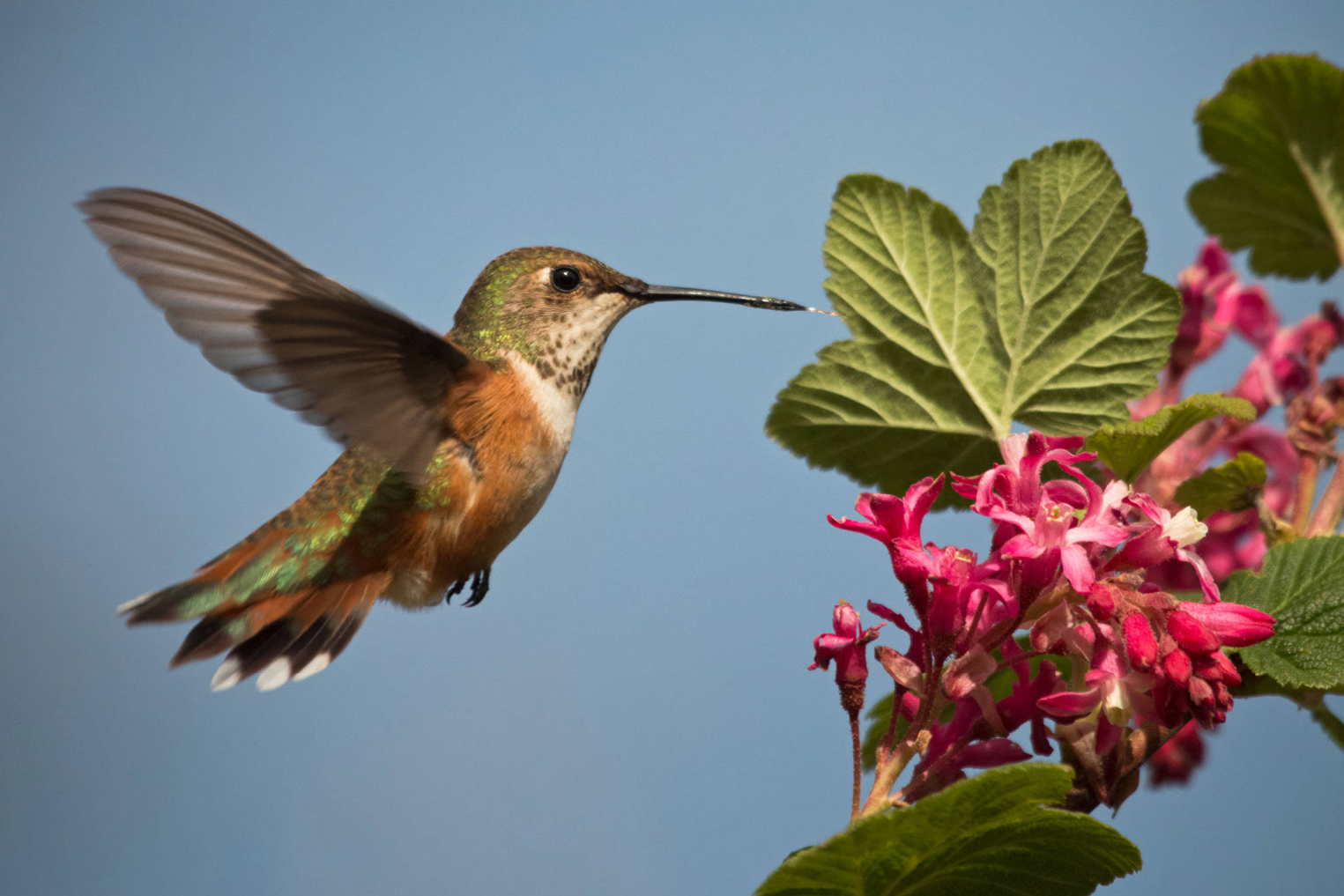
Native Plants for Birds: Female Rufous Hummingbird(Selasphorus rufus) on Red Flowering Current(Ribes sanguineum) Courtesy US FWS, Peter Pearsall, Photographer
Female Rufous Hummingbird(Selasphorus rufus) on Red Flowering Current(Ribes sanguineum)
Courtesy US FWS, Peter Pearsall, Photographer
When we are hungry, we head for the kitchen. When birds are hungry they head for plants. Native plants, in particular provide important sources of food for birds and other wildlife.

Native plants play an important role in an ecosystem, providing the best habitat for wildlife. They are species of plants that have grown naturally in an area and thrive in an environment that matches the soils, moisture, and weather of a particular locality.

Arrowleaf Balsamroot Hyde Park, UT Courtesy & Copyright Linda L'Ai
Arrowleaf Balsamroot
Hyde Park, UT
Courtesy & Copyright Linda L’Ai
There are mutually beneficial connections for plants and birds that have evolved together. Native plants are a veritable market place for birds offering them nuts, seeds, fruits, nectar, and tasty bugs. They have an important influence on a bird’s diet, feeding habits, and even migration patterns. And as birds feed on the local fare they spread pollen and seeds.

This data gathered by Audubon’s Plants for Birds Program supports the planting of native species whenever possible.

  • 96% of land birds feed insects to their chicks.
  • Native oak trees host over 530 species of caterpillars while non-native ginkgo trees host just 4.
  • To raise one nest of chickadee babies, parents must gather between 6,000 and 9,000 caterpillars.
  • Suburban yards planted with native species host 8 times more native birds.

Birds shape their migration patterns around native plants. Plants that produce fleshy fruit duirng the late summer and fall provide birds with the energy needed for long migrations.

Urbanization has resulted in a threat to native plants. According to Audubon, the continental United States has lost over 150 million acres of native habitat due to urban sprawl. Fragmentation of native plant habitat is believed to be due to the construction of cities, roads and river flow reservoirs. All of these, combined with a changing climate’s impact on timing of insect hatching and flowers opening, present many challenges to our birds.

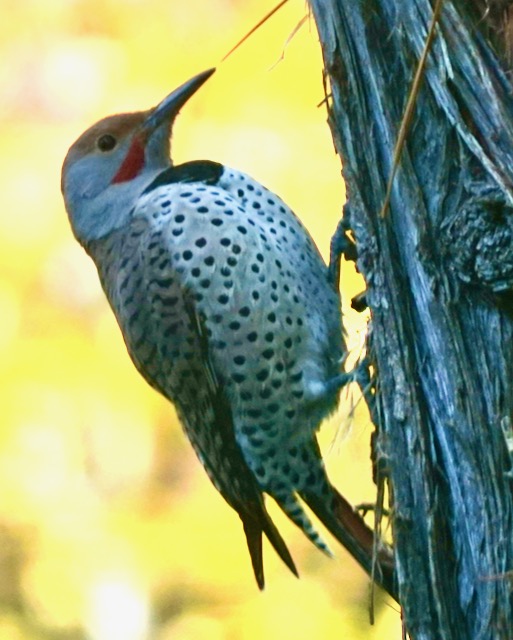
Northern Flicker Courtesy & Copyright Linda L'Ai
Northern Flicker
Courtesy & Copyright Linda L’Ai
You can help improve the connection between native plants and birds by adding native plants to your landscape. The native plants database developed by Audubon provides users with customized lists of native plants specific to your area, as well as the steps needed to evaluate which plants will find success in your soil. You can find the website at Audubon.org/plantsforbirds.  It’s as easy as putting in the area code, then clicking search. There are over 40 native plants listed for the Cache Valley area.

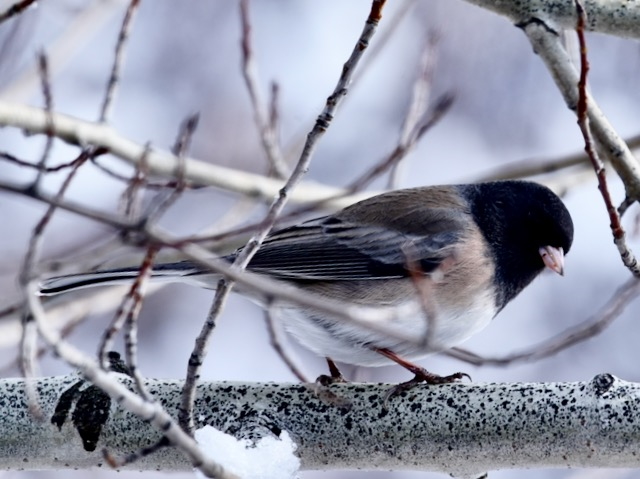
Dark-eyed Junco Courtesy & Copyright Linda L'Ai
Dark-eyed Junco
Courtesy & Copyright Linda L’Ai
Finches, sparrows, and chickadees are common birds to our area and are attracted to the seeds of the common sunflower.

The Wild plum, provides fleshy fruit for sparrows and chickadees and insects for woodpeckers.

Milkweeds attract hummingbirds and insect pollinators and serve as larval hosts for Monarch Butterflies.

Growing native plants is something we all can do in our yards or in the community to help bird populations increase now and in the future. Consider this: native plants that are adapted to the local region require less water, fertilizers and no pesticides.

Check out Audubon.org/plantsforbirds to find out more.
If you really dig birds, try digging native plants into your garden!

I’m Linda L’Ai with the Bridgerland Audubon Society, and I’m Wild About Utah!

Credits:

Photos: Courtesy US FWS, Peter Pearsall, Photographer, https://images.fws.gov/
Audio: Courtesy and Copyright Kevin Colver https://wildstore.wildsanctuary.com/collections/special-collections/kevin-colver
Text: Linda L’Ai, Bridgerland Audubon Society
Additional Reading: Lyle Bingham & Hilary Shughart, Bridgerland Audubon Society

Additional Reading

Grow Native For Birds, Bridgerland Audubon, https://bridgerlandaudubon.org/our-projects/grow-native-for-birds/

Plants For Birds, The Coleman and Susan Burke Center for Native Plants, National Audubon Society, https://www.audubon.org/plantsforbirds
“Plants for Birds,” National Audubon, https://vimeo.com/163864388

Native Plants for the Utah Landscape, Center for Water-Efficient Landscaping, Utah State University Extension, https://cwel.usu.edu/native-other

Native Plants, The Coleman and Susan Burke Center for Native Plants, National Audubon Society, https://www.audubon.org/native-plants/

Native Plant List-Utah and Western Colorado, PlantNative, Portland, OR, https://www.plantnative.org/rpl-ut.htm?fbclid=IwAR1nnlQUQ680x_SpwrKH_Fvtt2J2mtF7cqwZeUW8XAzzvlObs4K-kMPMIg0

Utah Native Plant Society, https://www.unps.org/

Tallamy, Doug, Sustainable Landscaping, Research, University of Delaware, May 2, 2013, 2.26 min, https://youtu.be/NTbPNwNIoLs

Tallamy, Doug, Eierman, Kim, EcoBeneficial Interview: Dr. Doug Tallamy In His Garden on the Importance of Native Plants, EcoBeneficial!, Nov 22, 2013, 29:30 min https://www.youtube.com/watch?v=w39g_f7BMUk


Duck Tornados

Duck Tornado: Male Mallard, Wings Set Courtesy Pixabay, Ilona Ilyés(ilyessuti), Photographer
Male Mallard, Wings Set
Courtesy Pixabay, Ilona Ilyés(ilyessuti), Photographer
If it flies like a duck, and it quacks like a duck, but there’s hundreds in a maelstrom whirlpool whose torrent of wingbeats make your ears mute and skull hum, it must be a Great Salt Lake tornado a la duck.

This past waterfowl season, I saw them out in some of the flats not yet trammeled by cover brush in the wetlands which drain the Bear River to the Great Salt Lake. The experience was possible because my friend, a well-seasoned duck hunter, had “a spot” he wanted to check out. We headed out at 4:30 in the morning from town, drove to the icy ramp, and put in his boat. We navigated the winding canals lined with irreconcilable phragmites in the black until we reached an end. When he cut the engine, nothing but the sound of water trickling from unnamed subfoliage passageways could be heard. We unloaded our equipment, moored the vessel, and took off on foot for “the spot”.

We hauled floating coffins with our gear: decoys, grass blankets, some food, and our hunting tools. The air was cold, but hauling sleds through muck and knee deep water is warm work. We could see the delicate prints of yesterday’s game puttering in the mud, foraging for fuel. Our heavy feet cratered their Pollack art, mud streaking behind and steam rising as we trudged on.

When we found the spot to set up near a small patch of open water just deep enough, we set out the decoys, took our positions, hid, and waited until the clock struck the shooting hour. With the sun yawning from behind the morning’s dense clouds, the tornados began.

They started to the west on a rest pond and slowly rose about a half mile out, an acrid steam swirling along magnetic edges of lazy morning thermals. Slowly, the steam became more dense, a heavier molecularity, and yet somehow like the paint stretching off a worn artist’s haggard brush, harnessed a fluid winged chaos into streaks of prehistoric migratory cosmos.

Once a feathered mass rises and begins its molasses churn about its night’s pond, it is as if an intuition shoots through the birds, and they become an it, and suddenly strike off unified in a particular direction on the morning flight. One such wave comes our way.

You don’t hear the mass at first, but when you do it begins with quacks. Their distant airy rasps build as they approach and eye our decoys and open water. It gains slowly, like Holst’s Mars, or Wagner’s Ride of the Valkyries, a romantic era symphony of avian legions unified by the course of cacophonous time. It’s epic and deeply beautiful.

Soon, they decide to give our hole a scout and the whirlwind aims itself at us. The squadrons of drakes and hens give passing dives. This is where the real magic lies; nothing makes your hair stand on end like the sound of cupped duck wings catching air, braking in the atmosphere with such force, and then throwing on the afterburners to pull back up towards their comrades. It makes F-35s look like the Wright brothers’ Kitty Hawk flier. That howl as air is held compressed beneath stressed wings comes in from all angles. We are transfixed within the eye.

Northern Shovelers Flying Courtesy US FWS, Steve Hillebrand, Photographer
Northern Shovelers Flying
Courtesy US FWS, Steve Hillebrand, Photographer
And as quickly as the tornado cometh, it also flyeth away. The music dissipates as the breath of ancient gods gains altitude, eyes another pond, and moves on from us. The duck tornado roars on.

So even if you’re not a hunter, or even that keen on ducks, there is nothing quite like a duck tornado; a force in this world which once was commonplace with the other primal elements of nature, but now only rarely seen in those last lightly touched places. Know that they’re out there, and if you can, one day go looking for them. Gaze at the power, the glory, and the mystery of the Great Salt Lake wetland duck tornados. You’ll never forget it.

I’m Patrick Kelly, and I’m Wild About Utah.
 
Credits:

Images: Image Courtesy Pixabay, Ilona Ilyés(ilyessuti), Photographer, https://pixabay.com/photos/duck-bird-waterfowl-lake-wild-5838408/
Images: Image Courtesy USFWS, Steve Hillebrand, Photographer https://digitalmedia.fws.gov/digital/collection/natdiglib/id/9588/
Audio: Contains audio Courtesy & Copyright Kevin Colver https://wildstore.wildsanctuary.com/collections/special-collections
Text:    Patrick Kelly, Director of Education, Stokes Nature Center, https://logannature.org/
Included Links: Lyle Bingham, Webmaster, WildAboutUtah.org

Additional Reading

Duck Tornado, Idaho Fish & Game, Feb 20, 2015, https://youtu.be/HmK9ArTgU0A

Bear River Migratory Bird Refuge, US Fish & Wildlife Service, US Department of the Interior, https://www.fws.gov/refuge/bear_river_migratory_bird_refuge/

Waterfowl Guidebook, Utah Division of Wildlife, Utah Department of Natural Resources, https://wildlife.utah.gov/guidebooks/2020-21_waterfowl.pdf

Hellstern, Ron, Autumn Migrations, Wild About Utah, October 15, 2017, https://wildaboututah.org/autumn-migrations/

Common Starlings

Common Starlings or European Starling, Sturnus vulgaris, Courtesy US FWS, Dave Menke, Photographer
Common or European Starling, Sturnus vulgaris, Courtesy US FWS, Dave Menke, Photographer
It all began so innocently. Let’s bring over a few European starlings to add authenticity for a Shakespearean theatrical. That was 1890. Today, North America has about half of the world population of starlings, approaching a few hundred million.

Following many years of demonizing this bird, I have become convinced they do have value beyond compost. In fact, they are utterly fascinating. My first glimmer came when a friend suggested I read “Arnie, the Darling Starling”. I have yet to read it, but he convinced me this bird was worth taking a second look.

European Starling, Sturnus vulgaris, Courtesy & © Hilary Shughart, Photographer
European Starling, Sturnus vulgaris,
Courtesy & © Hilary Shughart, Photographer”
Since that time in the mid 70’s, I’ve witnessed many of the starling’s remarkable behaviors. It possesses a maddening ability to imitate other birds- killdeer, red tail hawk, evening grosbeak, etc., with such accuracy I always stop to look for a killdeer perched in a tree- gotcha Jack! The starling’s gift for mimicry has long been recognised. Mozart had a pet starling which could sing part of his Piano Concerto in G Major. He became very attached to the bird and arranged an elaborate funeral for it when it died three years later.

Starlings are commonly kept as pets in Europe and widely used as laboratory animals, second only to pigeons. Austrian ethologist Konrad Lorenz wrote of them in his book King Solomon’s Ring as “the poor man’s dog” and “something to love”. Their inquisitiveness makes them easy to train or study.

Starling Murmuration Courtesy Wikimedia and Copyright Walter Baxter Licensed under Creative Commons Attribution-ShareAlike 2.0 license
Starling Murmuration
Courtesy Wikimedia and Copyright Walter Baxter
Licensed under Creative Commons Attribution-ShareAlike 2.0 license
I’ve always been amazed by their immense winter flocks called murmurations- thousands of birds reminiscent of what the now extinct passenger pigeons must have resembled, and for these massive bird clouds to change form and direction in milliseconds, which I observed when a merlin falcon plummeted into an enormous flock that split in half. I stood in disbelief as the cloud morphed, then saw the merlin emerge just below the bifurcated cloud.

The starling has 12 subspecies breeding in open habitats across its native range in temperate Europe to western Mongolia, and it has been introduced to seven other countries from Australia to Fiji.

Major declines in populations have occurred from 1980 onward in much of Europe and Eurasia. The decline appears to be caused by intensive farming methods used in northern Europe, and the reduced supply of grassland invertebrates needed for the nestlings. This in contrast to 1949, when so many starlings landed on the clock hands of London’s Big Ben that it stopped the clock!
Our love hate starling relationships are evident in how various countries view them. In Spain, starlings are hunted commercially as a food item. In France, it is classified as a pest, and can be killed throughout most of the year. In Great Britain, Starlings are protected under the Wildlife and Countryside Act. In 2008, the United States government killed 1.7 million starlings, the largest number of any nuisance species to be culled.

A closing note- starlings are trapped for food in some Arab countries. The meat is tough and of low quality, so it is casseroled or made into pâté. Even when correctly prepared, it may still be seen as an acquired taste. You may wish to remove them from your grocery list.

Jack Greene for Bridgerland Audubon Society, and I’m wild about Utah’s not so wild starlings!

Credits:

Pictures: Courtesy US FWS, Dave Menke, Photographer
Pictures: Courtesy US FWS, Lee Karney, Photographer
Pictures: Courtesy Wikimedia and Copyright Walter Baxter, Photographer (Licensed Under Creative Commons Attribution-ShareAlike 2.0 license) https://commons.wikimedia.org/wiki/File:Starling_murmuration.jpg
Audio: Courtesy & © Kevin Colver https://wildstore.wildsanctuary.com/collections/special-collections
Text: Jack Greene, Jack Greene, Bridgerland Audubon Society & Utah State University Sustainability
Additional Links: Lyle Bingham, Webmaster, Bridgerland Audubon Society, Wild About Utah,

Additional Reading:

Grant, Val, Short-tailed Bird of Perdition-Starlings, Wild About Utah, June 5, 2009, https://wildaboututah.org/short-tailed-bird-of-perdition-starlings/

European Starling, Sturnus vulgaris, Julia Butler Hansen Refuge, US Fish and Wildlife Service, US Department of the Interior, https://www.fws.gov/refuge/julia_butler_hansen/wildlife_and_habitat/habitats/birds/european_starling.html

King, Barbara J., Video: Swooping Starlings In Murmuration, National Public Radio (NPR), January 4, 2017 2:29 PM ET, https://www.npr.org/sections/13.7/2017/01/04/506400719/video-swooping-starlings-in-murmuration

European Starling, BirdWeb, https://www.birdweb.org/birdweb/bird/european_starling

Sigl Corbo, Margarete(Author), Barras, Diane Marie(Author), Morrill, Leslie(Illustrator), Arnie, the Darling Starling, Houghton Mifflin Harcourt, November 1, 1983, https://www.amazon.com/Arnie-Darling-Starling-Margarete-Corbo/dp/0395343909