Leafy Bee Nests

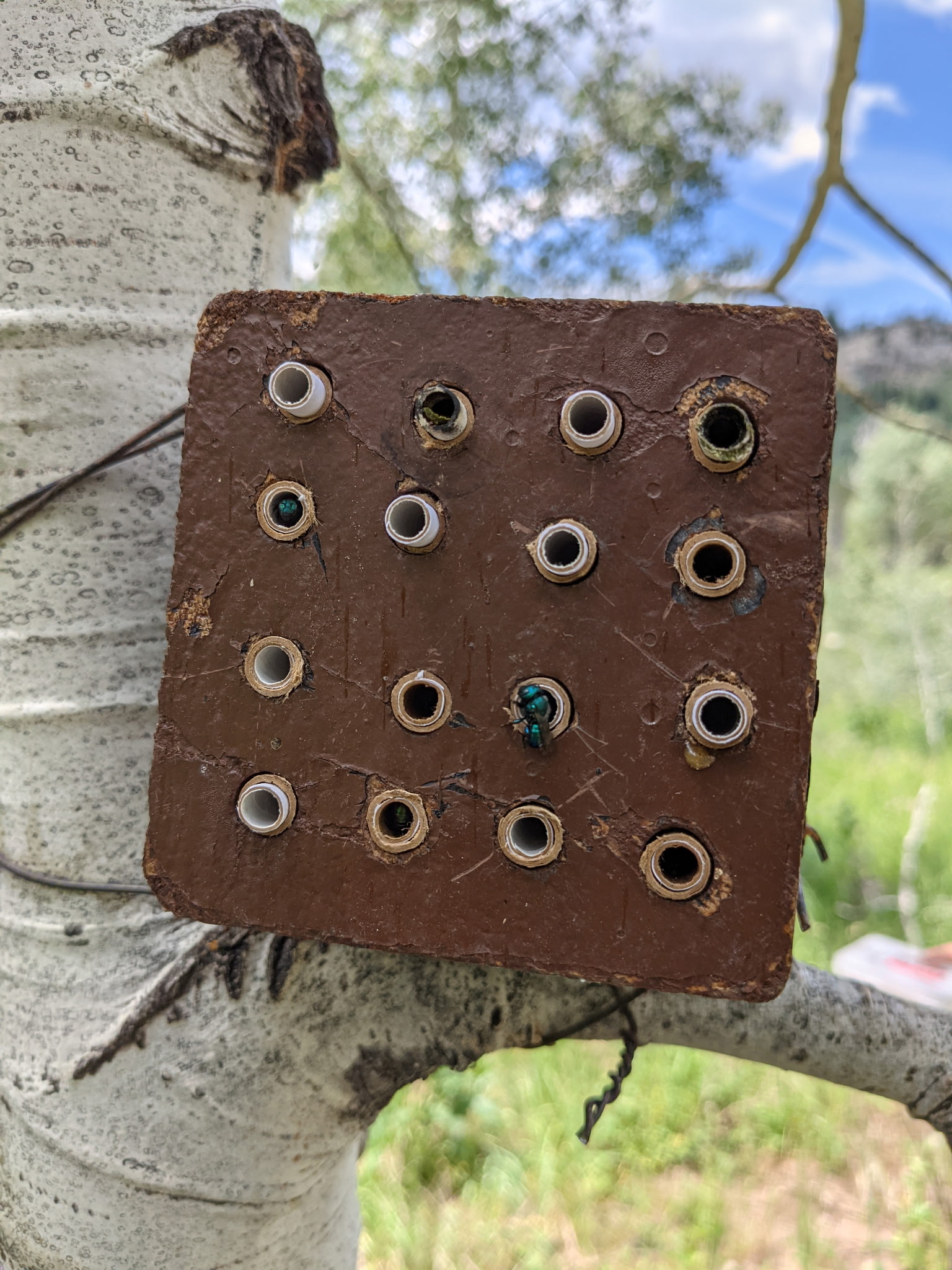
Mason Bee at the entrance to a nest tube
Courtesy & © Lindsie McCabe, Photographer
Mason Bee at the entrance to a nest tube
Courtesy & © Lindsie McCabe, Photographer
Today’s story is in both English and Spanish, to hear the Spanish translation tune in Wednesday evening at 9 or online at UPR.org

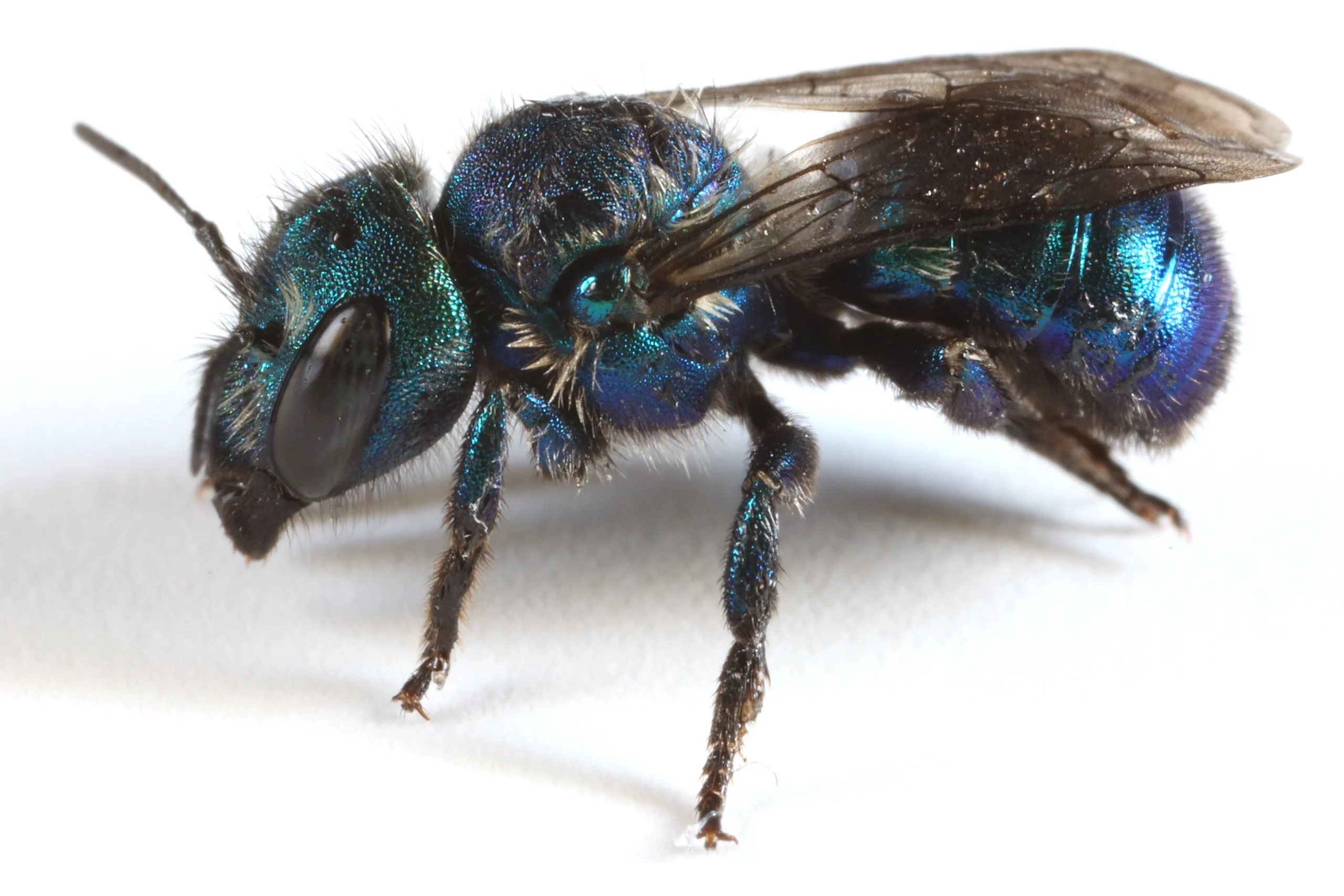
Osmia bruneri Female
Courtesy & © Michael Branstetter, Photographer
Osmia bruneri Female
Courtesy & © Michael Branstetter, Photographer
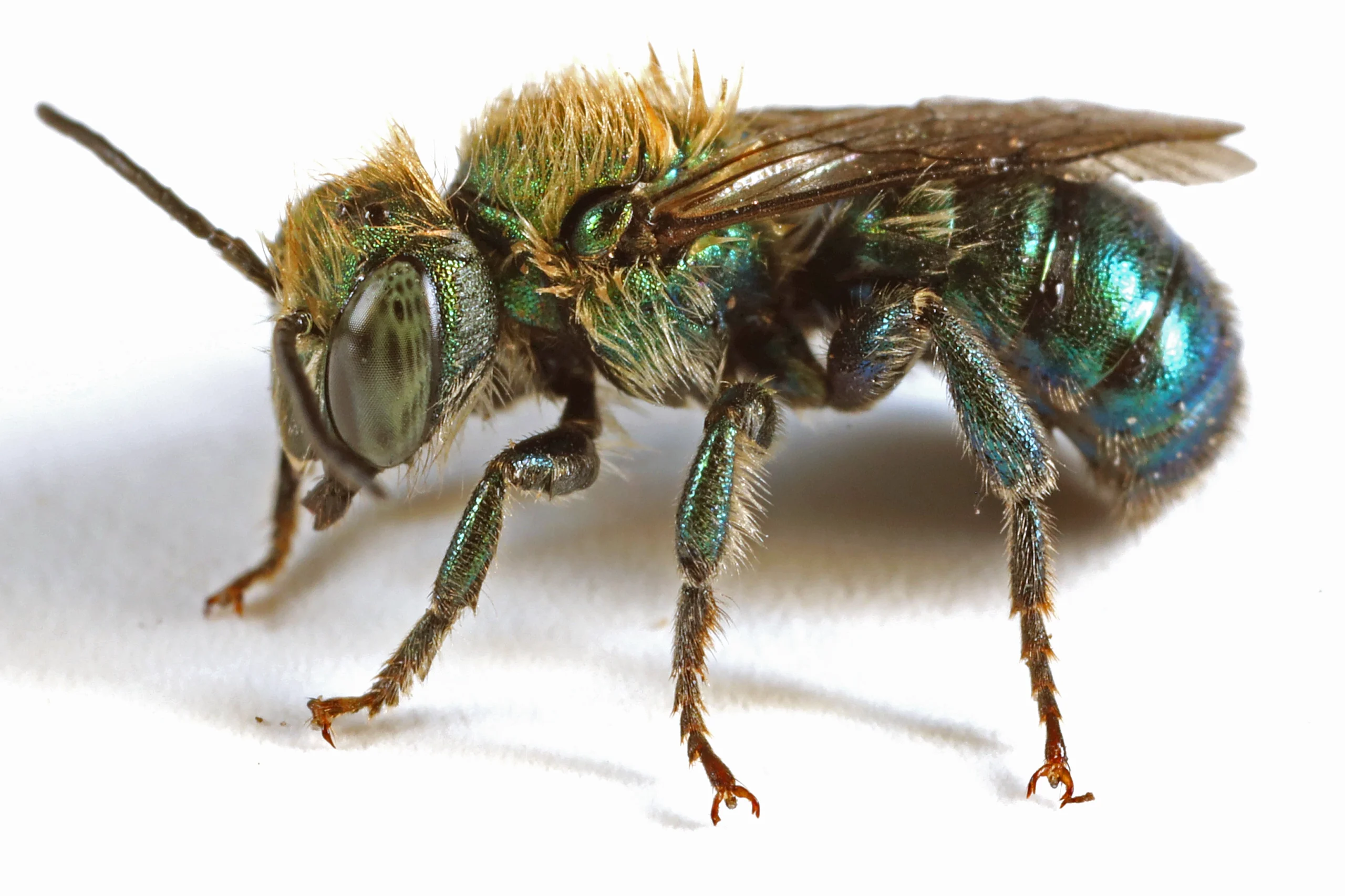
Osmia bruneri Male
Courtesy & © Michael Branstetter, Photographer Osmia bruneri Male
Courtesy & © Michael Branstetter, Photographer

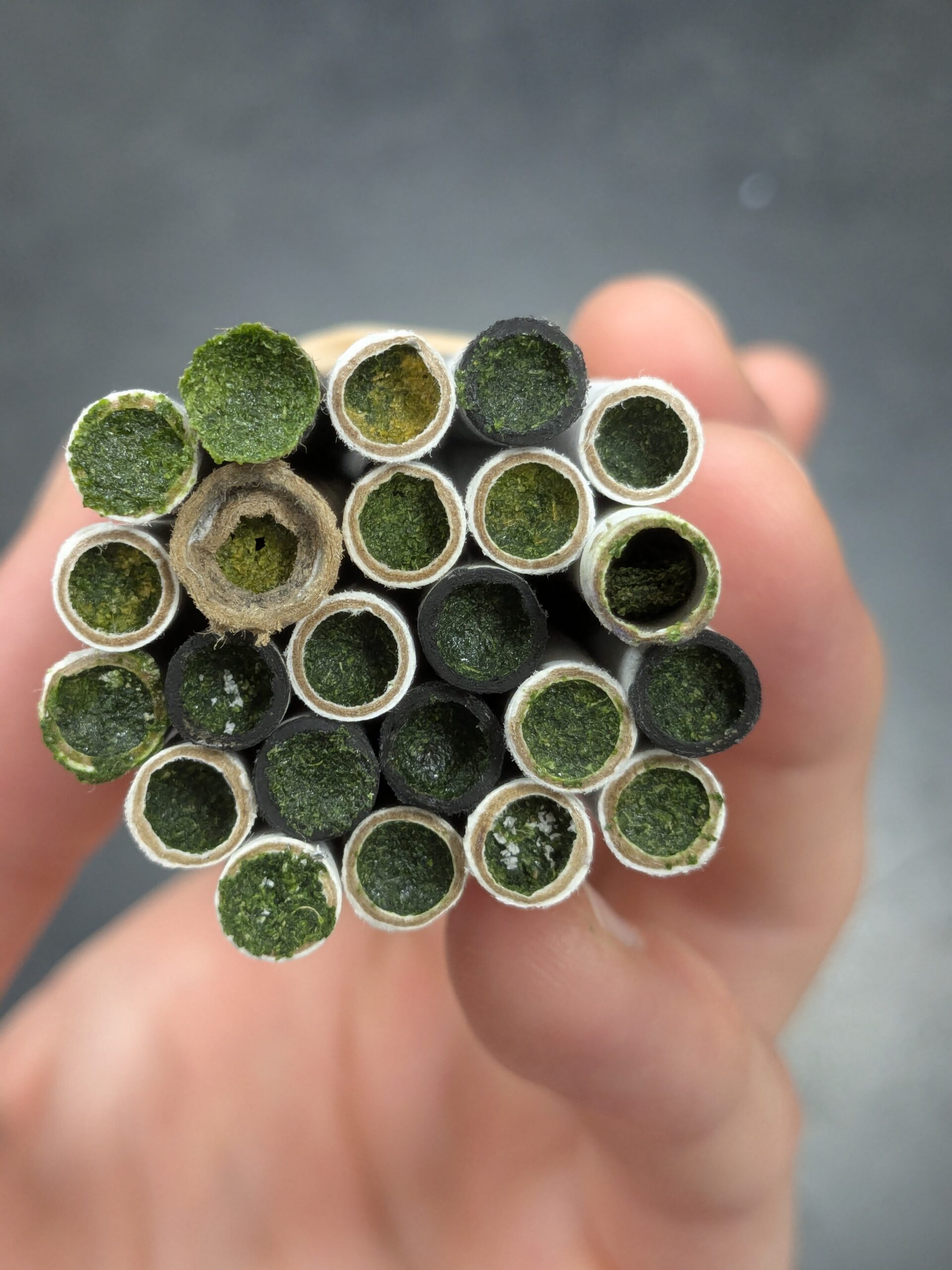
Filled and Leaf-capped Nest Tubes
Courtesy & © Anna Goates, Photographer Filled and Leaf-capped Nest Tubes
Courtesy & © Anna Goates, Photographer

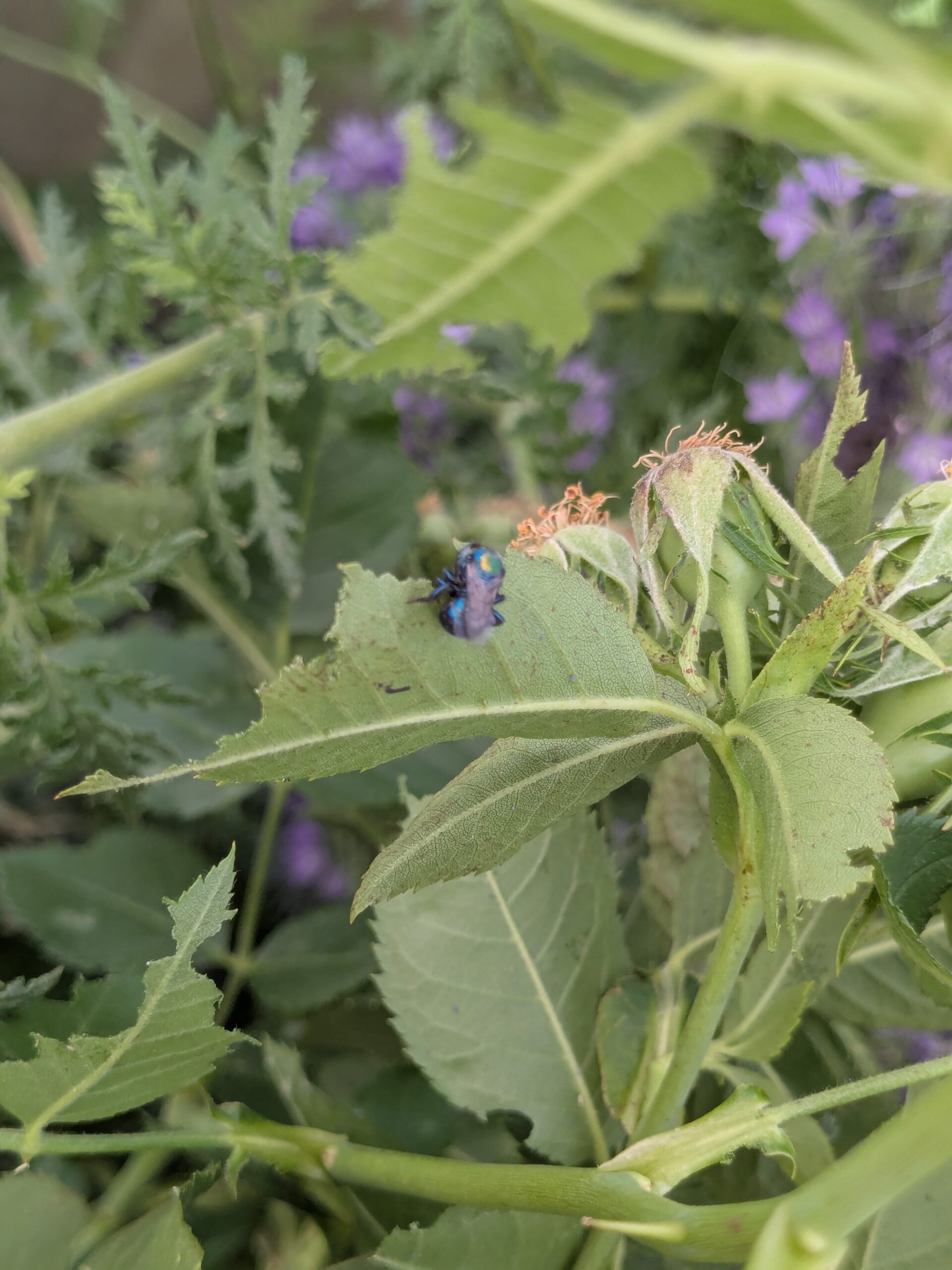
Female Osmia bruneri Harvesting Leaf Material
Courtesy & © Anna Goates, Photographer Female Osmia bruneri Harvesting Leaf Material
Courtesy & © Anna Goates, Photographer

When you think about what a bee needs to live, you probably think of flowers and a big hive. Bees do need flowers, and some live in a hive, but many bees also need other materials to build their nests. Some of my favorites build nests with mud, small rocks, pieces of leaves, sap from trees, flower petals, or even the fuzzy hairs that grow on plants. These bees are often solitary, relying on just one strong mama to take care of the whole nest.

It’s almost my favorite time of the year, when I get to watch these moms emerge and start their nests. Some solitary bees, like the ones I study, make their nests in holes in wood. Usually this means nesting in a wooden tunnel drilled out by a beetle, but it also means that they will nest in manmade nesting boxes. These nesting structures consist of a wooden block with long dead-end drilled holes where each hole belongs to a different mom, like rows of single story condos.

If I stand patiently next to a nesting box, I’m rewarded with the sight of a mama bee backing out of one of the nesting holes. She rests for a moment at the entrance to her nest, basking in some sun. She rubs her back legs together and wiggles her abdomen a bit. Then, she takes flight. I watch her buzz away to a leaf where she lands and rapidly chews on the leaf edge. Her motions are quick and urgent. Then she buzzes back to her nesting hole. She hovers for a moment, and pokes at the neighboring hole before landing back at her own and depositing the small bit of chewed leaf. She begins drywalling her new nursery, several trips of collecting, chewing up and puttying this bright green leaf pulp will result in a wall that protects her babies. Those babies develop throughout the rest of summer and fall and go into hibernation for the winter. When temperatures warm up, these new bees will chew through that leafy wall to enter the world.

My name is Anna Goates. I am a student at Utah State University and I study bees at the USDA-ARS Pollinating Insects Research Unit. I’m studying the nesting of one species of bee, Osmia bruneri, a bee that’s native here in Utah and throughout the Great Basin area. Like many other bees, bruneri need more than flowers. Bruneri bees use leaf pieces to build their nests. A mama bee will bring lots of pollen to her nest using fuzzy hairs on her belly. Then she lays an egg on top of the pollen and builds a wall out of leaf pulp. Female bruneri are a shiny metallic blue, and male bees are a metallic lime green with a fuzzy white mustache on their faces. If you don’t look closely, you might think they are flies.

As spring approaches, bees and other insects will start coming out from their winter hideaways. I’m excited to see my little bee friends again.

I’m Anna Goates, a volunteer for Stokes Nature Center, and I’m wild about Utah.

Credits:

Images: Capped Nesting Straws & Leaf-harvesting Osmia Female, Courtesy and Copyright Anna Goates, Photographer
Male & Female Osmia bruneri, Courtesy and Copyright Michael Branstetter, Photographer
Bee at tube entrance, Courtesy & Copyright Lindsie McCabe, Photographer
Featured Audio: Courtesy & Copyright Anderson, Howe, and Wakeman..
English Text & Voice: Anna Goates, Stokes Nature Center Volunteer, https://logannature.org/volunteer
Spanish Text & Voice: Carlos Ramos, Stokes Nature Center, https://logannature.org/staff
Additional Reading Links: Lyle Bingham, https://bridgerlandaudubon.org/

Additional Reading:

Wild About Utah Pieces by Anna Goates, https://wildaboututah.org/author/anna-goates/

Bruner’s Mason Bee — Osmia bruneri. Montana Field Guide. Montana Natural Heritage Program. Retrieved on April 5, 2026, from https://FieldGuide.mt.gov/speciesDetail.aspx?elcode=IIHYMA2610

Sunflowers, the late summer feast

Sunflowers, the late summer feast: Click for a larger view of the sunflower garden. Image courtesy and copyright Jim Cane
Stand of ornamental sunflowers
in Cache Valley
Image courtesy and Copyright Jim Cane

Click for a larger view. Image courtesy and copyright Jim CaneHoney bee foraging at sunflower
Image courtesy and Copyright Jim Cane


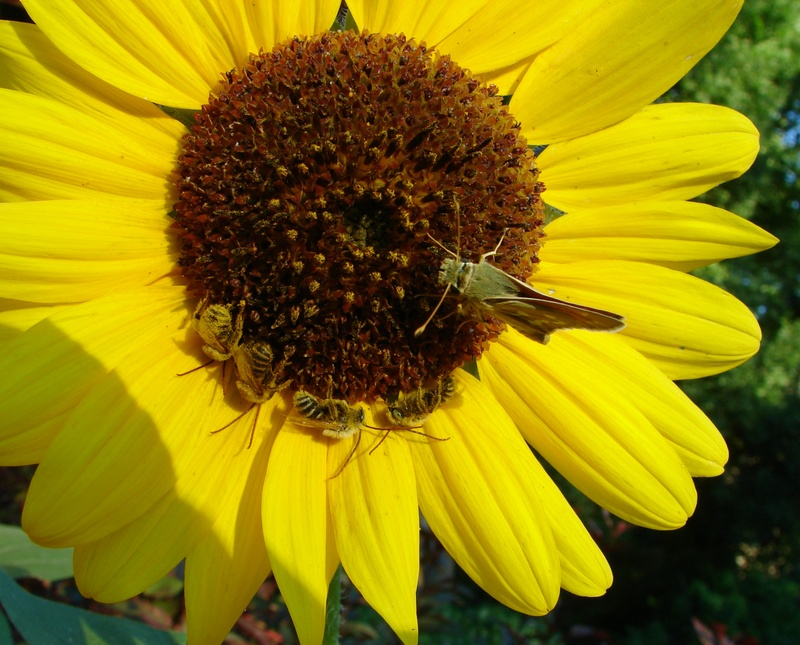
Click for a larger view. Image courtesy and copyright Jim CaneMale Melissodes bees and a skipper
butterfly sleeping on a sunflower at dusk
Image Courtesy and Copyright Jim Cane

Now, in late summer, the sunny golden blooms of sunflowers adorn gardens, roadsides and wild places across much of the United States. Utah is home to five sunflower species, four of them annuals. You are most likely to see Helianthus annuus, the aptly named “common sunflower”. Early domestication of common sunflower by Plains Indians led to the major oilseed crop that the world enjoys today.

Humans are not the only species seated at the sunflower dining table, however. The grub of one specialist weevil bores in sunflower stalks; as do larvae of 2 long-horned beetles. Another weevil hollows out the seeds. A third decapitates the flowerhead before ovipositing. One moth’s caterpillar gnaws the roots; several cutworm species topple seedling sunflowers, and several more kinds of butterfly caterpillars skeletonize sunflower leaves. In your garden, though, sunflowers generally escape pestilence. Chickadees and both American and Lesser Goldfinches cling to the ripe seed heads to pluck out the nutritious seeds. Listen for the plaintive call of the Lesser Goldfinch which is very distinctive.

[Lesser Goldfinch, Audio recording courtesy Kevin Colver, https://wildstore.wildsanctuary.com/collections/special-collections: Songbirds of the Southwest Canyon Country]

All those sunflower seeds are the direct result of pollination by bees. In the American West, more than 200 species of native bees visit sunflowers for nectar or pollen, a remarkably large fauna for any flower. None is more charming than the male of the bee genus Melissodes. They are discernible by their extra long antennae. Melissodes males dart among sunflowers all day long, seeking willing mates. Come sunset, the males bed down on the flower heads to snooze. They become drowsy enough to pet with your fingertip, and being males, have no sting. So if you have sunflowers at hand, chances are you have Melissodes bees around too. Look over your sunflowers this evening, and you may be lucky enough to find these dozing bachelor bees with their extra long antennae.

This is Linda Kervin for Bridgerland Audubon Society.

Credits:

Audio: Courtesy Kevin J. Colver, 7loons.com and On Amazon.com
Photos: Courtesy and Copyright Jim Cane
Text: Jim Cane, Bridgerland Audubon Society

Additional Reading:

LeBuhn, Gretchen, Greenleaf, Sarah, Cohen, David, The Great Sunflower Project, Department of Biology, San Francisco State University, https://www.greatsunflower.org/

Charlet, Larry D., Brewer, Gary J., Sunflower Insect Pest Management in North America, Radcliff’s IPM World Textbook, University of Minnesota, https://ipmworld.umn.edu/chapters/charlet2.htm

The Native Bees of Utah

Male Melissodes Bees
Sleeping on Sunflower
Courtesy and
Copyright © 2010 Jim Cane

The industry and cooperation of honeybees have inspired many a philosopher and society, including the Mormons who settled along the Wasatch front. The hive, or more specifically a skep, was later chosen as the emblem for the new state of Utah. But the honeybee, like it’s pioneer admirers, is a recent European immigrant, brought over for the wax and honey that colonies produce.

Utah did not lack for pollinators, however, prior to European settlement. More than 1000 species of native bees inhabit Utah, with several hundred species in any given county. A few of these bees — bumblebees and sweat bees — are social. They produce annual colonies headed by a queen. However, the vast majority of our bees are not social. For these, each adult female makes her own nest with no help from her sisters or mate.

Most solitary bee species nest underground; others use old beetle burrows in deadwood. The resident female subdivides her tunnel into bee-sized cavities. Each cavity receives a cache of pollen moistened with nectar and a single egg. There each grub-like larva will feed and develop in solitude. Most solitary bees will spend the winter here in their natal home.

Bombus griseocollis Queen
Foraging on Hedysarum
Courtesy and
Copyright © 2008 Jamie Strange

Native bees pollinate many of Utah’s wildflowers, doing so inadvertently as they busily gather pollen for their progeny. Many solitary bee species are taxonomic specialists, focusing all of their pollen foraging efforts on one or a few related genera of flowering plants. Some common hosts for specialist bees in Utah include squashes, sunflowers, globemallows and penstemons. Sweet honey does not result from the labors of solitary bees, but fruits and seeds do. The industry of Utah’s native bees merits our attention and admiration.

This is Linda Kervin for Bridgerland Audubon Society.

Credits:

Text: Jim Cane, Bridgerland Audubon Society

Additional Reading:

USDA-ARS Pollinating Insects – Biology, Management and Systematics Laboratory, https://www.ars.usda.gov/main/site_main.htm?modecode=54-28-05-00

Crop domestication facilitated rapid geographical expansion of a specialist pollinator, the squash bee Peponapis pruinosa, Margarita M. López-Uribe, James H. Cane, Robert L. Minckley, Bryan N. Danforth
Proc. R. Soc. B 2016 283 20160443; DOI: 10.1098/rspb.2016.0443. Published 22 June 2016https://rspb.royalsocietypublishing.org/content/283/1833/20160443.abstract

Hager, Rachel, Bees, Bees And More Bees! Researchers Find Over 650 Bee Species In Grand Staircase-Escalante, UPR-Utah Public Radio, Nov 20, 2018, https://www.upr.org/post/bees-bees-and-more-bees-researchers-find-over-650-bee-species-grand-staircase-escalante

Bumblebee Watch, https://www.bumblebeewatch.org/
Bumble Bee Watch is a citizen science project through the partnership of The Xerces Society, the University of Ottawa, Wildlife Preservation Canada, BeeSpotter, The Natural History Museum, London, and the Montreal Insectarium.

Koch, Jonathan, Strange, James, Silliams, Paul, Bumble Bees of the Western United States, Pollinator Partnership, 2012, https://www.xerces.org/publications/identification-monitoring-guides/bumble-bees-of-western-united-states
Original https://www.pollinator.org/pollinator.org/assets/generalFiles/BumbleBee.GuideWestern.FINAL.pdf

Pollinating Fruit Trees with Blue Orchard Bees

Audio:  mp3 Listen to WildAboutUtah

Blue Orchard Bee
Copyright Jim Cane

Apricots, plums, apples, cherries, and pears all need bees to pollinate their flowers. Traditionally, we’ve used the European honey bee, but now we know how to pollinate our fruit trees using a steely blue native bee, the blue orchard bee (Osmia lignaria). These wild bees fly nationwide.

In Utah, they live in foothill and lower montane habitats. Blue orchard bees are not social; every female is fertile and tends to her own tiny nest. Adults are the size of a chunky honeybee and are active for only 3-4 weeks in the spring. These bees naturally nest in the tunnels chewed by large wood-boring beetles in tree trunks. Each female partitions her tunnel into a series of tiny bee-sized rooms. Each room is stocked with a pea-sized provision of pollen moistened with nectar, followed by a single egg. Nest cells are partitioned, and ultimately capped, with mud, hence their other common name: “mason bees”.

Blue Orchard Bee eggs
on pollen provision mass
in nest
Copyright Jim Cane

You can have your own backyard population of blue orchard bees. An easy way to begin uses a short fat log that is seasoned and dry. Take a 5/16 bit and drill 20 or more holes radially 5 to 6 inches deep. Stand the log on end, facing the holes towards the southeast.

On cold mornings, nesting females bask in the sun before taking flight. If bees colonize your log, you will see the steely blue females busily coming and going all day long during fruit tree bloom. They tote their loads of dry yellow pollen in a brush of hair beneath the abdomen. Unloading that pollen at the nest requires some charming acrobatics that are well worth watching. While collecting pollen, female blue orchard bees pollinate your trees with hundreds of fruits resulting from each bee’s lifetime of work. Successive generations will nest for you every spring, but you’ll want to switch to replaceable nesting materials to prevent the accumulation of pathogens and parasites.

Details and links can be found at our Wild About Utah website.

This is Linda Kervin for Bridgerland Audubon Society.
Credits:

Photos: Courtesy & Copyright Jim Cane

Text: Jim Cane, Bridgerland Audubon Society
Additional Reading:

Drill Log with 5/16 holes
5 to 6 inches deep
Copyright Jim Cane

Resources:

https://www.sare.org/publications/bob.htm

https://www.ars.usda.gov/Research/docs.htm?docid=18333

https://www.pollinatorparadise.com/Binderboards/Hornfaced_Bees.htm

A Colonized log
Copyright Jim Cane