Killdeer, the bird that lives dangerously

Killdeer, the bird that lives dangerously

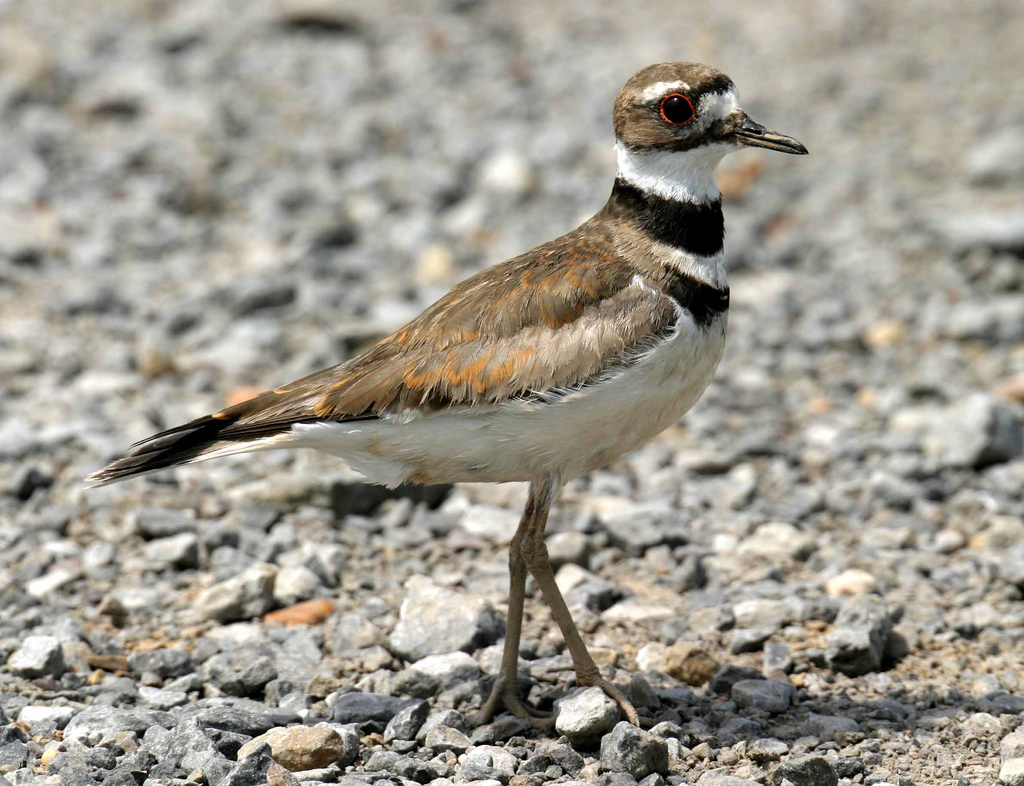
Killdeer on pebbles
Charadrius vociferus
Courtesy Wikipedia
Curt Hart, Photographer
Licensed under Creative Commons
Attribution 2.0 Generic license

 
Killdeer, the bird that lives dangerously
Killdeer nest on pebbles
Charadrius vociferus
Courtesy Wikipedia
Werther, Photographer
Courtesy US NPS and
J. Willard Marriott Library, University of Utah
Licensed under Creative Commons
Attribution 2.0 Generic license
Hi, this is Mark Larese-Casanova from the Utah Master Naturalist Program at Utah State University Extension.

The onset of springtime brings nesting birds in abundance. In the past week alone, blackbirds have been defending their territories in the marshes, goslings can be seen trailing behind their parents, and swallows are swooping and perching near their nests.
One bird that is impossible to ignore is the killdeer. Its call is loud, and easily recognizable.
[Audio Recording: Killdeer call, Audio file copyright 2006, Kevin Colver. All rights reserved, https://collections.lib.utah.edu/details?id=1117069&q=killdeer WesternSoundscape.org:
Licensed under Creative Commons Attribution-Noncommercial-No Derivative Works 3.0 United States License] It’s no coincidence that its scientific name is Charadrius vociferous.

Killdeer are a type of plover, similar to the snowy plovers that nest along the shores of Great Salt Lake. The killdeer, however, is well at home in dry upland habitats. The most peculiar characteristic of killdeer is that they are often seen and heard in the most unlikely of places- dirt roads, parking lots, or even construction sites.

Killdeer nest on open ground, digging just a shallow scrape in the soil. Gravel roads are often ideal nesting habitat because killdeer eggs blend in well with nearby pebbles. The spotted eggs and young hatchlings are very cryptic, invisible to the eye even when they are underfoot. This dangerous breeding strategy can often lead to trampled nests. Or, if a predator has a good sense of smell, the eggs and young are easily eaten.

Although, the killdeer has a trick up its sleeve (well… its wing)! When a predator, such as a fox, approaches the nest, the adult killdeer feigns a broken wing while walking away from its nest. This draws the attention of the predator, which thinks it’s found an easy meal, away toward the adult. Once it’s led the threat far enough from the nest, the adult killdeer takes off in flight, taunting the predator with its call.

It’s very hard to see a killdeer nest even when it’s obvious the adults are near it. Keep in mind, though, that time spent looking for a killdeer nest is time that the adults are not tending to the eggs or hatchlings, which puts their survival at risk. A bird that lives so dangerously can use all the help it can get.

For Wild About Utah, I’m Mark Larese-Casanova.

Credits:

Theme: Courtesy & Copyright Don Anderson Leaping Lulu
Images: Courtesy Wikimedia, Curt Hart as well as Clinton & Charles Robertson, Photographers
Audio: Courtesy Marriott Library, University of Utah & US National Park Service
Text & Voice:     Mark Larese-Casanova, Utah Master Naturalist Program at Utah State University Extension.

Additional Reading:

Cornell Lab of Ornithology. Killdeer. All About Birds. https://www.allaboutbirds.org/guide/killdeer/id

Tekiela, S. 2003. Birds of Utah. Adventure Publications, Inc. Cambridge, Minnesota.
https://www.amazon.com/Birds-Utah-Field-Guide-Tekiela/dp/1591930197

Killeer, Species, Utah Division of Wildlife Services, Utah Department of Natural Resources. Killdeer. https://fieldguide.wildlife.utah.gov/?species=charadrius%20vociferus

Ring-Necked Pheasant

Native distribution the Common Pheasant in Eurasia, Courtesy Wikimedia, licensed under GNU Free Documentation LIcense v1.2 https://en.wikipedia.org/wiki/en:GNU_Free_Documentation_License
Native distribution of the
Common Pheasant in Eurasia
Courtesy Wikimedia
Licensed Under CCL Attribution Share-Alike 3.0 Ported
 
wikipedia.noon.Pheasant.250x164.jpgMale Ring-Necked Pheasant
Courtesy Wikimedia
Gary Noon, Photographer
Licensed Under CCL Attribution Share-Alike 2.0 Ported
 
wikimedia.Manske.Ringnecked_pheasant_flying_USFWS.250x189.jpgMale Ring-Necked Pheasant in flight
Courtesy US FWS & Wikimedia
Magnus Manske, Photographer
 
wikimedia.Male_and_female_pheasant.250x188.jpgMale(R) and Female(F)
Ring Necked Pheasant
Courtesy Wikimedia, Chris O, Photographer
Licensed Under CCL Attribution Share-Alike 3.0 Ported
 

Hi I’m Holly Strand from the Quinney College of Natural Resources at Utah State University.

It’s spring, and the birds are starting to make quite a racket outside. Here’s a bird we hear every day now, in the morning or at dusk: [https://www.xeno-canto.org/explore?query=common+pheasant]
That’s the sound of a male ring-necked pheasant crowing and then beating his wings against his body. The male is announcing his territory which may be 7 acres or more. Under the right conditions his announcement can carry up to a mile. Looking out the window, I often see our resident pheasant marching around the yard, sometimes herding a female or two, or three. For the dominant males keep female harems during the mating season.

Last year another male wandered up our driveway. This led to a skirmish. The two males held their heads low, rumps raised and tails straight out behind. They pecked and said some choice words to each other in pheasant language. Periodically they burst into a fluttering fight that involved some vicious biting, and kicking. Eventually the intruder left leaving the other to resume his post as head pheasant of our yard.

If you haven’t ever seen a ring-necked pheasant you are in for a treat when you do. The males have a green iridescent head, a bright red face, and a distinctive white ring collar. Their spectacular multicolored plumage ends in a long coppery tail cropped with thin black bars. The females are much smaller; their feathers a mottled mixture of brown and buff with dark markings. While not so beautiful, they are much harder to see and therefore are safer from predators.

All pheasants are natives of the Old World–more specifically of southern Asia. The ring-necked pheasant is not a distinct species there. It’s an informal name that refers to certain subspecies of the Common Pheasant, which occupies a huge territory stretching from the Black Sea and Caucasus region through Central and Middle Asia all the way through China Korea and the Russian Far East. Throughout this enormous territory, over 34 different subspecies of common pheasant have evolved– some with a ringed marking around their necks and some without. What we have here in America is a hybrid mix of a few of these ring-necked subspecies—mostly from China.

Because of their huge popularity as a game bird, ring-necked pheasants have been transplanted all over the world. In the U.S. the pheasant was introduced on the west coast in the 1860’s , but now you can find them in all but the most southern states. They are especially concentrated in our central Corn Belt region.

The ring-necked pheasant was first introduced to Utah around 1890. Their numbers are maintained through transplanting, natural dispersion and further releases of game-farmed birds. Some of those birds end up on the dinner table and some of them find refuge on private lands and in Utah neighborhoods like ours.

Thanks to Paul Marvin for his Xeno-Canto recording.

For sources, pictures and more information, go to www.wildaboututah.org.

For Wild About Utah, I’m Holly Strand.

Credits:

Images:

  1. Native distribution the Common Pheasant in Eurasia
    https://commons.wikimedia.org/wiki/File:Phasianus_colchicus_distribution.png
  2. Male Ring-Necked Pheasant https://commons.wikimedia.org/wiki/File:Pheasant.jpg
  3. Male Ring-Necked Pheasant in flight https://commons.wikimedia.org/wiki/File:Ringnecked_pheasant_flying_USFWS.jpg
  4. Male and female Ring-Necked Pheasant https://commons.wikimedia.org/wiki/File:Male_and_female_pheasant.jpg licensed under Creative Commons Attribution 3.0 License.

Text: Holly Strand

Sources & Additional Reading

Giudice, John H. and John T. Ratti. 2001. Ring-necked Pheasant (Phasianus colchicus), The Birds of North America Online (A. Poole, Ed.). Ithaca: Cornell Lab of Ornithology; Retrieved from the Birds of North America Online: https://bna.birds.cornell.edu/bna/species/572

Heinz, Gary H. and Leslie W. Gysel. 1970. Vocalization Behavior Of The Ring-Necked Pheasant. The Auk, 87: 279-295. https://sora.unm.edu/sites/default/files/journals/auk/v087n02/p0279-p0295.pdf

Johnsgard, P. A. 1999. The pheasants of the world. 2nd ed. Smithson. Inst. Press, Washington, D.C.
All About Birds: Ring-Necked Pheasant https://www.allaboutbirds.org/guide/ring-necked_pheasant/id

Audio:

Paul Marvin, XC163168. Accessible at www.xeno-canto.org/163168. License: Creative Commons Attribution-NonCommercial-ShareAlike 3.0
Date 2011-06-04
Location National Bison Range, Dixon, Montana


Birds and West Nile Virus

Birds and West Nile Virus: Bald Eagle, Haliaeetus leucocephalus
Bald Eagle
Haliaeetus leucocephalus
Courtesy US FWS
It’s that time of year again when we encounter a barrage of public health messages alerting us to take precautions during cold and flu season. However, a different disease outbreak has been making headlines this winter in Utah: West Nile virus.

Though West Nile virus is not a new name to most of us, our familiarity with it typically comes from summer time outbreaks amongst human populations. Yet this particular flare up has gained attention for causing the deaths of over 50 Bald Eagles and it happened during winter.

West Nile virus is maintained in nature by a transmission cycle between mosquitoes and birds. In this cycle, birds simply act as pathogen reservoirs, while the mosquitoes act as pathogen vectors passing the virus on to their eggs and infecting humans and animals through bites. Historically, in the locations of its origin – Africa, Europe, Asia, and the Middle East – this pathogen is rarely fatal to its avian hosts. In fact, antibodies to West Nile virus have been found in the blood of birds native to this region.

It wasn’t until 1997, when a stronger strain of West Nile virus emerged and caused fatalities in a wide range of avian species, that the infection started to be considered pathogenic to birds. When the disease first reached the United States in 1999 it proved to be highly virulent in North American bird populations. The American crow was particularly susceptible. Within 4 months of detection in New York, nearly 5,500 crows died from the infection. Since this first outbreak, West Nile virus spread across the United States and has been isolated in over 250 species of birds, including Bald Eagles.

While wintertime infection amongst human populations is rare, infection during this season is not so uncommon for birds. This is because birds can contract the disease by a variety of routes other than mosquito bites and direct contact. This is especially the case amongst opportunistic scavengers like raptors. If a raptor consumes the carcass of a bird killed by West Nile virus it can contract the virus orally, as the Bald Eagles did after consuming the remains of infected Eared Grebes. Luckily, while bird-to-bird transmission does occur amongst birds that exhibit roosting and group behaviors, the likelihood of a Bald Eagle, which is typically a solitary bird, directly passing the disease to another Bald Eagle is quite low. Meaning that once the last of the infected food source is gone, hopefully no further infections will occur.

For Wild About Utah, I’m Anna Bengtson.

Credits:
Image: Courtesy US FWS
Text: Anna Bengston

Sources & Additional Reading:

West Nile Virus, World Health Organization, https://www.who.int/mediacentre/factsheets/fs354/en/

DWR Learns What Killed Bald Eagles, Wildlife News, Utah Division of Wildlife Resources, https://wildlife.utah.gov/wildlife-news/1330-utah-dwr-learns-what-killed-bald-eagles.html

Koenig, W.D., Hochachka, W. M., Zuckerberg, B., and Dickinson, J.L. 2010. Ecological Determinants of American Crow Mortality Due to West Nile Virus During its North American Sweep. Oecologia, 163: 903-909. https://www.nbb.cornell.edu/wkoenig/K156TA_10.pdf

Powell, Hugh, Counting Crows: The Impact of the West Nile Virus, All About Birds, Cornell Lab of Ornithology, October 15, 2010. https://www.allaboutbirds.org/Page.aspx?pid=1956

Rappole, J.H., Derrickson, S.R., and Hubálek, Z. 2000. Perspectives: Migratory Birds and Spread of West Nile Virus in the Western Hemisphere. Emerging Infectious Diseases, Vol. 6, No. 4, July-August 2000, pp. 319-328. https://wwwnc.cdc.gov/eid/article/6/4/pdfs/00-0401.pdf

Reisen, William K. 2013. Ecology of West Nile Virus in North America. Viruses, Vol. 5, Issue 9, pp. 2079-2105. https://www.mdpi.com/1999-4915/5/9/2079

Robins in Winter

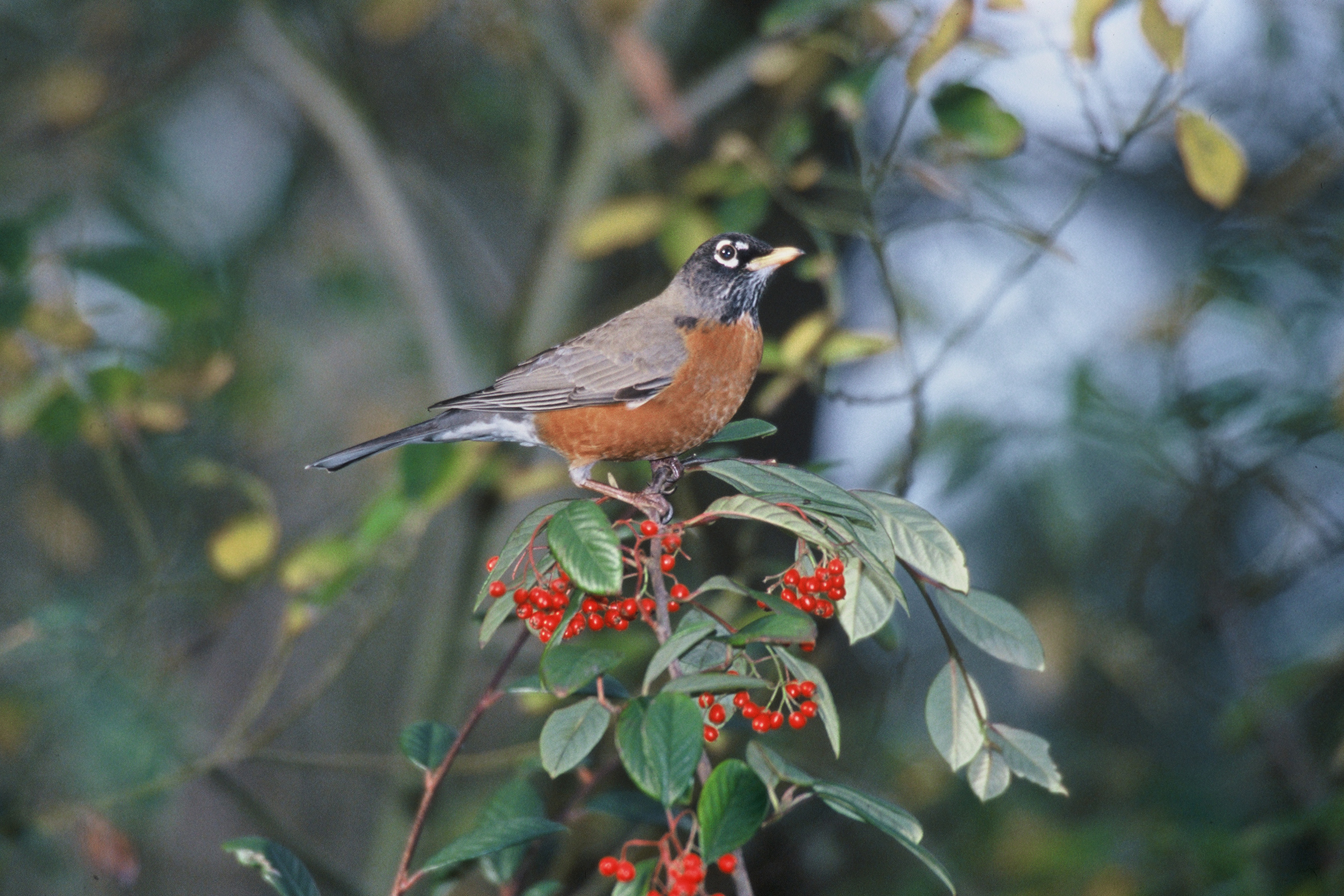
American Robin
American Robin
Turdus migratorius
Courtesy US FWS, images.fws.gov
Dr. Thomas G. Barnes, Photographer
 

Robin with Chicks in NestAmerican Robin
Turdus migratorius
Courtesy US FWS, images.fws.gov
Lee Karney, Photographer
 

Robin with Chicks in NestRobin with Chicks in Nest
Courtesy US FWS, images.fws.gov
James C. Leopold, Photographer

The American robin with its abundance, red breast, and loud song is one of the most recognizable backyard birds in North America. For many of us the robin – or Turdus migratorius – is also thought of as a herald of spring. So why is it that we still occasionally see them in our wintry Utah backyards?

Seasonal bird migration can be triggered by a number of things, but the two main drivers are food supply and nesting habitat. In spring and summer the birds move northward to take advantage of insect hatches, budding plants, and the plethora of nesting sites. Then, as food sources dwindle in fall, the birds move southward to areas where the necessary resources are still plentiful.

The distances birds migrate in order to access these resources can range widely. Therefore, birds are generally categorized as being short-, medium-, or long-distance migrants. Robins are considered short-distance migrants. While their range spans all of Canada and the United States extending down into Mexico, most robins do not travel far from their breeding grounds in winter and may not leave at all. Only the populations that breed and reside on the edges of this range will migrate seasonally.

The robin’s varied diet and behavioral adaptability are the primary reasons these short-migratory or non-migratory patterns are possible. Robins are preferably ground foragers, feasting on insects and earthworms in the spring and summer months. Yet, during the fall and winter, robins eat a fruit-based diet. They track this seasonal food source in flocks, abandoning their summer individualistic and territorial behavior. These flocks – or roosting aggregates – also help them survive the cold winter temperatures. As a result, robins are able to cope with the ground freezing, the disappearance of their preferred food source, and the harsh winter weather.

Returning to our original question: is the American robin truly a sign of spring here in Utah? Is it strange to see this bird in our backyards during the winter months? The simple answer is no. Robins can be found year round almost anywhere south of Canada. While they may migrate nomadically, staying or leaving areas as weather and snow cover affect their food supply, there could be some keeping us company in Utah all winter.

For Wild About Utah, I’m Anna Bengtson.

Credits:

Featured Music: Courtesy & Copyright Don Anderson as performed by Leaping Lulu
Image: Courtesy US FWS, Lee Karney, James C. Leopold, Photographers
Text & Voice: Anna Bengston
Additional Reading: Anna Bengston and Lyle Bingham

Sources & Additional Reading:

American Robin Profile, Utah Birds, Utah County Birders, http://utahbirds.org/birdsofutah/BirdIndex.htm

American Robin, All About Birds, The Cornell Lab of Ornithology, https://www.allaboutbirds.org/guide/American_Robin

American Robin, The Birds of the World Online https://birdsoftheworld.org/bow/species/amerob/cur/introduction

The Basics of Bird Migration: How, Why, and Where, Cornell Lab of Ornithology, August 1, 2021, https://www.allaboutbirds.org/news/the-basics-how-why-and-where-of-bird-migration/ [Updated January 31, 2026]

Where Have all the Robins Gone?, Migration, Cornell Lab of Ornithology https://www.birds.cornell.edu/AllAboutBirds/faq/master_folder/migration/document_view

Snow Depth Survey, The Great Backyard Bird Count [Formerly at https://www.birdsource.org/gbbc/science-stories/past-stories/snow-depth-survey – A mention of the Snow Depth Survey is found in an article in The Lahontan News, National bird count starts today, February 15, 2002]

Winter Robins, The Great Backyard Bird Count [Formerly at https://www.birdsource.org/gbbc/science-stories/past-stories/is-that-winter-flock-of-robins-in-your-yard-unusual Updated January 31, 2026]

Kelly, Patrick, A Moral Dilemma, Wild About Utah, June 29, 2020, https://wildaboututah.org/a-moral-dilemma/

Bengston, Anna, Robins in Winter, Wild About Utah, February 2, 2015, https://wildaboututah.org/robins-in-winter/

Bengston, Anna, American Robin, Wild About Utah, January 18, 2016, https://wildaboututah.org/american-robin-160118/

Bingham, Lyle, Richard Hurren(voice), The Occupants on Robin Street, Wild About Utah, July 8, 2008, https://wildaboututah.org/the-occupants-on-robin-street/