Nesting Season

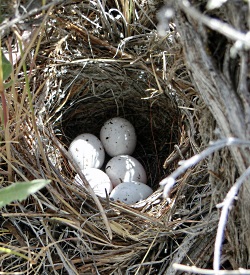
Lark Sparrow Nest, Courtesy & Copyright © Jim Cane, Photographer
Lark Sparrow Nest, June
Courtesy & © Copyright
Jim Cane, Photographer
While we swelter in summer’s heat, the southward shorebird migration has begun. But some songbirds find this a perfect time to nest. We think of spring as nesting season and for the majority of birds it is. But there are some birds nesting almost year round in Utah.

Living organisms are impelled to maximize the number of successful offspring they produce. Therefore, they tend to reproduce during times of plenty, because the breeding season is strenuous. Males compete for mates and territory and females produce eggs. Both parents may guard the nest from predators and feed the young. Many birds feed nutrient rich insects to their nestlings so nesting season is timed to coincide with the greatest abundance of insects, usually spring in temperate and arctic climes.

American and Lesser Goldfinches are one example of birds who do things differently. (Lesser Goldfinch. Kevin Colver: Songbirds of the Southwest Canyon Country) Instead of insects, they feed their young a regurgitated milky seed pulp. Therefore, they time their nesting for greatest abundance of seeds, especially sunflower and thistle, which is in the summer.

Other birds prefer one type of nut. These include Pinon Jays and crossbills. Abundant pinon nuts trigger Pinon Jay nesting. (Pinon Jay. Kevin Colver: Songbirds of the Southwest Canyon Country) If they have enough nuts cached from the previous season, they will nest in late winter, even while snow blankets the landscape. In years with a bumper crop of pinon nuts, they will also breed in late summer to take advantage of the plentiful food. Good conifer cone crops determine when and where crossbills nest, which can be almost any time.

Great-horned Owls are one of the first to nest each year. (Great-horned Owl. Kevin Colver: Songbirds of the Southwest Canyon Country) You can hear courting pairs hoot back and forth in midwinter. They may incubate their eggs while covered in snow, and if the temperature is too frigid, the eggs freeze and the young die. Many predatory birds nest early, perhaps to insure that the young learn how to proficiently hunt before winter.

The drive to reproduce is inviolable and birds take advantage of whatever season gives them the greatest chance for success. For every nesting bird there is a season.

Thanks to Kevin Colver for the use of his bird recordings.

This is Linda Kervin for Bridgerland Audubon Society and Wild About Utah.

Credits:
Images: Jim Cane, Bridgerland Audubon Society
Audio: Courtesy & © Kevin Colver https://wildstore.wildsanctuary.com/
Theme: Courtesy & Copyright Don Anderson as performed by Leaping Lulu
Text & Voice: Linda Kervin, Bridgerland Audubon Society

Additional Reading:

Linda Kervin’s pieces on Wild About Utah

Red Crossbill, All About Birds, Cornell Lab of Ornithology, Cornell University, https://www.allaboutbirds.org/guide/red_crossbill/lifehistory

Great Horned Owl, All About Birds, Cornell Lab of Ornithology, Cornell University, https://www.birds.cornell.edu/AllAboutBirds/owlp/ghowl

American Goldfinch, Spinus tristis, Guide to North American Birds, National Audubon, https://birds.audubon.org/birds/american-goldfinch

Erlich, Paul, Birders Handbook, Touchstone/Simon & Schuster, June 15, 1988, https://books.simonandschuster.com/Birders-Handbook/Paul-Ehrlich/9780671659899

Sandhill Cranes, Utah’s Meadow Dancers

Sandhill Crane Pair, Grus canadensis, Courtesy US FWS, Justine Belson, Photographer
Sandhill Crane Pair
Grus canadensis
Courtesy US FWS,
Justine Belson, Photographer

Cranes of the Swaner Nature Preserve by Michael Flaherty, Nesting cycle of Sandhills Cranes, Swaner Nature Preserve, Park City, UT

Hi, this is Mark Larese-Casanova from the Utah Master Naturalist Program at Utah State University Extension.

The grace of sandhill cranes draws our attention when we see them in the marshes, meadows, and fields across northern Utah. As one of the tallest birds in the state, the sandhill crane is hard to miss. They’ll glide low over farm fields, with their large slate-grey bodies and red caps making them difficult to mistake with any other bird.

Northern Utah is near the lower end of the sandhill crane’s breeding range, so we’re fortunate to see them. They’ll arrive to Utah beginning in March, and stay for the summer breeding season.

Sandhill cranes develop pair bonds for life, and their choice in mates is influenced by elaborate courtship dances. Crane dances are like awkward avian ballet, with an assortment of bows, flapping wings, and leaps into the air with wings outstretched. At times, sticks or plants are grasped with their long, dagger-like bills and tossed into the air. At up to four feet tall with a wingspan of five feet, the sandhill crane as it dances is quite a sight to see!

Sandhill cranes are often heard before they’re seen. Their loud, rolling trumpets fill the air, even for a couple miles. Males and females call in unison, as a loud duet that helps reinforce their pair bond.

[Sandhill Crane Call Copyright 2006 Kevin Colver, as found at https://collections.lib.utah.edu/details?id=1117102]

Once a suitable nest location is found on the ground or on shallow water, both the male and female toss plant material over their shoulders to build their large nest. As spring now fades to summer, sandhill cranes can be seen strolling through farm fields with their young colts, encouraging them to feed, and protecting them from predators. While the dance of the sandhill cranes has mostly ended, their elegance hangs in our memory until next year.

As Aldo Leopold wrote in A Sand County Almanac, “our appreciation of the crane grows with the slow unraveling of earthly history… And so they live and have their being- these cranes- not in the constricted present, but in the wider reaches of… time. A crane marsh holds a paleontological patent of nobility, won in the march of aeons.”

For Wild About Utah, I’m Mark Larese-Casanova.

[End with Kevin Colver, WesternSoundscape.org sandhill crane call again https://collections.lib.utah.edu/details?id=1117102&q=sandhill+crane]

Credits:

Theme: Courtesy & Copyright Don Anderson Leaping Lulu
Images: YouTube video Courtesy and Copyright Michael Flaherty, Park City. UT
Audio: Copyright Kevin Colver
Text & Voice:     Mark Larese-Casanova, Utah Master Naturalist Program at Utah State University Extension.

Additional Reading:

References:
Cornell Lab of Ornithology. Sandhill Crane. All About Birds. https://www.allaboutbirds.org/guide/sandhill_crane/lifehistory

Leopold, A. 1986. A Sand County Almanac. Ballantine Books. https://www.amazon.com/County-Almanac-Outdoor-Essays-Reflections/dp/B00J5SEZ6S

National Wildlife Federation. Sandhill Crane. https://www.nwf.org/wildlife/wildlife-library/birds/sandhill-crane.aspx

Tekiela, S. 2003. Birds of Utah. Adventure Publications, Inc. Cambridge, Minnesota. https://www.amazon.com/Birds-Field-Guide-Identification-Guides/dp/1647554071

Species, Utah Division of Wildlife Resources, Utah Department of Wildlife Resources. Sandhill Crane. https://fieldguide.wildlife.utah.gov/?species=antigone%20canadensis

US Geological Survey. Sandhill crane summer distribution map. https://www.mbr-pwrc.usgs.gov/bbs/htm96/map617/ra2060.html

Photos:
Category:Grus canadensis, Wikimedia Commons, https://commons.wikimedia.org/wiki/Category:Grus_canadensis#mediaviewer/File:Grus_canadensis,_two,_Bosque_del_Apache_NWR.jpg

Category:Grus canadensis, Wikimedia Commons, https://commons.wikimedia.org/wiki/Category:Grus_canadensis#mediaviewer/File:Sandhill_Crane_in_Love^_%28_Grus_canadensis_pratensis_%29_-_Flickr_-_Andrea_Westmoreland.jpg

A Sandhill Crane flying at Sacramento River National Wildlife Refuge, Dayton, California, USA., Courtesy USFWS, Steve Emmons, Photographer, https://commons.wikimedia.org/wiki/Category:Grus_canadensis_in_flight#mediaviewer/File:Grus_canadensis_-Sacramento_River_National_Wildlife_Refuge,_Dayton,_California,_USA_-flying-8.jpg

Gardening for Hummingbirds

Gardening for Hummingbirds

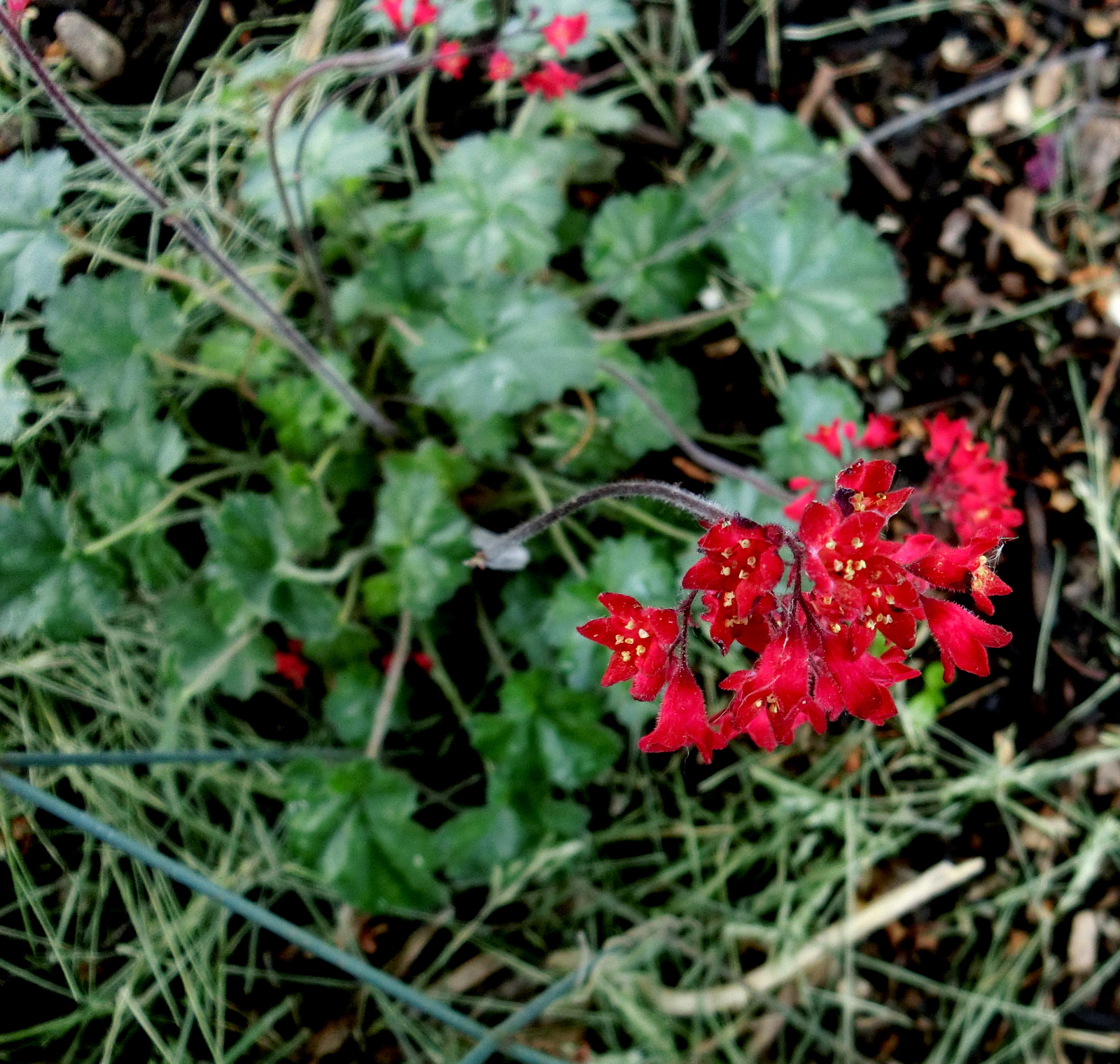
Gardening for Hummingbirds: Heuchera, hummingbird host. Courtesy and copyright Jim Cane, Photographer
Huechera
Courtesy & © Jim Cane, Photographer

 
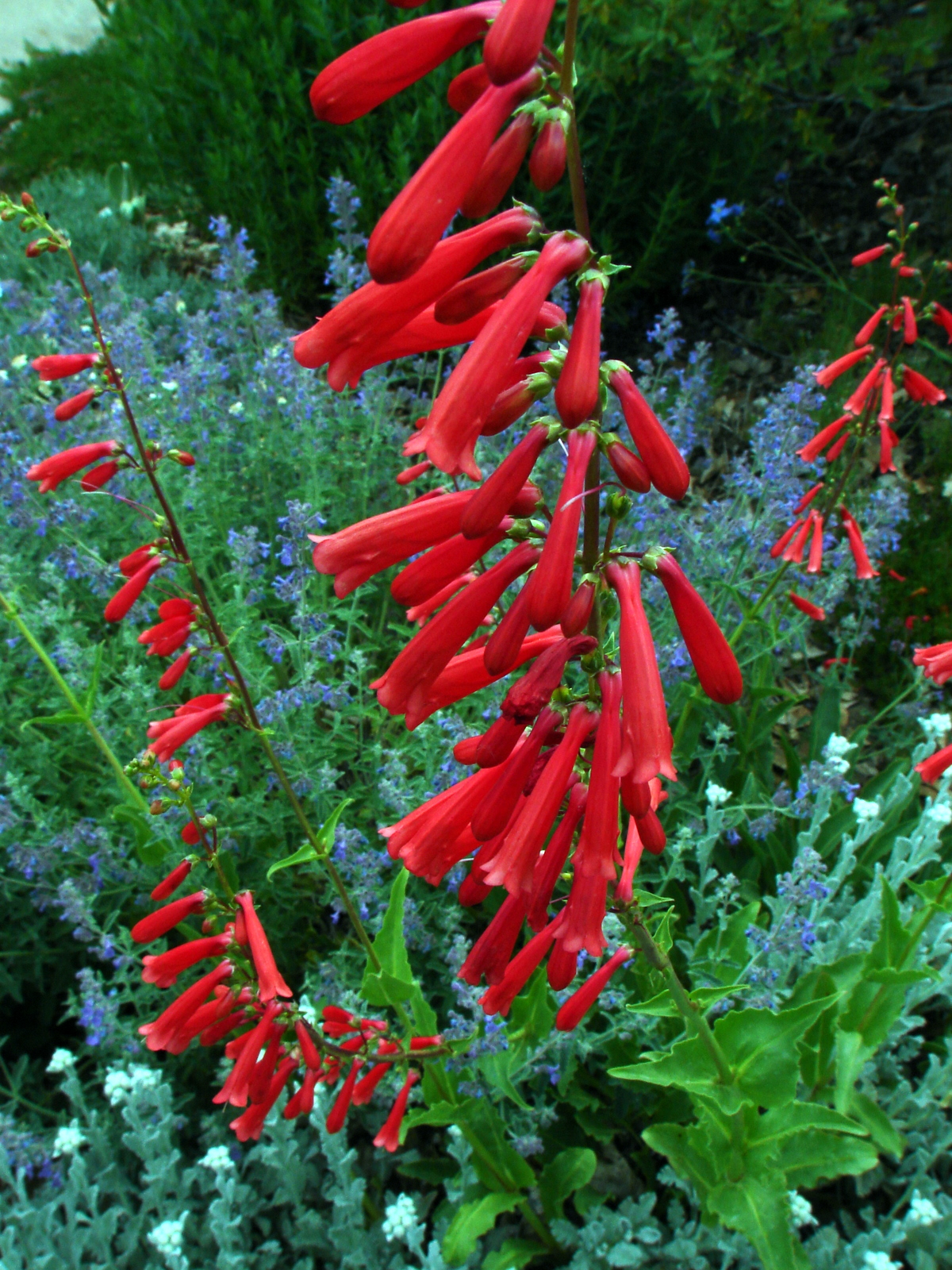
Gardening for Hummingbirds: Penstemon hummingbird host Courtesy & © Jim Cane, PhotographerPenstemon eatonii
Courtesy & © Jim Cane, Photographer

 
At long last, summer has returned as have the hummingbirds who zip around my garden, visiting flowers and chasing off intruders. (Kevin Colver: Songbirds of Rocky Mountain Foothills. Broad-tailed Hummingbird) Hummingbirds are a delight in the yard and so we plant flowers specifically to attract and feed them. In general, hummingbirds prefer long tubular flowers especially those that are red, orange or violet. But not all these flowers are created equally.Gardening for Hummingbirds

Hummingbirds visit flowers for their nectar which fuels their flight. Their long tongue reaches well beyond the tip of their needle like bill when they lap up nectar; capillary action then draws the sweet liquid up tiny grooves along the length of the tongue.

Floral nectar evolved to attract potential pollinators. The floral nectary is generally found inside the flower, at the base. When probing for nectar, floral visitors brush by the reproductive structures. Pollen adheres to parts of their body and then at the next flower of the same species, some pollen sticks to the female stigma. This transfer is pollination.

Many nectar-rich flowers grow well in Utah gardens. In the xeric garden, Penstemons are a good choice, as are Red Hot Pokers and Zauschneria, sometimes called Hummingbird Trumpet. In more moist sites, red flowered Heuchera is popular. Some red flowered cacti and Trumpet Creeper are good choices, as are Agastache and many Salvias.

Watch which flowers hummers visit. They will check out many blooms, but the ones they routinely return to are the ones yielding generous nectar. Many flowers produce little or no nectar, including some that look to us like good hummingbird flowers. Also, many horticultural hybrids and doubled flowers produce paltry amounts of nectar.

To encourage hummingbirds to remain in your garden, you can grow trees and shrubs for cover. Nectar is only part of their diet. For protein, they regularly eat insects and spiders small enough for their tiny bill so a garden free of insects is not desirable. They also appreciate a place to perch where they can digest, wait for a tasty insect to fly by and keep an eye out for potential rivals. So grab your trowel and lets feed those hummers.(Kevin Cover: Songbirds of Rocky Mountain Foothills. Broad-tailed Hummingbird)

This is Linda Kervin for Bridgerland Audubon Society.

Credits:

Images: Courtesy and Copyright Jim Cane, Photographer
Theme: Courtesy & Copyright Don Anderson as performed by Leaping Lulu
Text & Voice: Linda Kervin, Bridgerland Audubon Society

Additional Reading:

Linda Kervin’s pieces on Wild About Utah

Hummingbirds and How to Attract Them, Washington Department of Fish & Wildlife, https://wdfw.wa.gov/living/hummingbirds/

Hummingbirds 101, The Hummingbird Society, https://www.hummingbirdsociety.org/hummingbirds-101/

Coro Arizmendi Arriaga, Maria del, Hummingbirds of
Mexico and North America, In Spanish and English, CONABIO, 2014, https://www.biodiversidad.gob.mx/Difusion/pdf/colibries_mexico_y_norteamerica.pdf

Gardening for Hummingbirds

The Raft River Mountains

The Raft River Mountains: Clear Creek in Spring
Clear Creek in Spring
Courtesy & Copyright Holly Strand

The Raft River Mountains: Raft River MountainsRaft River Mountains
Courtesy & Copyright Holly Strand

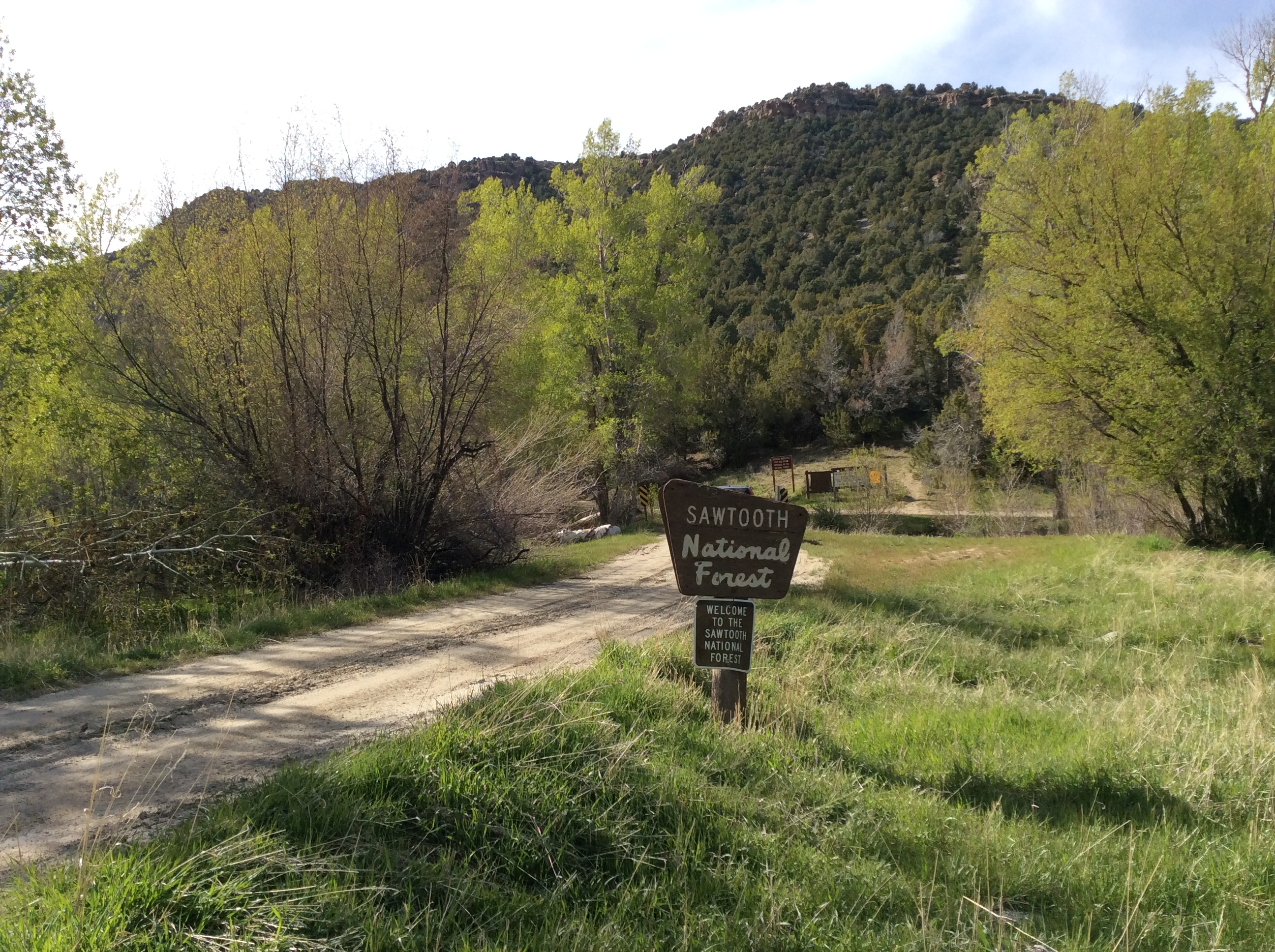
The Raft River Mountains: Near Clear Creek Campground.Near Clear Creek Campground.
Courtesy & Copyright Holly Strand


Hi, I’m Holly Strand of the Quinney College of Natural Resources at Utah State University.

In each of Utah’s six corners you’ll find one or more remarkable natural features. Moreover, each corner represents a totally different geographic environment. No doubt you are familiar with turquoise blue Bear Lake in the upper northeast and the magnificent High Uintas near the angle formed by Wyoming. Flaming Gorge and Dinosaur National Monument flank the lower northeast corner. The ancient ruins and Monument Valley draw international visitors to the southeast corner. The numerous canyon parks in Utah’s southwest corner offer endless opportunities for exploration. 

That’s five corners. But what do you know about the northwest corner of our state? I live in Northern Utah and I had never been there. Resolved to correct this omission I consulted a map as well as Joan Hammer of Box Elder County’s Office of Tourism. I concluded that the Raft River Mountains were worth checking out. The highest point in the County, Bull Mountain is here. And the 40 mile long range defines the southernmost section of Sawtooth National Forest.

The Raft River Mountains are unusual in that they run east-west. The normal pattern for Basin and Range country is north-south. The east-west orientation creates an important geographic dividing line. For Clear Creek drains the northern slopes of the Raft River Mountains. Then Clear Creek joins the Raft River which flows north to the Snake River. Thus the mountains form the sole—and very small—piece of Utah real estate that belongs to the great Colombia River Basin. The southern slopes are part of Great Basin. Rain or snow falling on this side is absorbed into the ground or evaporates.

Another interesting fact: The Raft River Mountains is where you can view some of the oldest rock in Utah. In this region, outcrops of Precambrian material are 2.5 billion years old. The largest and thickest exposures are in the eastern half of the range.

The Raft River Mountain peaks may not make it onto post cards. But when I saw them they were nothing less than beautiful. The lower slopes of sagebrush had the grayish-green tint that emerges all too briefly in the spring. Snow still gleamed on the 8-9000 foot summits. Clear Creek was running full through riparian forest that was just starting to leaf out. There were no people at the campground but wildlife was plentiful. I saw wild turkey, deer, jackrabbits and squirrels. A few pronghorn looked up as I drove out through the sagebrush. All in all, I found Utah’s sixth corner to be well worth a visit.

For pictures and more information about the Raft River Mountains, go to www.wildaboututah.org

For Wild About Utah, and the Quinney College of Natural Resources, I’m Holly Strand.

Credits:

Images: Courtesy and Copyright Holly Strand
Text: Holly Strand

Additional Reading

Doelling, Hellmut H. Geology and Mineral Resources of Box Elder County. Utah Geological and Mineral Survey. 1980. Bulletin 115.,

Stokes, William Lee. 1988. Geology of Utah. Salt Lake City: Utah Museum of Natural History. SummitPost.org Bull Mountain. https://www.summitpost.org/bull-mtn-ut/183282https://www.summitpost.org/bull-mtn-ut/183282 [Accessed May 13, 2014 and July 10, 2020]

USDA Forest Service. Sawtooth National Forest, Raft River Division. https://www.fs.usda.gov/recarea/sawtooth/recarea/?recid=5806 [Accessed May 13, 2014 and July 10, 2020]

Hylland, Rebecca, What are Igneous, Sedimentary & Metamorphic Rocks?, Glad You Asked, Utah Geological Survey, https://geology.utah.gov/map-pub/survey-notes/glad-you-asked/igneous-sedimentary-metamorphic-rocks/