Andrea Explains Fitting the Bill

Andrea Explains Fitting the Bill

Andrea Explains Fitting the Bill: White-winged Crossbill, Courtesy and Copyright Paul Higgins, www.pbase.com/phiggins/
White-winged Crossbill
Copyright © 2009 Paul Higgins
More photos at pbase.com/phiggins/
and utahbirds.org Photo Gallery
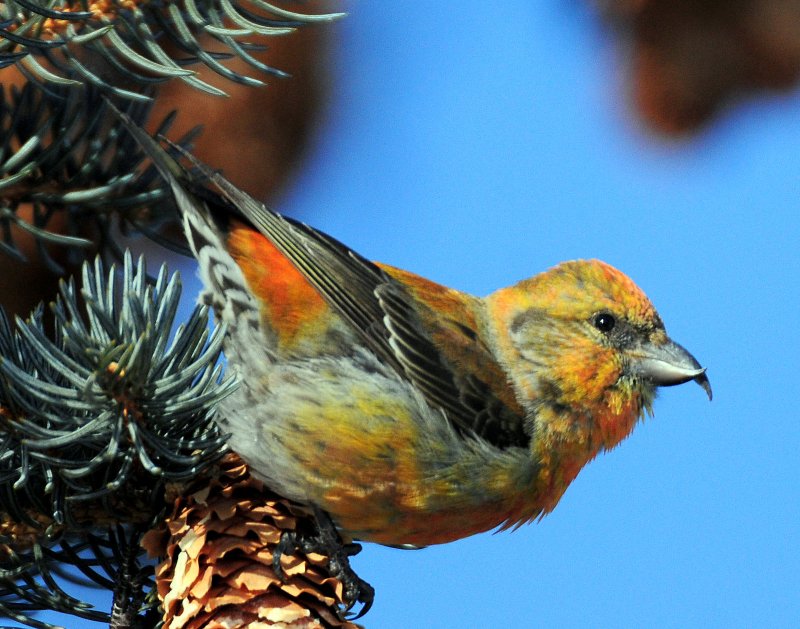
Red Crossbill (female)
Copyright © 2009 Paul Higgins
More photos at pbase.com/phiggins/

Few among us would choose to eat a steak with a spoon or soup with a fork. And in the world of birds, it’s the same story – you need the right tool for the right job – and you can tell a lot about a bird by paying attention to its beak.Andrea Explains Fitting the Bill

Physiologically, beaks are a specialized extension of the skull and are coated in keratin – the same material that makes up our fingernails. And like our fingernails, the cutting edges of the beak can be re-grown as they are worn down by use.

Birds use beaks for a multitude of tasks including preening, weaving nests, and defending territories. However it is the task of eating that seems to dictate beak shape and size. Envision the hummingbird, for instance. Its long, thin beak – and corresponding tongue – is designed to reach deep into flowers to collect the nectar within. A hummingbird beak would not work for a woodpecker or a great horned owl. Likewise an eagle’s beak needs to be sharp and strong for tearing flesh, and wouldn’t suit the lifestyle of an ibis or a sparrow.

One Utah native, the aptly-named red crossbill, has one of the most unique beaks around. When closed, its curved top and bottom bills overlap crossways in what looks like an awkward and uncomfortable pose.

French naturalist Count Buffon, first laid eyes on a crossbill in the mid-1700’s. The bird was collected in the Americas, then shipped abroad for examination. Without observing the crossbill in its natural habitat, Buffon labeled its beak “an error and defect of nature, and a useless deformity.” More than 50 years later, Scottish-American naturalist Alexander Wilson observed a crossbill in the wild and determined that its beak ‘deformity’ was in reality a magnificently adapted tool. The crossbill’s diet consists mainly of the seeds of conifer trees, and it turns out that the bird’s curiously crossed beak is perfectly adapted to prying apart the scales of pinecones to get at the seeds within.

Members of the finch family, these birds are often seen in flocks and occasionally visit backyard feeders. They are easily identified by their unique beaks, which serve as a reminder that the right tool for the right job can sometimes seem a bit unconventional.

For more information and photographs of crossbills, visit our website at www.wildaboututah.org. Thank you to Rocky Mountain Power Foundation for supporting the research and development of this Wild About Utah topic.

For the Stokes Nature Center and Wild About Utah, this is Andrea Liberatore.
Credits:
Photos: Courtesy & Copyright Paul Higgins(phiggins)www.pbase.com/phiggins
Text:    Andrea Liberatore, Stokes Nature Center, logannature.org

Additional Reading:

Benkman, Craig W. 1987. Crossbill Foraging Behavior, Bill Structure, and Patterns of Food Profitability. The Wilson Bulletin 99(3) p. 351-368 https://www.uwyo.edu/benkman/pdfs%20of%20papers/benkman_1987_wilsonbull.pdf

Conniff, Richard. 2011. The Species Seekers: Heroes, Fools and the Mad Pursuit of Life on Earth. W.W. Norton & Company: NY https://www.amazon.com/Species-Seekers-Heroes-Fools-Pursuit/dp/0393341321

Pearson, T. Gilbert (ed.). 1936. Birds of America. Garden City Publishing Company, Inc. Garden City, NY https://www.amazon.com/T-Gilbert-Pearson/dp/1331531268/ref=pd_lpo_14_t_0/144-1525643-4789824

Andrea Explains Fitting the Bill

I Love the Four Seasons

Red Admiral Butterfly, Thomas G. Barnes, US FWS Digital Library
Red Admiral Butterfly
Thomas G. Barnes
US FWS Digital Library

Glacier Lilies
Erythronium grandiflorum
Copyright © 2010 Andrea Liberatore


I love the four seasons. Having spent my 72 years residing in the mid latitudes, I’ve learned to celebrate each of our seasons, but especially spring!

This is the rebirth flush with abundant water, new greenery, and air filled with bird song and sweet aromas as new flowers perfume the air hoping to lure in a pollinator.

With mid-April upon us and our 42 degree latitude, spring is in full swing here in northern Utah! Winter departs grudgingly slapping us with snow squalls intermingled with glorious, early summer days, a wild roller coaster ride which I truly enjoy!
I’m an avid phenology follower. Phenology is the study of how life adapts to seasonal changes. I revel in the first floral bloom, the first neotropical birds returning from Latin America with a heart full of song, and newly emerged, gaudy butterflies.

With a relatively stable climate, until recently, the timing of these events has evolved to near perfection
Let’s take a closer look at some of these phenomena. I’ll begin with our neotropical birds such as lazuli buntings, yellow warblers, and Western tanagers to mention a few. These species spend over half of their year in Mexico, Central and South America flying thousands of miles to for the breeding and nesting season in the Intermountain West. This may seem a bit extreme for these tiny flurries of life.

On closer inspection, you will find they have good reason for this daunting and dangerous task. The tropics have a relatively stable climate without the dramatic seasonal change that we experience. This results in relatively stable populations of flowers and insects, the primary food sources for most species. Further, the ratio of daylight to darkness is nearly constant with 12 hours of each. Our days lengthen as we journey toward summer solstice with nearly 16 hours of daylight! This allows a burst of energy to flow through ecosystems resulting in eruptive populations of insects and floral bloom. It also offers long hours of daylight for parents to gather food for their young which grow rapidly toward fledglings, thus reducing the possibility of predation and also preparing them for the arduous flight south as fall approaches.

Let’s examine flowers and insects. With our very warm winter and spring, I was expecting a much earlier arrival of both and was not disappointed. I counted 17 species of flowers by the second week of April! And butterflies were on a similar schedule with 9 different species during the last week of March- remarkably early! Although delighted, it occurred to me that returning birds may not be so pleased. If the flowers begin to fade, and insects begin their downward slide at the peak of birds rearing their young, trouble is afoot! A five year Audubon study revealed that 1/3 of our birds are predicted to be severely impacted by these rapid climate shifts.

On a more positive note, spring will continue as will bird song, vernal waterfalls, eruptions of wildflowers and butterflies. And spring repeats itself as we move to higher elevations. As cornices on our mountain ridges recede, up pops flowers for yet another spring bloom, and with them butterflies, bees, and birds!

Credits:

Pictures: Courtesy Dr. Thomas G. Barnes, US FWS
Pictures Lilies: Copyright © 2010 Andrea Liberatore
Audio: Courtesy and Copyright Kevin Colver
Text: Jack Greene, Bridgerland Audubon Society

Additional Reading:

Kervin, Linda, USA National Phenology Network, Wild About Utah, July 2, 2009, https://wildaboututah.org/usa-national-phenology-network/

Phenology Tools for Community Science
USA National Phenology Network, https://www.usanpn.org/
Nature’s Notebook Education Program, US National Phenology Network, https://www.usanpn.org/nn/education

North American Bird Phenology Program, USGS Patuxent Wildlife Research Center, https://www.pwrc.usgs.gov/bpp/BecomeAParticipant.cfm

eBird, https://www.ebird.org/

iNaturalist, https://www.inaturalist.org/

Birds Fitting the Bill

Birds Fitting the Bill

Fitting the Bill: White-winged Crossbill
White-winged Crossbill
Copyright © 2009 Paul Higgins
More photos at pbase.com/phiggins/
and utahbirds.org Photo Gallery

Red Crossbill (female)
Copyright © 2009 Paul Higgins
More photos at pbase.com/phiggins/

Fitting the Bill: Few among us would choose to eat a steak with a spoon or soup with a fork. And in the world of birds, it’s the same story – you need the right tool for the right job – and you can tell a lot about a bird by paying attention to its beak.

Physiologically, beaks are a specialized extension of the skull and are coated in keratin – the same material that makes up our fingernails. And like our fingernails, the cutting edges of the beak can be re-grown as they are worn down by use.

Birds use beaks for a multitude of tasks including preening, weaving nests, and defending territories. However it is the task of eating that seems to dictate beak shape and size. Envision the hummingbird, for instance. Its long, thin beak – and corresponding tongue – is designed to reach deep into flowers to collect the nectar within. A hummingbird beak would not work for a woodpecker or a great horned owl. Likewise an eagle’s beak needs to be sharp and strong for tearing flesh, and wouldn’t suit the lifestyle of an ibis or a sparrow.

One Utah native, the aptly-named red crossbill, has one of the most unique beaks around. When closed, its curved top and bottom bills overlap crossways in what looks like an awkward and uncomfortable pose.

French naturalist Count Buffon, first laid eyes on a crossbill in the mid-1700’s. The bird was collected in the Americas, then shipped abroad for examination. Without observing the crossbill in its natural habitat, Buffon labeled its beak “an error and defect of nature, and a useless deformity.” More than 50 years later, Scottish-American naturalist Alexander Wilson observed a crossbill in the wild and determined that its beak ‘deformity’ was in reality a magnificently adapted tool. The crossbill’s diet consists mainly of the seeds of conifer trees, and it turns out that the bird’s curiously crossed beak is perfectly adapted to prying apart the scales of pinecones to get at the seeds within.

Members of the finch family, these birds are often seen in flocks and occasionally visit backyard feeders. They are easily identified by their unique beaks, which serve as a reminder that the right tool for the right job can sometimes seem a bit unconventional.

For more information and photographs of crossbills, visit our website at www.wildaboututah.org. Thank you to Rocky Mountain Power Foundation for supporting the research and development of this Wild About Utah topic.

For the Stokes Nature Center and Wild About Utah, this is Andrea Liberatore.
Fitting the Bill-Credits:
Fitting the Bill
Photos: Courtesy & Copyright Paul Higgins(phiggins)www.pbase.com/phiggins
Text:    Andrea Liberatore, Stokes Nature Center, logannature.org

Fitting the Bill-Additional Reading:

Benkman, Craig W. 1987. Crossbill Foraging Behavior, Bill Structure, and Patterns of Food Profitability. The Wilson Bulletin 99(3) p. 351-368 https://www.uwyo.edu/benkman/pdfs%20of%20papers/benkman_1987_wilsonbull.pdf

Conniff, Richard. 2011. The Species Seekers: Heroes, Fools and the Mad Pursuit of Life on Earth. W.W. Norton & Company: NY https://www.amazon.com/Species-Seekers-Heroes-Fools-Pursuit/dp/0393341321

Pearson, T. Gilbert (ed.). 1936. Birds of America. Garden City Publishing Company, Inc. Garden City, NY https://www.amazon.com/T-Gilbert-Pearson/dp/1331531268/ref=pd_lpo_14_t_0/144-1525643-4789824

Bald Eagles

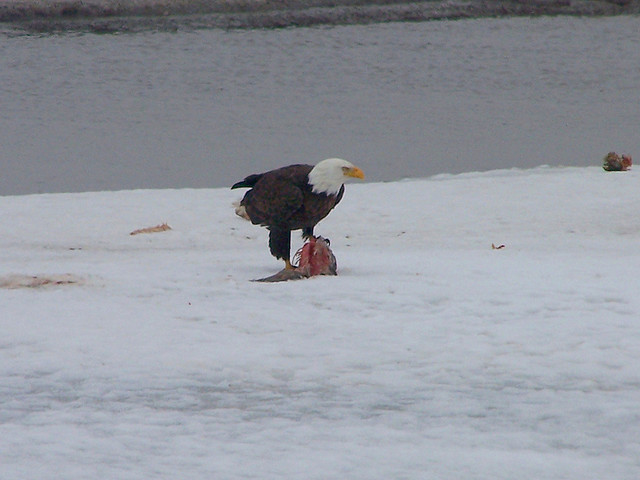
Bald Eagle Feeding
Copyright © 2011 Bryant Olsen

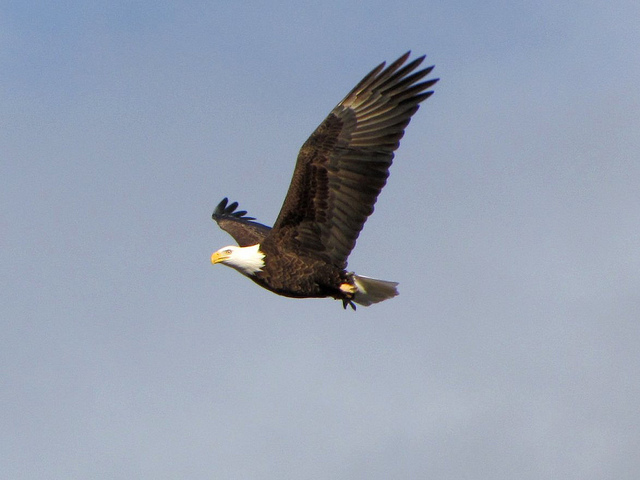
Bald Eagle in Flight
Copyright © 2011 Bryant Olsen

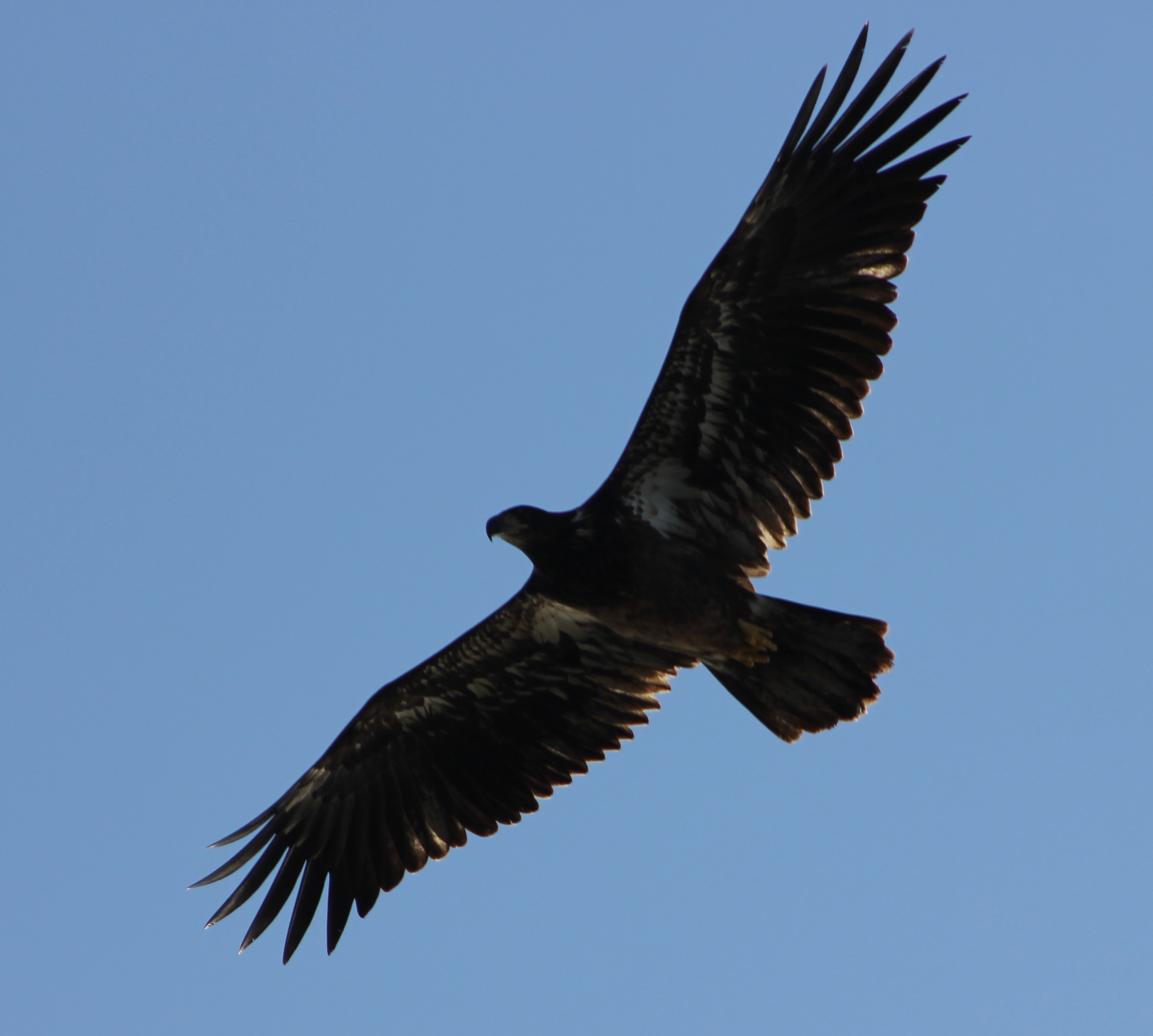
Juvenile Bald Eagle in Flight
Copyright © 2011 Terry Greene

Flying Immature Bald Eagle
Copyright © 2011 Terry Greene

Flying Immature Bald Eagle

Copyright © 2011 Terry Greene, Photographer

When winter arrives in Utah, a number of our bird species hit the road – some flying thousands of miles to Mexico and Central America in search of a warm winter home.

But there is one notable bird that actually migrates to Utah in the winter – the bald eagle. In general, birds migrate because of seasonal food shortages. Think of the hummingbirds that rely on flower nectar and insects, which Utah cannot provide in winter, but which are abundant other times of the year. The same is true for bald eagles, whose main food source is fish. Winter comes on strong in Alaska and Canada, freezing lakes, ponds, and all but the strongest flowing rivers. So the birds travel to seek out the relatively mild winters found farther south.

One of the largest birds of prey you’ll see in our Utah skies, a mature bald eagle can have a wingspan of 6 to 8 feet and stand almost three feet tall. Only the golden eagle rivals it in size. Pairs are thought to mate for life, and they are also responsible for the largest nests of any bird in North America. One record-setting abode measured 9 feet wide, 20 feet deep, and weighed more than 2 tons.

And to think, we almost lost this incredible species. Since DDT and hunting heavily affected bald eagle numbers in the early half of the 20th century, the birds have made a truly remarkable comeback. From a low point around 4,000 individuals in the lower 48 states, they are now thought to number in the tens of thousands, and have been removed from the Threatened and Endangered Species lists.

Perhaps as their comeback continues, Utah will once again see these majestic animals make their massive nests here, fishing in our many rivers and lakes year round. For now, though, aside from a few rare exceptions, bald eagle enthusiasts will have to make the most of their short winter stay. To observe bald eagles, consider a visit to the Great Salt Lake Nature Center at Farmington Bay. Every year, the Bay plays host to hundreds of eagles, from November to March, and while this milder-than-usual winter has brought in fewer numbers of eagles, you may still be able to catch a glimpse. They will likely be heading north later this month, however, so don’t delay. And be sure to keep your ears tuned into the bald eagle’s haunting song:

[Bald Eagle call from Songbirds of Yellowstone, Kevin Colver]

Thank you to the Rocky Mountain Power Foundation for supporting the research and development of this Wild About Utah topic. For the Stokes Nature Center and Wild About Utah, this is Andrea Liberatore.

For the Stokes Nature Center and Wild About Utah, this is Andrea Liberatore.

Credits:

Audio: Courtesy & Copyright Kevin Colver
Photos: Courtesy & Copyright Bryant Olsen and
            Courtesy & Copyright Terry Greene
Text:    Andrea Liberatore, Stokes Nature Center, logannature.org

Additional Reading:

Parrish, J. and Walters, B., Editors. (2009) Bald Eagle (Haliaeetus leucocephalus). Utah Division of Wildlife Resources: Wildlife Notebook Series No. 3. https://wildlife.utah.gov/publications/pdf/2010_bald_eagle.pdf

National Geographic Society (2012) Animals: Bald Eagle (Haliaeetus leucocephalus)
https://animals.nationalgeographic.com/animals/birds/bald-eagle/