Marie and Her Yellow Jacket

Western yellowjacket (Vespula pensylvanica) on a fennel flower (Foeniculum vulgare), Courtesy Wikimedia, By Davefoc - Own work, CC BY-SA 3.0, Link
Western yellowjacket (Vespula pensylvanica)
on a fennel flower (Foeniculum vulgare)
Courtesy Wikimedia, By DavefocOwn work, CC BY-SA 3.0, Link
Marie y su chaqueta Amarilla.
Today’s story is in both Spanish and English. To hear a Spanish version listen on Wednesday evening at 9pm, or online here and at UPR.org
La historia de hoy está en español e inglés. Para escuchar una versión en español, escuche el miércoles por la noche a las 9 p. m., o en línea aquí y en UPR.org

We’ve had some hot days, during which we’ve been able to enjoy rivers, lakes, and pools—but what I enjoy most during this time is walking along the trails of this beautiful valley where I live.

Cache Valley has a unique geographic shape unlike anywhere else in the world. Just a short distance from our homes, we can find natural beauty that captivates us and makes us lose track of time within stunning landscapes such as the First Dam, the Second Dam, the Wind Caves, the Stokes Nature Center Trail, Tony Grove, and Bear Lake, among others. It would take me an entire book to list every single one.
Among the many beautiful things this summer has brought are the chance to live unique experiences—like watching fireflies, feeding hummingbirds, and seeing people learn about native species from experts.

All of this reminds me that I live in a magical place, full of life—a place where everyone would want to stay forever and where time feels like it stands still.

A few leaves have started to fall, and the landscapes are turning orange, brown, and golden. That reminds me that autumn is coming and winter will soon arrive. It’s time to start preparing my little home. I’ve been working, gathering mud from the banks of the Logan River, but I still take notice of all those who take photos, who sing, and who speak words of love, joy, and hope to their loved ones—including their pets.

My family and I are almost ready to rest and hope that this winter will be as pleasant as all the previous ones, and that people will enjoy it with their walks and warm clothes—with their boards and funny shoes—and that children will be able to run and slide with their little faces red from the cold.

You might be wondering who I am, since I’ve already given you a few hints about where I live. My family and I have spent many years here, close to you, watching you pass by. Many times, I’ve startled you—and you’ve applauded me for my good performance.

There are many of us who live here. I have wonderful neighbors—like the snakes that rest near the rocks or by the riverbanks, the birds that fly each day in search of seeds, and the squirrels that gather food and run toward the trees. Do you know who I am now?

Thank you for understanding that we are important. Thank you for studying and learning about me. Thank you for giving me fancy hotels where I can live and spend time.

Although I always prefer to build my own mud house—the one that protects us from rain and snow.

It’s me, your little friend, the one who helps with pollination and eats caterpillars in your garden. I always wear a yellow jacket in case bad weather catches me away from home. Yes, that’s me—Marie, the yellow jacket wasp.

Remember that our magical place is here. We live in harmony with one another, and keeping it that way forever depends on us. Help me ensure that our place of peace and tranquility remains for generations to come.

This is Kate Hunter with Stokes Nature Center, and I’m Wild about Utah.

Credits:
English Version: Kate Hunter, Education, Stokes Nature Center https://logannature.org/staff/
Spanish Version: Carlos Ramos, Facilities, Stokes Nature Center https://logannature.org/staff/
Images: Courtesy Wikimedia Commons, Davefoc, – Own work, CC BY-SA 3.0, Link
Featured Audio: Courtesy & Copyright Anderson, Howe, & Wakeman
Text: Kate Hunter & Carlos Ramos, https://logannature.org/staff
Additional Reading: Kate Hunter, Carlos Ramos, https://logannature.org/staff & Lyle Bingham, https://bridgerlandaudubon.org/

Additional Reading

Wild About Utah Pieces by Kate Hunter https://wildaboututah.org/author/kate-hunter/
Wild About Utah Pieces by Carlos Ramos https://wildaboututah.org/author/carlos-ramos/

Western Yellowjacket drinking water, Wikimedia Commons, Katja Schulz, Author/Contributor, https://commons.wikimedia.org/wiki/File:Western_Yellowjacket_drinking_water_-_Flickr_-_treegrow.jpg
Originally posted to Flickr by treegrow at https://flickr.com/photos/86548370@N00/8137488317

Western Yellowjacket Wasp: Western Paper Wasp, Mischocyttarus flavitarsushttps://en.wikipedia.org/wiki/Mischocyttarus_flavitarsis

Yellow-legged Mud Dauber: Sceliphron caementarium, Wikimedia, https://en.wikipedia.org/wiki/Sceliphron_caementarium

Bald-faced hornet: Dolichovespula maculata, Plant Health, Extension, Utah State University, https://extension.usu.edu/planthealth/ipm/notes_nuisance/baldfaced-hornet

Nature Out Your Front Door

Nature Out Your Front Door, Pavement Ants July 2025, Payson UT Courtesy & Copyright Lyle W. Bingham, Photographer
Pavement Ants
July 2025, Payson UT
Courtesy & Copyright Lyle W. Bingham, Photographer
If you’ve listened to these Wild About Utah segments for a while, you’ll have noticed that we tend to focus on places where humans don’t live. But what we call “nature” can flourish almost anywhere, including the places where people dominate.

I’m an avid runner and walker. And my town has done a lot of street and sidewalk work this year, so I’ve spent a lot of time looking down to make sure I don’t suddenly trip or step in a hole. Earlier this year, I was looking down while walking to my office, and I was amazed by how many ant colonies I was seeing on the sidewalks. Each colony included hundreds of tiny ants, milling around in what looked like random patterns. Some blocks had an ant swarm every 20 to 30 feet.

I’d seen them before, of course, but hadn’t realized just how ubiquitous they are. Being a scientist and therefore endlessly curious, I began to wonder: What are these ants doing when they swarm? And how do they all know to do it at the same time?

Nature Out Your Front Door, Pavement Ants July 2025, Payson UT Courtesy & Copyright Lyle W. Bingham, Photographer
Pavement Ants
July 2025, Payson UT
Courtesy & Copyright Lyle W. Bingham, Photographer
The particular species of ant that I was seeing – and I’m sure most of us have seen them at one time or another – is called the immigrant pavement ant. In some places they’re also called sugar ants, thanks to their nasty habit of sneaking into people’s kitchens to find sweet things to eat. They’re tiny, 2.5 to 4 millimeters long, shorter than a grain of rice. Originally native to Europe, some of them probably stowed away on a ship to America in colonial times. Now they’re widespread across North America.

As I watched closely, I realized that the ants’ movements weren’t entirely random. They would approach another ant, stop for a half second, then move on. That’s because one purpose of swarming is colony expansion. They wander around checking each other out. If an interloper from another colony enters the swarm and is recognized as a stranger, it will be attacked. Sometimes hundreds of ants can die in battles between neighboring colonies.

The other thing that happens when they’re swarming is mating. Some of the ants develop wings and take nuptial flights, when males and queens from different colonies take to the air and mate. They like to do this on clear, warm surfaces, when the days are long and hot sunlight has warmed the soil for a while. If each colony responds to the same environmental cue, it means there is a huge pool of prospective mates, which increases genetic diversity and colony success.

After mating, the males die and the queens, which are about twice as big as the other ants, fly off to start new colonies. Worker ants from nearby colonies will collect and remove the dead ants quickly. This helps prevent predators from being able to locate the colonies, which spend most of their time in nests beneath flat stones or similar hard spaces – such as sidewalks. Within a week after the swarms appear, they’re gone.

Pavement ants can be a nuisance if they get into your pantry. But when they’re swarming safely out on the sidewalk, they’re just a fascinating part of nature – one that most of us can observe without going more than a block or two from home.

I’m Mark Brunson, and I’m wild about Utah’s natural creatures, wherever they’re found.

Credits:

Images Courtesy & Copyright Lyle Bingham, Photographer, Bridgerland Audubon Society
Featured Audio: Courtesy & © Kevin Colver, https://wildstore.wildsanctuary.com/collections/special-collections and Anderson, Howe and Wakeman
Text: Mark Brunson, https://www.usu.edu/experts/profile/mark-brunson/
Additional Reading: Mark Brunson, https://www.usu.edu/experts/profile/mark-brunson/ & Lyle Bingham, Bridgerland Audubon Society

Additional Reading

Mark Brunson’s archive: https://wildaboututah.org/?s=brunson


Pavement Ants, Hillman Ball Park, Payson UT, After the Sprinklers
Courtesy & Copyright Lyle W. Bingham, Photographer

Tetramorium caespitum – Bugwoodwiki
https://wiki.bugwood.org/Tetramorium_caespitum

Tetramorium caespitum – iNaturalist
https://www.inaturalist.org/guide_taxa/832327

Immigrant Pavement Ant (Tetramorium immigrans) – iNaturalist
https://www.inaturalist.org/taxa/569552-Tetramorium-immigrans

Pavement Ant | NC State Extension Publications
https://content.ces.ncsu.edu/pavement-ant

“Pavement ants (Formicidae, Tetramorium immigrans) are northern Utah’s most common pest ant in and around homes and structures. Until recently, the pavement ant’s scientific name was Tetramorium caespitum, but recent genetic work has clarified that our common pest Tetramorium species in the U.S. is from Europe and has been given the name T. immigrans (Wagner et al., 2017; Zhang et al., 2019). Genetic variation among pavement ant populations in the U.S. is low and it is believed that current populations were derived from one or a few closely related colonies from Europe introduced into the northeastern U.S. about 200 years ago (Wagner et al., 2017; Zhang et al., 2019).”
Pavement Ants, Extension, Utah State University (USU), https://extension.usu.edu/planthealth/research/pavement-ants

When the Ants Come Marching In…, IPM Fact Sheet #8, USU Extension, Utah State University, https://extension.usu.edu/planthealth/schoolipm/files/pest-press-fact-sheets/pdf/ants_pestpress.pdf

Pavement Ant, Tetramorium caespitum | USU
https://extension.usu.edu/planthealth/ipm/notes_ag/hemp-pavement-ants

Pollinator Camp: Bees

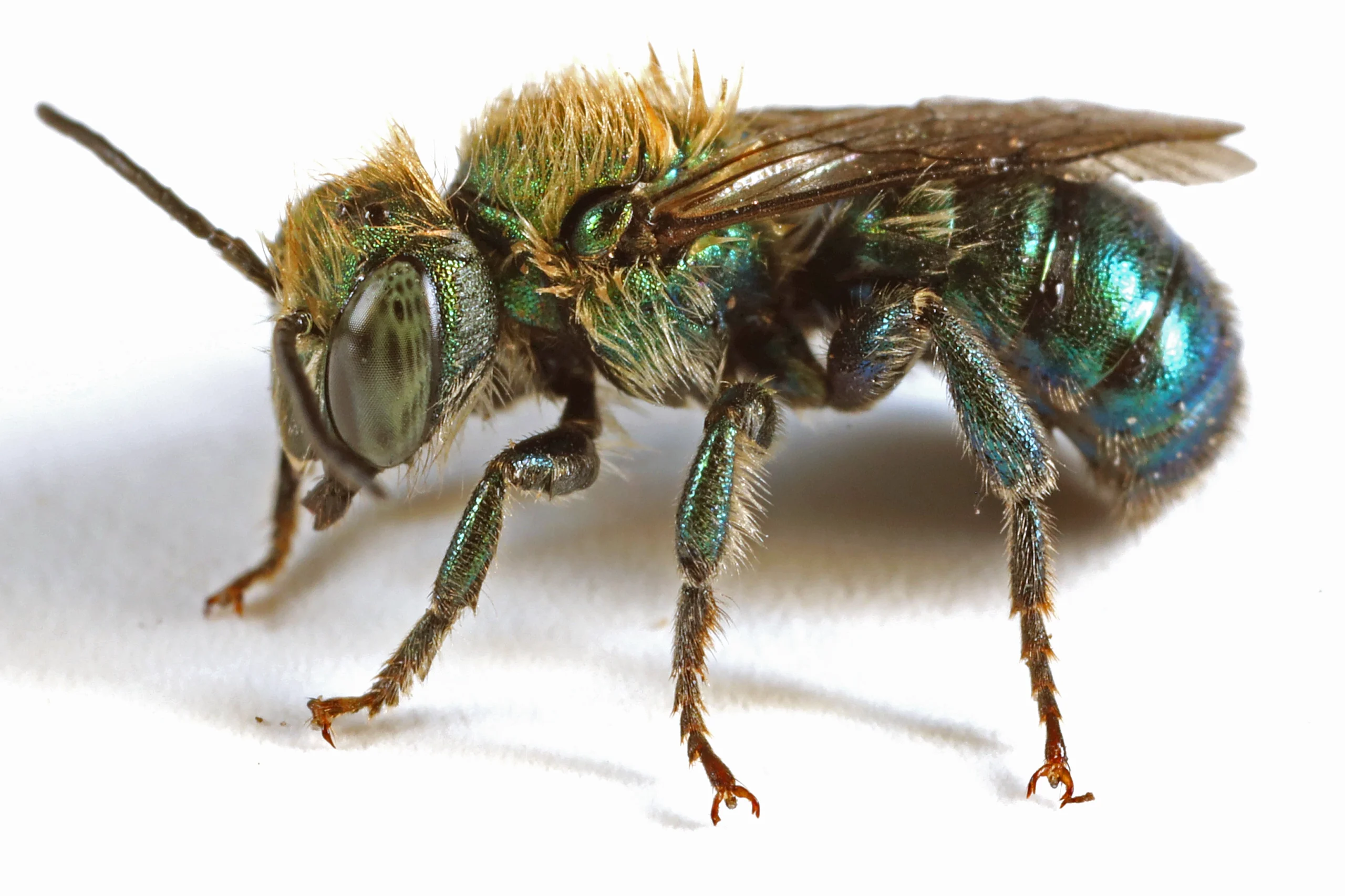
Blue Orchard Bee, Osmia Lignaria On California Five-Spot Flower Courtesy USDA ARS Jim Cane, Photographer
Blue Orchard Bee, Osmia Lignaria
On California Five-Spot Flower
Courtesy USDA ARS
Jim Cane, Photographer
By Kate Hunter,         Leer en español
In late June of this year, we at Stokes Nature Center held our first pollinator camp. In this period, we worked with a local beekeepers, visited the USDA U.S. National Pollinating Insects Collection at Utah State University, and we fed hummingbirds from the palm of our hands. In spite of the short attention spans that summer brings, there were moments of pure uncut interest from the middle school age campers. Here, I’ll describe some bees and I want you to think if these would hold the attention of any teenagers in your life. Images of these bees and many more can be found online at the flikr page of the USGS bee lab, links to this page are online at WildAboutUtah.org and UPR.org

A Fairy Bee, Perdita minima ( Courtesy DiscoverLife.com, Copyright John Ascher, Photographer
A Fairy Bee, (Perdita minima)
Copyright John Ascher / Discover Life
When I say fairy bee, what do you think of? Small? Adorned with jewels? The fairy bees of the genus Perdita are a group of very small bees, with the largest of them being just 10 mm long (or the length of two grains of rice put together end to end). The smallest bee on the earth, Perdita minima, or mini fairy bee is just 2mm-the width of a grain of rice. Though they may seem easy to miss, they are numerous and right under our noses. These fairy bees are one of the most common types of bees in desert ecosystems, like that of the Grand Staircase Escalante National Monument in Southern Utah. These bees are other-wordly, sometimes a blonde or light brown or dark with white metallic reflective markings perhaps like a jewel.

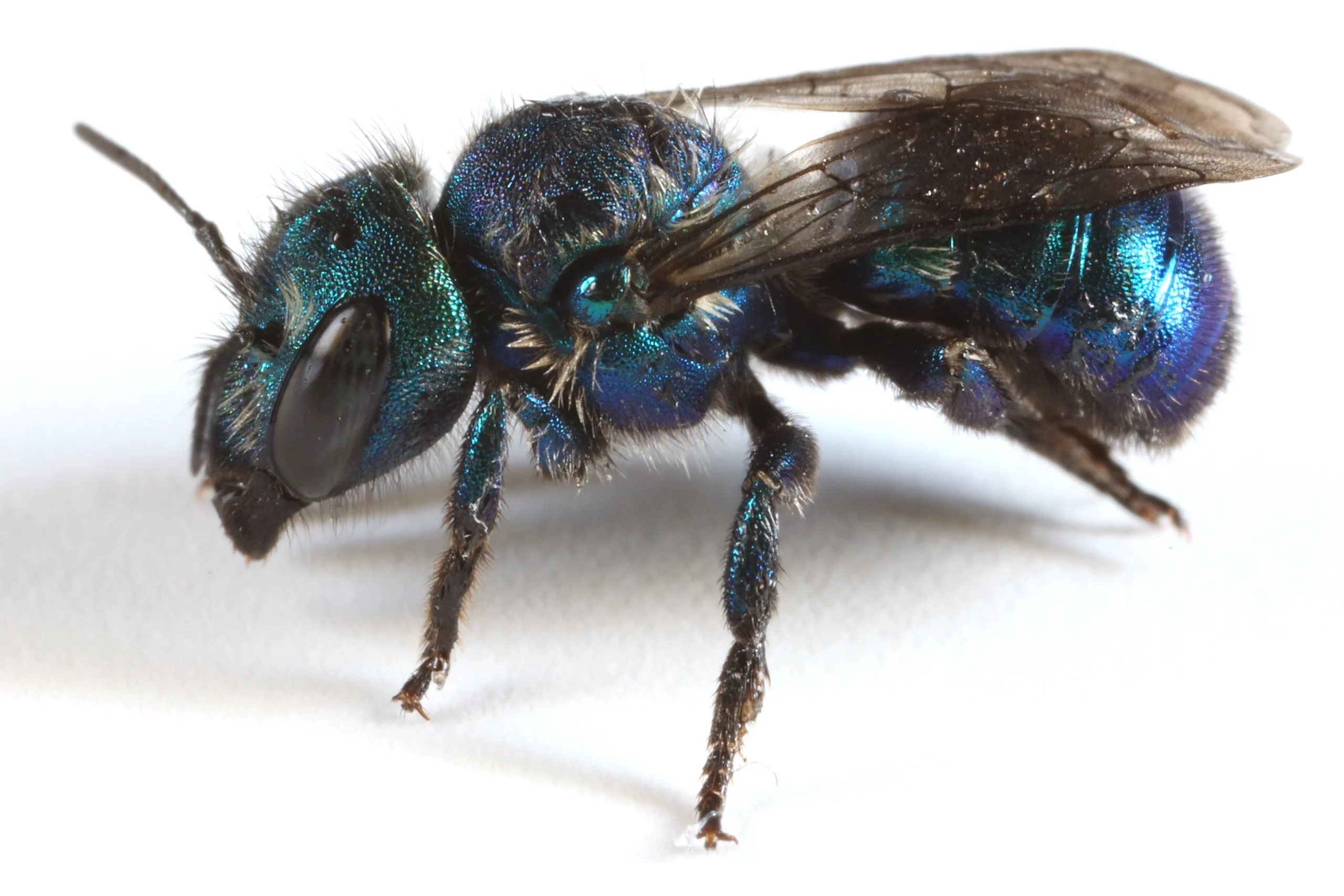
What about a blue bee? Do you know much about what pollinates your fruit trees? The Blue Orchard bee, Osmia lignaria, is a shiny blue bee that pollinates many fruit trees here in Utah including apple, apricot, almond, plum, cherry, peach, nectarine, and pear. They’re more efficient than the honeybee when it comes to fruit production per individual and there are great efforts to understand their future as a managed pollinator at the Pollinating Insect-Biology, Management, Systematics Research unit here in Logan UT.

Sweat bee (Halictidae) Courtesy USDA ARS, Scott Bauer, Photographer
Sweat bee (Halictidae)
Courtesy USDA ARS, Scott Bauer, Photographer
Here’s my last marvel-the sweat bee. Have you ever noticed a small insect landing on you in the heat of day that might have been black, green, or green up top and striped on the bottom? This might be a sweat bee! This name sweat bee encompasses many types of bees-with 4,500 species in this group of all varieties of shapes, sizes, colors. One of my favorite for its fascinating clashing color combination is the bicolored striped sweat bee, Agapostemon virescens. This sweat bee has a green upper body reminiscent of a wicked green witch with a yellow or white and stripped lower body.

I could go on, as there are 21,000 species of bees each with their own outfits and lifestyles, with Utah being home to an estimated 1,100 species. But for now, I’ll leave you be.

I’m Kate Hunter, Director of Education at Stokes Nature Center, and I’m Wild About Utah.

Credits:
Spanish Version: Carlos Ramos, Facilities, Stokes Nature Center https://logannature.org/staff/
Images: Blue Orchard Bee, Courtesy USDA ARS, © Jim Cane, Photographer
A Fairy Bee (Perdita minima), Copyright John Ascher / Discover Life
Sweat bee (Halictidae)
Courtesy USDA ARS, Scott Bauer, Photographer https://aglab.ars.usda.gov/fuel-your-curiosity/insects/buzz-about-bees
Featured Audio: Courtesy & Copyright Anderson, Howe, & Wakeman
Text: Kate Hunter & Carlos Ramos, https://logannature.org/staff
Additional Reading: Lyle Bingham, https://bridgerlandaudubon.org/

Additional Reading

Wild About Utah Pieces by Kate Hunter https://wildaboututah.org/author/kate-hunter/
Wild About Utah Pieces by Carlos Ramos https://wildaboututah.org/author/carlos-ramos/

Summer Camps, Stokes Nature Center, https://logannature.org/camps

USGS Bee Lab Flickr Account, https://www.flickr.com/photos/usgsbiml/

USU Insect Collections including Bees (Hymenoptera), https://artsci.usu.edu/biology/research/insect-holdings/

Cane, James H., Gardening and Landscaping Practices for Nesting Native Bees, USU Extension/USDA ARS, May 2015, https://www.ars.usda.gov/ARSUserFiles/20800500/gardland-nativebees.pdf

Cane, James H., Gardening for Native Bees in Utah and Beyond, USU Extension/USDA ARS, January 2013, https://www.ars.usda.gov/ARSUserFiles/20800500/Gardening.pdf

Pollinating Insect-Biology, Management, Systematics Research: Logan, UT, (USDA Bee Lab, Logan UT), USDA ARS, US Department of the Interior, https://www.ars.usda.gov/pacific-west-area/logan-ut/pollinating-insect-biology-management-systematics-research/

Koch, Jonathan, Strange, James, Silliams, Paul, Bumble Bees of the Western United States, Pollinator Partnership, 2012, https://www.xerces.org/publications/identification-monitoring-guides/bumble-bees-of-western-united-states
Original https://www.pollinator.org/pollinator.org/assets/generalFiles/BumbleBee.GuideWestern.FINAL.pdf

Love nature? There’s an app for that

Painted Schinia, Schinia volupia, Courtesy & Copyright Mark Brunson
Painted Schinia
Schinia volupia
Courtesy & Copyright Mark Brunson
We hear a lot these days how people spend too much time with their electronic devices. The internet is full of advice on how to get kids away from their screens to enjoy nature, and that’s great. But for me, as someone who has always loved natural spaces, I’m finding that a screen can actually enhance my time outdoors.

My iPhone is packed with apps that help me connect to nature. One lets me identify birds by their song. Another recognizes constellations in the night sky. I’ve got several plant identification apps. But my favorite nature app is called iNaturalist. When I see a plant or animal in the wild, I can snap a photo, and the app’s artificial intelligence will help me identify what species I’m seeing. Then I can upload the photo and its GPS coordinates so others can see what I found and where I found it. In doing this, I help scientists learn where species are found and how common there are. And if the AI turns out to be wrong – which does happen – experts who use the app can tell me what they think I really saw.

I’m outdoors a lot, and I use iNaturalist a lot. It’s almost an obsession. But this obsession helps me learn to see nature in new ways. Here’s an example: Earlier this year, my wife and I were walking along a cattle trail near Canyonlands National Park. It was early May, and we were delighted to see wildflowers blooming in the desert. And of course, I took photos as we went. At one point, I happened to see a bright yellow, daisy- shaped flower with a red center. I knew it was a red dome blanketflower, closely related to the bright red and yellow Gaillardia plants that many Utahns grow in their waterwise gardens.

But when I knelt to take a closeup photo, I saw something I hadn’t noticed. Feeding on nectar from some of the flowers were small, brightly colored moths, their wings a deep red with white stripes in a pattern like a woven blanket, their heads a vivid orange. iNaturalist told me I’d found a group of painted schinia moths – a species I’d never encountered or even heard of before.

Intrigued, I wanted to know more. I learned there are at least five species of painted schinia moth in the U.S. Southwest, each of which feeds only on a particular kind of blanketflower. This sort of plant-insect specialization is common. It benefits the plants, because as moths move from flower to flower, they carry pollen with them, and a specialist pollinator won’t bring its pollen load to a species that can’t use it. And it benefits the insects. As they adapt to the unique chemical and physical features of their host plants, they can gather and use food most efficiently. And – as I learned when I had to look closely to even see my painted schinia moths – they can evolve to use camouflage to avoid predators.

Of course, the downside to specialization is that if something bad happens to the host plant, it also endangers their insect specialist. Luckily for the painted schinia moth, blanketflowers are abundant in late spring in the southeast Utah desert. That’s lucky for us humans, too, as we enjoy the brilliant color they bring to red rock country – even more so if we take time to kneel down, snap a photo, and examine them more closely.

I’m Mark Brunson, and I’m Wild About Utah.

Credits:

Images Courtesy & Copyright Mark Brunson, Photographer
Featured Audio: Courtesy & © Kevin Colver, https://wildstore.wildsanctuary.com/collections/special-collections
Text: Mark Brunson, https://www.usu.edu/experts/profile/mark-brunson/
Additional Reading: Mark Brunson, https://www.usu.edu/experts/profile/mark-brunson/ & Lyle Bingham, Bridgerland Audubon Society

Additional Reading

Mark Brunson’s archive: https://wildaboututah.org/?s=brunson

Loarie, Scott. The surprising power of your nature photos. TED talk, April 2025.
https://www.ted.com/talks/scott_loarie_the_surprising_power_of_your_nature_photos

Southwest Desert Flora. Gaillardia pinnatifida, Red Dome Blanketflower.
https://southwestdesertflora.com/WebsiteFolders/All_Species/Asteraceae/Gaillardia%20pinnatifida,%20Red%20Dome%20Blanketflower.html

Painted Schinia Moth, Schinia volupia, iNaturalist, https://www.inaturalist.org/guide_taxa/1565242
Photos of Painted Schinia Moth Schinia volupia, iNaturalist, https://www.inaturalist.org/taxa/230575-Schinia-volupia/browse_photos