Lichens

Click for a larger view of Lichens, Courtesy and copyright 2013 Andrea Liberatore, Photographer
Boulder covered in a
variety of lichen species
Copyright 2013
Andrea Liberatore, Photographer

Click for a larger view of Rosette Lichen, Courtesy and copyright 2013 Andrea Liberatore, PhotographerRosette Lichen
Physcia dubia
Lives in both Antarctica
and the Mojave Desert
Copyright 2013
Andrea Liberatore, Photographer

Click for a larger view of Rim Lichen, Courtesy and copyright 2013 Andrea Liberatore, PhotographerRim Lichen
Lecanora muralis
Has anti-cancer and
anti-microbial properties
Copyright 2013
Andrea Liberatore, Photographer
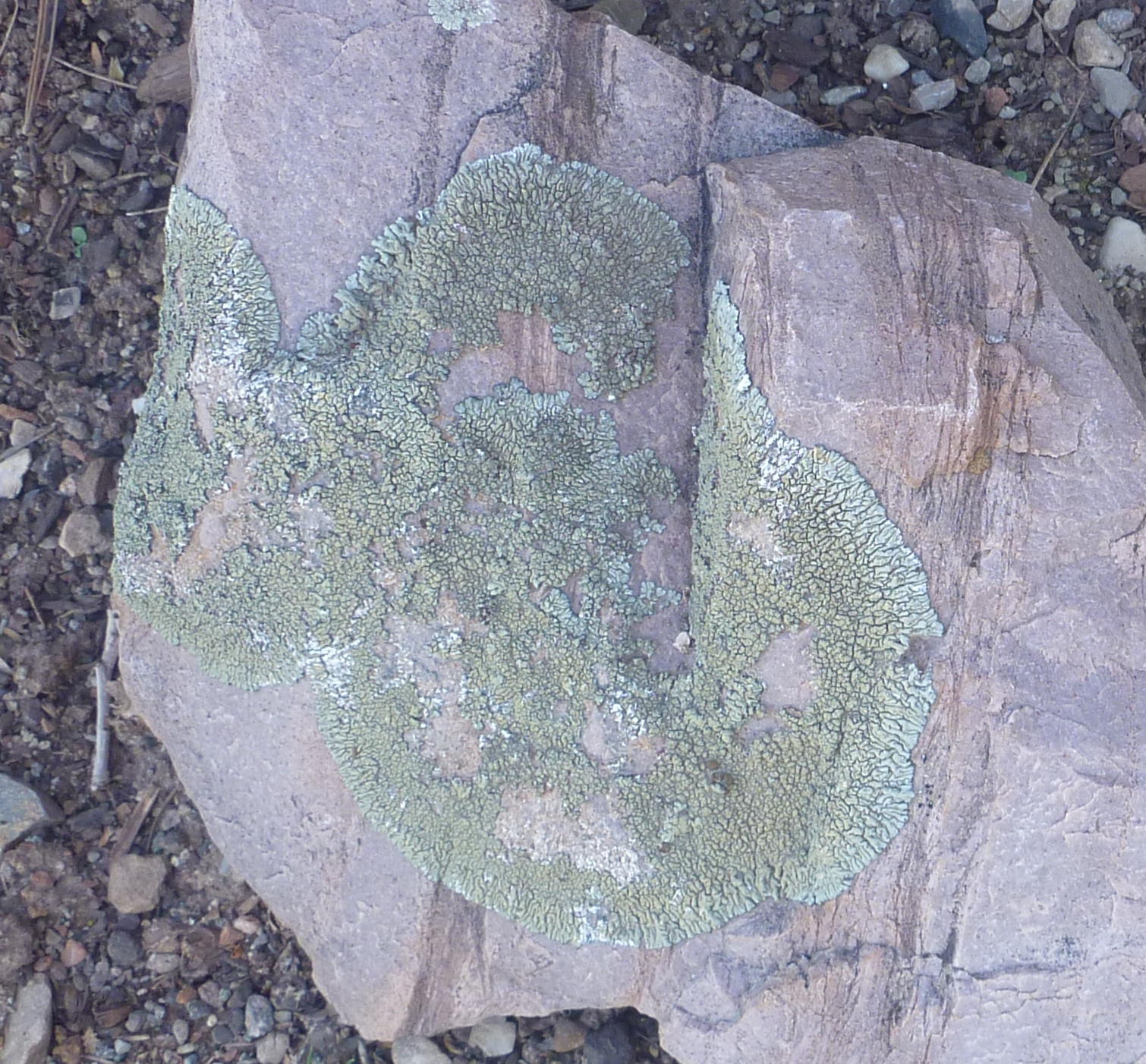
Click for a larger view of Lichens, Courtesy and copyright 2013 Andrea Liberatore, PhotographerGarovagis Rim Lichen
Leconara garovagii
Used in perfume & sunscreen
Copyright 2013
Andrea Liberatore, Photographer

This spring I visited Red Butte Gardens in Salt Lake City for the first time. My favorite part was a small and very non-descript garden, tucked alongside a walkway and devoted to an organism that isn’t a plant at all, but instead a very under-appreciated genera of life – the lichen.

Lichens are those colorful crusts found growing on rocks and trees, and while sometimes plant-like in appearance, they are not plants. Lichens have no leaves, stems, roots, or vascular systems. Even more strange, lichens are not a single organism, but instead a partnership between two organisms: a fungus and an algae or cyanobacteria. Because the fungus is generally the dominant partner, lichens are classified as members of the Fungus kingdom.

The partnership exhibited by these two organisms is an example of mutualism – a relationship where both parties benefit in some way through their interaction. In this case, the fungus provides a safe and secure home for the alga or cyanobacteria, which in return photosynthesizes and provides the fungus with nutrients. Cyanobacteria and algae are typically found in water and are prone to drying when exposed to sun and wind. The fungal partner provides shade and protection from desiccation by sheltering the algae within its body. As a result, lichens are incredibly drought-resistant and can be found in a wide variety of habitats including some of the most extreme environments Earth has to offer. In fact the Rosette Lichen or Physica dubia grows in both Antarctica and the Mojave Desert!

Lichens are not just interesting from a biological perspective, but also a chemical one. Lots of lichens create and exude a suite of chemicals, the roles of which aren’t entirely known. Some are thought make the lichen distasteful to predators, while others may help block harmful UV rays and increase membrane permeability to facilitate the movement of nutrients, water, and cellular byproducts between algae and fungi.

These chemicals have also attracted the attention of scientists, as some exhibit antimicrobial, antiviral, anti-tumor, and insecticidal properties. Many are being analyzed and tested for a variety of medicinal and household uses and may soon become a key ingredient in a physician’s arsenal. Already, these organisms are utilized by humans in a number of different ways, and have been for hundreds of years.

In some native cultures around the globe, lichens are a part of the traditional diet for both people and livestock. However, most lichens have little nutritional value, are bitter tasting, and some can be toxic. Lichen extracts are also used as natural dyes for wool and cloth with colors ranging from browns and purples, to yellows and oranges. Other uses include the manufacture of perfume, cosmetics and sunscreen, a substitute for hops in brewing beer, and as a key ingredient in litmus paper.

Lichens are also sensitive to air pollution, and for that reason don’t typically grow too close to human habitation. In fact, lichens absorb pollutants into their tissues and for that reason can play an important role as an indicator species for pollution problems. As air pollution becomes more widespread, lichen species could be in danger of being lost. And because we have only scratched the surface of what these amazing organisms can do, who knows what future medicine could be lost along with it.

I could go on, as I have only scratched the surface of what these organisms can do. And in the coming years, I think we’ll hear of even more lichen-based breakthroughs in science and medicine. The next time you pass a colorful, lichen-covered rock, take a closer look at these incredible organisms and pause for a moment to wonder about the mysteries, and possible answers, that lie within.

For the Stokes Nature Center and Wild About Utah, this is Andrea Liberatore.

Credits:

Photos: Courtesy & © Andrea Liberatore
Text:    Andrea Liberatore, Stokes Nature Center, logannature.org

Additional Reading:

Ivins, Robert Fogel (1998) Lichens are Fungi! Utah State University Herbarium. Available online at: https://herbarium.usu.edu/fungi/funfacts/lichens.htm

Center for Ecological Sciences, Indian Institute of Science. Lichen Chemistry. Sahyadri E-news. Issue 34. Formerly available online at: https://wgbis.ces.iisc.ernet.in/biodiversity/sahyadri_enews/newsletter/issue34/lichens_chemistry/lichen_chemistry.pdf See https://www.researchgate.net/publication/257213745_Sahyadri_Shilapushpa_Lichen_Chemistry [Link updated Dec 1, 2023]

US Forest Service (2013) Celebrating Wildflowers: Lichens. Available online at: https://www.fs.fed.us/wildflowers/interesting/lichens/
 

Aquatic Insects, Harbingers of Health

Aquatic Insects, Harbingers of Health
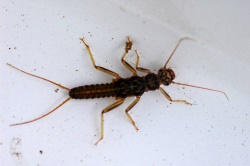
Skwala (Large Springflies)
Stonefly Nymph
Courtesy & Copyright
Robert Newell
As found on
TroutNut.com

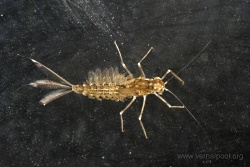
Aquatic Insects, Harbingers of HealthMayfly nymph
Courtesy & Copyright
Leo Kenney, Vernal Pool Association

Aquatic Insects, Harbingers of HealthNorthern caddisfly Larvae

Limnephilidae
Photo Credit:
Howard Ensign Evans,
Colorado State University,
Bugwood.org
Used under
Creative Commons Attribution 3.0
License.

Hi, this is Mark Larese-Casanova from the Utah Master Naturalist Program at Utah State University Extension.

As we officially enter summer, it’s easy to notice nature at its peak. Wildflowers are in bloom, birds are feeding their young, and insects fill the air. Life is especially robust near our wetlands, lakes, and streams.

Our aquatic, or wet, ecosystems provide habitat to abundant plants and animals. Only 1% of Utah is wet, but over 80% of all wildlife in Utah depend on aquatic ecosystems for at least part of their life cycle. However, the quality of Utah’s aquatic habitats is often affected by chemical pollution or excessive nutrients and sediment.

Some organisms, including many aquatic insects, only live in the healthiest of aquatic habitats. Many of the insects we see in summer live in the water when young, during the larval or nymph stage, before becoming adults. Three insects in particular- mayflies, stoneflies, and caddisflies- require especially clean, cold streams low in nutrients and high in dissolved oxygen to survive.

Mayflies are aquatic as nymphs and emerge from the water to live as adults for just a day. The external feather-like gills of the nymphs can be seen fluttering along the sides of their abdomen. They feed by scraping algae from rocks.

Stonefly nymphs are well adapted to living among the rocks of swift-moving streams. Their hooked legs grasp the slick rocks as they shred apart plant litter that falls into the stream.

Caddisfly larvae spin a sort of spider silk to glue rocks or sticks together to form a case in which they live. They will also build webs underwater to collect small particles of food that drift by.

The quality of a stream habitat can be assessed by counting the number of different species, or types, of mayflies, stoneflies, and caddisflies. A greater number of species generally means that habitat and water quality are higher. Dramatic decreases in insect diversity from season to season or year to year can signal a decline in stream health. Monitoring aquatic insects over time gives us an accurate picture of the long-term health of our stream ecosystems.

For more information about monitoring water quality and aquatic insects, visit Utah State University Water Quality Extension’s website. Once there, you’ll find a wealth of information about monitoring Utah’s aquatic ecosystems, including Utah Water Watch, a statewide volunteer citizen science program.

For Wild About Utah, I’m Mark Larese-Casanova.

Credits:
Images: Northern caddisfly larvae, Howard Ensign Evans,
            Colorado State University
            Creative Commons Attribution 3.0 License.
            Stonefly Nymph, © Robert Newell, displayed on Troutnut.com
            Mayfly nymph, © Leo Kenney Vernal Pool Association
Text:     Mark Larese-Casanova, Utah Master Naturalist Program
            at Utah State University Extension.

Additional Reading:

Larese-Casanova, M. Utah Master Naturalist Watersheds Wildlife Field Guide. Utah State University Extension. 2012. https://extension.cart.usu.edu/Details.cfm?ProdID=41&category=0

USU Water Quality Extension. Utah Stream Team Manual. https://extension.usu.edu/waterquality/htm/citizen_monitoring/ust

Voshell, J. R. A Guide to Common Freshwater Invertebrates of North America. The McDonald and Woddward Publishing Company. 2002. https://www.amazon.com/Guide-Common-Freshwater-Invertebrates-America/dp/0939923874

Cryptobiotic Soil Crusts

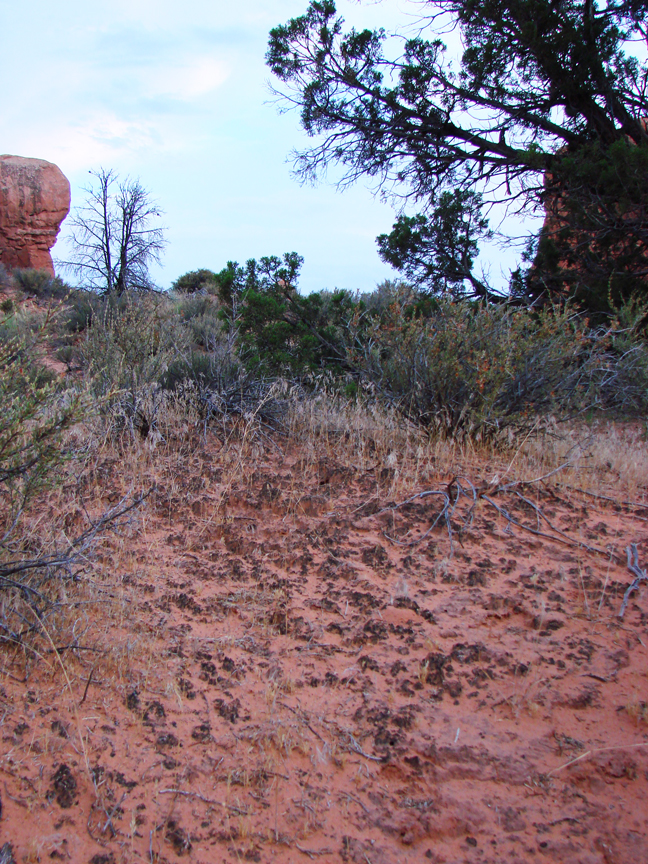
Click to view larger image of Cryptobiotic Soil Crust, Photo Courtesy and Copyright Mark Larese-Casanova
Cryptobiotic Soil Crust
Photo Courtesy & Copyright 2009
Mark Larese-Casanova

Hi, this is Mark Larese-Casanova from the Utah Master Naturalist Program at Utah State University Extension.

Looking out over a Utah desert, we might see relatively few plants- perhaps some sagebrush, maybe a few junipers or Joshua trees, or even some small wildflowers or cacti. What is less noticeable, though, is the living soil crust that holds this entire landscape together. It’s not just sand, but rather an important and vast partnership between bacteria, lichens, algae, and fungi. These soil crusts are often referred to as ‘cryptobiotic’, which means ‘living in suspended animation’. This is a fitting description, considering that water can be so rare in Utah’s deserts.

Cyanobacteria, which is often called blue-green algae, is the backbone of cryptobiotic soil crust. Vast networks of long, microscopic filaments of cyanobacteria and fungi grow in length when they are wet, and leave behind a casing that literally binds the soil together. So, what might otherwise be loose sand not only is less likely to be washed away by water or blown away by wind, but also is able to hold much more water for plants.

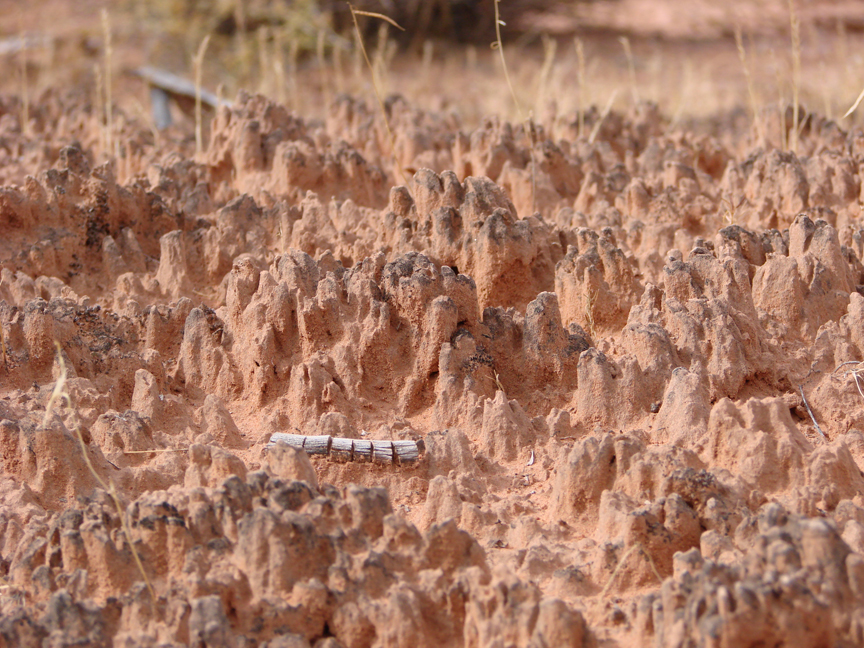
Click to view larger image of Cryptobiotic Soil Crust, Photo Courtesy and Copyright Mark Larese-Casanova
Cryptobiotic Soil Crust
Photo Courtesy & Copyright 2009
Mark Larese-Casanova

Cyanobacteria is also extremely useful to desert landscapes for its ability to take Nitrogen out of the air and make it available to plant roots in the soil. Desert soils typically have relatively low nutrients, so this is especially important to desert plants.

In many Utah deserts, cryptobiotic soil crusts can cover up to 70% of the ground surface. Old soil crust can often look like small mountain ranges with black or white peaks inhabited by lichens or mosses. The little valleys in between the tiny mountains of crust are perfect spots for the seeds of desert plants to grow. Over time, the above ground crust can grow up to ten centimeters, or four inches, thick!

However, cryptobiotic soil crust grows at an alarmingly slow rate of about one millimeter per year. So, any soil crust that is disturbed can take a very long time to recover. Depending on the amount of moisture a desert receives, it can take anywhere between 20 and 250 years for soil crust to grow back.

Next time you’re out in the desert, kneel down and have a close look at the telltale peaks and valleys of cryptobiotic soil crust. If you bring a magnifying glass, you just might be able to see some of the lichens and mosses. Be sure to stay on trail, though, and whatever you do, don’t bust that crust!

For Wild About Utah, I’m Mark Larese-Casanova.

Credits:

Images: Courtesy and copyright Mark Larese-Casanova
Text:     Mark Larese-Casanova, Utah Master Naturalist Program at Utah State University Extension.
Additional Reading:

US Department of Interior. 2001. Biological Soil Crusts: Ecology and Management. Bureau of Land Management Technical Reference 1730-2., https://www.blm.gov/nstc/library/pdf/CrustManual.pdf
Rosentreter, R., M. Bowker, and J. Belnap. 2007. A Field Guide to Biological Soil Crusts of Western U.S. Drylands. U.S. Government Printing Office, Denver, Colorado., https://www.soilcrust.org/

Oolites

Click to view larger image of the Utah's Oolitic Sand, Photo Courtesy and Copyright Mark Larese-Casanova
Utah’s Oolitic Sand, Photo Courtesy and Copyright Mark Larese-Casanova

Hi, this is Mark Larese-Casanova from the Utah Master Naturalist Program at Utah State University Extension.

Imagine if prehistoric brine shrimp were responsible for one of the finest examples of architecture in Salt Lake City today.

Okay, so it may be a bit of a stretch, but let me explain. In a previous episode of Wild About Utah, I discussed the life cycle of brine shrimp and the important role that they play in the Great Salt Lake Ecosystem. Well, as the billions of brine shrimp feed on bacteria in Great Salt Lake, they excrete waste in the form of tiny fecal pellets. These pellets, along with sand grains and other bits of debris, eventually settle to the bottom of Great Salt Lake.

In shallow areas of the lake, where wind and waves routinely mix the water, these small particles gradually accumulate layers of calcium carbonate, forming an oolite (spelled o-o-l-i-t-e). This is very similar to how a pearl, also layers of calcium carbonate around a small particle, is formed within the shell of an oyster or mussel. The main difference, aside from a pearl being much larger, is that oolites are typically oblong, rather than round. The beaches on the west side of Antelope Island are a great place to find oolitic sand, which will look and feel as though you have a handful of tiny pearls.

Click to view larger image of the Utah's Oolitic Sandstone, Photo Courtesy and Copyright Mark Larese-Casanova
Utah’s Oolitic Sandstone
Photo Courtesy & Copyright
Mark Larese-Casanova

Around 50 million years ago, large fresh- and salt-water lakes covered parts of Utah, and in these areas, vast amounts of sediments, including oolites, were deposited. Over time, these oolites were compressed and cemented together into limestone.

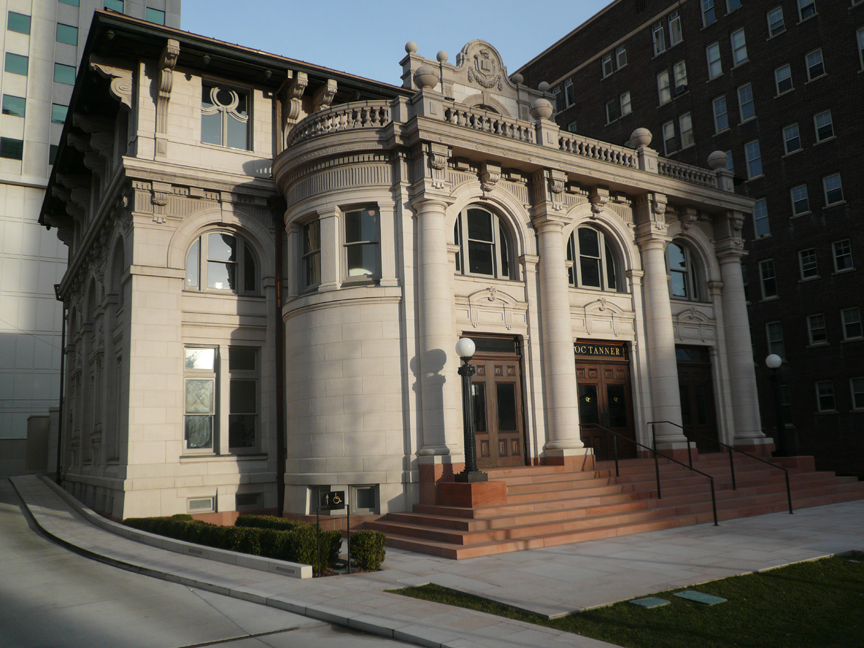
A quarry near Ephraim in Sanpete County supplied oolitic limestone for the construction of the Governor’s Mansion in 1902 and the original Salt Lake City Public Library in 1905. The Library building, located at 15 South State Street, eventually housed the Hansen Planetarium and is now home to the O.C. Tanner flagship store. The building underwent an extensive restoration just a couple of years ago, and now serves as a shining example of neoclassical architecture in our capitol city.

The truth is, there are tens of millions of years separating oolitic limestone from our modern-day brine shrimp. So, we can’t exactly say that prehistoric brine shrimp were responsible for the existence of the O.C. Tanner building. But, it’s fun to imagine precious gems from around the world housed in a beautiful building constructed from the ‘pearls’ of Great Salt Lake.

Click to view larger image of the historic OC Tanner building made from oolitic sandstone (This building formerly housed the Salt Lake Library and Hansen Planetarium), Photo Courtesy and Copyright Mark Larese-Casanova
Historic OC Tanner Building
(formerly the Salt Lake Library
and later the Hansen Planetarium)
Photo Courtesy & Copyright
Mark Larese-Casanova

For Wild About Utah, I’m Mark Larese-Casanova.
Credits:

Images: Courtesy and copyright Mark Larese-Casanova

Text:     Mark Larese-Casanova, Utah Master Naturalist Program at Utah State University Extension.
Additional Reading:

Utah Geological Survey https://geology.utah.gov/utahgeo/rockmineral/collecting/oolitic.htm

Utah Division of Wildlife Resources, Great Salt Lake Ecosystem Program
https://wildlife.utah.gov/gsl/facts/oolitic_sand.php

Salt Lake Brine Shrimp, https://saltlakebrineshrimp.com/harvest/