Defining the Great Basin

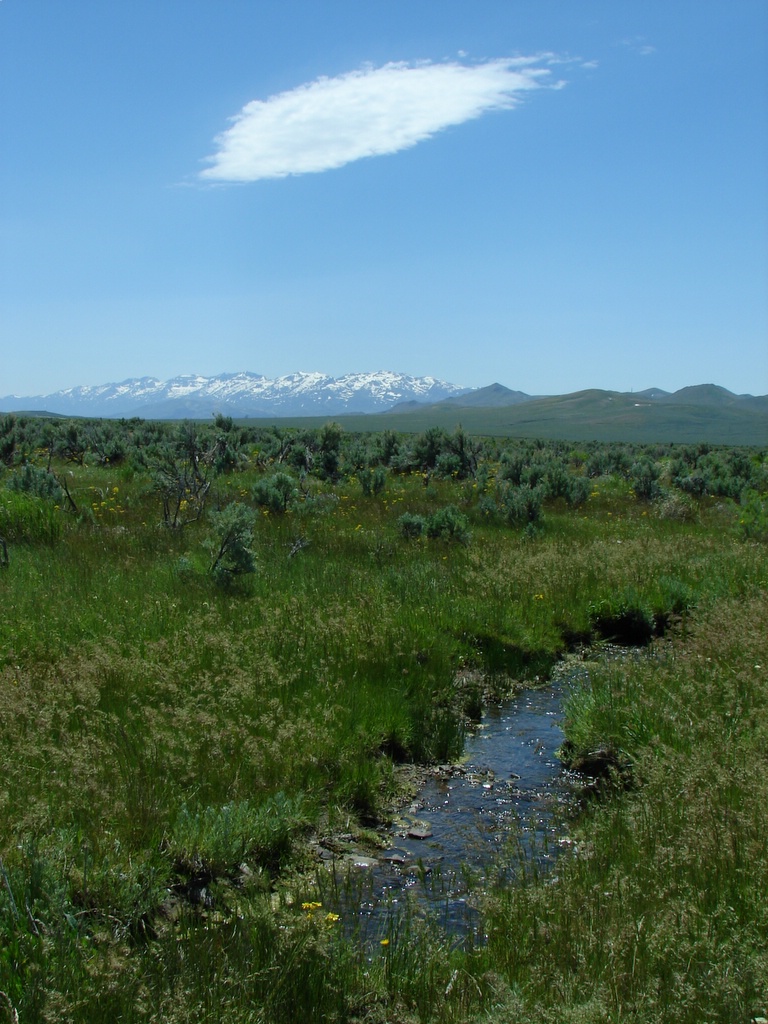
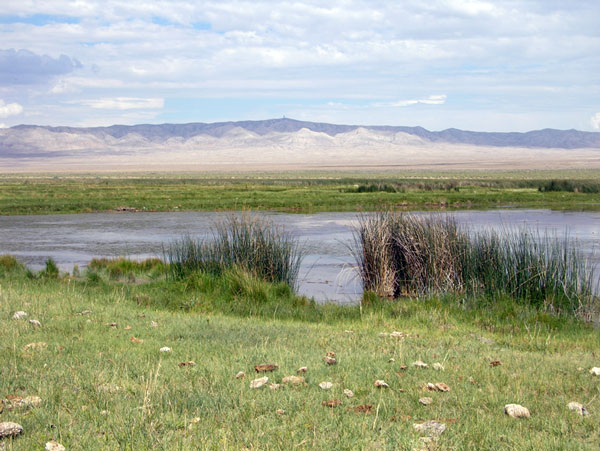
Willow Creek North of Wells, NV. Sagebrush at mid-distance. Route of the California Trail used by pioneers.
Willow Creek north of Wells, NV.
Sagebrush at mid-distance.
Route of the California Trail
used by pioneers.

Courtesy & Copyright
Jim Cane, Photographer

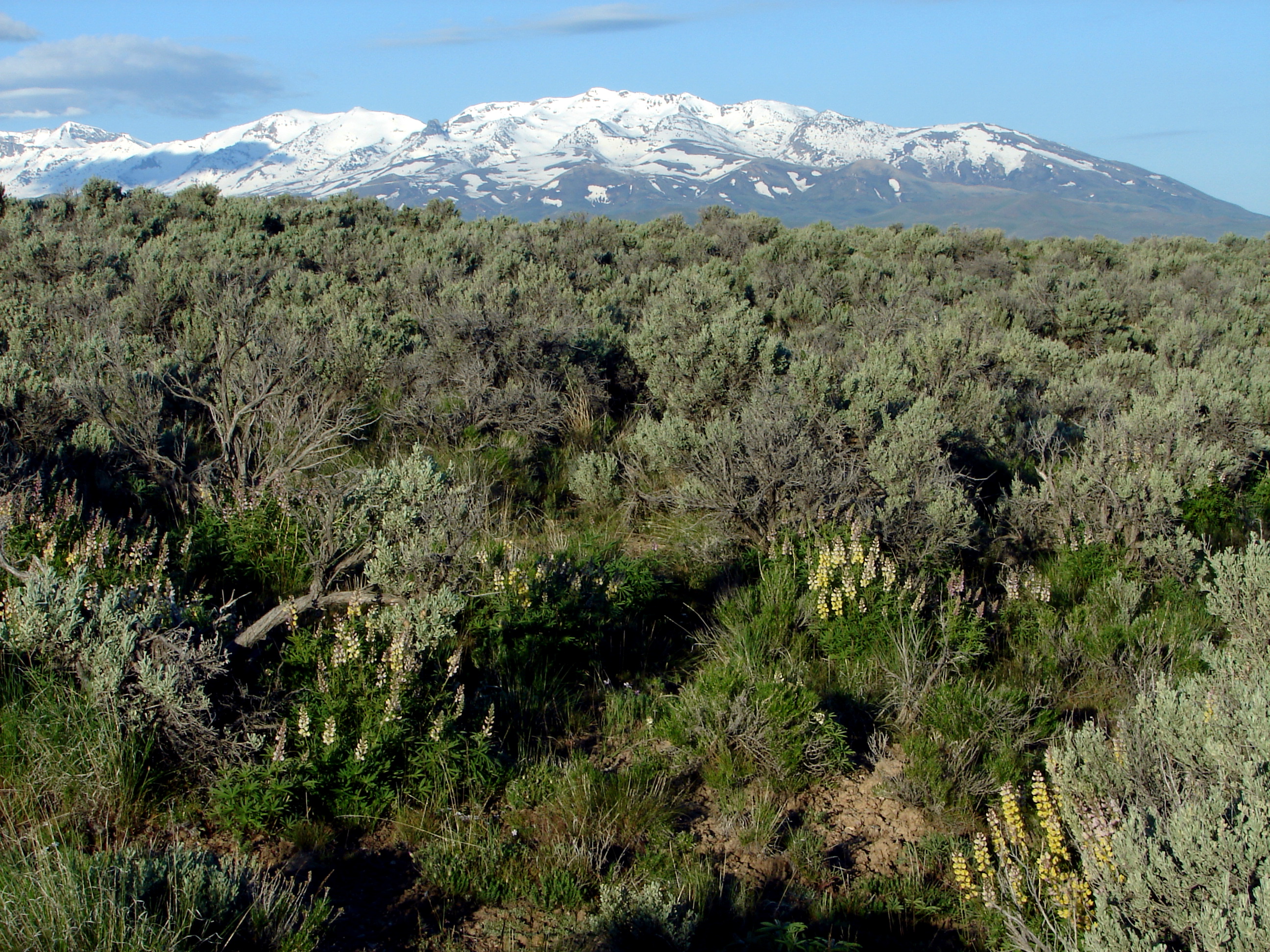
Lupines amid sagebrush north of Wells, NV. Ruby Mountains in backgroundLupines amid sagebrush
north of Wells, NV.
Ruby Mountains in background
Courtesy & Copyright
Jim Cane, Photographer

Map delineating the Great basinMap delineating the Great basin
Courtesy Wikimedia, KMusser, Artist
Ref: wikipedia.org/wiki/Great_Basin


The Great Basin is aptly named.  Twice the size of Kansas, it stretches from the watersheds of the Columbia and Snake rivers south to that of the Colorado, and from the crests of the Sierra Nevada and southern Cascades eastward to the Wasatch front.  The Western explorer John Fremont coined its name in 1845.  The rivers and streams of the region that Fremont had seen all ended in sinks, marshes or lakes. None flowed to the Pacific Ocean.  He confirmed this on meeting Joseph Walker at Mountain Meadows in Utah.  Walker had traveled more of the basin’s western margins, dispelling  rumors of a river traversing the Sierra Nevada.  Precipitation that falls in the Great Basin stays in the Great Basin; water leaves only as vapor.  This is the hydrographic Great Basin.

How else to view the vast region between the Rockies and the Sierra Nevada? Geologists speak of the “Basin and Range Province”, so named for its valleys and the towering ranks of north-south mountain ranges that march across the landscapes of Nevada and edges of adjacent states. Unlike the upthrust Rockies and Sierra Nevada, Earth’s crust in the Great Basin appears to be spreading, to be pulling apart. The tilted escarpments of the Wasatch front are the easternmost evidence of this crustal deformation that has built the Basin and Range Province.

Botanists delimit the Great Basin by the hardy flora that clothes this rugged landscape. Great Basin plants tolerate freezing winters and parched summers, and in the valleys, soils of varying salinity.  The so-called Sagebrush Ocean fills many of the basins, as do other shrubs, such as shadscale and greasewood.  Upslope, these give way to juniper woodlands, often mixed with piñon pine.  This floristic Great Basin reaches eastward to central Utah and the Wasatch front, beyond which trees and other plants of the Rockies make their appearance.

The boundaries of all three concepts for the Great Basin — hydrographic, geologic and floristic — largely coincide.  Each recognizes the distinctive attributes of the Great Basin that set it apart from neighboring regions.  The Great Basin is readily recognizable to the trained eye, whether looking at satellite images, river courses, or the native plant communities encountered on a simple walk.

Credits:
Images: Jim Cane
Map: Courtesy Wikimedia, KMusser, Artist, licensed under Creative Commons Attribution-Share Alike 3.0 Unported
Text: Jim Cane

Additional Reading

Frémont, John Charles. 1845. Report of the exploring expedition to the Rocky Mountains in the year 1842 and to Oregon and North California in the years 1843 – 44. Printed by order of the Senate of the United States , Gales & Seaton, 693 pages. –available as a Google eBook scanned from the original published book Grayson, Donald K. 1999. The desert’s past : a natural prehistory of the Great Basin. Smithsonian Institution Press, Washington D.C., 356 pages. –an exceptionally readable, thorough and authoritative overview of the Great Basin, with many maps, photographs and illustrations.https://books.google.com/books?id=W8ICAAAAMAAJ

Intermountain Regional Herbarium Network. searchable plant database representing multiple holdings of herbaria at universities in Utah and Nevada, with maps, images and more https://swbiodiversity.org/seinet/projects/index.php?proj=10

McPhee, John. 1981. Basin and Range. Farrar, Straus, Giroux, New York. 215 pages. –the first of the author’s many engaging books about geology. https://www.amazon.com/Basin-Range-John-McPhee/dp/0374516901

Rock Climbing

Photo Courtesy Wikimedia, Bob Protus (katsrcool) Photographer
Rock Climbing
on Potash Road, Moab, UT
Courtesy Wikimedia & Bob Protus (katsrcool), Photographer

Hi, this is Justin Lofthouse from the USU Natural Resource Interpretation Class.

Many might think that rock climbing results from a quest for adrenaline and danger. On the contrary, most rock climbers strive for a calm and controlled state of mind. Many participate in rock climbing for reasons such as solitude, adventure, self-exploration, pushing physical limits and accomplishment. The explosion of the number of people participating in rock climbing over the last decade has altered how many obtain these benefits.

As more and more people are climbing in Utah, it has become harder to find solitude and adventure. This increase in numbers has led to Federal land managers taking a closer look at the impacts caused by overuse. A strong wilderness ethic is vital to the future access of climbing areas.

In a recent poll on mountainproject.com, the question was asked, “What are the top 10, best climbing states?” Among the replies, Utah is almost always among the top three. Canyons such as American Fork, Logan, Maple, Little and Big Cottonwood make northern Utah a top competitor. These steep technical faces offer difficult, continuous routes that push the physical realm of the sport. When southern Utah is thrown into the mix, Utah truly stands out as a gem. Places like Zion, Indian Creek, Moab, and St. George have parallel-sided cracks that split sandstone walls for hundreds of feet. These remote desert regions offer a feeling of adventure and solitude that many areas in the U.S. lack. These qualities have put Utah high on the list as a must-visit climbing destination.

Gone are the days when you and your partner were the only people climbing in an area on a weekend. As information about the amazing climbing in Utah has become readily available, people have come by hordes to explore what Utah has to offer. Although rock climbers will have to find new ways to share such a unique resource, no one is doubting that Utah truly has something special to offer when it comes to rock climbing. It will take a concentrated effort on the part of all climbers to help maintain such a wonderful resource for future generations of climbers.

For Wild About Utah, I’m Justin Lofthouse.

Credits:
Image: Courtesy Wikimedia, Bob Protus (katsrcool) Photographer, licensed under Creative Commons Attribution Generic 2.0
Text: Justin Lofthouse

Sources and Additional Reading

Climbing and Canyoneering, Bureau of Land Management, Department of the Interior,
https://www.blm.gov/ut/st/en/fo/st__george/recreation/rock_climbing.html

Rock Climbing, Capital Reef National Park, National Park Service, https://www.nps.gov/care/planyourvisit/rockclimbing.htm

Utah is Worth its Salt

Bonneville Salt Flats as seen from Interstate 80 in Utah, USA
Bonneville Salt Flats
as seen from Interstate 80
East of Wendover, UT
Courtesy Wikimedia
Hermann Luyken, Photographer
Image licensed through
Creative Commons
CC0 1.0 Universal Public Domain Dedication

Salt Production, Solar Evaporation, Courtesy Morton Salt, Inc.Salt Production
Solar Evaporation
Courtesy Morton Salt, Inc.

Sevier Lake, a Saline Lake in Central UtahSevier Lake
Courtesy & Copyright 2013
Holly Strand, Photographer

Salt Crystal, Photo Courtesy Minerals and Materials Photo Gallery, U.S House Subcommittee on Energy and Natural ResourcesSalt Crystal
Minerals and Materials Photo Gallery
U.S House Subcommittee
on Energy and Natural Resources

Hi, I’m Holly Strand from the Quinney College of Natural Resources at Utah State University.

Throughout history, salt has held enormous significance for human society. And not just because it makes food taste better. Salt is a biological necessity. The human body needs a small but regular supply of sodium to maintain a balance of body fluids, keep muscles and nerves running smoothly and help certain organs work properly.

Thousands of years ago, salt was discovered to have another vital function– as a food preservative. This discovery quickly transformed the human lifestyle. For if people could preserve their food, they no longer had to depend upon the seasonal availability of food. Further, preservation allowed people to travel over long distances with a portable food supply.

Because of its central importance to health and human welfare, salt acquired some interesting forms of cultural significance as well. For instance, spilling salt is a bad omen. But you can mitigate by throwing the spilled salt over your left shoulder into the eyes of the Devil that lurks there. In many places salt was used as money. The English word “salary” comes from the Latin phrase salarium argentum, or “salt money,” which was paid to Roman soldiers.

Before the evolution of modern geology and extraction techniques, salt was difficult to find and to remove. The limited supply led to increased demand. In Salt: A World History author Mark Kurlansky described how salt demand spawned extensive trade routes, alliances, and even empires. Salt taxes were a common source of government income as well as a cause for revolt.

Here in Utah, it’s hard to imagine getting worked up about salt supply. There’s just so much of it lying around. That’s because as the 20,000 square miles of water that was Lake Bonneville evaporated, salt was precipitated all over the dried up lake bed.

The Great Salt Lake itself contains about 4.5 billion tons of salt. Currently 3 corporations extract salt using over 80000 acres of solar evaporation ponds near the lake. They produce over 2 millions tons of salt per year. This roughly equals the amount of salt flowing into the lake. For the Bear, Weber and Jordan Rivers add about 2.2 million tons of salt annually.

Utah and nearby states use the Great Salt Lake salt for de-icing roadways. Some of the salt is pressed into pellets for water softeners. Ranchers get salt-lick blocks for their livestock. And huge quantities of bulk salt are used in metal, chemical, paper and other industries.

Food grade or table salt is not produced from the Great Salt Lake area. However Redmond Minerals Inc. produces table salt in Sevier County.

For Wild About Utah, I’m Holly Strand.

Credits:
Image: Courtesy Wikimedia, Hermann Luyken, Photographer, Image licensed through Creative Commons CC0 1.0 Universal Public Domain Dedication
Image: Courtesy & Copyright Morton Salt, Inc.
Image: Sevier Lake, Courtesy & Copyright 2013 Holly Strand
Image: Courtesy U.S House Subcommittee on Energy and Natural Resources, Public Domain
Text: Holly Strand

Sources & Additional Reading

Wild About Utah pieces authored by Holly Strand

Freeman, Shanna. 2007. “How Salt Works” HowStuffWorks.com. https://science.howstuffworks.com/innovation/edible-innovations/salt.htm

Gwynn, Mark, Ken Krahulec, and Michael Vanden Berg. Utah Mining 2010, Utah Geological Survey of Utah Department of Natural Resources, https://ugspub.nr.utah.gov/publications/circular/c-114.pdf Circular 114

Gwynn, J. Wallace, ed. Great Salt Lake: an overview of change. 2002. DNR Special Publication. Utah Geological Survey of Utah Department of Natural Resources. formerly at: https://wildlife.utah.gov/gsl/gsl_cmp_resource_doc/10minerals.pdf

Kurlansky, Mark. 2003. Salt: A World History. London: Penguin Books. https://www.amazon.com/Salt-World-History-Mark-Kurlansky/dp/0142001619

Salt Institute. A non-profit trade association dedicated to advocating the many benefits of salt. https://www.saltinstitute.org/ [Dissolved March 2019]

Stephens, Doyle W. and Joe Gardner USGS. Great Salt Lake, Utah https://pubs.usgs.gov/wri/wri994189/PDF/WRI99-4189.pdf

USDA. Sodium in Your Diet: Using the Nutrition Facts Label to Reduce Your Intake. https://www.fda.gov/Food/ResourcesForYou/Consumers/ucm315393.htm.

Investigating the Causes of Wildfires

Investigating the Causes of Wildfires: A wildfire near Hyrum, UT, Courtesy & Copyright 2013 Holly Strand, Photographer

Wildfire near Hyrum, UT
Showing Fixed-Wing Retardant Drop
Courtesy & Copyright 2013
Holly Strand, Photographer

Fulgurites, caused by lightning
Courtesy Wikimedia Commons,
John Elson, Photographer
Licensed under GNU Free Documentation License v 1.2

Utah Sand Fulgurites
Found on Mount Raymond
Courtesy Utah Geological Survey
Carl Ege, Photographer

Rock Fulgurite (circled)
Found on quartzite at the summit of
Mount Raymond, Wasatch Range,
Salt Lake County, UT.
Courtesy Utah Geological Survey
Carl Ege, Photographer

‘Frozen’ leaves pointing in the direction of prevailing winds during the passage of the fire.
From the ‘Wildfire Origin & Cause Determination Handbook’
Courtesy National Wildfire Coordinating Group(NCGW.gov)

Hi I’m Holly Strand of Utah State University’s College of Natural Resources.

It’s fire season in UT. The hill slopes have turned a parched yellow-brown and the trees look thirsty and flammable. As of Aug. 13, there were 7 fires burning across the state.

One of the first questions that arises with any wildfire is “What started it?”

And I wonder: “How in the world would you figure this out given the destruction that a fire leaves in its wake?”

The first step toward identifying a cause involves finding the exact spot where the fire started. To do this, investigators look for witnesses. And having information on wind direction for the duration of the fire helps a lot. But even in the absence of these, the fire itself leaves clues regarding the direction of movement. And if you know the direction of movement, you can trace the path backwards to the ignition site.

For instance, on a tree or post, the side exposed to the oncoming fire will show deeper charring, more loss of wood and more white ash than the unexposed side.

However the leeward side of a tree may have the highest char mark. That’s because as strong winds blows the fire past a tree, the flames are drawn into the eddy zone on the leeward side and extend higher up the trunk. Still, the deeper char will be on the side facing the advancing flame. So to get to the area of the fire origin, you’d want to follow direction indicated by the most damaged tree face.

When green leaves of shrubs or trees are scorched, they tend to become soft and pliable and bend in the direction of the prevailing wind. After the fire passes they become fixed in this position as they cool, still pointing in the direction of the wind. So the opposite direction of the pointing leaves will take you closer to the fire origin.

Another thing that generally helps fire investigators is the fact that all fires need time to achieve their maximum spread rate/intensity. A newly ignited fire may take 30 min or more to ramp up. As a result even with high intensity fires, the area of initial ignition will show relatively less damage; upper foliage and branches may even remain intact.

Once the area of origin is identified, investigators look for the human or natural source of the blaze. Footprints, tire marks or evidence of a campfire are noted with interest. Nearby power lines, railroad tracks or electric fences may have provided the initial spark. Investigators often end up on their hands and knees searching for things such as cigarette parts, ignitable liquid residue; bullets or empty shell casings.

If lightening is a suspected source investigators look for strike marks or splintered wood fragments. Lightening can also leave a glassy residue, called a fulgurite, when the strike melts sand on the ground or on vegetation.

Thanks to Wesley Page of USU’s Department of Wildland Resources for sharing his wildfire expertise.

For sources and more information on investigating the cause of wildfires go to www.wildaboututah.org

For Wild About Utah and USU’s College of Natural Resources, I’m Holly Strand.

Credits:

Images: Hyrum Fire, Courtesy & Copyright 2013 Holly Strand
Courtesy Wikimedia, John Elson, Licensed under GNU Documentation License V1.2
Also images from Wildfire Origin & Cause Determination Handbook, Courtesy National Wildfire Coordinating Group(NCGW.gov)
Text: Holly Strand

Sources & Additional Reading

Cheney, Phil and Andrew Sullivan. Grassfires: Fuel, weather and fire behavior. 2008. CSIRO. https://www.amazon.com/Grassfires-Fuel-Weather-Fire-Behaviour/dp/0643093834

Wildfire Origin & Cause Determination Handbook. 2005. A publication of the National Wildfire Coordinating Group Fire Investigation Working Team NWCG Handbook 1. PMS 412-1. May 2005. https://www.nwcg.gov/pms/pubs/nfes1874/nfes1874.pdf

Investigating Wildfires: Part One. Interfire online. https://web.archive.org/web/20240406114120/https://www.interfire.org/features/wildfires.asp
(https://www.interfire.org/features/wildfires.asp accessed August 14, 2013 — Updated Apr 17, 2025 and pointed to Waybackmachine archived content)

Investigating Wildfires: Part Two. Interfire online. https://web.archive.org/web/20240406114120/https://www.interfire.org/features/wildfires2.asp
(https://www.interfire.org/features/wildfires2.asp accessed August 14, 2013 — Updated Apr 17, 2025 and pointed to Waybackmachine archived content)

Map of current large active wildland fires in Utah.
(accessed August 14, 2013) https://www.utahfireinfo.gov/

Live Worldwide Network for Lightning and Thunderstorms in Real Time, Blitzortung, https://en.blitzortung.org/live_lightning_maps.php?map=30 [URL inactive as of 1 Aug 2020}]

Wildfire Investigation, Wildland fire investigation: common wildfire causes, National Interagency Fire Center, US Department of the Interior, https://www.nifc.gov/fire-information/fire-prevention-education-mitigation/wildfire-investigation