Why I Teach Outside

Why I Teach Outside: Josh and his students study outdoors Courtesy & Copyright Steph Juth
Josh and his students study outdoors
Courtesy & Copyright Steph Juth
In February of this year, researchers published an integrative review of the literature on nature’s role as a catalyst for academic growth in children. They had this to say about their findings: “In academic contexts, nature-based instruction outperforms traditional instruction. The evidence here is particularly strong…” (Kuo, Barnes, and Jordan, 2019). For a long time, great thinkers such as renowned educator John Dewey and conservationist Aldo Leopold have recognized and professed the power of situational, hands-on learning—especially in the natural world, and especially among children. This sentiment is something we all share, I think—something bordering on instinct. Now, scientific research has caught up to a truth we all know in our bones.

This is a topic close to my heart; I’m a third grade teacher who got his start leading groups of kids into the backcountry, canoeing and backpacking the lake-littered northern latitudes of the mid-west. Adventure and education always seemed necessarily intertwined to me. “Education is not preparation for life,” said John Dewey; “education is life itself.” And life, I’ve always thought, is out there. The authors of the literature review agree, writing that “experiences with nature…promote children’s academic learning and seem to promote children’s development as persons” (Kuo et al., 2019). One of the key logs for this increase in learning and development is the increase in students’ motivation once they’ve left the walls and classrooms behind. According to the researchers’ report, “learning in and around nature is associated with intrinsic motivation, which, unlike extrinsic motivation, is crucial for student engagement and longevity of interest in learning” (Kuo et al., 2019). Even more “[e]ncouragingly, learning in nature may improve motivation most in those students who are least motivated in traditional classrooms” (Kuo et al., 2019).

I’ve been fortunate to have had the opportunity to work with students in the field. While out there, I’ve had that instinctual knowledge we all share reaffirmed while sitting next to a dammed-up beaver pond, watching third-graders reverse engineer the beaver dam out of rocks, sticks, silly putty, and freshly-chewed wood chips from a beaver log. I know my circumstances are not the norm, though—not yet, at least. So, how might teachers utilize the natural world when there’s no beaver dam on campus and they can’t get the funding or administrative support to go find one? It may be simpler than one thinks! There is an abundance of evidence that indicates students can reap the same benefits just from being outside while they learn. “In multiple studies,” the researchers point out, “the greener a school’s surroundings, the better its standardized test performance—even after accounting for poverty and other factors—and classrooms with green views yield similar findings” (Kuo et al., 2019). To supplement the views and the greenspaces, though, teachers can consult research-based resources like UC Berkley’s teaching guide, School Yard Ecology, and the National Science Teachers Association’s inspired 10-minute Field Trips.

If the increasingly robust academic research into nature’s role in student learning is any indication, though, I foresee a not-so-distant future replete with an even wider diversity of resources and opportunities for teachers and students to explore the natural world in pursuit of academic rigor. “It is time,” the authors of the integrative review write, “to bring nature and nature-based pedagogy into formal education—to expand existing, isolated efforts into increasingly mainstream practices” (Kuo et al., 2019). It seems incumbent upon us to trust the truth we feel in our bones.

I’m Josh Boling, and I’m Wild About Utah.

Credits:
Photos: Courtesy & Copyright Steph
Sound: Courtesy & Copyright
Text: Josh Boling, 2018

Sources & Additional Reading

Kuo, Barnes, Jordan, Frontiers in Psychology, Do Experiences With Nature Promote Learning? Converging Evidence of a Cause-and-Effect Relationship, 2019, https://www.frontiersin.org/articles/10.3389/fpsyg.2019.00305/full

Barrett, Katharine, Willard, Carolyn, SchoolYard Ecology, GEMS (Great Expections in Math & Science), Lawrence Hall of Science, University of California, Berkeley, https://lhsgems.org/GEMSschooleco.html

Russell, Helen Ross, Ten-Minute Field Trips: A Teachers’s Guide to Using the Schoolgrounds for Environmental Studies, National Science Teaching Association, 1998, https://www.nsta.org/store/product_detail.aspx?id=10.2505/9780873550987
A Short History of Logan River

Over fifteen thousand years ago, the glacially fed Logan River was flowing into Lake Bonneville which covered most of the NW quadrant of the state and completely filled Utah’s Cache Valley.

The river met the ancient Lake Bonneville some distance up Logan Canyon so it was much shorter. Animals that lived along the river included saber-toothed cats, woolly mammoths and giant ground sloths.

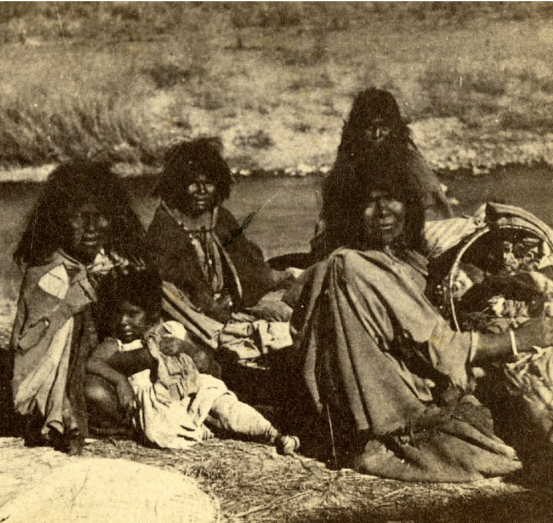
About ten thousand years later, after Lake Bonneville had disappeared, the Logan River meandered across the old lake bed and the Shoshone Native American tribe made Cache Valley their home.

Shoshone Women and Children. Photo taken in 1870, Unknown photographer. Courtesy USU Digital History Collections.
Frank Howe, chairman of the Logan River Task Force, adjunct associate professor, and university liaison for Utah Division of Wildlife Resources said, “When people say ‘let’s return Cache Valley to how it was naturally’ they don’t realize the valley [had been] managed by the Shoshone for thousands of years before the settlers arrived.”

The Shoshone burned the valley frequently to drive the Bison and provide better forage for their horses. This impacted the vegetation across the valley and along the river. Instead of large stands of tall trees, the river was lined with shrubs which responded better to fire, hence the valley’s first name Willow Valley.

Water flowing in Right-hand Fork one of the tributaries of Logan River. Courtesy & Copyright Shauna Leavitt
During this time the flow and movement of the Logan River was much different, in part because of the beaver families who built their homes and dams up and down the waterway. The dams created ponds whose waters seeped into the valley bottoms raising the water table and saturating the sponge. Joseph Wheaton, associate professor of the Department of Watershed Sciences in the Quinney College of Natural Resources explained, “the saturated ground increased resilience to drought, flood and fire.”

In the early 1800s trappers arrived in the valley.

Michel Bourdon was one of the earliest trappers to see Cache Valley around 1818. The river was, for a short time, named after him. A few years later, Ephraim Logan arrived in Cache Valley. He and many other trappers attended the Rocky Mountain Rendezvous along the Bourdon River in 1826. Shortly thereafter, Logan died during one of his outings and the area’s trappers decided to rename the river Logan, in his honor.

Trapping for the fur industry severely impacted the beaver population and the Logan River. The dam building beavers were almost trapped to extinction because of the European fashion demand. Luckily, fashion trends changed before beaver were extinct. However, the virtual elimination of beavers fundamentally changed the character of the Logan River to this day.

Man fly-fishing in Logan River, Logan Canyon, Utah, July 21, 1937. Courtesy of USU Digital History Collections.
In the 1850s the first settlers arrived in Cache Valley. Their arrival had a large impact on Logan River. Within a year they began constructing the first canal for irrigation.

Logan’s Main Street about 1920, Courtesy of Darrin Smith
Around the turn of the 19th century it became apparent the grazing and timber need of the settlers had been hard on the Logan River and the surrounding landscape. Albert F. Potter surveying the Logan River watershed for President Theodore Roosevelt, reported the canyon had been overgrazed and its timber overcut. The timber, at the time, was used for railroad ties and to build Logan City.

Logan Canyon about 1910. Four waterways: the aquaduct which was used for power generation, the canal, a water way that ran behind the building which had been part of the old Hercules Power Plant, and the Logan River. Photographer H.G. Hutteballe, Courtesy of Darrin Smith Photo Collection
As the valley’s population grew, so did the demand for Logan River water.

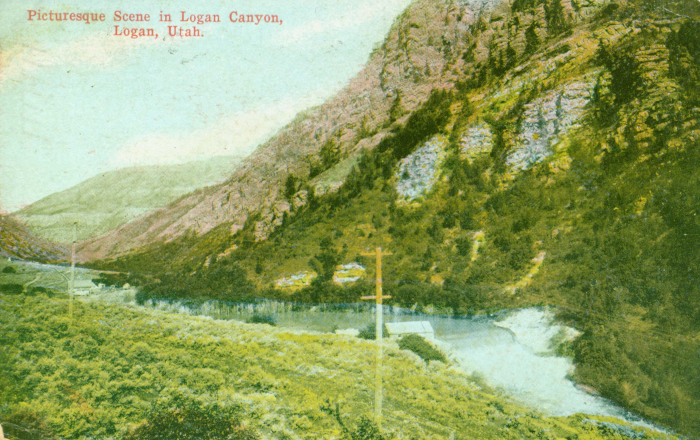
Color enhanced photo 1910 photo of Logan Canyon Courtesy Logan Library
Color enhanced photo 1910 photo of Logan Canyon
Courtesy Logan Library
Over the next few months, Wild About Utah will continue this series on the Logan River to tell the stories about its ecology, social value, and how humans have worked together to make it a community amenity not just a canal.

We hope you’ll join us as we learn more interesting facts about Logan River.

This is Shauna Leavitt and I’m wild about Utah.

Credits:
Photos: Courtesy & Copyright ©
Audio: Courtesy & Copyright © Friend Weller, Utah Public Radio
Text: Shauna Leavitt, Utah Cooperative Fish and Wildlife Research Unit, Quinney College of Natural Resources, Utah State University
Co-Authored by: Frank Howe, chairman of the Logan River Task Force, adjunct associate professor, and university liaison for Utah Division of Wildlife Resources.

Sources & Additional Reading

Geologic Map of the Logan 7.5′ Quadrangle, Cache County, Utah, Utah Geological Survey, 1996, https://ugspub.nr.utah.gov/publications/misc_pubs/mp-96-1.pdf

Williams, Stewart J. Lake Bonneville: Geology of Southern Cache Valley, Utah, Geological Survey Professional Paper 257-C, US Department of the Interior, 1962, https://pubs.usgs.gov/pp/0257c/report.pdf

Biek, Bob; Willis, Grant; Ehler, Buck; Utah’s Glacial Geology, Utah Geological Survey, September 2010, https://geology.utah.gov/map-pub/survey-notes/utahs-glacial-geology/

Hylland, Rebecca, What are Igneous, Sedimentary & Metamorphic Rocks?, Glad You Asked, Utah Geological Survey, https://geology.utah.gov/map-pub/survey-notes/glad-you-asked/igneous-sedimentary-metamorphic-rocks/

Extinction or Survival?

Extinction or Survival: Environmental Protection Image by <a href="https://pixabay.com/users/ejaugsburg-148268/?utm_source=link-attribution&utm_medium=referral&utm_campaign=image&utm_content=326923">ejaugsburg</a> from <a href="https://pixabay.com/?utm_source=link-attribution&utm_medium=referral&utm_campaign=image&utm_content=326923">Pixabay</a>
Environmental Protection
Image by ejaugsburg from Pixabay
Some people complain that the NEWS only reports bad things, and that can be depressing. But maybe that is the way we can learn how to improve things. If all we ever heard was that everything was wonderful, even though it truly wasn’t, how would we feel if we accidentally stumbled across a negative situation? Let’s consider the present global status of the wildlife with which we share this planet.

One of the pleasures of hiking in scenic vistas, such as our forests or National Parks, is to see the wildlife that call those places home. People want to see bears or wolves in Yellowstone. They are thrilled when they see Desert Bighorn Sheep in Arches or Zion. But the latest comprehensive report on biodiversity by the United Nations revealed some startling results. The report included over 1,000 pages compiled by more than 450 researchers who analyzed 15,000 scientific and government reports. And this summary had to be approved by representatives of all 109 nations.

The message is that nature is being threatened more now than any other time in human history. Literally, a million species of plants and animals are facing serious threats to their survival. And this is due to several harmful actions: Invasive species that crowd out native wildlife from their home habitats; the pollution of water and land by the dumping or runoff of toxic materials; overfishing the oceans; and permitting the continual burning of fossil fuels which alter the climate for some wild species. And, as a result of increasing human populations, many forests and grasslands are converted into farmland, cities, or business ventures. That reduction in the number of large plants and trees affects the Earth’s ability to reduce heat-trapping carbon dioxide.

Currently, over 1,200 mammal species, 1,500 bird species, and 2,300 fish species are threatened, endangered or extinct in the wild.

This indeed sounds dismal, but if we consider it as a warning there is still time left to alter this downward spiral. What can we do? Simple tasks, really: Replace lawns by planting trees, shrubs and flowers native to your area. This provides habitat as well as food for pollinators. Avoid using harmful pesticides and herbicides which can collect and wash down into streams and rivers, which then pollute that water as well as the ocean. Respect the privacy needed by wildlife by observing them from a distance. Never poach any species. Place birdfeeders and/or birdhouses in your area. Consider renewable energy sources for your home and community. Don’t allow your vehicle engines to idle. And encourage your community to preserve open, green spaces when new developments are proposed.

Life is easier if we decide to let others do the work that will benefit us all. But if everyone made some small improvements in their lifestyle we might be able to avoid future dismal reports.

This is Ron Hellstern, and I am Wild About Utah.
 
Extinction or Survival-Credits:

Images: Courtesy & Copyright
Lead Audio: Courtesy and Copyright Kevin Colver
Text: Ron Hellstern, Cache Valley Wildlife Association

Extinction or Survival-Additional Reading

Before Trees, We Had Giant Mushrooms

Mushrooms in the Grass Courtesy MW at Pixabay
Mushrooms in the Grass
Courtesy MW at Pixabay
Yes, trees are the answer. But they owe their magnificence to a less known life form that has long intrigued me. Long before trees overtook the land, Earth was covered by giant mushrooms 24 feet tall and three feet wide. And consider Utah’s Pando aspen clone, one of the largest and oldest, mycorrhizal-dependent, living organisms

Mushrooms are actually the reproductive manifestation of a much larger organism, a brief glimpse of the wonders that reside beneath the ground. Called mycorrhizal fungi, they form a mutually beneficial relationship with tree roots and other plants. They vastly increase the absorption capacity for water and minerals. Many trees and other plants cannot live without these fungal partners. It also makes the plant less susceptible to soil borne pathogens and other environmental stresses such as drought and salinity.

Regarding climate protection, mycelium make up the bulk of carbon storage in forests. Scientists in Sweden were surprised by this; they were expecting dead tree matter to shoulder the carbon burden. But as mycologist Paul Stamets states, “dead mycelium can store carbon for hundreds of thousands of years.

Remarkably, recent research has shown that plants connected by mycorrihzal fungi can use these underground connections to produce and receive warning signals. When a host plant is attacked, the plant signals surrounding plants of its condition. The host plant releases volatile organic compounds (VOCs) that attract the insect’s predators, as do the plants connected by the fungi network.

Further, fungi have been found to have a protective role for plants rooted in soils with high toxic metal concentrations. This is likely due to the metal binding to fungal mycelium.

Taking a broader view, recent research indicates mushrooms possess curative properties for many diseases, including neurological. Add to this bioremediation through cleaning up industrial waste and oil spills, and applications for reducing loss of our pollinators. Critical to soil function as decomposers and providing nutrients, mushrooms also play a major role in soil structure through hyphae networking and glomalin (that is biological glue) production.

The idea that a universal web of dark matter, plus our more familiar World Wide Web, plus the neurological networking in the human brain, all mimicking the mycelial networks of mushrooms under our feet that bind and feed all of Earth’s soil. The idea that this network, an enormous mass of fungus that branches and communicates underground, is in some way sentient. The idea that human brains went through an evolutionary growth spurt after we encountered “magic” mushrooms on the savannah of Africa- all worthy of serious rumination.
Fall has arrived, and with it mushrooms to titillate the imagination- and gastric juices.

This is Jack Greene and boy am I wild about Utah and Pando’s mycelium!

Credits:

Pictures: M W from Pixabay
Sound: Courtesy Kevin Colver
Text: Jack Greene, Bridgerland Audubon Society

Additional Reading:

Pace, Matthew, (Intern, NYBG), Hidden Partners: Mycorrhizal Fungi and Plants, New York Botanical Garden, https://sciweb.nybg.org/science2/hcol/mycorrhizae.asp.html

Chadwick, Douglas H., Mycorrhizal Fungi: The Amazing Underground Secret to a Better Garden. Mother Earth News, August/September 2014, https://www.motherearthnews.com/organic-gardening/gardening-techniques/mycorrhizal-fungi-zm0z14aszkin

See “Mushrooms” in the following:
Cumo, Christopher, Encyclopedia of Cultivated Plants: From Acacia to Zinnia [3 volumes]: From Acacia to Zinnia, Amazon Digital Services LLC, April 25, 2013, https://www.amazon.com/Encyclopedia-Cultivated-Plants-Acacia-volumes-ebook/dp/B00ODJN5BU
See also: https://books.google.com/books?id=Ja7WAQAAQBAJ&q=mushrooms#v=snippet&q=mushrooms&f=false