Full Moon Serenades

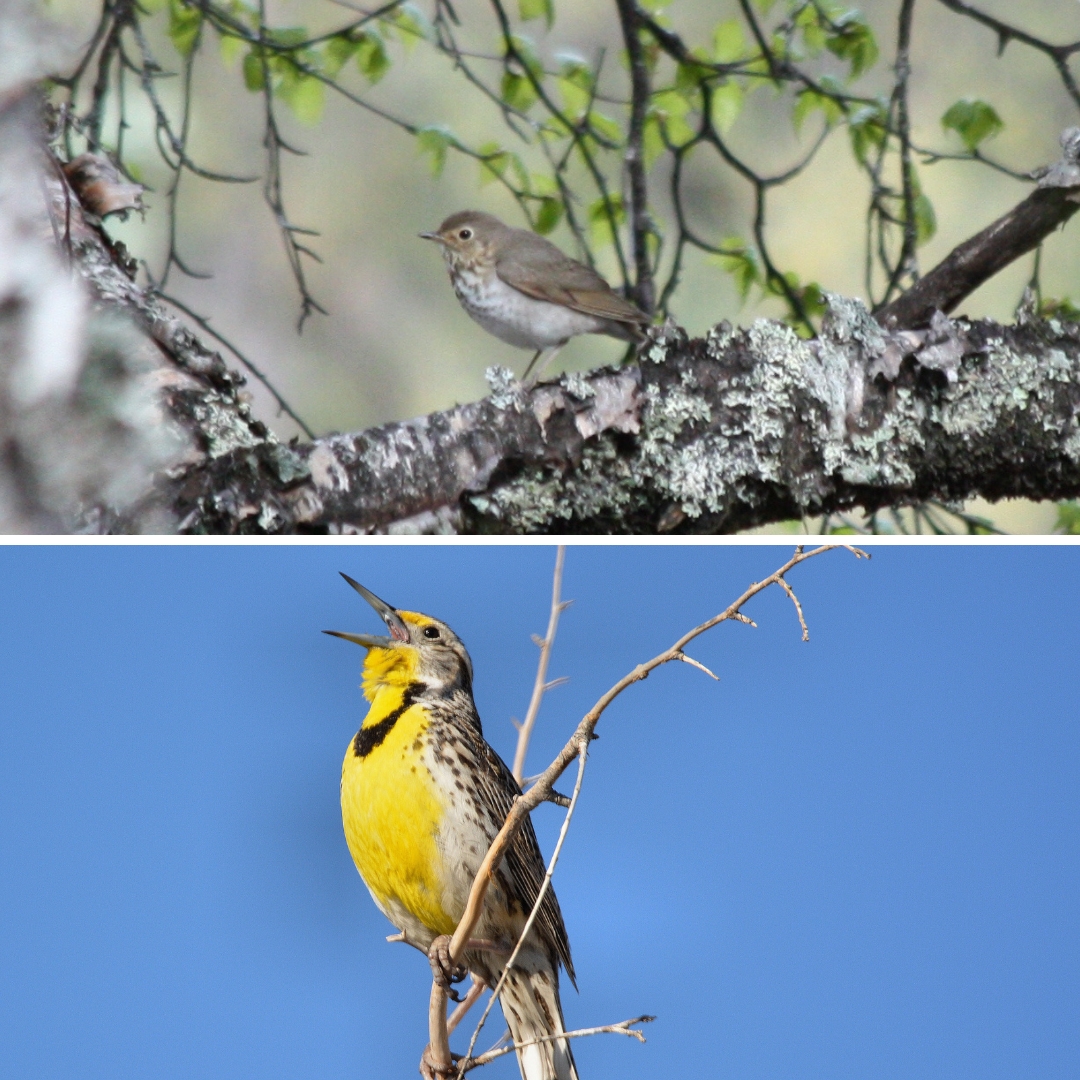
Swainson's Thrush & Western Meadowlark Courtesy US NPS Robbie Hannawacker, Photographer (thrush) Albert Myran, Photographer (meadowlark) Combined by Patrick Kelly
Swainson’s Thrush & Western Meadowlark
Courtesy US NPS
Robbie Hannawacker, Photographer (thrush)
Albert Myran, Photographer (meadowlark)
Combined by Patrick Kelly
The serenades around where I live begin early. Today it was during the full moon at 3am, in a break from the blessed rain. The chorus is mostly of robins, but one voice sticks out as new; a call I do not know; a love letter to curiosity of who could make such a call. I have hope that I’ll be able to find who sings like a Geddy Lee who has found Xanadu. It isn’t the first mystery bird I’ve encountered though.

I do remember my first, how can one not, that first call which bamboozled and hypnotized me years ago, both awakening and soothing that inside of me which makes me human. I used to live in a small cabin in the middle of Alaska, and during the eternal summers I’d hear this bird’s haunting call lull me to sleep. It was a Weddell seal of the woods. A UAP that sang.

At first, I didn’t want to know who it was filling the woods with quicksilver honeydew, drop by drop. I somehow felt that the magic would be lost, that by knowing the source I would ruin the spring. But then one day, the music maker appeareth. He was brown, squat, with a small thin beak, just sitting on a spruce branch at my eye level. When he sang, I found I was not disappointed. The Eden of unknowing bliss was not left behind. Instead, where once I saw an it, now I saw a thou. He was singing. The noble, sylvan Swainson’s Thrush.

This trend continued on for me, and once I moved to Utah, I found even more new strange songs. I learned to let the choir sing from their perches, and wait for them to show themselves. The newest singer I discovered was last summer, out in the last intact meadows which border the Bonneville Shoreline trail in Cache Valley, fast disappearing to the grind of half-acre plots and four-car garages which confuse godliness with gaudiness. In their loss, also deplete becomes their song.

Once I heard this new serenader, an avian Van Halen, I began repeating the trail just to hear his song. Like the thrush, which at this point was many years prior, his song seemed to have no source, it simply emanated from the golden grasses and muted sage which, pressed by wind, created a woven mat of gestalt terroir and echoed off the small crevices which led to the mountainsides.

So days and weeks went by as I hiked with my dogs. I’d keep an ear to the pastures and when I heard him, or his premonition upon the wind, I’d freeze and bend in. And sure enough, a certain day came where on this hike I listened, heard, and then saw him. Speckled brown back, golden chest with a black chevron, perched atop a scrubby little juniper calling into the wind. A Western Meadowlark at work.

So if this summer you hear a new sound in the full moon morning and don’t know who makes it, don’t shy, ignore, nor give up. The best thing you can do is to keep listening and keep waiting, be it your first or just most recent. Eventually the caller will pull the curtain back of their own accord and be revealed. So here’s my wish of good luck to you, that you will find what you’re listening for out in the world.

I’m Patrick Kelly, and I’m Wild About Utah.
 
Credits:

Images: Courtesy US National Park Service(NPS) Robbie Hannawacker, Photographer (thrush) & Albert Myran, Photographer (meadowlark)
Audio: Courtesy US NPS Media / David Betchkal (thrush) & US NPS & MSU Acoustic Atlas/Jennifer Jerrett (meadowlark)
Additional Audio Courtesy & © Kevin Colver, J. Chase and K.W. Baldwin.
Text:    Patrick Kelly, Director of Education, Stokes Nature Center, https://www.logannature.org
Included Links: Patrick Kelly & Lyle Bingham, Webmaster, WildAboutUtah.org

Additional Reading

Wild About Utah, Posts by Patrick Kelly

Stokes Nature Center in Logan Canyon, https://www.logannature.org/

Bonneville Shoreline Trail, Logan Canyon Hiking, Bridgerland Audubon & Cache Hikers, site per Sarah Ohms, https://logancanyonhiking.com/bonneville.htm

Bonneville Shoreline Trail, Cache Hikers, https://www.cachehikers.org/Descriptions/BonnevilleShorelineTrail.html

Bonneville Shoreline Trail, Official Site(2016), https://www.bonnevilleshorelinetrail.org/

Swainson’s Thrush, All About Birds, Cornell Lab of Ornithology, Cornell University, https://www.allaboutbirds.org/guide/Swainsons_Thrush/overview

Swainson’s Thrush, American Bird Conservancy, https://abcbirds.org/bird/swainsons-thrush/

Swainson’s Thrush, UtahBirds.org, https://www.utahbirds.org/birdsofutah/ProfilesS-Z/SwainsonsThrush.htm

Western Meadowlark, All About Birds, Cornell Lab of Ornithology, Cornell University, https://www.allaboutbirds.org/guide/Western_Meadowlark

See Western Meadowlark in Sagebrush Communities in the Intermountain West, Bird Habitat Guide, American Bird Conservancy, https://abcbirds.org/wp-content/uploads/2015/05/SagebrushGuide.pdf

Western Meadowlark, UtahBirds.org, https://www.utahbirds.org/birdsofutah/ProfilesS-Z/WesternMeadowlark.htm

Nibley Firefly Park

Nibley Firefly Park: Luci the Firefly from  The Mystery of Luci’s Missing Lantern by Melissa Marsted and illustrated by Liesl Cannon Courtesy & © Liesl Cannon, Illustrator
Luci the Firefly from
The Mystery of Luci’s Missing Lantern by Melissa Marsted, illust. by Liesl Cannon
Courtesy & © Liesl Cannon, Illustrator
Just imagine waking from a very long sleep into a bright May morning in Cache Valley. This is the story of Luci, a western firefly, told charmingly by Melissa Marsted and illustrated by Liesl Cannon in their new children’s book, The Mystery of Luci’s Missing Lantern. After completing her transition from a larva to an adult firefly, Luci notices she has no light. She flies up Logan Canyon looking for her missing lantern, where the animals she meets encourage her to keep looking. But its a bluebird on top of Mt. Naomi, the highest point in the canyon, who turns Luci around and sends her back to where she was born, the Nibley Firefly Park.

Author Melissa Marsted and Illustrator Liesl Cannon at the Stokes Nature Center Book Signing Courtesy & © Mary Heers
Author Melissa Marsted and Illustrator Liesl Cannon at the Stokes Nature Center Book Signing
Courtesy & © Mary Heers
There Luci finds her light. She sits down near the top of a tall blade of grass, and suddenly males fly by, flashing their lights, trying to get her attention. Luci discovers she can flash back. It’s a party – a big courtship dance.

You can see the story unfold if you visit the Nibley Firefly Park after dark. But please tread carefully. For fireflies, this is their Grand Finale. It has taken two years for them to grow from larvae to flying adults. Now they are choosing a mate. By July they will have laid their eggs in the nearby marshy ground and their life cycle will come to an end.

Any artificial light brought to the scene (such as flashlights and car headlights) seriously disrupts the courtship flashing. If you visit the Nibley Firefly Park this summer, please keep your light to the barest minimum, and – enjoy the party.

This is Mary Heers and I’m Wild About Utah

Credits:
Images: Courtesy & Copyright © Mary Heers
Featured Audio: Courtesy & Copyright
Text: Mary Heers, https://cca.usu.edu/files/awards/art-and-mary-heers-citation.pdf
Additional Reading: Lyle Bingham, https://bridgerlandaudubon.org/

Additional Reading

Western Firefly Project: A Community Science Initiative, Natural History Museum of Utah, https://nhmu.utah.edu/citizen-science/fireflies

Wild About Utah, Mary Heers’ Postings

Bills, Christy, Utah Fireflies, Wild About Utah,Sept 7, 2020, https://wildaboututah.org/utah_fireflies/ AND
Bills, Christy, Fireflies, Wild About Utah, May 15, 2019, https://wildaboututah.org/fireflies/

Hellstern, Ron, June Fireflies, Wild About Utah, June 19, 2017, https://wildaboututah.org/june-fireflies/

Strand, Holly, Firefly light, Wild About Utah, June 20, 2013, https://wildaboututah.org/firefly-light/

Marstad, Melissa C, Author, & Cannon, Liesl, Illustrator, The Mystery of Luci’s Missing Lantern, Lucky Penny Publications, LLC, Mar 16, 2021, https://www.amazon.com/Mystery-Lucis-Missing-Lantern/dp/1945243805

Utah: A Love Story

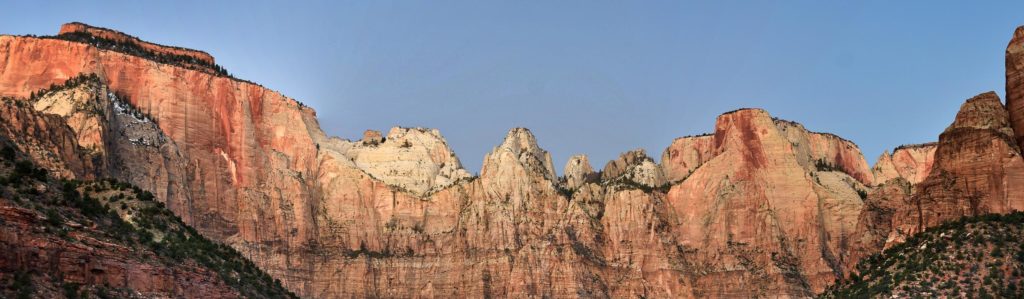
Utah: A Love Story-Zion National Park Courtesy US National Park Service
Zion National Park, Courtesy US National Park Service
“…[A] word of caution: Do not jump into your automobile next June and rush out to the canyon country hoping to see some of that which I have attempted to evoke in these pages. In the first place you can’t see anything from a car; you’ve got to get out…and walk, better yet crawl, on hands and knees, over the sandstone and through the thornbush and cactus. When traces of blood begin to mark your trail you’ll see something, maybe.”

Ed Abbey penned those words waxing elegiac on a barstool in Hoboken, New Jersey. I read them decades later on yellowed pages in a rain-drenched tent somewhere in the Northwoods of Wisconsin. When the rain stopped and summer ended, I enthusiastically disregarded Abbey’s first cautioning. I jumped into my car and rushed to the desert.

Another decade has passed since then, and Utah has become home as I’ve spent those years heeding Abbey’s instructions: walking and crawling over sandstone, through thornbush and cactus, blazing trails with spots of blood, finding and falling in love with places. The Colorado, the Green, the San Juan; Bears Ears, Cedar Mesa, Comb Ridge; Arches, Bryce, Canyonlands, Capitol Reef, and Zion; the named and nameless places in between—the cloven topography where we slogged through flash flood debris, broke through the ice of slot canyon pools, and howled at the setting sun flashing shades of red we’d never seen. After a time, the trails I blazed no longer led to vistas, but to memories.

It’s not just the canyon country I fell in love with, though. I came for the desert, but I stayed for the mountains. And after walking their well-blazed trails, I shambled down the ones overgrown and choked with disuse; and when those ran out, crawled on hands and knees. And I saw things. More importantly, I found something: perspective—of place and of home—perspective gained from the many secrets divulged by mountains and running waters, red rock amphitheaters and alpine meadows. It has been a great privilege to share the stories of those places with you all. They are my love letters to their secrets. My family is off to find and fall in love with new places, now, but I’ll always be Wild About Utah!

Credits:
Photos: Courtesy US National Park Service
Additional Sound: Courtesy & Copyright J. Chase and K.W. Baldwin and Friend Weller
Text: Josh Boling, Edith Bowen Laboratory School, Utah State University https://edithbowen.usu.edu/
Additional Reading Links: Josh Boling Utah A Love Story

Sources & Additional Reading

Abbey, Edward, Desert Solitaire: A Season in the Wilderness, Ballantine Books (January 1, 1971), https://www.amazon.com/Desert-Solitaire-Wilderness-Edward-Abbey/dp/0345326490

Boling, Josh, Author Page, Wild About Utah, https://wildaboututah.org/author/josh-boling-boling/

    Josh’s Pieces:

  1. Old Ephraim, The Infamous Northern Utah Grizzly, Wild About Utah, Aug 7, 2017, https://wildaboututah.org/old-ephraim-the-infamous-northern-utah-grizzly/
  2. Tree Talk, Wild About Utah, Feb 27, 2017 https://wildaboututah.org/tree-talk/
  3. Water-Liquid Life, Wild About Utah, May 23, 2017, https://wildaboututah.org/water-liquid-life/
  4. The Urban Ecotone, Wild About Utah, Nov 6, 2017, https://wildaboututah.org/urban-ecotone/
  5. Kokanee Salmon in Utah, Wild About Utah, Oct 9, 2017, https://wildaboututah.org/kokanee-salmon-in-utah/
  6. Fire, Wild About Utah, Aug 13, 2018, https://wildaboututah.org/fire/
  7. Wild Cats, Wild About Utah, Dec 10, 2018, https://wildaboututah.org/wild-cats/
  8. A Desert’s Paradox, Wild About Utah, Dec 15, 2018, https://wildaboututah.org/a-deserts-paradox/
  9. The Language of Ravens, Wild About Utah, Feb 189, 2018, https://wildaboututah.org/language-of-ravens/
  10. Wild Children, Wild About Utah, Jan 8, 2018, https://wildaboututah.org/wild-children/
  11. Wild Neoteny, Wild About Utah, Jul 9, 2018, https://wildaboututah.org/wild-neoteny/
  12. Josh’s Raven Encounter, Wild About Utah, Jun 11, 2018, https://wildaboututah.org/joshs-raven-encounter/
  13. Wilderglyphs, Wild About Utah, Mar 30, 2018, https://wildaboututah.org/wilderglyphs/
  14. Hidden in Plain Sight, Wild About Utah, May 14, 2018, https://wildaboututah.org/hidden-in-plain-sight/
  15. Greenback Cutthroat Trout, Wild About Utah, Nov 19, 2018, https://wildaboututah.org/greenback-cutthroat-trout/
  16. Habitat Heroes Explore More Utah Biomes, Wild About Utah, Apr 8, 2019, https://wildaboututah.org/explore-utah-biomes/
  17. Josh Explains Wild Neoteny, Wild About Utah, Aug 19, 2019, https://wildaboututah.org/josh-explains-wild-neoteny/
  18. A Solstice Vignette, Wild About Utah, Dec 16, 2019, https://wildaboututah.org/a-solstice-vignette/
  19. Beaver Creek Greenback Cutthroat Trout, Wild About Utah, Feb 25, 2019, https://wildaboututah.org/beaver-creek-greenback-cutthroat-trout/
  20. The Henry Mountains’ Bison Herd, Wild About Utah, Jan 14, 2019, https://wildaboututah.org/the-henry-mountains-bison-herd/
  21. The River, Wild About Utah, Jul 15, 2019, https://wildaboututah.org/the-river/
  22. The Bear River’s History and Contributions, Wild About Utah, Jun 10, 2019, https://wildaboututah.org/bear-rivers-history-and-contributions/
  23. Habitat Heroes Explore Utah Biomes, Wild About Utah, Mar 4, 2019, https://wildaboututah.org/utah-biomes/
  24. Why I Teach Outside, Wild About Utah, Nov 11, 2019, https://wildaboututah.org/why-i-teach-outside/
  25. Utah’s Desert Paradox, Wild About Utah, Oct 14, 2019, https://wildaboututah.org/utahs-desert-paradox/
  26. Rock Art, Wild About Utah, Sep 16, 2019, https://wildaboututah.org/rock-art/
  27. You, Too, Can Teach Outside!, Wild About Utah, Apr 20, 2020, https://wildaboututah.org/you-too-can-teach-outside/
  28. Brand New Eyes, Wild About Utah, Aug 17, 2020, https://wildaboututah.org/brand-new-eyes/
  29. Snowshoes and Adaptations, Wild About Utah, Feb 17, 2020, https://wildaboututah.org/snowshoes-and-adaptations/
  30. The Henry Mountain Bison, Wild About Utah, Jan 20, 2020, https://wildaboututah.org/the-henry-mountain-bison/
  31. Imaginary Wanderings, Wild About Utah, Mar 16, 2020, https://wildaboututah.org/imaginary-wanderings/
  32. Questions, Wild About Utah, Mar 22, 2020, https://wildaboututah.org/questions/
  33. A New Beginning, Wild About Utah, May 25, 2020, https://wildaboututah.org/a-new-beginning/
  34. Karst Topography, Wild About Utah, Nov 23, 2020, https://wildaboututah.org/karst-topography/
  35. Wandering Home, Wild About Utah, Oct 19, 2020, https://wildaboututah.org/wandering-home/
  36. Equinox, or Equilux?, Wild About Utah, Sep 21, 2020, https://wildaboututah.org/equinox-or-equilux/
  37. Finding Remoteness, Wild About Utah, Feb 22, 2021, https://wildaboututah.org/finding-remoteness/
  38. Utah: A Love Story, Wild About Utah, May 24, 2021, https://wildaboututah.org/utah-a-love-story/

Acorn Woodpeckers

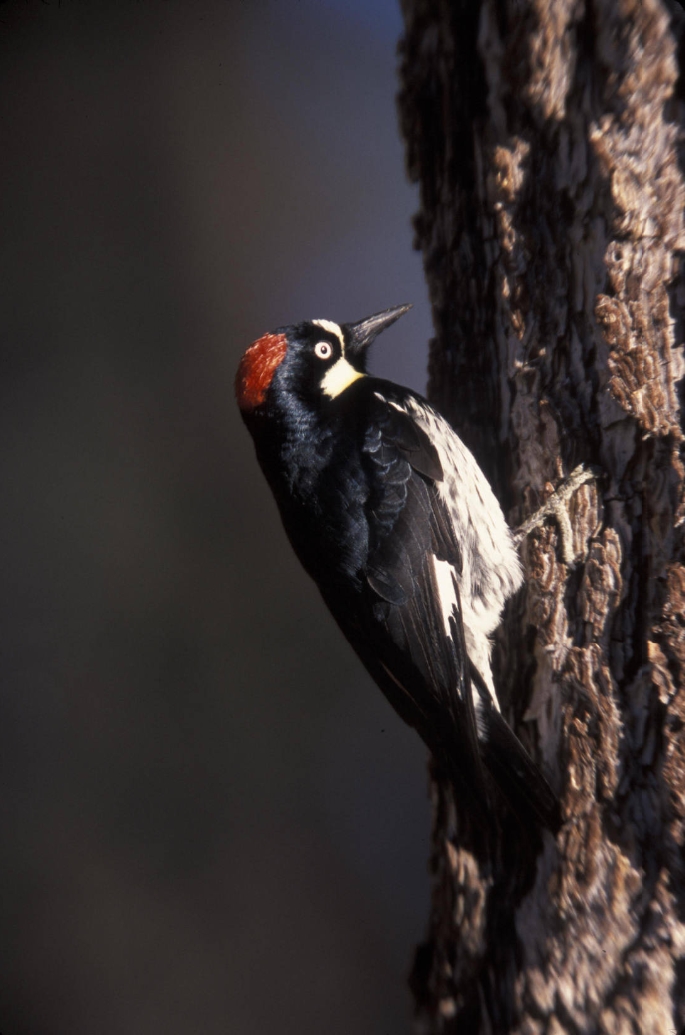
Acorn Woodpecker Melanerpes formicivorus Courtesy US FWS, Gary Kramer, Photographer
Acorn Woodpecker
Melanerpes formicivorus
Courtesy US FWS,
Gary Kramer, Photographer

My first encounter with an acorn woodpecker occurred many years ago in California, a species unknown to me. I was surprised to find a small flock of these comedic looking birds- most unusual for woodpeckers, which are generally solitary other than with mates or young. And those startling yellow eyes!
On a recent West Rim trek in Zion N.P., to my delight, I got a second encounter near Potato Hollow. Their loud, sharp calls first alerted me. I paused to find the source, and was startled to see who it was, unaware they existed in our state.

Acorn woodpeckers live in large groups, hoard acorns, and breed cooperatively. These woodpeckers live in oak and mixed oak-evergreen forests on slopes and mountains in the Southwest and West Coast. They are found infrequently in the south end of our state. They’re tolerant of humans, and occur in towns where there are acorns and suitable places to store them.
If more than one female in a colony breeds, they lay eggs in the same nest cavity. When egg-laying is not synchronized, females often destroy each other’s eggs. In-synch egg-layers, however, produce a clutch totaling three to seven eggs. Although this behavior seems counterproductive, it may be beneficial, resulting in all chicks being roughly the same age and size. Several different individuals of each sex may breed within one family, with up to seven breeding males and three breeding females in one group.

All members of the colony share in incubation duties, and all pitch in to feed the chicks when they hatch. Young adults remain with their parents for several years to help raise successive broods, but eventually disperse to other territories. Nesting groups can contain up to ten offspring helpers. These breeding coalitions are typically closely related. The males are often brothers, and the females are usually sisters. Inbreeding is rare, however, meaning that co-breeders of the opposite sex are almost never related.

All members of an Acorn Woodpecker group spend large amounts of time storing acorns. typically stored in holes drilled into a single tree, called a granary tree. One granary tree may have up to 50,000 holes, each of which is generally filled with an acorn by autumn.

When any protective group of woodpeckers experiences a death or disruption to the hierarchy, nearby birds rush to the area and fight for access to the trove; these fights also attract woodpecker audiences who leave their own territories to witness the battles.

In 1923, American ornithologist William Leon Dawson called the dapper Acorn Woodpecker “our native aristocrat.” “He is unruffled by the operations of the human plebs in whatever disguise…Wigwams, haciendas, or university halls, what matter such frivolities, if only one may go calmly on with the main business of life, which is indubitably the hoarding of acorns.”

Jack Greene for Bridgerland Audubon Society and I’m totally wild about Utah and its acorns!

Credits:

Nest Picture: Courtesy US FWS, Gary Kramer, Photographer, https://digitalmedia.fws.gov/digital/collection/natdiglib/id/2755/rec/3
Audio: Courtesy and Copyright Kevin Colver, https://wildstore.wildsanctuary.com/collections/special-collections/kevin-colver
Text: Jack Greene, Bridgerland Audubon, https://bridgerlandaudubon.org/
Additional Reading: Lyle W Bingham, Webmaster, and Jack Greene, Author, Bridgerland Audubon, https://bridgerlandaudubon.org/

Additional Reading:

Acorn Woodpecker Overview, All About Birds, Cornell Lab of Ornithology, Cornell University, https://www.allaboutbirds.org/guide/Acorn_Woodpecker/overview

Acorn Woodpeckers, Species, Utah Division Wildlife Resources, Utah Department of Natural Resources, State of Utah, https://fieldguide.wildlife.utah.gov/?species=melanerpes%20formicivorus [Link updated January 2024]

DAWSON, William Leon, Islapedia, Santa Cruz Island Foundation(SCIF), https://www.islapedia.com/index.php?title=DAWSON,_William_Leon

Webinar: Adaptations of Acorn Woodpeckers with Sahas Barve, National Museum of Natural History, Science How, Smithsonian Institution, https://naturalhistory.si.edu/education/teaching-resources/life-science/webinar-adaptations-acorn-woodpeckers-sahas-barve

Murtaugh, Paul, Granary Tree Image, Oregon State University, sites.science.oregonstate.edu/~murtaugp/photos/jan2017/p12.html [Link broken and removed January 2024]

When It Comes to the Family Granary, an Acorn Woodpecker’s Work Is Never Done by BirdNote, Podcast, National Audubon, September 23, 2019, https://www.audubon.org/news/when-it-comes-family-granary-acorn-woodpeckers-work-never-done [Added January 2024]