Footprints of Dinosaurs in Our Past

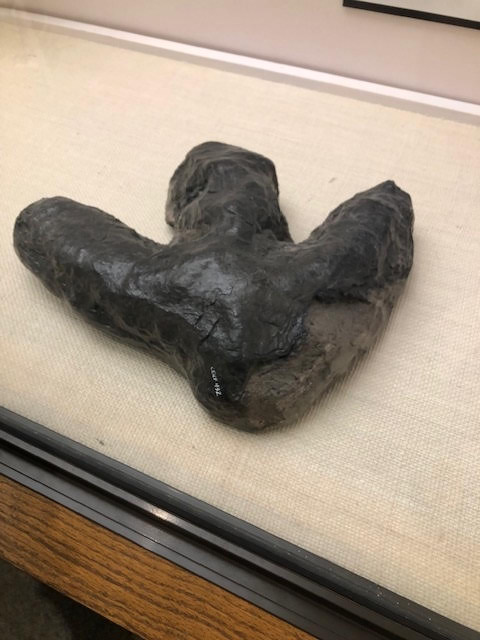
Dinosaurs in our past: Dinosaur Footprint Cast, The Prehistoric Museum, USU Eastern Campus, Price, UT Courtesy Mary Heers, Photographer
Dinosaur Footprint Cast
The Prehistoric Museum,
USU Eastern Campus, Price, UT
Courtesy Mary Heers, Photographer

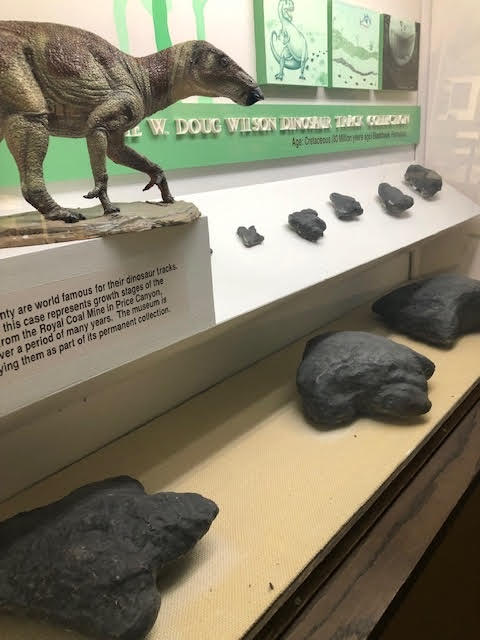
Dinosaur Footprint Display, The Prehistoric Museum, USU Eastern Campus, Price, UT  Courtesy Mary Heers, Photographer Dinosaur Footprint Display
The Prehistoric Museum,
USU Eastern Campus, Price, UT
Courtesy Mary Heers, Photographer

When I saw my first giant dinosaur footprint a the Natural History Museum of Utah, I said it was terrific.

“Dime a dozen, “ said my father-in-law, who was standing next to me. “The ceiling of the coal mine is littered with them.”

My ears perked right up. “Really,?” I said. “Maybe I could get one?”

As a young mining engineer right out of college, my father in law had been hired to run the Sunnyside coal mine about 25 miles outside of Price. He went on to explain that it was impossible to take a footprint out of the mine ceiling with risking bringing the whole roof down on your head. I had to agree it sounded difficult, but that didn’t stop me from sighing and saying, “I sure would like a dinosaur footprint for Christmas. “

In the end, he compromised by arranging a trip into the mine to see the footprints.

So, on a day no one was working in the mine, we climbed into the low riding miner’s car that carried us deep, deep into the heart of the mountain. When we got to the face we stopped and got out. In the dim light of our headlamps I could see we were in a huge cavernous room with massive pillars of coal, seven feet high and almost as wide, holding up the roof. And then I looked up and saw them – three toed footprints pressed down into the ancient mud that had turned into coal millions of years ago. Whole families of dinosaurs had strolled through this prehistoric swamp, leaving big prints, as long as two feet, and small ones, as small as six inches.

I found out later that the preservation of these footprints was a happy accident of sand filling up the prints soon after they were made. Millions of years later, when the decaying swamp plants were compressed into coal, the sand (itself pressed into sandstone,) held the shape of the foot.

A similar lucky mix of sand, water and pressure was needed to preserve dinosaur bones. Not all bones become fossils. So you can imagine the excitement in the scientific community when a fossil bed containing more than 12,000 dinosaur bones were discovered 30 miles south of Price. There were enough bones to qualify as a crime scene. To this day, my favorite spot in the Natural History Museum of Utah is the corner where 4 paleontologists on 4 TV screens square off with their earnest explanations for this massive bone pile-up.

    One says it was a watering hole that dried up so the dinosaurs died.

    “No,” says the second. There was too much water. The site became so muddy that the dinosaurs got stuck in the mud.

    The third offers up the idea that it could have been poison or a lethal germ that got in the water.

    “Oh, no,” says the fourth. The dinosaurs died somewhere else, and floodwaters floated them here.

It’s a mystery still waiting to be solved, and that’s what makes studying Utah’s past so interesting.

This is Mary Heers, and I’m Wild About Utah.

Credits:
Photos: Courtesy Mary Heers,
Featured Audio: Courtesy & Copyright © Friend Weller, Utah Public Radio upr.org
Text: Mary Heers, https://cca.usu.edu/files/awards/art-and-mary-heers-citation.pdf
Additional Reading: Lyle Bingham, https://bridgerlandaudubon.org/

Additional Reading

Wild About Utah, Mary Heers’ Wild About Utah Postings

Sunnyside Coal Mines, UtahRails.net, Last Updated March 8, 2019, https://utahrails.net/utahcoal/utahcoal-sunnyside.php

Prehistoric Museum, USU Eastern Campus, Price, UT, https://eastern.usu.edu/prehistoric-museum/

Natural History Museum of Utah, Rio Tinto Center, University of Utah, https://nhmu.utah.edu/

Mindful Birding

Goldfinch Courtesy Pixabay, Beto MdP, Contributor
Goldfinch
Courtesy Pixabay, Beto MdP, Contributor
Mindful birding- hmmm? Mindfulness has become a common word and way to a better life they say. As I understand, “mindfulness” is a mild form of meditation, where one is “in the moment” focusing on a thought or object that is all consuming. My personal experiences of this type are when I’m painting a picture, weaving a basket, or sitting very motionless for long periods while hunting deer where every sound and sight is in the moment. Birding, not so much, unless an unexpected species presents itself through sight or sound. A goshawk sitting on its kill nearby- a rarity I can vividly recall, including its surroundings. The sound of a peregrine falcon flying above Temple Square in Salt Lake City. Thus, my interest was piqued when I first saw the phrase “mindful birding”. To gain some enlightenment, myself and another Bridgerland Audubon board member attended a “Mindful Birding” workshop in Colorado to gain some insight into this enigma.

These opening statements at the workshop encapsulated its essence- “Mindful birding combines observing birds with mindfulness techniques, creating a practice that incorporates heightened awareness. Labeling or identifying birds is not the primary focus; instead, we intend to slow down and notice, using birds as our guides. Mindful birding deepens our relationship with birds and our connection with the natural world.”

“Whether it's observing a goldfinch delicately pecking at a sunflower seed or witnessing a raptor stealthily hunting its prey, the profound sense of wonder experienced when we slow down and immerse ourselves in nature is truly remarkable. Research demonstrates the mental and physical health advantages derived from engaging with the natural world.”

As the day progressed, we put these statements into practice, as we watched a Swainson’s hawk sitting in a large cottonwood tree while clutching a rabbit in its talons. We surmised it was a young bird whose eyes were larger than its stomach, not knowing quite what to do with such large quarry. Swainson’s typically capture grasshoppers and small rodents. Oops! The highlight came when my traveling companion spotted a barn owl with young in a tree hollow. We all became “mindful” emitting oohs and ahhs to express our delight. For Meg, this was her moment as she focused her powerful camera lens and nailed the perfect photo to capture the moment- mindful photography!

The workshop was emphatic that mindful birding is for everyone, all inclusive, regardless of their seeming limitations or reservations. Bird language was stressed for the blind, which I rely on for songbirds who are often hidden in foliage. This week, I will be presenting birds to an assisted living facility in Logan. I plan to attached a window feeder so residents can enjoy them from their central meeting room: Another mindful bird activity.

“There are times when the primary intention of Mindful Birding may be self-care. And, there are other times when it may be more relational – a search for a deep connection with nature through our love and curiosity about birds.” Mindful birding network

Jack Greene for Bridgerland Audubon Society Let us get mindful about Utah’s Wild Birds!

Credits:
Image: Courtesy Pixabay, Beto MdP, Contributor https://pixabay.com/photos/goldfinch-bird-animal-wildlife-7228334/
Audio: Courtesy & © Kevin Colver https://wildstore.wildsanctuary.com/collections/special-collections/kevin-colver
Text: Jack Greene, Bridgerland Audubon, https://bridgerlandaudubon.org/
Additional Reading: Jack Greene & Lyle W Bingham, Webmaster, Bridgerland Audubon, https://bridgerlandaudubon.org/

Additional Reading:

Jack Greene’s Postings on Wild About Utah, https://wildaboututah.org/author/jack/

As a postscript Jack wrote:
Numerous resources and organizations are working towards greater
inclusivity in outdoor spaces, particularly in the birding community. Some
notable groups include:

The American Psychological Association's Inclusive Language Guide is an excellent starting point for guidance on inclusive language.

A Good IDEA for Birding, Birdability, [accessed November 18, 2024], https://www.birdability.org/a-good-idea-for-birding

Lundin M, Bombaci S. Making outdoor field experiences more inclusive for the LGBTQ+ community. Ecol Appl. 2023 Jul;33(5):e2771. doi: 10.1002/eap.2771. Epub 2022 Dec 29. PMID: 36271764. https://pubmed.ncbi.nlm.nih.gov/36271764/

Yuhas, Daisy, Five Ways to Connect With Nature and Boost Your Mood No Matter Your Schedule, Audubon Magazine, Fall 2024, https://www.audubon.org/magazine/five-ways-connect-nature-and-boost-your-mood-no-matter-your-schedule

McGlashen, Andy, Donna Posont Helps Blind People Become Birders—and Whatever Else They Want To Be, Audubon Magazine, Fall 2024, https://www.audubon.org/magazine/donna-posont-helps-blind-people-become-birders-and-whatever-else-they-want-be

The World Keeps Turning

Bald Eagle Gliding on a Thermal
Courtesy Pixabay, Dave Eslinger, Photographer/Contributor
Bald Eagle Gliding on a Thermal
Courtesy Pixabay, Dave Eslinger, Photographer/Contributor
I stepped outside on election morning, into a gusty, cold wind. Leaves skidded across the ground, mixed with heavy graupel which fell hard from sky, pelting me from all directions. Graupel is a type of snow—soft hail-like miniature snowballs—that fall with turbulent winds typically associated with either the beginning or the end of a storm cycle. It seemed fitting and it made me smile—in a curious and uneasy sort-of-way.

To the west, through the dim-gray rage of the storm, the Wellsville Mountains appeared to glow in the morning light.

Regardless of the outcome of the election, the earth keeps turning. And though elections can—and do—have direct impact on the wildlands of Utah and the health of our planet, today, the crows in the yellow pine in my front yard still call out, “Caw! Caw! Caw!” The snow still accumulates on the highest peaks. Squirrels still scurry frantically to cache enough supplies for winter. The Bear River keeps flowing to the Great Salt Lake, steady and silent.

In this climate of divisiveness I want to believe, at the core, we all share similar values that we express differently.

US Flag
Courtesy Pixabay, RoadTripGuys photographer/contributor
US Flag
Courtesy Pixabay, RoadTripGuys photographer/contributor
I found myself reflecting back on September 11, 2001—how helpless I felt watching the news throughout the day. Late in the afternoon, I headed up Logan Canyon to center my thoughts and to finish a climbing route I had been working to establish. I carefully painted the last bolt anchor at the top of the climb with stars and stripes—it wouldn’t be visible from below—and named the route “Old Glory.”

That time alone on the mountain brought clarity. I came home, called the Scouts in my troop and told them we were flying the flags and to meet at my house as soon as they could. Troop 1, at the time, volunteered to hang the US flags on Main Street in Logan for holidays—it was a task I dreaded sometimes, because it was an inconvenience. Suddenly it felt like the most important thing we could do.

I didn’t ask permission from anyone. I had the key to the flag shed.

Four or five teens and I loaded one hundred American Flags into my van. As we drove slowly down Main Street—hazards flashing, stopping at each light post so the boys could mount each flag—everyone driving past honked and cheered. The boys knew we were part of something special that night—something that mattered. We were part of building a sense resilience and unity.

I have flown the flag at my house ever since.

United we stand.

Votes are being cast as I write. When this segment airs on Monday, we should know the outcomes of local, state, and national races. And those first rays of sunshine that set the Wellsville’s aglow through the graupel this morning—I hope they are a signal for all of us that the end of this storm is near. I hope we can all move past hate, past fear, past division, to a place of understanding that the left wing and the right wing are extensions of the whole bird.

My wife shared Mary Oliver’s poem, “I Worried,” with me this morning and I think I shall do as Mary did:

She wrote: “Finally, I saw that worrying had come to nothing. And gave it up. And took my old body and went out into the morning and sang.”

I am Eric Newell and I am Wild About Utah

Credits:
Images: Bald Eagle-Courtesy Pixabay, Dave Eslinger, Photographer/Contributor, https://pixabay.com/users/dave_e-6829662/
US Flag-Courtesy Pixabay, Road Trip Guys, Photographer/Contributor, https://pixabay.com/photos/us-flag-old-glory-american-flag-3838582/
Featured Audio: Courtesy & © Kevin Colver https://wildstore.wildsanctuary.com/ and Rubber Rodeo-Before I Go Away, Producer, Hugh Jones, Writer, Barc Holmes, https://www.discogs.com/artist/311765-Rubber-Rodeo
Text: Eric Newell, Edith Bowen Laboratory School, Utah State University
Additional Reading: Eric Newell

Additional Reading

Wild About Utah Pieces by Eric Newell

https://avalanche.org/avalanche-encyclopedia/snowpack/weak-layer/storm-snow-weak-layers/graupel-rimed-particles/

https://www.mindfulnessassociation.net/words-of-wonder/i-worried-mary-oliver/

The Unique Biodiversity of Washington County

The Colorado Plateau Courtesy & Copyright Marshall Topham, Photographer
The Colorado Plateau
Courtesy & Copyright Marshall Topham, Photographer

The Great Basin Courtesy & Copyright Marshall Topham, Photographer The Great Basin
Courtesy & Copyright Marshall Topham, Photographer

Mojave Desert with Joshua Trees Courtesy & Copyright Marshall Topham, Photographer Mojave Desert with Joshua Trees
Courtesy & Copyright Marshall Topham, Photographer

Mojave Desert Courtesy & Copyright Marshall Topham, Photographer Mojave Desert
Courtesy & Copyright Marshall Topham, Photographer

Mojave Desert Tortoises Courtesy & Copyright Marshall Topham, Photographer Mojave Desert Tortoises
Courtesy & Copyright Marshall Topham, Photographer

Mojave Desert Tortoise Courtesy & Copyright Marshall Topham, Photographer Mojave Desert Tortoise
Courtesy & Copyright Marshall Topham, Photographer

Mojave Desert Tortoise in a Burrow Courtesy & Copyright Marshall Topham, Photographer Mojave Desert Tortoise in a Burrow
Courtesy & Copyright Marshall Topham, Photographer

For 44 years I have spent considerable time in the company of the desert creatures that reside outside my home in St. George Utah. That number doesn’t include my frequent visits to this area as a young man growing up in Iron County. Back then I did not appreciate the uniqueness of the environment I was invading. I do now. Washington County is an area of unusual biodiversity. An impressive variety of plants and animals call Utah’s Dixie home. Over 100 species of plants and animals found here don’t exist anywhere else in Utah. This extraordinary biodiversity is the result of several factors working together to create an environment that is uniquely its own. The biologically diverse environment of Washington County can’t be found anywhere else on Earth.

Today on the trail, I pondered the reason for such incredible biodiversity I was experiencing. Three large geophysical features collide and overlap here. The Great Basin Desert invades from the North, and the Mojave Desert from the South. The Colorado Plateau, a semi-desert pushes in from the East. Each of these deserts bring with them their own unique complement of plants and animals, making Washington County a mixing pot of biodiversity. In addition to the merging of these three deserts, the incredible local topography plays a role in the diversity of life here as well. Washington county elevation ranges from 1,800 to 10,365 feet above sea level creating a number of different life zones influenced by elevation change. Erosion has also been a contributing factor by created mesas and canyons that provide additional habitat diversity.

I marvel at this environment as I stand in one place and see around me plants that originated in each of these very different desert environments. This same experience is reflected in the wildlife I encounter as I traverse the trails in the Red Cliffs Desert Reserve. Today I encountered juvenile and adult Chuckwallas, sunning on sandstone outcrops or aggressively dismembering a Desert Marigold plant to feast on its blossoms. Tiger Whiptail Lizards dash back and forth across the trail in front of me, as Side-blotched Lizards casually watch me pass by from the edge of the trail. At one point, I had to alter my path a little to avoid a Desert Horned Lizard lying motionless in the trail. Intentionally watching carefully off trail, I observe the occasional Leopard Lizard in the sand or a Desert Spiney Lizard atop a rock. Today was a good day for Mojave Desert Tortoises, as I observed three along my route. All were foraging not far from the trail. Today was a great day to be in the desert, but I will be back again tomorrow. The desert is an incredible therapist. And the price of therapy is extremely reasonable. Who wouldn’t be wild about that?

I’m Professor Marshall Topham and I’m Wild About Utah.

Credits:

Images Courtesy & Copyright
Courtesy & © Friend Weller, https://www.upr.org/people/friend-wellerCourtesy & Copyright © Anderson, Howe, Wakeman
Text: Marshall Topham,
Additional Reading: Lyle Bingham, https://bridgerlandaudubon.org/

Additional Reading

Wild About Utah pieces by Marshall Topham https://wildaboututah.org/author/marshall-topham/

Washington County Utah https://www.washco.utah.gov/

Snow Canyon State Park, Utah State Parks, https://stateparks.utah.gov/parks/snow-canyon/

Joshua Tree National Landmark, US Bureau of Land Management, https://www.blm.gov/visit/joshua-tree-national-landmark

Red Cliffs Desert Reserve, Washington County & US Bureau of Land Management, http://www.redcliffsdesertreserve.com/