
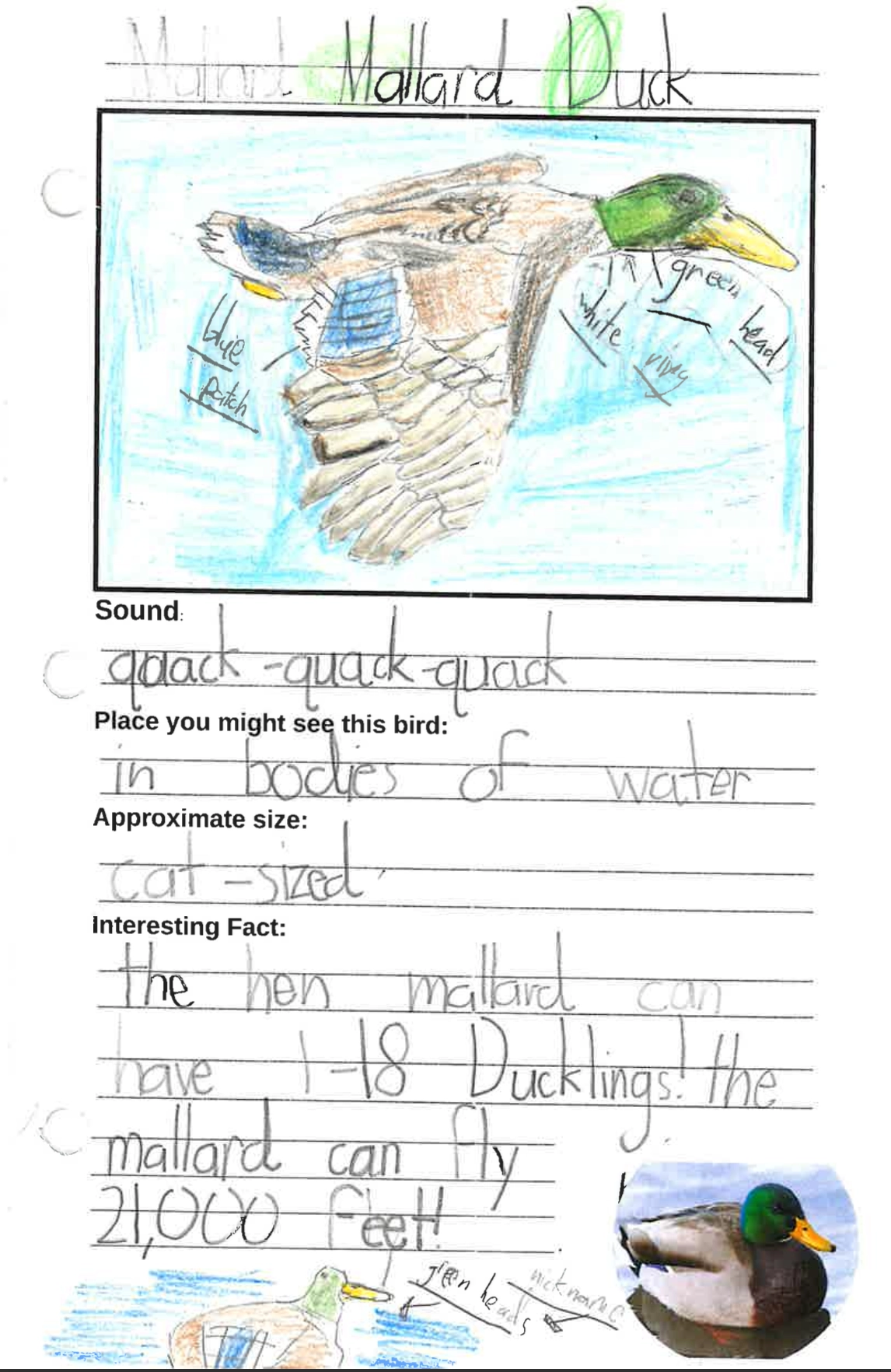
Bird Guide Card
Student Art from Second Grade,
Edith Bowen Lab School, Utah State University
Courtesy & Copyright Joseph Kozlowski, Photographer
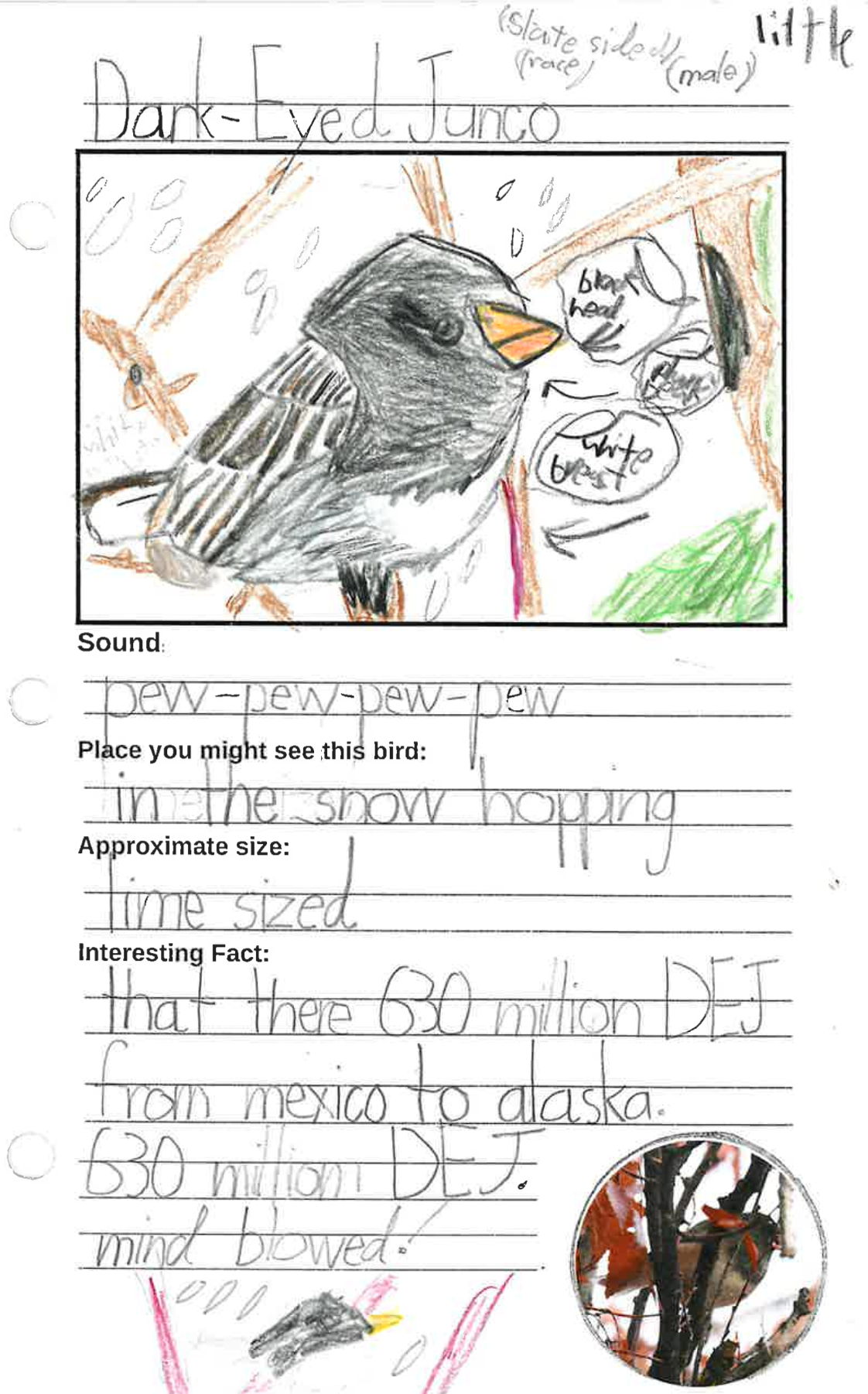 Dark-Eyed Junco
Bird Guide Card
Student Art from Second Grade,
Edith Bowen Lab School, Utah State University
Courtesy & Copyright Joseph Kozlowski, PhotographerAs an educator focused on outdoor experiential learning, I’m always looking for ways to integrate nature’s aesthetic beauty into my teaching. Aldo Leopold wrote, “Our ability to perceive quality in nature begins, as in art, with the pretty. It expands through successive stages of the beautiful to values as yet uncaptured by language.” This quote epitomizes some of my own progression with noticing, with understanding quality, and with art. As someone, who, throughout life has dodged the necessity to engage in art, I would have never thought that my love for birds and my increased awareness of them, would one day help me appreciate the capacity for anyone, even an untrained artist like myself, to enjoy and value art.
I try to foster this appreciation for art through a routine and rigorous integrated series of bird sketches and colored pencil drawings with my second-grade students at Edith Bowen Laboratory School. Students study a unique bird species each week, and as a culminating artifact, create a Bird Guide Card. On this card they record the bird sound, size, habitat and an interesting fact. Additionally, they carefully sketch, color, and label notable identifying characteristics of the bird. This artistic portion of the week’s lesson has so many powerful learning benefits that I’ve seen develop in the kids.
First and foremost, students’ attention to detail is greatly enhanced. In the beginning of the year, students’ birds have an oval body, wings outstretched like an airplane’s, two stick legs dangling down like two grandfather clock pendulums, and a pointy triangle beak. However, as their perception of detail increases over the year, they begin to notice the subtle details that in fact, provide insight to the scientific principles of life; such as the change in angle after the hinge-like joints midway through a bird’s wing, the different textures of flight-feathers vs. down-feathers, or the various structures and shapes of beaks based on what diet is of primary concern.
Second, students’ patience and attentiveness in increased, which I think we can all agree are much needed traits in this world. Students who were so eager to outline a bird sketch and then scribble it with color at the beginning of the year, now are seen fastidiously sketching and erasing, thoughtfully blending various colors, and even seeking counsel from other classmates on whether this or that tweak would improve their artistic masterpiece.
Finally, I have seen my students develop an appreciation for diversity in peer artwork. Let’s face it, some people have a natural artistic proclivity, and some have to work a bit harder. However, my students no longer giggle or make snide comments about bad art. Instead, I hear kids say things like “Wow, Jim! That’s your best bird yet! I love the way you did the feet!” or “You got the colors just right on the tail feathers, Emily!” Instead of seeing students as bad artists, they respect their contribution and acknowledge beauty in various forms.
So I challenge you. Grab a pencil, paper, eraser, and colored pencils. Find a picture on the internet of a bird you’ve seen in the last week, and then zoom in! Start with a pencil sketch. Look for detail, notice, wonder. Try to capture those observations in your sketch. Then, move to colored pencils and attempt to shade, color, and blend until you’ve represented what you want. I hope you find, like I have, that whatever turns out, whether you realize you’re the next John James Audubon or your bird looks more like something that came straight out of Sesame Street, you will have entered a special thinking place where your focus on nature’s beauty enhances your ability to perceive quality.
I am Dr. Joseph Kozlowski, and I am Wild About Outdoor Education in Utah.
Credits:
Images: Courtesy & Copyright Joseph Kozlowski, Photographer, Used by Permission
Featured Audio: Courtesy & Copyright © Kevin Colver, https://wildstore.wildsanctuary.com/collections/special-collections/kevin-colver and including contributions from Anderson, Howe, and Wakeman.
Text: Joseph Kozlowski, Edith Bowen Laboratory School, Utah State University https://edithbowen.usu.edu/
Additional Reading Links: Joseph Kozlowski & Lyle Bingham
Additional Reading:
Joseph (Joey) Kozlowski’s pieces on Wild About Utah:
Edith Bowen Lab School, Utah State University, https://edithbowen.usu.edu/