Sereno Watson and the King Survey

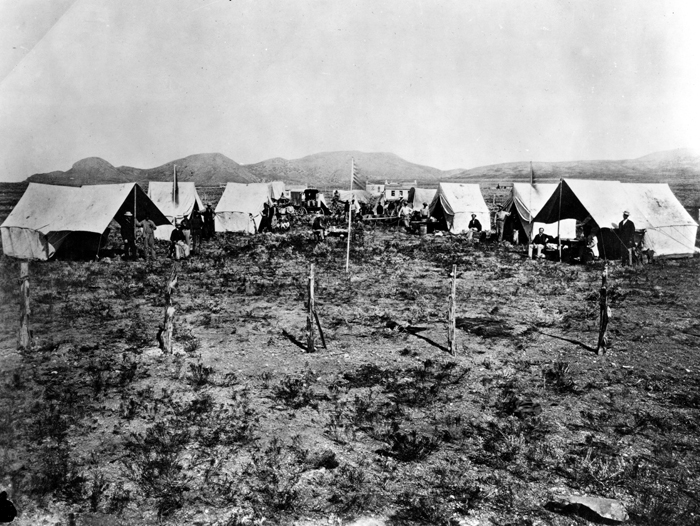
Sereno Watson and the King Survey: Click for a larger view of a King Survey Camp near Salt Lake City, Utah. Courtesy USGS, T.H. O'Sullivan, Photographer
A King Survey Camp
Near Salt Lake City

Courtesy USGS
T.H. O’Sullivan, Photographer


Click for a larger view of Ogden Canyon taken by the King Survey. Courtesy USGS, T.H. O'Sullivan, PhotographerThe Mouth of Ogden Canyon
at the time of the King Survey

Courtesy USGS
T.H. O’Sullivan, Photographer


Click for a larger view of Penstemon watsonii. Photographed in Millard County. And named for Sereno Watson of the King Survey. Courtesy PenstamenFestival.com
Penstemon watsonii
named for Sereno Watson
of the King Survey

Courtesy PenstemonFestival.com
Copyright Lisa White, Photographer

The mid-1800s were a transformative period in US history. The bloody Civil War had run its course. Twelve years earlier, the Mexican/American war had forced annexation of a vast territory that stretched from the Rockies to the Pacific Ocean. Across the northern edge of this territory, a transcontinental railroad was planned. An ambitious young geologist, Clarence King, convinced President Lincoln of the need to explore, survey and map the topography, watersheds, geology, mineralogy, flora and fauna of this vast uncharted region. King mustered 20 scientists, technicians and frontiersmen to form his Survey of the 40th Parallel. The Survey team took multiple years to thoroughly explore and map a 100-mile-wide band from Virginia City Nevada to Cheyenne Wyoming.

Among the men was one Sereno Watson, who at 42, found himself disenchanted by his forays into medicine, teaching, farming and banking. Word of the King Survey fired his imagination, so in 1867 he joined the migration west. A barefoot, penniless Sereno Watson found the Survey encamped on the lower Truckee River south of Pyramid Lake. More from pity than need, Clarence King let Watson join as an unpaid assistant. When illness sidelined the Survey’s botanist, Serano Watson eagerly took his place.

King prized Watson for his diligence and enthusiasm. In June of 1869, the Survey staked out what would become a favorite encampment at Parley’s Park north of Park City. From that base, Survey members fanned out to explore the Wasatch Range, the western spurs of the High Uintas, and the Great Salt Lake. Watson added to his plant collections, ultimately pressing 900 specimens, many new to science. He later curated them back at Yale. Watson honored the Survey’s leader by naming new plant species kingii, including a species each of biscuit root, buckwheat, bladderpod, flax, lupine, clover and ragwort. Asa Gray, then the reigning US botanist, honored Sereno in naming Penstemon watsonii, a lovely species discovered by the mining town of Austin Nevada. You can see the striking sky blue flowering spires of this wildflower amid montane meadows from eastern Nevada across central Utah into Colorado, including the vicinity of Parley’s Park.

This is Linda Kervin for Bridgerland Audubon Society.

Credits:

Images: Courtesy USGS

and Courtesy PenstamonFestival.org, Lisa White, Photographer,
Text: Jim Cane, Bridgerland Audubon Society

Additional Reading:
Cryptobiotic Soil Crusts

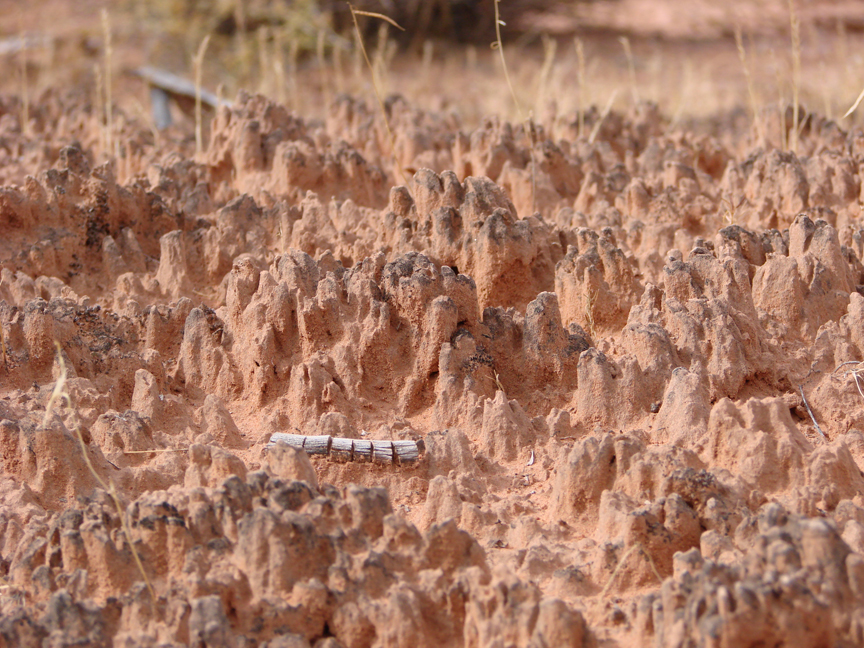
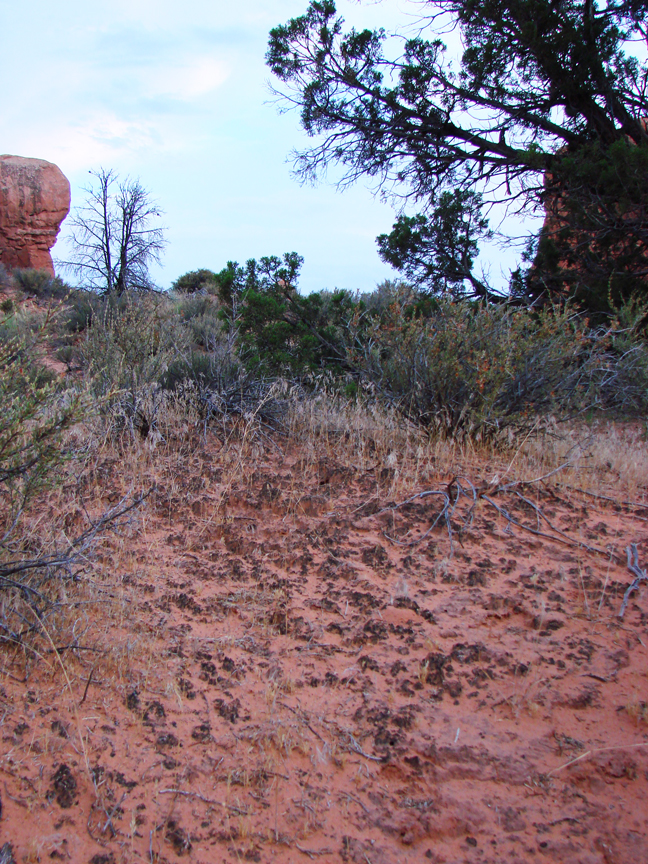
Click to view larger image of Cryptobiotic Soil Crust, Photo Courtesy and Copyright Mark Larese-Casanova
Cryptobiotic Soil Crust
Photo Courtesy & Copyright 2009
Mark Larese-Casanova

Hi, this is Mark Larese-Casanova from the Utah Master Naturalist Program at Utah State University Extension.

Looking out over a Utah desert, we might see relatively few plants- perhaps some sagebrush, maybe a few junipers or Joshua trees, or even some small wildflowers or cacti. What is less noticeable, though, is the living soil crust that holds this entire landscape together. It’s not just sand, but rather an important and vast partnership between bacteria, lichens, algae, and fungi. These soil crusts are often referred to as ‘cryptobiotic’, which means ‘living in suspended animation’. This is a fitting description, considering that water can be so rare in Utah’s deserts.

Cyanobacteria, which is often called blue-green algae, is the backbone of cryptobiotic soil crust. Vast networks of long, microscopic filaments of cyanobacteria and fungi grow in length when they are wet, and leave behind a casing that literally binds the soil together. So, what might otherwise be loose sand not only is less likely to be washed away by water or blown away by wind, but also is able to hold much more water for plants.

Click to view larger image of Cryptobiotic Soil Crust, Photo Courtesy and Copyright Mark Larese-Casanova
Cryptobiotic Soil Crust
Photo Courtesy & Copyright 2009
Mark Larese-Casanova

Cyanobacteria is also extremely useful to desert landscapes for its ability to take Nitrogen out of the air and make it available to plant roots in the soil. Desert soils typically have relatively low nutrients, so this is especially important to desert plants.

In many Utah deserts, cryptobiotic soil crusts can cover up to 70% of the ground surface. Old soil crust can often look like small mountain ranges with black or white peaks inhabited by lichens or mosses. The little valleys in between the tiny mountains of crust are perfect spots for the seeds of desert plants to grow. Over time, the above ground crust can grow up to ten centimeters, or four inches, thick!

However, cryptobiotic soil crust grows at an alarmingly slow rate of about one millimeter per year. So, any soil crust that is disturbed can take a very long time to recover. Depending on the amount of moisture a desert receives, it can take anywhere between 20 and 250 years for soil crust to grow back.

Next time you’re out in the desert, kneel down and have a close look at the telltale peaks and valleys of cryptobiotic soil crust. If you bring a magnifying glass, you just might be able to see some of the lichens and mosses. Be sure to stay on trail, though, and whatever you do, don’t bust that crust!

For Wild About Utah, I’m Mark Larese-Casanova.

Credits:

Images: Courtesy and copyright Mark Larese-Casanova
Text:     Mark Larese-Casanova, Utah Master Naturalist Program at Utah State University Extension.
Additional Reading:

US Department of Interior. 2001. Biological Soil Crusts: Ecology and Management. Bureau of Land Management Technical Reference 1730-2., https://www.blm.gov/nstc/library/pdf/CrustManual.pdf
Rosentreter, R., M. Bowker, and J. Belnap. 2007. A Field Guide to Biological Soil Crusts of Western U.S. Drylands. U.S. Government Printing Office, Denver, Colorado., https://www.soilcrust.org/

Looking for Nightjars

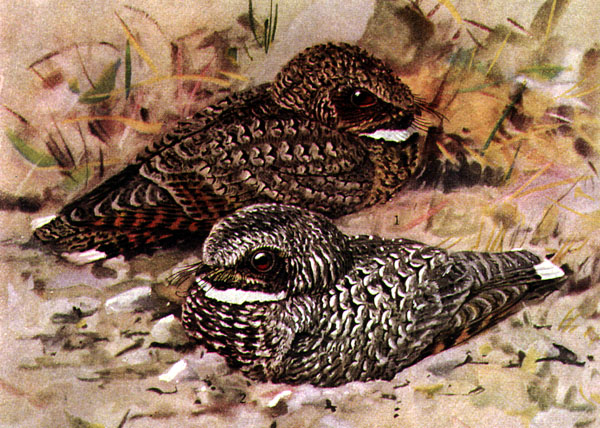
Looking for Nightjars: Click to view the larger image of Common Poorwill (front) and Dusky Poorwill. Courtesy Wikimedia and Louis Agassiz Fuertes (artist, 1874-1927), US Copyright expired
Common Poorwill (foreground)
Phalaenoptilus nuttallii
Dusky Poorwill
Phalaenoptilus nuttalli californicus
Courtesy Wikimedia and
Louis Agassiz Fuertes (artist, 1874-1927)
US Copyright expired

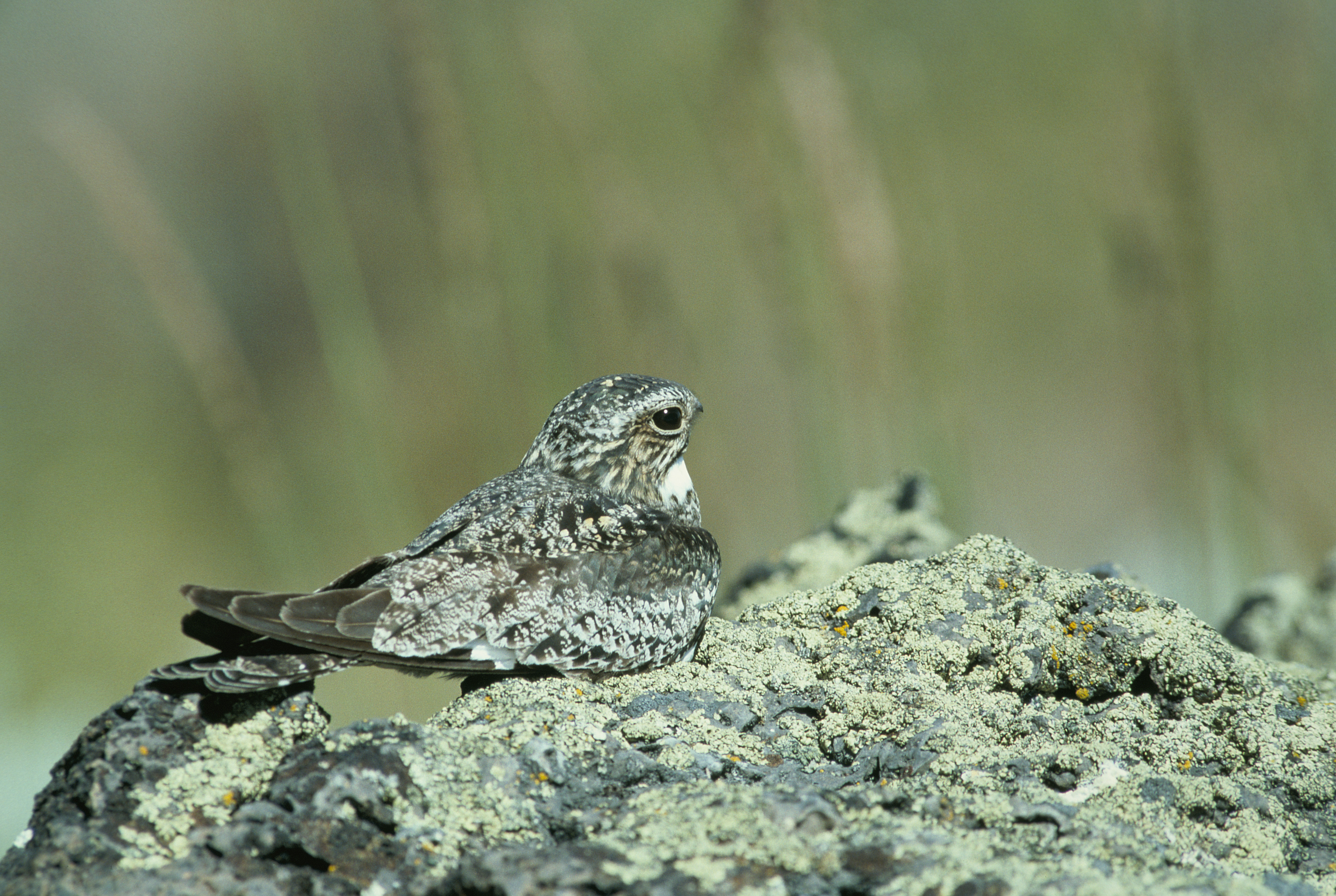
Click to view the larger image of Common Nighthawk. Courtesy Wikimedia and Gavin Keefe Schaefer, PhotographerCommon Nighthawk
Chordeiles minor
Courtesy Wikimedia and
Gavin Keefe Schaefer, Photographer
Licensed under the Creative Commons Attribution 2.0 Generic license

Click to view the larger image of Common Nighthawk. Courtesy US Images.FWS.gov and Dave Menke, PhotographerCommon Nighthawk
Chordeiles minor
Courtesy US FWS and
Dave Menke, Photographer

Hi, I’m Holly Strand.

Citizen Science networks are proliferating across the globe. These networks conduct important research that could not otherwise be accomplished –And they do it using nonprofessional, mostly volunteer labor. An army of civilian data collectors can capture more data over a larger area at a relatively small cost. Aside from collecting data, participants can generate ideas, and help coordinate various aspects of a particular program. Many citizen-driven networks collectenvironmental data at prescribed locations. Wielding Smartphones with GPS receivers, anyonecan instantaneously and accurately determine their geographic coordinates to submit along with their observations.

The Audubon’s Society Christmas Bird Count is one of the oldest and most successful examples of citizen science networks. Since 1900 volunteers have been collecting information about local populations of birds. More recent examples include FrogWatch USA (for observing frogs and toads) Project BudBurst (for observing the leafing and flowering of plants in relation to changing weather patterns) and the World Water Monitoring Challenge (for observing water quality indicators).

One project that recently piqued my interest is the US Nightjar Survey Network coordinated by The Center for Conservation Biology in Virginia.

“What in the world is a nightjar?” you might ask. “Is it something you take camping so you don’t have to get out of the tent?” No. A Nightjar is a medium-sized plump-looking bird withlong wings, a broad head and a very short bill. Nightjars have short legs in relation to their bodies. So they aren’t great at walking. They are exceptional fliers though , catching moths and other insects in mid-flight.

Nightjars are very hard to see because of their camouflage plumage and because they are mostly active after sunset and before sunrise. Thus, you’d want to memorize their very distinctive calls if you are going to try to find them.

Two nightjars breed regularly in Utah. We have the common poorwill which sounds like this…[INSERT 3 CALLS OF POORWILL] . That’s the eastern whippoorwill without the whip. Another Utah breeder is the common Nighthawk which sounds like this …[INSERT 3 CALLS OF NIGHTHAWK].

The nightjar survey for Utah and other northern states begins June 27 and runs through July 11, 2012. Individual surveys are easy to perform and do not take more than two hours to complete.Surveyors work at night, when the moon is at least half full. You need to drive, stopping at 10 points along a 9-mile route. At each point, you count all Nightjars seen or heard during a 6-minute period.

To participate in a survey you can sign up for a Pre-existing route or design your own route. There are still many routes left in all parts of Utah.

For pictures of these extremely interesting birds and a link to the remaining Nightjar Surveyroutes go to www.wildaboututah.org

For Wild About Utah, I’m Holly Strand.
Credits:


Images: Courtesy Wikimedia, Louis Agassiz Fuertes, Gavin Keefe Schaefer and Dave Menke, US FWS images.fws.gov

Text: Holly Strand

Sources & Additional Reading:


Cleere, Nigel. 2010. Nightjars: A Guide to Nightjars, Nighthawks, and Their Relatives. Princeton University Press. https://yalepress.yale.edu/yupbooks/book.asp?isbn=9780300074574

National Geographic Education Encyclopedic Entry: Citizen Science. https://education.nationalgeographic.com/encyclopedia/citizen-science/?ar_a=1

[Accessed June 21, 2012]

Woods, Christopher P., Ryan D. Csada and R. Mark Brigham.2005. Common Poorwill (Phalaenoptilus nuttallii), The Birds of North America Online (A. Poole, Ed.). Ithaca: Cornell Lab of Ornithology; Retrieved from the Birds of North America Online: https://bna.birds.cornell.edu/bna/species/032

United States Nightjar Survey Network (Center for Conservation Biology), https://www.nightjars.org/about/center-for-conservation-biology/

Utah Nightjar Survey Routes (Center for Conservation Biology), https://www.nightjars.org/about/center-for-conservation-biology/

Bird Song Recordings:


Common Poorwill links from WildSoundscape.org recordings collection at the University of Utah

Common Poorwill Phalaenoptilus nuttallii : Nathan Pieplow, XC11631. Accessible at www.xeno-canto.org/11631

Buff-collared Nightjar links from WildSoundscape.org recordings collection at the University of Utah 3 selections

Common Nighthawk Chordeiles minor ; Andrew Spencer, XC14400. Accessible at www.xeno-canto.org/14400

Hummingbird Nests

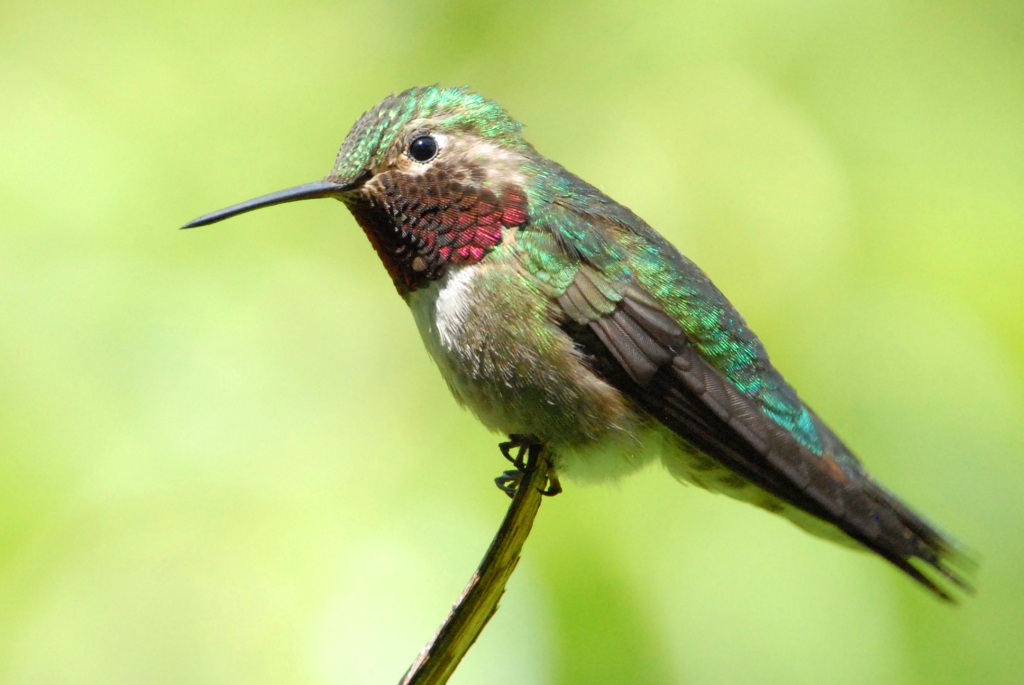
Male Broad-tailed Hummingbird
Selasphorus platycercus
Copyright © 2010 Michael Fish

Glacier Lilies
Erythronium grandiflorum
Copyright © 2010 Andrea Liberatore

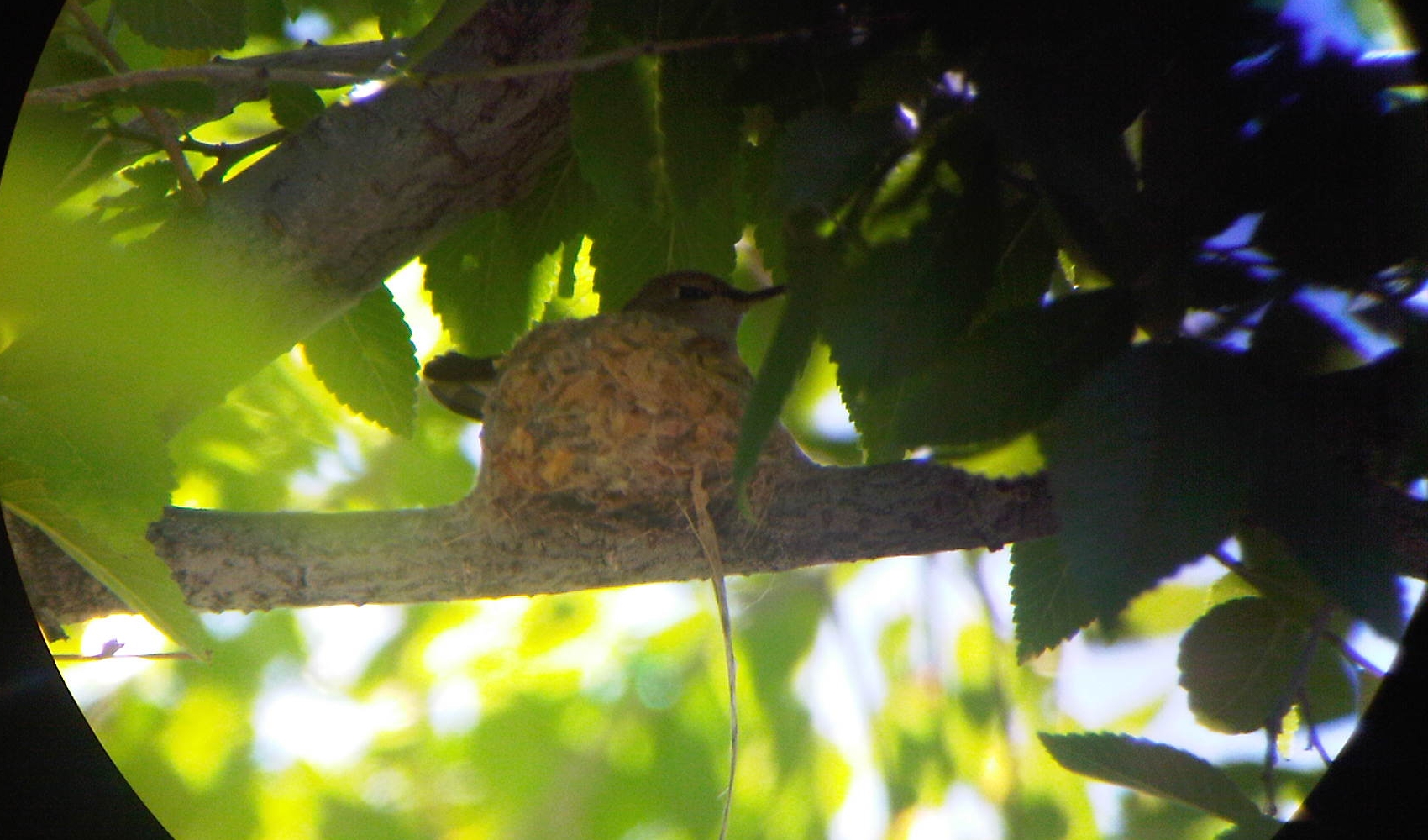
Adult Black-chinned Hummingbird
incubating eggs in nest
Archilochus alexandri
Copyright © 2010 Lyle Bingham
(cell phone through spotting scope)

Young Black-chinned Hummingbird
with beak hanging out of nest
Archilochus alexandri
Copyright © 2010 Lyle Bingham

The hummingbird feeders at Stokes Nature Center are a busy place this time of year. Little bullets of metallic green zoom in and out jockeying for position, while others rest or await their turn in the branches of nearby box elder trees. The birds are a great source of wonder and amusement for staff and guests alike.

June signals the start of nesting season for Utah hummingbirds. At this point in the year, the birds have mainly recovered from their lengthy migration from places as far away as Central America, and are ready to focus on their next set of challenges: establishing a territory, courtship, mating, and rearing young.

Hummingbird nests are a wonder all their own. Tiny and cup-like, they are generally found affixed to small branches near riparian areas. Nests are constructed primarily of plant materials and are lined with plant down such as the fluffy seeds produced by cottonwood trees. Materials used on the exterior of the nest vary from species to species. Black-chinned hummingbirds use leaves and flowers, while Broad-tailed hummingbirds are partial to decorating with lichens or shredded bark. Regardless of the exterior appearance, hummingbird nests have one important material in common – spider webs. Hummingbirds collect the webs and use them to plaster the outside of the nest, which serves two important purposes: acting as a glue that holds nest materials together while at the same time providing some flexibility that allows the nest to stretch and grow with the developing young.

Nests are occasionally constructed on the foundation of last year’s home, and two eggs around half-an-inch in length are laid and incubated by the female for about 16 days before hatching. Young will fledge and join their mother at your feeder about 20 days later. If nesting is successful, the family migrates south in the fall and will return to the same general area next May.

Finding food in early spring, however, is becoming more of a challenge each year to hummingbirds in the American West. A recent study published in the journal Ecology shows that hummingbird migrations and spring flower blooms are becoming out of sync. Broad-tailed hummingbirds in particular rely upon the nectar of petite, yellow glacier lilies – one of the first flowers to bloom in spring. Scientists have found that due to global temperature increases glacier lilies are blooming about 17 days earlier than they did in the 1970’s. The birds, however, haven’t altered their migration timing and so often arrive to find the flowers already in full swing. If this trend continues, scientists predict that within the next 20 years, the birds could miss the glacier lily bloom entirely. Hope lies in the hummingbirds’ ability to adapt– either by migrating farther north to places where lilies bloom later, or shifting their own migration time to match the changing bloom dates.

Photos of glacier lilies, Utah hummingbirds, and their nests, can be found on our website, www.wildaboututah.org. Thank you to the Rocky Mountain Power Foundation for supporting the research and development of this Wild About Utah topic.

For the Stokes Nature Center and Wild About Utah, this is Andrea Liberatore.

Credits:
Images: Courtesy & Copyright 2010 Mike Fish
            Courtesy & Copyright 2010 Andrea Liberatore
            Courtesy & Copyright 2010 Lyle Bingham
Text:     Andrea Liberatore, Stokes Nature Center in Logan Canyon.


Additional Reading:

Harrison, H. H. (1979) Peterson Field Guides: Western Birds’ Nests. Houghton Mifflin Co: Boston

Ehrlich, P.R., Dobkin, D.S., Wheye, E. (1988) The Birder’s Handbook: a field guide to the natural history of north American birds – The Essential Companion to Your Identification Guide. Simon & Schuster/Fireside Books: New York.

National Science Foundation press release, 05-30-2012, Where Have All the Hummingbirds Gone? Retrieved online at: https://www.nsf.gov/news/news_summ.jsp?cntn_id=124345&WT.mc_id=USNSF_51&WT.mc_ev=click

Live Webcam of black chinned hummingbird nest:
https://www.livestream.com/hummingbirdsociety

Nature News, Evolution News and Views, David Klinghoffer, The Genius of Birds: Watch a Hummingbird’s Tongue in Action – See more at: https://www.evolutionnews.org/2013/06/the_genius_of_b073491.html

Coro Arizmendi Arriaga, Maria del, Hummingbirds of
Mexico and North America, In Spanish and English, CONABIO, 2014, https://www.biodiversidad.gob.mx/Difusion/pdf/colibries_mexico_y_norteamerica.pdf