Utah Paper Wasps

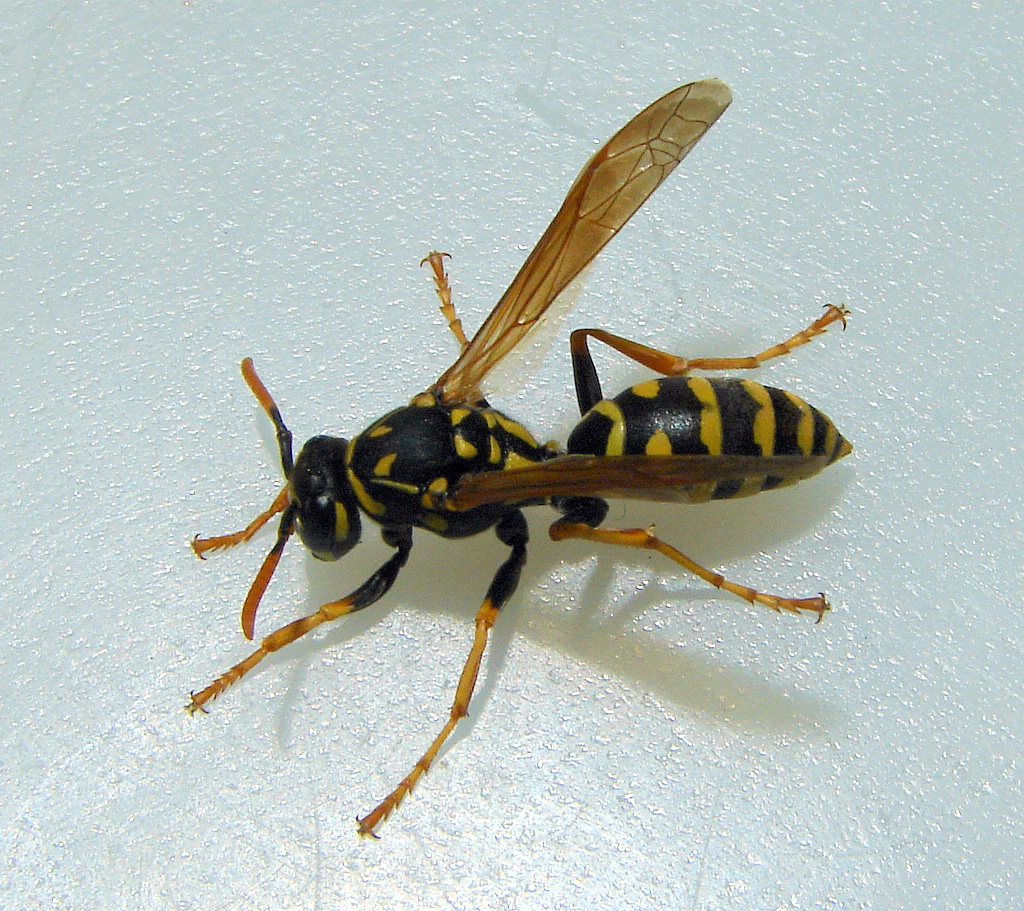
Adult Poliste Paper Wasp, Courtesy and Copyright 2009 Jim Cane - All Rights Reserved
Adult Poliste Paper Wasp
Copyright © 2009 Jim Cane

We credit the Chinese with inventing paper 2000 years ago, but some social wasps have been making their paper nests for eons. Species of paper wasps are found throughout Utah.

The burly bald-faced hornet workers are patterned in black and white. They place their grey, basketball sized paper nests in tree branches.

Bold yellow and black striped Yellowjackets are the persistent unwelcome guests at summer picnics. They too wrap their round nests in an envelope of paper, but typically place it in a shallow underground chamber. Within the paper envelope, both hornets and yellowjackets have a muti-tiered stack of paper honeycombs, like an inverted pagoda.

Open-faced nest of Polistes  paper wasp with grub-like larvae, Courtesy and Copyright 2009 Jim Cane - All Rights Reserved
Open-faced nest of Polistes
paper wasp with grub-like larvae
Copyright © 2009 Jim Cane

Our most familiar paper wasps belong to the genus Polistes. These are the reddish-brown spindly looking wasps. They make their simple paper nests under your home’s roof eaves and deck railings. A Polistes nest consists of a single inverted paper honeycomb suspended from a stiff, short stalk. There is no paper envelope, so you can readily see the hexagonal paper cells. Around your yard, look for the workers scraping fibers from weathered wood surfaces. Workers mix the chewed fibers with saliva and water, carry the ball of wood pulp home, and add it to the thin sheets of their paper nest. The nest is their nursery, where you can see the queen’s tiny sausage shaped eggs and the fat white grubs. The grubs are fed by their sisters, the workers, who scour the surrounding habitat for insect prey or damaged fruit.

The enclosed nest of the bald-faced hornet Copyright © 2009 Jim Cane - All Rights Reserved
The enclosed nest of the
bald-faced hornet
Copyright © 2009 Jim Cane

Utah has been invaded by the European species Polistes dominula. These interlopers are displacing our native Polistes. Where these European Polistes wasps are a stinging nuisance, you can easily dispatch them at their nests with a sprayed solution of dishwashing detergent and water. Thus stripped of its clever defenders, take the opportunity to admire their homes of paper.

This is Linda Kervin for Bridgerland Audubon Society.

Credits:

Photo: Courtesy and © Copyright 2009 Jim Cane

Text: Jim Cane, Bridgerland Audubon Society

Additional Reading:

https://extension.usu.edu/files/publications/factsheet/yellowjackets-hornets-wasps09.pdf

https://ohioline.osu.edu/hyg-fact/2000/2077.html

https://insects.tamu.edu/fieldguide/cimg348.html
Wildfires in Utah

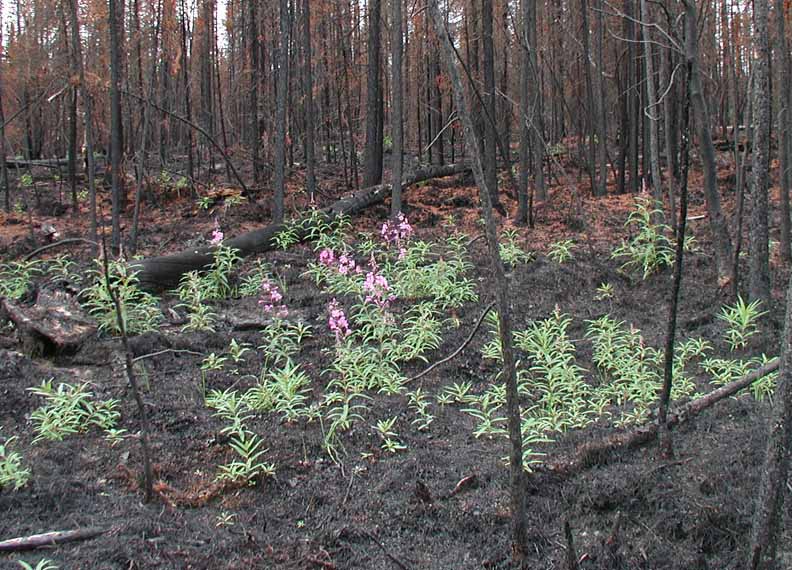
Wildfires in Utah: Click to view larger image of Fireweed growing in burned area, Photo Courtesy US FWS, U.S. Fish and Wildlife Service
Fireweed Grows in Burned Area
Photo Courtesy
U.S. Fish and Wildlife Service

Hi, this is Mark Larese-Casanova from the Utah Master Naturalist Program at Utah State University Extension.

Prior to settlement by the pioneers at the end of the 19th century, wildfires were relatively common throughout the mountains of Utah. Wildfires were a result of natural disturbance, such as lightning strikes, but many were purposely set by Native Americans. Wildfires restarted the cycle of forest succession and also created a mosaic of plant communities across the landscape.

Although Utah’s changing climate has had a major influence, human factors have considerably altered the natural fire regime over the past 150 years. Fire frequency slowly declined prior to settlement by the pioneers due to a period of global cooling; however, fire activity increased considerably to its highest point during the settlement period between 1856 and 1909. This increase was linked to the dramatic growth in human population and activity, which lead to increased surface fuel from extensive timber harvesting, and inevitably to more ignition sources for more frequent fires.

Between 1910 and 1990, there was a dramatic decline in wildfires throughout Utah, despite the gradual increase in global temperatures. This was due to intensive livestock grazing, habitat fragmentation as a result of development, agricultural expansion, and effective fire suppression. As a result, shade-intolerant trees that relied on fire for regeneration, such as aspen and lodgepole pine, were often replaced by long-lived, shade-tolerant trees, such as spruce and fir. In general, this resulted in a gradual decline in diversity of plant communities.

As a result, more homogenous forests that are densely populated with trees and accumulated fuels are more susceptible to intense fires that burn hotter and are more difficult to control. In 2007, Utah had a record-setting fire season that burned over 629,000 acres, including the 363,000-acre Milford Flat Fire. We’re halfway through the fire season this year, and approximately 400,000 acres have burned in Utah, costing over $47,000,000 to control. Additionally, wildfires that have burned about three-quarters of the acreage this year were classified as large in size. It seems that increased temperatures, decreased snowpack, and a century of land use and management has resulted in a dangerous wildfire situation in Utah and much of the West. It will take some creative management strategies, such as sustainable timber harvesting or prescribed fires, to tackle this ongoing issue if we want to limit the risk and cost of larger and more frequent wildfires.

For Wild About Utah, I’m Mark Larese-Casanova.

Credits:

Images: Courtesy U.S. Fish and Wildlife Service, images.fws.gov

Text:     Mark Larese-Casanova, Utah Master Naturalist Program at Utah State University Extension.
Additional Reading:

Madany, M. H., and N. E. West. (1983). Livestock grazing-fire regime interactions within montane forests of Zion National Park, Utah. Ecology 64:661-667., https://www.jstor.org/discover/10.2307/1937186?uid=3739928&uid=2&uid=4&uid=3739256&sid=21100946519023

Neugebauer, C. (Jul 15, 2012). Burning through money: the cost of Utah wildfires. Salt Lake Tribune., https://www.sltrib.com/sltrib/news/54485976-78/fire-fires-cost-costs.html.csp

Utah Fire Info webpage: https://www.utahfireinfo.gov/

Williams, J., D. Albright, A.A. Hoffmann, A. Eritsov, P.F. Moore, J.C.M. de Morais, M. Leonard, J.S. Miguel-Ayanz, G. Xanthopoulos, P. van Lierop. (2011). Findings and implications from a coarse-scale global assessment of recent mega-fires. 5th International Wildland Fire Conference. Sun City, South Africa., https://www.fao.org/docrep/014/am663e/am663e00.pdf

Live Worldwide Network for Lightning and Thunderstorms in Real Time, Blitzortung, https://en.blitzortung.org/live_lightning_maps.php?map=30

A Modern Day Phoenix

“Phoenix,” an immature Golden Eagle
Aquila chrysaetos
Courtesy Wildlife Rehabilitation Center of Northern Utah (WRCNU.org)

Elk Bath
From a 2000 fire in the
Bitterroot National Forest in Montana

Courtesy Wikimedia &
USDA Forest Service
John McColgan, Photographer

Hi, I’m Holly Strand.

You may have heard about the golden eagle nestling that was badly burned during a recent Utah wildfire. Its nest was totally destroyed, but the little eagle had fallen to the ground and survived. After the fire, he was found by Kent Keller, a volunteer for Utah’s Div. of Natural Resources, who had banded the young eagle a month before. The eagle was dehydrated—his feathers, face, and feet were badly burned. So Keller obtained a permit from wildlife officials to intervene. Now in the care of the Wildlife Rehabilitation Center of Northern Utah the eagle is recovering rapidly. Even so, it will take a while for the damaged feathers to be replaced by healthy new ones. Phoenix–as is he was aptly named–won’t learn to fly for at least another year.

With this and other fire-related stories in the news, I‘ve been wondering about the fate of animals caught in wildfires. Scientific observations of animal behavior during fire events are rare. But by conducting post-fire surveys, and comparing results with unburned areas, some researchers have been able to piece together an idea of who survives, who dies and who thrives.

Obviously, faster and more mobile animals have the advantage. Birds can fly away and most mammals can outrun the spreading flames. Spring fires can be disastrous, destroying birds who haven’t fledged –like Phoenix– or mammals who are still too immature to escape. Fortunately, fires are more frequent in mid to late summer when little ones have matured.

If a fire moves through an area quickly, without superheating the ground, dormant animals or those hiding in burrows can survive. The surrounding soil provides plenty of insulation. Soil also protects most soil macrofauna and the pupae of many insects.

Animals that live their lives totally or partially in the water may not suffer at all during a fire. However, smaller bodies of water, such as streams, can quickly heat up fairly quickly. Oxygen loss is a problem as well. And fire-fighting chemicals dumped from the air can end up in water, killing fish, frogs and other animals.

Indirectly, the alteration of habitat by fire can also restructure animal populations. Interestingly, there are quite a lot of animals that benefit from post-fire habitats. For example, the insect population above ground may plummet during a fire, but then increase above pre-fire levels when fresh young plants start to grow back. Burned trees are attractive to certain beetles as breeding sites. An increase in beetles is a windfall for the woodpeckers that devour them. Swallows and flycatchers use burned dead trees as perch sites. They survey from on high and then swoop to catch their insect dinner. Seed eating birds like Clark’s Nutcracker, gobble up conifer seeds when cones open in response to fire.

Among mammals, ground squirrels, pocket gophers and deer mice generally increase after severe fires. Even large herbivores such as pronghorn or deer may benefit from the increased food and nutrition on recent burns. In turn, predators of these creatures enjoy a bumper crop as well.

For images of Phoenix the recovering golden eagle and a link to the Wildlife Rehabilitation Center of Northern Utah go to www.wildaboututah.org.

For Wild About Utah, I’m Holly Strand.

Credits:

Images: Courtesy Wikimedia, Louis Agassiz Fuertes, Gavin Keefe Schaefer and Dave Menke, US FWS images.fws.gov
Text: Holly Strand

Sources & Additional Reading:


Baker, William L. 2009. Fire ecology in Rocky Mountain Landscapes. Washington, DC: Island Press.https://islandpress.org/ip/books/book/islandpress/F/bo7019409.html

Bradley, Anne F.; Noste, Nonan V.; Fischer, William C. 1992. Fire ecology of forests and woodlands in Utah. Gen. Tech. Rep. INT-287. Ogden, UT: U.S. Department of Agriculture, Forest Service, Intermountain Research Station. https://www.fs.fed.us/rm/pubs_int/int_gtr287.pdf

Hutto, RL. 1995. Composition of bird communities following stand-replacement fires in northern Rocky-Mountain (USA) conifer forests in Conservation Biology Volume: 9 Issue: 5 Pages: 1041-1058 https://www.fsl.orst.edu/ltep/Biscuit/Biscuit_files/Refs/Hulto%20CB1995%20fire%20birds.pdf

Wildlife Rehabilitation Center of Northern Utah https://wrcnu.org/

Utah Prairie Dogs

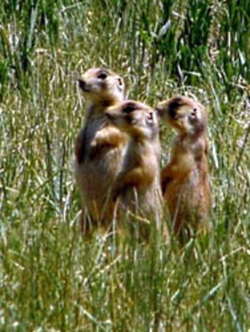
Three Utah Prairie Dogs
Cynomys parvidens
Courtesy US NPS, Bryce Canyon NP

White-tailed Prairie Dog
Cynomys leucurus
Courtesy US FWS
Rhonda Foley, Photographer

Throughout certain areas in southwestern Utah, construction is currently underway. New neighborhoods and subdivisions are being worked on daily, with mounds of dirt displaced. But this isn’t your typical suburban development. Its inhabitants are only 12 inches tall and furry.

The Utah prairie dog is the westernmost of five prairie dog species in the US and is unfortunately the most threatened. Since 1973 it has been a regular feature on the endangered species list, though it was downgraded to ‘threatened’ in 1984 and populations continue to show signs of growth.

Utah prairie dogs are very social creatures, living in large groups called colonies or towns which consist of hundreds or even thousands of individuals and their vast networks of underground burrows. While the group forages for grasses, seeds, leaves, and insects, colony guards or lookouts take turns watching for danger. If a hazard is identified, loud barks echo throughout the colony and foraging dogs run for cover.

Earlier this spring, Utah Prairie dogs in Parowan made national news when the town started construction on a $300,000 fence to keep these industrious critters from burrowing under and buckling the local airport’s runway. Their threatened status means special care must be taken in removing the dogs from airport property and relocating them to nearby public lands. Airport personnel waited until the beginning of July, after this year’s offspring had matured and left home, to begin the specialized trapping and relocation process.

While some consider prairie dogs and their digging habits to be a nuisance, these diminutive creatures are an incredibly important part of their ecosystem. Ecologists have a name for organisms whose role is disproportionately large – a keystone species. In architecture, a keystone is the uppermost piece in an arch – the one on which all the other stones lean. Ecologically speaking a keystone species is one that supports many others that live around it.

It has been estimated that more than 170 species – many of them also threatened or endangered – depend in some way on the Utah prairie dog, generally for either food or shelter. For example, the quirky and unique burrowing owl depends upon abandoned prairie dog homes for constructing its underground nests. Black – footed ferrets, whose population was at one time reduced to only 18 individuals, inhabit abandoned burrows within a large prairie dog colony and rely almost 100% upon the rodents for food.

Other animals that are linked to the Utah prairie dog include badgers, coyotes, sage grouse, Swainson’s hawks, and kit foxes. Like its architectural counterpart, if an ecological keystone is removed the whole system is prone to collapse. Thankfully, with a species recovery plan in place, and a dedicated inter-agency group of supporters, the Utah prairie dog’s housing market continues to boom.

Thank you to the Rocky Mountain Power Foundation for supporting the research and development of this Wild About Utah topic.

For the Stokes Nature Center and Wild About Utah, this is Andrea Liberatore.

Credits:
Images: Courtesy & US FWS, images.fws.gov
            Courtesy US NPS, https://www.nps.gov/brca/naturescience/upd.htm

Text:     Andrea Liberatore, Stokes Nature Center in Logan Canyon.


Additional Reading:

Hengesbaugh, M.G. (2001) Creatures of Habitat: The Changing Nature of Wildlife and Wild Places in Utah and the Intermountain West. Utah State University Press: Logan, UT,

U.S. Fish & Wildlife Service – Mountain-Prairie Region. (2012) Endangered Species: Utah Prairie Dog. Available online at: https://www.fws.gov/mountain-prairie/species/mammals/UTprairiedog/

National Park Service – Bryce Canyon National Park, Utah. (2012) Utah Prairie Dog. Available online at: https://www.nps.gov/brca/naturescience/upd.htm

Carlton, J. (2012) In Utah, A Town Digs Deep to Battle Prairie Dogs. Wall Street Journal, May 6 2012. Available online at: https://online.wsj.com/article/SB10001424052702304020104577384642186959960.html