Huddling for Warmth

Beaver in snow, Courtesy US FWS
Beaver in snow
Image Courtesy US FWS

When temperatures dip below freezing and wind hurries on its way, we often find ourselves looking for another warm body to huddle near and share heat. Children snuggle into laps and dogs lean close.

Many animals huddle to stave off the cold. Species that are strong individualists in balmy seasons seek warmth from a group when temperatures drop. Many non-colonial rodents will share a den come winter.

[Kevin Colver recording: Songbirds of the Southwest Canyon Country]

Pygmy nuthatches jam themselves tightly together into tree cavities as do flying squirrels. Through the winter, worker honeybees huddle tightly around a central patch of wax comb where developing larvae are growing. The larvae die if temperatures drop below 83 degrees, so a living blanket of worker bees shivers to generate the heat equivalent to a 40 watt incandescent bulb.

An animal loses heat in direct proportion to its surface area. By huddling together, each animal reduces its exposed surface area. This in turn allows them to reduce their metabolic rate and so conserve energy at a time when food can be scarce or inaccessible.

Nests or dens occupied by numerous individuals can be much warmer than ambient. A snow covered lodge with at least 2 beaver occupants can be as much as 35 degrees warmer than the outside air temperature. A study of taiga voles showed that underground nests containing 5 to 10 residents remained 7 to 12 degrees warmer than the surrounding soil and up to 25 degrees warmer than the air above. Individuals take turns going out to forage so their nest remains toasty.

Living in close proximity does have its problems. Disease and parasites are readily transmitted in tight quarters. Local food competition could potentially lead to hunger or starvation. Predators may more easily discover prey in groups. But for many animals, the advantages of huddling for warmth far outweigh the risks during our chilly winter months.

This is Linda Kervin for Bridgerland Audubon Society.
Credits:

Photos: Courtesy US FWS

Audio: Courtesy Kevin Colver, https://wildstore.wildsanctuary.com/collections/special-collections, https://wildstore.wildsanctuary.com/collections/special-collections

Text: Linda Kervin, Bridgerland Audubon Society
Additional Reading:

Life in the Cold: An Introduction to Winter Ecology. Peter Marchand. 1991, University Press of New England. https://www.amazon.com/Life-Cold-Introduction-Winter-Ecology/dp/0874517850

Lives of North American Birds. Kenn Kaufman. 1996, Houghton Mifflin Company. https://www.amazon.com/American-Peterson-Natural-History-Companions/dp/0395770173

The Birder’s Handbook. Paul R. Ehrlich, David S. Dobkin and Darryl Wheye. 1988, Simon & Schuster, Inc. https://www.amazon.com/Birders-Handbook-American-including-Regularly/dp/1435277589
Sleeping Winter Away

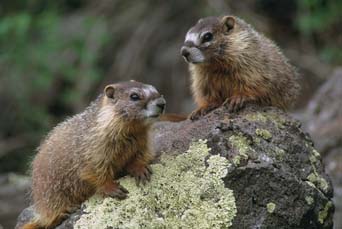
Yellow-bellied marmots,
one of Utah’s true hibernators
Photo courtesy Utah Division of Wildlife Resources,
Copyright Lynn Chamberlain

As Utah’s blanket of snow grows thicker and cold temperatures set in, some of our furred friends quietly retire for the winter. Gone are the marmots that basked on sunny slopes, the bears that browsed in the forests, and the bats that winged silently overhead.

Animals have a number of different strategies to help them survive in winter. Some, such as hummingbirds, migrate to a more temperate climate. Some have special adaptations that allow them to withstand cold temperatures such as mink, which grow wonderfully thick winter coats. And some, such as marmots, bears, and bats, simply find a cozy place to sleep away the winter.

The general term for this period of inactivity is “dormancy,” which includes more specific terms such as “hibernation” and “torpor.” During this time, an animal’s heart rate, breathing rate and metabolism slows down considerably. Contrary to popular belief, most of the mammals that hole up for the winter do not actually hibernate. The term hibernation applies to only a small portion of our Utah mammals – a few species of bats and some rodents like the marmot. True hibernation means that an animal’s metabolism turns off to the point that its body temperature nearly matches that of the environment around it. And in winter, this means that body temperatures can drop to nearly freezing. Hibernating animals become unresponsive to environmental stimuli such as loud noises and being touched, and it takes hours and lots of energy for them to finally awaken.

A black bear,
which survives winter
in a state called torpor
Photo courtesy Utah Division of Wildlife Resources,
Copyright Lynn Chamberlain

In contrast, consider the bear, which does not technically hibernate, but instead enters a state called torpor or ‘winter lethargy’. A bear’s body temperature does decrease during this time but never approaches freezing. Bears also remain semi-active occasionally moving about in their dens, or even giving birth and tending to their newborns. Other animals that become largely inactive in winter but do not fully hibernate include skunks, raccoons, and opossums. These animals can respond very well to environmental stimuli and can resume their full abilities in less than a minute if disturbed – something to keep in mind in case you stumble across a bear’s den this winter.

Thanks to the Rocky Mountain Power Foundation for supporting research and development of this Wild About Utah topic. For the Stokes Nature Center and Wild About Utah, this is Andrea Liberatore.

Credits:

Photos: Courtesy Utah Division of Wildlife Resources and Copyright Lynn Chamberlain, photographer

Text: Andrea Liberatore, Stokes Nature Center

Additional Reading:

Encyclopædia Britannica. 2010. “Dormancy.” Encyclopædia Britannica Online. https://www.britannica.com/EBchecked/topic/169514/dormancy (Accessed Nov. 20, 2010)

New Jersey Division of Fish and Wildlife. 2010. Black Bear Biology and Behavior. https://www.state.nj.us/dep/fgw/bearfacts_biology.htm (Accessed Nov. 20, 2010)

Pygmy Rabbits

Pygmy Rabbit
Brachylagus idahoesis
Courtesy & Copyright 2007 Len Zeoli

Pygmy rabbits!! Sure, like there’s these little rabbits running around out there, and nobody’s seen them. Right!

Well pygmy rabbits do exist and they’re cute as a button. They are found living it up in sagebrush from Utah north into Idaho and west to California. They eat sagebrush year-round but to fight monotony, they add a few forbs and grasses during spring, summer and fall.

Pygmy rabbits look like cottontails, but different. There’s no conspicuous white fluff ball on their tail. The fur is more slate gray than the pale gray of the desert cottontail. The pygmy rabbit is dinky, with significantly smaller ears and weighing less than a pound. Pygmy rabbits favor dense stands of big sagebrush, sometimes near riparian areas. Based on Val Grant’s experience they can also be found in sparse sagebrush and well away from water.

These rabbits are not as easy to see as they are to identify by their sign: fecal pellets, browse patterns and mobility patterns in snow. When you’re out in sagebrush, check the ground under a sage plant. If you see small piles of pellets the size of BBs, you may be onto the wily pygmy. They dig burrows beneath the sage plants and frequently fresh pellets are found at the entrance. The sage branch tips will show distinct browsing on the new growth. In winter, launching pads used by pygmy rabbits are a sure way to identify their presence. Rather than frolic through the snow like cottontails and jackrabbits, leaving a distinct trail, these little guys leap from pad to pad when traveling across the snow during the winter. This adds skiers and snowshoers to the list of observers who should be on the lookout for these diminutive rabbits with a big appetite for sagebrush.

This is Linda Kervin for Bridgerland Audubon Society.
Credits:

Photos: Courtesy & Copyright 2007 Len Zeoli

Text: Val Grant, Bridgerland Audubon Society

Additional Reading:

Pygmy Rabbit, The Rabbits Archive, https://www.rabbitsarchive.com/species/pygmy-rabbit.php

Pygmy rabbit pictures and facts, https://thewebsiteofeverything.com/animals/mammals/Lagomorpha/Leporidae/Brachylagus/Brachylagus-idahoensis.html

Endangered Rabbit Beats the Odds, College of Agricultural, Human and Natural Resource Sciences, Washington State University, https://cahnrsnews.wsu.edu/2007/06/13/endangered-rabbit-beats-the-odds/

Pygmy rabbit, mondo adorable, L.A. Unleashed, LA Times Local, February 8, 2009, https://latimesblogs.latimes.com/unleashed/2009/02/pygmy-rabbit.html

Pygmy Rabbits, Western Watersheds Project, https://www.westernwatersheds.org/wildlife/pygmy-rabbits

Follow the Bouncing Deer

Image Pending

Hi, I’m Holly Strand from Stokes Nature Center in beautiful Logan Canyon.Follow the Bouncing Deer

Mule deer are frequent visitors to our yard in Providence. I love their large liquid eyes and their huge questioning ears.

What I don’t like is that they eat our garden and stunt our trees. So when I find them munching, I fling open the back door and run toward them, yelling and flapping my arms –often in my nightshirt. In response, they bounce, bounce, bounce away. That is, they employ a springy gait that biologists call stotting. What possible benefit is it to bounce like? Why don’t they just run?

When a mule deer or pronghorn or bighorn stotts, it keeps the right and left forelegs close together and likewise the hindlegs. During the jump, all four legs leave the ground simultaneously and land simultaneously. In between landings all four legs are stiff and straight.

In between jumps the animal is suspended in the air for 64% of the entire length of one stride. You would think that the energy required to keep the animal in the air could be better used to propel forward. In other words, wouldn’t a fast horizontal run be a better way to keep a coyotes teeth out of your rump? Or– in the case of our backyard– to distance yourself from a wild looking woman waiving her arms and yelling.

One researcher clocked the speeds of galloping vs. stotting mule deer. Surprisingly, the fastest speeds of a stotting mule deer were just as fast as top galloping speeds—around 9.5 meters per second. That’s over 21 miles per hour.

There are lots of opinions on why stotting evolved. But most experts agree it is a response to predators.

Some say that stotting is a signal to predators that deer is healthy and will be able to outrun the predator. Thus, the deer is sending a “Don’t waste your time” message.

Many believe that stotting delivers an advantage on rugged open terrain. Stotters can clear rocks, logs and brush more effectively than gallopers.

Stotting might also be an anti-ambush behavior. The height gained during stotting allows the mule deer to check the surrounding vegetation along their escape path. Crouching coyotes, wolves and mountain lions are detected and avoided.

Whatever the reason—and there may not be just one–those bouncing deer are fun to watch.

For sources and archives of past Wild About Utah programs, go to www.wildaboututah.org.

For Wild About Utah and Stokes Nature Center, I’m Holly Strand.

Credits:
Photo: Courtesy US FWS Digital Media, Jack Woody Photographer
Text: Stokes Nature Center: Holly Strand

Sources & Additional Reading

Caro, T.M. 1986. The functions of stotting: a review of the hypotheses. Animal Behaviour Vol. 34, No. 3. Pp. 649-662. https://www.sciencedirect.com/science?…

Lingle, Susan. 1992. Escape gaits of white-tailed deer, mule deer and their hybrids: Gaits observed and patterns of limb coordination. Behaviour Vol. 122 No. 3-4. https://booksandjournals.brillonline.com/content/journals/10.1163/156853992×00499

Utah Division of Wildlife. 1999. Mule Deer. Wildlife Notebook Series No. 13
wildlife.utah.gov/publications/pdf/2010_mule_deer.pdf [Accessed September 29, 2010]