Utah’s Desert Fox

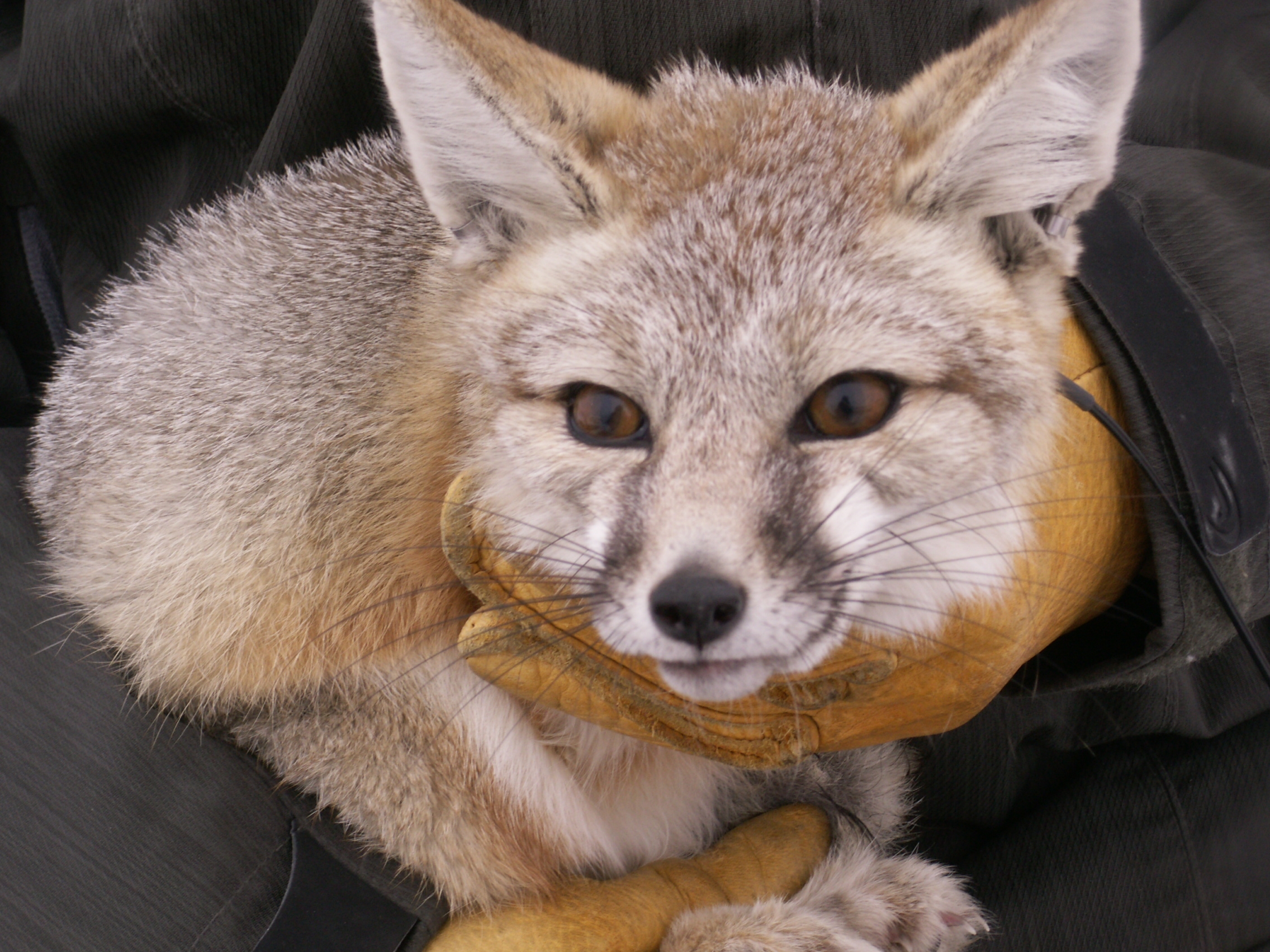
Kit Fox, click to view larger image, Photo Courtesy and Copyright © 2009 Bryan Kluever, graduate research assistant, Utah State University Department of Wildland Resources
PhD student Bryan Klueve
with an adult kit fox
that was captured
with a box trap.
Kit foxes are weighed,
fitted with a radio collar,
and then released
Courtesy & Copyright © 2010
Bryan Kluever
Graduate Research Assistant
Utah State University
Dept of Wildland Resources

Hi, I’m Holly Strand from Stokes Nature Center in beautiful Logan Canyon.

The kit fox just might be Utah’s cutest mammal. Weighing in at four to five pounds or so, the kit fox is about a third of the size of the more common red fox.. The kit fox has delicate cat- like features and it has comically large, furry ears. It’s desert-colored coat is tinged with rusty orange finishing in a long black-tipped bushy tail.

The kit fox is the only desert dwelling fox in North America. In Utah, you’ll find it mostly in the western part of the state, where it lives off field mice and jackrabbits as well as insects, birds, amphibians and fish.

The kit fox has evolved a number of adaptations to deal with the desert’s harsh conditions.. First of all those big ears aren’t just for looks. They help the kit fox dissipate body heat through evaporative cooling.

Secondly, kit foxes are nocturnal, avoiding the high temperatures of the daytime hours. During the day they lounge in subterranean dens.

Kit fox legs are relatively short for a fox. That helps them zig-zag through the brush when chasing prey or being chased. And the pads of their paws are furry which gives them better traction in the sandy soil of desert habitats.

Long droughts are common in desert environments and kit foxes have developed ways to deal with them. During a drought, fewer vixens breed and litters become smaller. Kit fox families maintain large territories—larger than necessary for normal years. So when a drought hits, and the population of prey species plummets, the foxes have a larger area in which to hunt.

Adult kit fox prior to being
released. Note the black
collar antenna on the right
side of the fox.
Courtesy & Copyright © 2010
Bryan Kluever

Kit foxes get top marks in water conservation. Little goes in and little comes out.. A kit fox can exist for many months without ever drinking water. Instead, the fox can draw water from the food that it eats. And that water is used with great efficiency. Little is lost through metabolic processes such as urination, defecation breathing and panting.

Too see pictures of the diminitive kit fox, go to www.wildaboututah.org

Thanks to Brian Kleuwer and Mary-Ann Muffoletto of Utah State University’s College of Natural Resources for supporting this Wild about Utah topic.

For Wild About Utah and Stokes Nature Center, I’m Holly Strand.
Credits:
Images: Courtesy & Copyright Bryan Kluever, USU Department of Wildland Resources
Text:     Mary-Ann Muffoletto, Utah State University College of Natural Resources

Additional Reading:

White, P. J. and K. Ralls. 1993. Reproduction and spacing patterns of kit foxes relative to changing prey availability. Journal of Wildlife Management 57:861–867 The Wildlife Society, https://si-pddr.si.edu/dspace/bitstream/10088/510/1/White1993.pdf

Kit Fox (Vulpes macrotis), Wildlife Notebook Series No. 9, Utah Division of Wildlife Resourceswildlife.utah.gov/publications/pdf/2010_kit_fox.pdf

Kit Fox (Vulpes macrotis), Species Fact Sheets, Utah Conservation Data Center, Utah Division of Wildlife Resources, https://dwrcdc.nr.utah.gov/rsgis2/Search/Display.asp?FlNm=vulpvelo

Bats and Echolocation

Bats and Echolocation: Little Brown Bats, Courtesy U.S. Fish and Wildlife Service, Photographer: W.D. Fritzwater
Little Brown Bats
Photographer: W.D. Fritzwater
Courtesy US FWS

Hi, I’m Holly Strand from Stokes Nature Center in beautiful Logan Canyon.

There are approximately 4600 mammal species in the world. A fifth—yes, 20%– of these species are bats. They are found everywhere except Antarctica. In Utah they are found at every elevation and in every ecosystem.

Bats are the only mammal that flies. “You forgot about humans,” my very precise husband points out. Well, OK bats are the only mammal that flies without a license and an airplane.

The majority of bats have smallish eyes perhaps leading to the expression “blind as a bat.” But bats are not at all blind. All of them can see and some rely solely on vision for both navigation and foraging. But most bats also have a sixth sense—called echolocation–to navigate and detect prey.

Mariana Fruit Bat
From the
Northern Mariana Islands
Photographer: Ann Hudgins
Courtesy US FWS

Echolocation refers to the process of sending out pulses of sound and listening to
the echoes to locate or avoid objects. Bats emit pulses of high frequency sound from their larynx or voicebox. These sounds are ultrasonic which means that they occur at frequencies beyond the range that humans can hear. The sounds are emitted through the mouth in some bats and through the nose in others.

The sounds bounce off external objects and echoes are returned to the bat’s ear. The size and shape of the bat’s ears help amplify the returning sound. The sound travels through the ear and is converted to vibrations in the inner ear fluid and then on to the brain via the auditory nerve.

Bat brains have unique structures that compare the features of the original sound pulse against the characteristics of the returning echoes. By assembling and assessing the return data, bats can know the direction of and distance of an object. Some bat species have evolved echolocation to such a degree that they can even distinguish shape among individual species of insects.

Townsend’s Big-eared Bat
Courtesy National Park Service

Because of echolocation bats are phenomenal hunters in low light conditions. A single little brown bat can catch 300 to 3,000 insects per night, and a nursing mother little brown bat eats more than her body weight each night — up to 4,500 insects. Hmm. That’s a lot of mosquitoes. I think I’ll invite some bats to my backyard this summer.

Thanks to the Marie Eccles Foundation –the Russell Family for supporting Stokes Nature Center programs.

For Wild About Utah and Stokes Nature Center, I’m Holly Strand.

Credits:
Images: Courtesy US FWS and USDA Forest Service
Text: Stokes Nature Center: Holly Strand

Sources & Additional Reading

Bat Conservation International. 1997. Bat Chat: An Introduction to Echolocation
https://www.batcon.org/, https://www.batcon.org/resources/media-education/learning/bat-squad/bat-squad-ep-4-bat-chat-join-the-bat-squad

Wilson, Don E. 1997 Bats in Question: The Smithsonian Answer Book. Smithsonian Institution Press, Washington, DC https://www.amazon.com/Bats-Question-Smithsonian-Answer-Book/dp/1560987391

Bats Live, Prince William County Public Schools, Manassas, VA, https://batslive.pwnet.org/

Bat Week 2015
Sometimes misunderstood, bats are important and fascinating animals. Watch this video to learn some bat facts, find out what challenges are facing bats today and what you can do to help #savethebats.
Bat Week Video

13 Facts About Bats, US Department of the Interior, Blog, 10/24/2016, https://www.doi.gov/blog/13-facts-about-bats

White-nose syndrome: a disease of bats, Wildlife Blog, Utah Division of Wildlife Resources, https://wildlife.utah.gov/news/wildlife-blog/724-white-nose-syndrome-a-disease-of-bats.html

Building nurseries for big-eared bats, Wildlife Blog, Utah Division of Wildlife Resources, https://wildlife.utah.gov/news/wildlife-blog/707-building-nurseries-for-big-eared-bats.html

Beavers: The Original Army Corps of Engineers

Beaver with branch in water
Courtesy US FWS,
Steve Hillebrand, Photographer


Hi, I’m Holly Strand from Stokes Nature Center in beautiful Logan Canyon.

Beavers and beaver dams are a common feature of the Utah landscape. You’ll see the dams on smaller streams and side channels, constructed of branches, downed trees and mud. The still, deep water of the resulting pond creates ideal conditions for a beaver lodge. Beavers can escape and hide from predators by slipping into the pond and disappearing into the lodge. Beavers also use their ponds to cache their favorite
food—aspen and willow.

Because of their tree cutting and dam making skills, humans tend to have two divergent opinions of beavers: 60-pound nuisance or environmental engineer.

Beaver lodge
Courtesy US FWS
Hans Stuart, Photographer

Beavers are considered a nuisance when they gnaw down trees that humans want to keep. Dams can flood roads or stop up irrigation canals. When beaver activity conflicts with human interests, they—the beavers–are likely to be trapped and killed.

However, beaver activity has many positive environmental consequences that we are just beginning to appreciate. Wetlands created by beaver dams help soak up sediments, improving downstream water quality. Because of beaver dams, the winter snowpack isn’t lost in a short spring pulse, This results in a more constant stream flow through the summer –and that’s important as Utah’s climate is predicted to become drier. Finally, beaver dams enhance habitat for many other fish and wildlife species and plants.

Beaver in pond
Courtesy US FWS
Steve Hillebrand, Photographer

According to Dr. Joe Wheaton, a geomorphologist at Utah State University, there’s a lot of untapped potential for employing beaver engineers in stream and floodplain restoration. Say you want to restore a stream by reconnecting it with its floodplain. You need to excavate channels, redirect stream flow, revegetate and nurture the
area for a long period of time. To accomplish this, you often need a
number of highly trained professionals and some large Tonka toys.

Alternatively –under the right conditions– you might transplant a
colony of beavers and let them apply their vigorous work ethic to your
landscape and get quite satisfying results.

Recognizing that nuisance beavers can be rehabilitated into hard
working wetland engineers and stream habitat restorationists, the Utah
Division of Wildlife Resources has rolled out the state’s first beaver
management plan in 2010. This plan encourages live trapping of entire
families of beavers in nuisance areas and moves them to specific sites where their
environmental services can be appreciated and put to use.

Beaver in snow
Courtesy US FWS

Thanks to the USU College of Natural Resources for supporting this Wild about Utah topic.

For Wild About Utah and Stokes Nature Center, I’m Holly Strand.

Credits:
Images: Courtesy US FWS, Photographers: Steve Hillebrand and Hans Stuart, https://images.fws.gov
Text: Holly Strand, Stokes Nature Center

Sources & Additional Reading

Collen, P. and R.J. Gibson. 2001. The general ecology of beavers (Castor spp.), as related to their influence on stream ecosystems and riparian habitats, and the subsequent effects on fish – a review. Reviews in Fish Biology and Fisheries 10: 439–461, 2001. https://web.archive.org/web/20230202160926/https://www.researchgate.net/publication/227028536_The_general_ecology_of_beavers_Castor_spp_as_related_to_their_influence_on_stream_ecosystems_and_riparian_habitats_and_the_subsequent_effects_on_fish_-_A_review [ Accessed May 1, 2010]

Prettyman, B. 2009. Utah wildlife: Leave it to the beavers. Article in Salt Lake Tribune, October 16, 2009. https://www.sltrib.com/ci_13570110 [ Accessed April 29, 2010]

Smithsonian Castor Canadensis Information Page https://www.mnh.si.edu/mna/image_info.cfm?species_id=32 [ Accessed April 29, 2010]

Big Bend Habitat Restoration Project: A Natural Work of Heart, Open Spaces-A Talk on the Wild Side, US FWS, https://www.fws.gov/news/blog/index.cfm/2016/3/25/Big-Bend-Habitat-Restoration-Project-A-Natural-Work-of-Heart [Accessed March 31, 2016]

Beaver Dams Strengthened by Humans Help Fish Rebound
60-Second Science – July 25, 2016 – By Jason G. Goldman02:29 https://www.scientificamerican.com/podcast/episode/beaver-dams-strengthened-by-humans-help-fish-rebound/ Also available through the podcast https://itunes.apple.com/us/podcast/60-second-science/id189330872?mt=2

Restoring Degraded Waters, One Pest at a Time, Utah State Magazine, Utah State University, December 7, 2021, https://utahstatemagazine.usu.edu/environment/restoring-degraded-waters-one-nuisance-at-a-time/

Goldfarb, Ben, Eager: The Surprising, Secret Life of Beavers and Why They Matter, Chelsea Green Publishing, March 8, 2019, https://www.amazon.com/Eager-Surprising-Secret-Beavers-Matter/dp/1603589082/ref=asc_df_1603589082/

American Pronghorn

American Pronghorn Buck
Courtesy US FWS Digital Library
Photographer: James C. Leopold

Hi, I’m Holly Strand from Stokes Nature Center in beautiful Logan Canyon.

The American pronghorn has an identity problem. It’s Latin name Antilocapra Americana means “American antelope goat.” But the fleet-footed animal of the American West is neither an antelope nor a goat. It is the sole survivor of a family of hooved animals that flourished in the Miocene, from 7-25 million years ago. More than 13 species of that family have been found in the fossil record, but only one pronghorn survived to modern times. 
 

American Pronghorn DoePhotographer: James C. Leopold Courtesy US FWS Digital Library

Many consider the pronghorn to be the fastest land animal in the world. Certain individuals have been clocked up to 60 miles an hour. It’s true that cheetah can go 70 miles per hour,–but only for several hundred yards. The pronghorn on the other hand, can go for great distances at high speed without breaking a sweat, leaving pursuers such as coyotes and wolves in the dust. Mountain lions occasionally creep up behind them, but that’s tricky in the open grasslands and shrub steppe that pronghorns prefer. Simply put, no land mammal on earth can keep up with the pronghorn over a significant distance.

Pronghorn Herd RunningCourtesy US FWS Digital Library
Photographer: Jack Woody

So why is this animal so implausibly fast? John Byers of the University of Idaho believes that the pronghorn and its relatives evolved traits to enhance speed under the influence of ghost predators. These predators are now extinct but their existence is memorialized through the adapted traits of their prey.

Before the late Pleistocene extinction, a variety of carnivorous megafauna filled grasslands often referred to as the American Serengeti. The giant short-faced bear, the American lion, a jaguar, a form of hyena and the saber-toothed cat were likely ambush predators of the pronghorn. But the most compelling reason for the pronghorn’s improbable speed is the presence of the North American cheetah. This long -limbed cat with powerful heart and lung capacity set off an evolutionary arms race with the pronghorn. Natural selection favored speed since slow cats went hungry and slow pronghorns were devoured.

American Pronghorn BuckCourtesy US FWS Digital Library
Photographer: Harvey Doerksen
[/caption]

Nowadays, lacking the need for such swift getaways, it’s possible that the pronghorn has slowed down. But if slowing down is 60 miles an hour, imagine what a high speed chase with the powerful prehistoric cheetah must have been like!

For Wild About Utah and Stokes Nature Center, I’m Holly Strand.
Credits:
Images: Courtesy US FWS Digital Library
Text:     Holly Strand, Stokes Nature Center
Sources & Additional Reading:

Adams, Daniel B. 1979, “The Cheetah: Native American” Science 205 (4411): 1155–1158. https://www.sciencemag.org/cgi/content/abstract/205/4411/1155

John A. Byers, American Pronghorn: Social Adaptations and the Ghosts of Predators Past, University of Chicago Press, 1998, https://www.amazon.com/American-Pronghorn-Social-Adaptations-Predators/dp/0226086992

John A. Byers, Built for Speed: A Year in the Life of Pronghorn, Harvard University Press, 2003, https://www.amazon.com/Built-Speed-Year-Life-Pronghorn/dp/0674011422

Pronghorn, ANTILOCAPRA AMERICANA, Utah Conservation Data Center, Utah Division of Wildlife Resources, https://dwrcdc.nr.utah.gov/rsgis2/Search/Display.asp?FlNm=antiamer

Pronghorn, Wildlife Library, National Wildlife Foundation, https://www.nwf.org/Wildlife/Wildlife-Library/Mammals/Pronghorn.aspx

Antilocapra americana, Pronghorn, Animal Diversity Web, University of Michigan Museum of Zoology, https://animaldiversity.org/accounts/Antilocapra_americana/