Turkey Vulture in flight Cathartes aura Courtesy Utah Division of Wildlife Resources Scott Root, Photographer Licensed under CCL
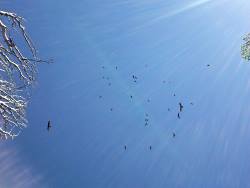
Turkey Vulture Kettle above Logan Cathartes aura Courtesy and Copyright Andrea Liberatore, Photographer
Turkey Vulture Kettle above Logan Cathartes aura Courtesy and Copyright Andrea Liberatore, Photographer
On certain days in the spring and fall, the sky above my neighborhood looks like a scene from Alfred Hitchcock’s ‘The Birds’. As many as 60 large black birds swarm the sky, circling above the rooftops. On the busiest of days, people will stop their cars in the middle of the road to gawk at the sight. Some give a visible shiver when told that the birds are turkey vultures. But we have nothing to fear from these birds – in fact they should be embraced for the absolutely vital role they play in our environment.
There are lots of myths surrounding vultures, which in turn creates a misunderstanding about them. So let’s set the record straight on a few things. Vultures circle for two main reasons, neither of which involves waiting for a sick or wounded animal to die. The first reason is to take advantage of rising columns of air, called thermals, which generally occur in the mornings as the sun warms the air closest to the earth. Vultures are soaring birds and flapping their 6-foot wingspans takes a lot of effort, so they rarely do it. In fact these birds can fly for hours without a single flap. Circling within a thermal helps them travel higher and farther on much less energy.
The second reason vultures circle is to hone in on a food source. Turkey vultures are one of the few birds that have a highly developed sense of smell. Working together with their excellent eyesight, the birds soar and circle to pin down the location of their next meal.
Hi, I’m Holly Strand from the Quinney College of Natural Resources at Utah State University.
More and more you are likely to hear this sound in Utah yards, parks and fields. [Eurasian Collared Dove, Courtesy Ryan O’Donnell, www.xeno-canto.org/98068] That’s the call of the Eurasian collared dove. Originally from Asia, this dove has been expanding its territory around the world at an incredible rate. The first sighting in Utah was in Orem in 1997. And now the doves are everywhere. So far, it doesn’t look like our native mourning dove is affected. But such rapid population explosions rarely occur without some sort of undesirable ecological consequence.
In America, the Eurasian collared dove is an invasive species. But not all non-native species are invasive. “Invasive” only applies when species spread far beyond the area where they are first introduced. Luckily, not all invasive species turn out to be serious pests. Ecologist Mark Williamson suggested the tens rule. About 10% of introduced species establish lasting populations and 10% of those go on to become problems.
There’s a long list of Eurasian invasives in Utah. Among them is the highly flammable cheat grass that comes from southwestern Asia. Those massive clouds of starlings? They come from Europe. Tamarisk from Eurasian deserts lines the Colorado River and tributaries. The common carp is an unwelcome Eurasian colonist of our lakes and large rivers. And the American west’s iconic tumbleweed is an invader from the Russian steppe.
Why so many invaders from Eurasia? Well for the last 500 years, there has been a net outflow of Eurasians—especially Europeans—to other parts of the world. And this human population carried its biological baggage along with it—in the form of animals, plants and diseases. Some ecologists believe that the physical geography and human history of Eurasia has conditioned its species in such a way that they will consistently outcompete the species of other continents. But that’s debatable. For in the last decades the New World has started to lob some pretty competitive species over to Eurasia.
For example, the American mink was brought to the Eurasian continent in the 1920s for use on fur farms. But–because of deliberate releases and accidental escapes–the mink is now common in the European wild. And it’s a pest. The American mink is taking the place of the European mink which is now threatened with extinction. Furthermore, the American mink is gobbling up populations of many ground-nesting birds.
Unless you are involved in agriculture, you might not have heard of the Colorado potato beetle. But potato growers around the globe know this striped orange and brown beetle from the American southwest very well. It has a voracious appetite for potato leaves and quickly develops resistance to any chemicals used against it.
And a final example: the American bullfrog is considered one of the world’s most damaging invasives. The bullfrog does amazingly well in a variety of habitats –even artificial ones like millponds, irrigation ditches and reservoirs. Its incredible adaptability helps it spread and outcompete native frogs. Moreover, it has been transmitting a deadly fungus to previously unaffected populations of frogs, toads and salamanders.
Thanks to Lyle Bingham for information on the Eurasian collared dove. And to Ryan ODonnell for his audio recording from xeno-canto.org. For more information on the Eurasian collared dove and other invasive species go to www.wildaboututah.org.
For Wild About Utah, and the Quinney College of Natural Resouces, I’m Holly Strand.
Credits:
Theme: Courtesy & Copyright Don Anderson Leaping Lulu
1. Photographer Joy Viola, Northwestern University, Bugwood.org https://www.invasive.org/browse/detail.cfm?imgnum=5413582
2. USDA ARS Photo Unit, USDA Agricultural Research Service, Bugwood. https://www.insectimages.org/browse/detail.cfm?imgnum=1321015
Audio of Eurasian collared dove:
Ryan P. O’Donnell, XC98068. Accessible at www.xeno-canto.org/98068.
Creative Commons Attribution-NonCommercial-NoDerivs 2.5
Text & Voice: Stokes Nature Center: Holly Strand
Sources & Additional Reading:
Bingham, Lyle. 2009. The New Dove in the Neighborhood. Wild About Utah Program https://wildaboututah.org/the-new-dove-in-the-neighborhood/ October 8, 2009.
di Castri F. 1989. History of biological invasions with special emphasis on the Old World. In: Drake JA, Mooney HA, di CastriF, Groves RH, Kruger FJ, Rejma´nek M, Williamson M, eds. Biological invasions: a global perspective. Chichester, UK: John Wiley and Sons.
European Environment Agency, 2012. The impacts of invasive alien species in Europe EEA Technical report No. 16/2012. EEA, Copenhagen.
National Invasive Species Information Center (NISIC): Gateway to invasive species information; covering Federal, State, local, and international sources.
https://www.invasivespeciesinfo.gov/index.shtml
Simberloff, Daniel. 2013. Invasive Species: What Everyone Needs to Know. Oxford University Press
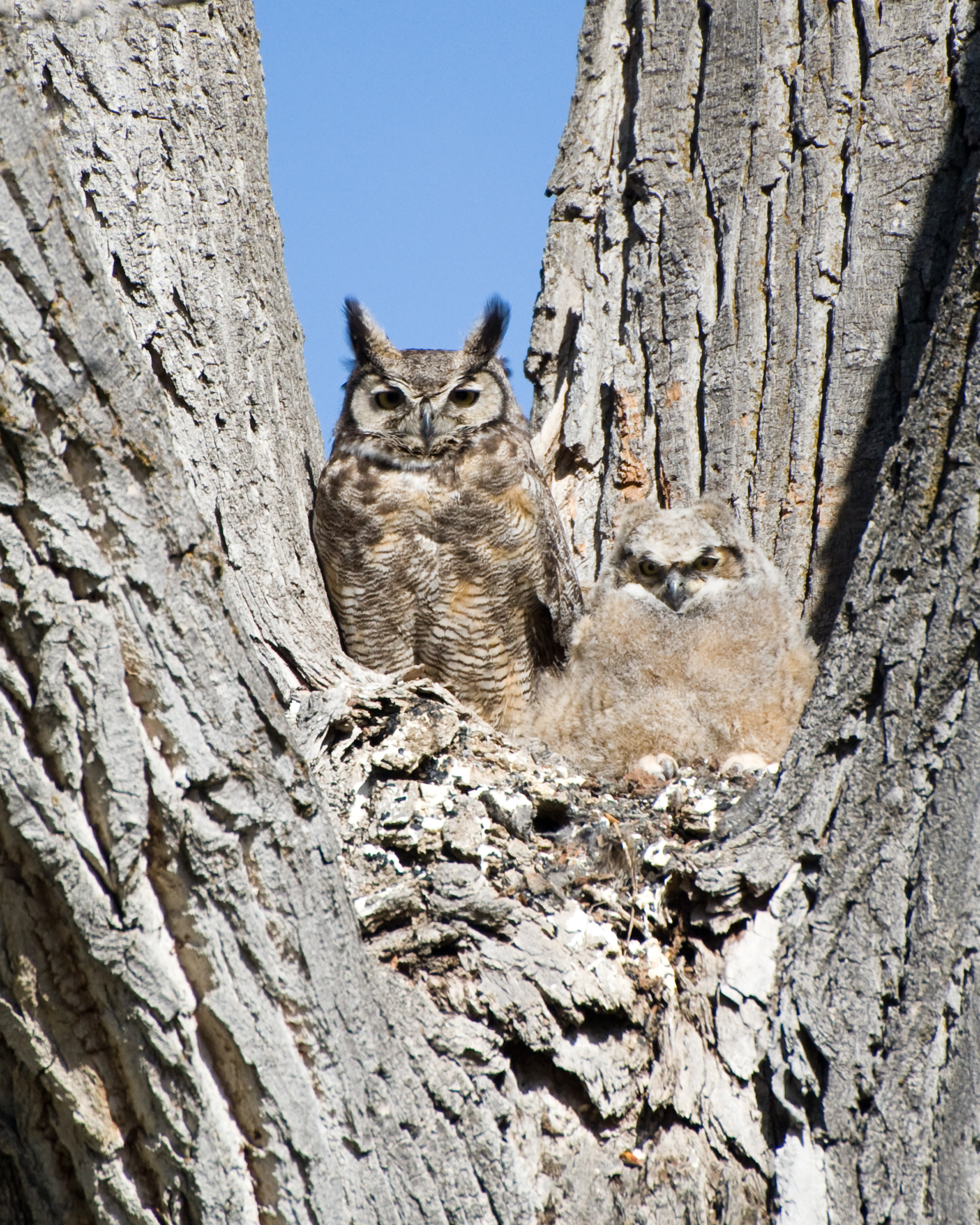
Adult great-horned owl perched at dusk, hunting for its young Photo Courtesy & Copyright 2009 Mark Larese-Casanova
Hi, this is Mark Larese-Casanova from the Utah Master Naturalist Program at Utah State University Extension.
Late summer is the time of change when the rich nature born of spring matures and enters the next stage of its life. Streams and wetlands may dry up in the heat. Wildflowers wither and produce seeds to ensure a plant’s survival into the future. And, young wildlife leave their place of birth to strike out on their own.
Prior to fledging, young red-tailed hawks build flight muscles by hopping and flapping their wings in the nest. Once they are strong enough, the young red-tailed hawks make excursions from the nest, often soaring together, calling to each other while they fly. This time of year, red-tailed hawk fledglings can still be seen perched atop telephone poles, even in the middle of town, calling to their parents and begging for food. As a bird that usually spends the entire year in Utah, the red-tailed hawk must prepare for its solitary, cold winter ahead.
The calls of great horned owls often echo through the late summer nights. The adult owl soars through an open field while the fledgling owlet is perched nearby, calling for food. The parent responds, and faithfully catches a mouse to feeds its young. Aside from their echoing calls, this all happens quietly and almost invisibly. A lucky observer might spy an owlet and its parent at dusk, but the great horned owl’s soft feathers ensure that their flight is silent, even when just overhead.
Some young reptiles disperse in summer, too, just like birds. Tiny garter snakes, no larger in length or width than a pencil, can often be found slithering across meadows or even lawns. Rather than laying eggs in a nest, the female garter snake retains the eggs in her body until they are ready to hatch. While young garter snakes receive no parental care after birth, the mother hedges her bets by producing upwards of twenty young in the second half of each summer. At least two need to survive over the mother’s life to maintain a stable population.
Fledging and dispersal in late summer is a time of great risk, though. It’s very common in Utah to see road kill of young marmots, skunks, raccoons, and mink, among others. Many inexperienced young animals are also taken by predators. In nature, survival to adulthood is relatively uncommon, so the great investment of the parents is essential for a species to survive.
Great Horned Owl and Chick Photographer: George Gentry US FWS Digital Library
Hi I’m Holly Strand.
In early spring, my friends and I went owling in a northern Utah canyon. We were hoping for modest success—just to see or hear a northern pygmy or great horned owl — both common owls in our area.
To better the odds we brought an iPod with prerecorded owl sounds. We played the northern pygmy call for 20-30 second intervals and listened intently in between intervals.
After 10 minutes of off-and-on playbacks we heard an answering call from a nearby conifer grove. We were ecstatic that we had made contact with an actual owl. But wait! Was it an owl we heard or just another iPod user?
Pygmy Owl Photographer: Bob Miles US FWS Digital Library
According to David Sibley, author of the Sibley Guide to Birds, the proliferation of digital audio devices and recorders among birders has both pluses and minuses. On the plus side, you can often entice certain birds out of hiding using playbacks. For example, if a territorial male thinks a rival bird is threatening to encroach on its territory, he may come out to confront the intruder. Or he may sing his “I’m Here, So Stay Away” song. A female bird might approach the recording source as a potential date. Using playbacks, you can target specific species to see or hear without disturbing others.
On the flip side, overuse of these playback devices can cause unnecessary stress and distraction in the target birds—and annoyance among other birders. In one study, the use of playbacks upset the avian apple cart by causing high-ranking black- capped chickadee males to lose status. The rest of the flock perceived them as losers as they were unable to drive away an unwanted phantom intruder.
Because the widespread use of recorded playbacks is relatively new, proper etiquette is still evolving. But here are some key points.
Keep the volume low and use only occasional snippets of sound—less than 30 seconds at a time. Leave a long pause between snippets. Definitely do not broadcast loud or continuous sound.
It is illegal to disturb endangered or threatened species. And these recordings can be interpreted as disturbance. So stick with sounds of non-threatened species.
Finally, check the rules at your birding location. The use of playback is prohibited in some parks and refuges.
For source material and websites with bird sound recordings, go to www.wildaboututah.org.
For Wild About Utah, I’m Holly Strand.
Credits:
Photos: Courtesy US FSW Digital Media Library
Text: Holly Strand


 Turkey Vulture Kettle above Logan
 Turkey Vulture Kettle above Logan