Acorn Woodpeckers

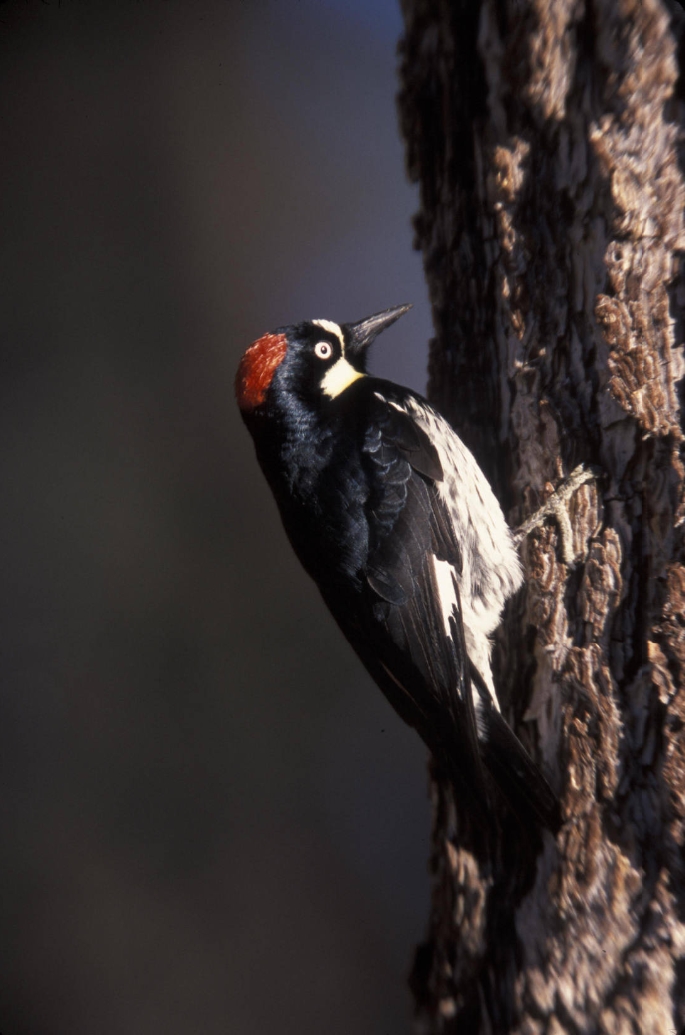
Acorn Woodpecker Melanerpes formicivorus Courtesy US FWS, Gary Kramer, Photographer
Acorn Woodpecker
Melanerpes formicivorus
Courtesy US FWS,
Gary Kramer, Photographer

My first encounter with an acorn woodpecker occurred many years ago in California, a species unknown to me. I was surprised to find a small flock of these comedic looking birds- most unusual for woodpeckers, which are generally solitary other than with mates or young. And those startling yellow eyes!
On a recent West Rim trek in Zion N.P., to my delight, I got a second encounter near Potato Hollow. Their loud, sharp calls first alerted me. I paused to find the source, and was startled to see who it was, unaware they existed in our state.

Acorn woodpeckers live in large groups, hoard acorns, and breed cooperatively. These woodpeckers live in oak and mixed oak-evergreen forests on slopes and mountains in the Southwest and West Coast. They are found infrequently in the south end of our state. They’re tolerant of humans, and occur in towns where there are acorns and suitable places to store them.
If more than one female in a colony breeds, they lay eggs in the same nest cavity. When egg-laying is not synchronized, females often destroy each other’s eggs. In-synch egg-layers, however, produce a clutch totaling three to seven eggs. Although this behavior seems counterproductive, it may be beneficial, resulting in all chicks being roughly the same age and size. Several different individuals of each sex may breed within one family, with up to seven breeding males and three breeding females in one group.

All members of the colony share in incubation duties, and all pitch in to feed the chicks when they hatch. Young adults remain with their parents for several years to help raise successive broods, but eventually disperse to other territories. Nesting groups can contain up to ten offspring helpers. These breeding coalitions are typically closely related. The males are often brothers, and the females are usually sisters. Inbreeding is rare, however, meaning that co-breeders of the opposite sex are almost never related.

All members of an Acorn Woodpecker group spend large amounts of time storing acorns. typically stored in holes drilled into a single tree, called a granary tree. One granary tree may have up to 50,000 holes, each of which is generally filled with an acorn by autumn.

When any protective group of woodpeckers experiences a death or disruption to the hierarchy, nearby birds rush to the area and fight for access to the trove; these fights also attract woodpecker audiences who leave their own territories to witness the battles.

In 1923, American ornithologist William Leon Dawson called the dapper Acorn Woodpecker “our native aristocrat.” “He is unruffled by the operations of the human plebs in whatever disguise…Wigwams, haciendas, or university halls, what matter such frivolities, if only one may go calmly on with the main business of life, which is indubitably the hoarding of acorns.”

Jack Greene for Bridgerland Audubon Society and I’m totally wild about Utah and its acorns!

Credits:

Nest Picture: Courtesy US FWS, Gary Kramer, Photographer, https://digitalmedia.fws.gov/digital/collection/natdiglib/id/2755/rec/3
Audio: Courtesy and Copyright Kevin Colver, https://wildstore.wildsanctuary.com/collections/special-collections/kevin-colver
Text: Jack Greene, Bridgerland Audubon, https://bridgerlandaudubon.org/
Additional Reading: Lyle W Bingham, Webmaster, and Jack Greene, Author, Bridgerland Audubon, https://bridgerlandaudubon.org/

Additional Reading:

Acorn Woodpecker Overview, All About Birds, Cornell Lab of Ornithology, Cornell University, https://www.allaboutbirds.org/guide/Acorn_Woodpecker/overview

Acorn Woodpeckers, Species, Utah Division Wildlife Resources, Utah Department of Natural Resources, State of Utah, https://fieldguide.wildlife.utah.gov/?species=melanerpes%20formicivorus [Link updated January 2024]

DAWSON, William Leon, Islapedia, Santa Cruz Island Foundation(SCIF), https://www.islapedia.com/index.php?title=DAWSON,_William_Leon

Webinar: Adaptations of Acorn Woodpeckers with Sahas Barve, National Museum of Natural History, Science How, Smithsonian Institution, https://naturalhistory.si.edu/education/teaching-resources/life-science/webinar-adaptations-acorn-woodpeckers-sahas-barve

Murtaugh, Paul, Granary Tree Image, Oregon State University, sites.science.oregonstate.edu/~murtaugp/photos/jan2017/p12.html [Link broken and removed January 2024]

When It Comes to the Family Granary, an Acorn Woodpecker’s Work Is Never Done by BirdNote, Podcast, National Audubon, September 23, 2019, https://www.audubon.org/news/when-it-comes-family-granary-acorn-woodpeckers-work-never-done [Added January 2024]

To Grow Your Own Bird Food, Native Plants Are Key!

Native Plants Are Key: Black-chinned Hummingbird, Archilochus alexandri Courtesy US FWS, Alan Schmierer, Photographer
Hummingbirds Eat Insects
and Drink Nectar From Flowers
Black-chinned Hummingbird
Archilochus alexandri
Courtesy US FWS, Alan Schmierer, Photographer
Did you know that hummingbirds eat aphids and mosquitoes?Native Plants Are Key
When we think about landscaping for the birds we might think of the National Wildlife Federation guidelines to include food, water, shelter and places to raise young, but chances are the foods we think of first are berries, nuts, and seeds, when in fact the single most important food to ensure the survival of songbirds are the insects hosted by native plants. The Bridgerland Audubon Society website includes a wealth of resources on many aspects of Bird_Friendly Living, not least of which native plants for Utah gardens.

Douglas Tallamy’s website “Bringing Nature Home” states that most songbirds need insect protein for their young, and the top plant species that host the caterpillars birds need are oak, cherry and willow. Just one of many plants to share with birds is the Chokecherry, preferably with green leaves, as the red-leafed cultivars are not attractive to insects. Chokecherry fruits are great for people and birds, and the leaves will host insects for baby birds. Remember, those little hummingbirds aren’t just sipping nectar and pollinating flowers, they’re eating aphids and mosquitoes, serving an important pest management role in your garden!

I will now read the Mayor’s Proclamation to Grow Native for Birds, a timeless summary of the reasons to err toward native plants:

Proclamation To Grow Native For Birds:

Whereas, growing native plant communities in our residential, municipal and commercial landscapes promotes and enhances our sense of place; and Whereas, increased awareness and use of native plants is fundamental to water conservation, water quality, habitat preservation and successful gardening; and

Whereas, gardens and landscapes composed of Utah’s native plants require little or no fertilizers, soil amendments, or pesticides; and

Whereas, using firewise plants native in our landscape is often the safest option; and

Whereas, landscaping choices have meaningful effects on the native insects that bird populations need to survive; and

Whereas, a diversity of birds is indicative of a healthy ecosystem, including biological control of pests, carrion regulation, seed dispersal, and nutrient cycling; and
Whereas, birdwatching can be a fun, relaxing, multigenerational, educational family wellness activity;

Now, Therefore, we do hereby declare this Proclamation to Grow Native for Birds and encourage everyone to actively foster and support the use of Utah native plants in their gardens and landscapes.

I’m Hilary Shughart with the Bridgerland Audubon Society, and I’m Wild About Utah

Credits:
Photo: Courtesy US FWS, Alan Schmierer, Photographer, https://images.fws.gov/
Featured Audio: Courtesy & Copyright © Kevin Colver, https://wildstore.wildsanctuary.com/collections/special-collections/kevin-colver
Text: Hilary Shughart, President, https://bridgerlandaudubon.org/
Additional Reading: Hilary Shughart and Lyle Bingham, https://bridgerlandaudubon.org/

Additional Reading

Grow Native For Birds Project, Bridgerland Audubon Society, https://bridgerlandaudubon.org/our-projects/grow-native-for-birds/

Logan, UT Mayor Holly Daines, Proclamation to Grow Native for Birds,
Facebook Live, https://www.facebook.com/watch/?v=2627914670831507
Text: https://bridgerlandaudubon.org/wp-content/uploads/2020/04/Proclamation.pdf

Grow Native For Birds, Bridgerland Audubon Society, https://bridgerlandaudubon.org/our-projects/grow-native-for-birds/

Liberatore, Andrea, Grow Native!, Wild About Utah, June 9, 2011, https://wildaboututah.org/grow-native/

Hellstern, Ron, Attracting Birds and Butterflies to Your Yard, Wild About Utah, May 28, 2018, https://wildaboututah.org/attracting-birds-and-butterflies-to-your-yard/

Hellstern, Ron, Build a Certified Wildlife Habitat at Home, Wild About Utah, Jul 17, 2017, https://wildaboututah.org/build-community-wildlife-habitats/

National Audubon Native Plant Finder, Coleman and Susan Burke Center for Native Plants, Audubon.org, https://www.audubon.org/plantsforbirds


Native Plants For Birds, National Audubon Society
Nov 20, 2017

Cane, James, Gardening for Native Bees in Utah and Beyond, (includes a flowering calendar for cultivated bee plants), https://extension.usu.edu/files/publications/factsheet/plants-pollinators09.pdf

RESOURCES: Water-Wise and Native Plants, Center for Water Efficient Landscaping, Utah State University Extension, https://cwel.usu.edu/plants

Kuhns, MIchael, Are Native Trees Always the Best Choices?, Forestry, Utah State University Extension, https://forestry.usu.edu/trees-cities-towns/tree-selection/native-trees

Creating Landscapes for Wildlife… A Guide for Backyards in Utah, Written by Sue Nordstrom and Illustrated by Kathlyn Collins Department of Landscape Architecture and Environmental Planning, Utah State University with Margy Halpin, Utah Division of Wildlife Resources; Second Printing 2001,
Updated for the Utah Division of Wildlife Resources, by Frank Howe, DWR Avian coordinator; Ben Franklin, DWR–Utah Natural Heritage Program botanist; Randy Brudnicki, DWR publications editor; and landscape planning illustrations by Stephanie Duer.,
Published by:
State of Utah Natural Resources, Division of Wildlife Resources,
Utah State University Cooperative Extension Service and
Utah State University Department of Landscape Architecture and Environmental Planning;
1991 updated 8/2025 https://wildlife.utah.gov/pdf/landscapingforwildlife.pdf

Handbook on Riparian Restoration, Utah Division of Wildlife Resources, Utah Department of Natural Resources, State of Utah, https://wildlife.utah.gov/pdf/riparian.pdf

Kirchner, Jane, Meet the Squad of Mosquito-Eating Species, National Wildlife Federation, August 24, 2020, https://blog.nwf.org/2020/08/meet-the-squad-of-mosquito-eating-species/

Tundra Swans

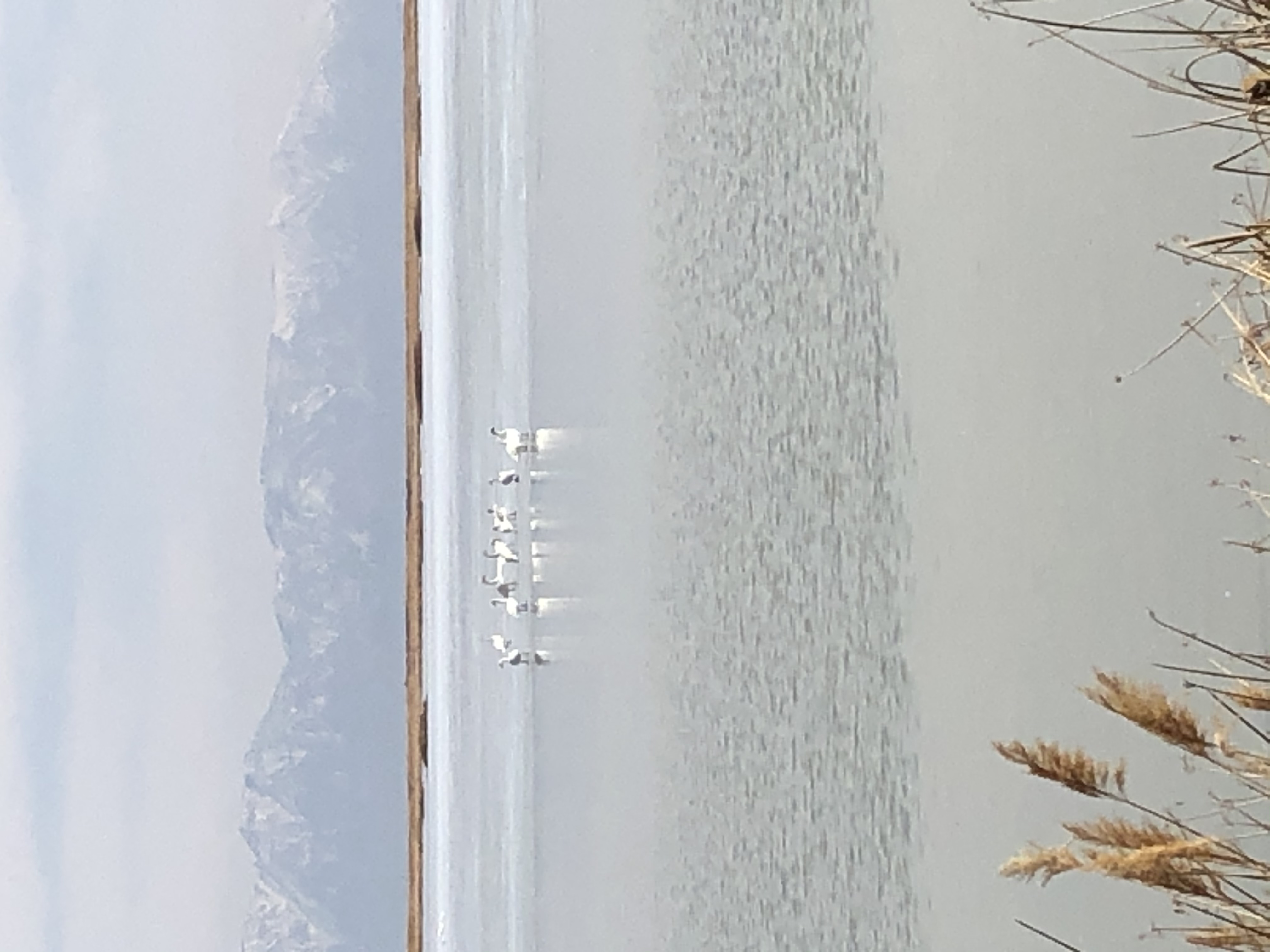
Tundra Swans Courtesy & © Mary Heers
Tundra Swans
Courtesy & © Mary Heers
A few months ago, I was driving a car on an interstate road trip when a picture of a coffee cup suddenly appeared on my dashboard with the question, “Need a rest?” I was a little startled to suddenly be getting questions from my car, but I must admit I felt a surge of relief when a large truck stop soon came into view.

I can imagine that the thousands of tundra swans following their traditional migration route must feel the same sense of relief when the Bear River Migratory Bird Refuge comes into view: Below them lie 74,000 acres of wetlands where the Bear River flows into the northern arm of the Great Salt Lake. Plenty of room, plenty of fresh water, and plenty of food.. It’s hidden from view, but the swans know its there. Growing in the muddy bottom of the shallow water is a marvelous buffet of the tundra swan’s favorite food: Pondweed.

Tundra Swans in Flight Courtesy & © Mary Heers
Tundra Swans in Flight
Courtesy & © Mary Heers
In early March, when I heard the swans had started to arrive, I headed right over Ice was just beginning to melt and the first arrivals were sitting on the water and standing around on the ice. Of course I cringed to think about standing around on ice in bare feet, but these swans seemed perfectly content. They had already flown over 600 miles and had another 2,000 to go to get to their nesting grounds in the Alaska tundra. This was their time to rest and refuel. People who study the biology of swans tell us that eating pondweed is pretty effortless: the swan dips its flexible 3 ft neck into the water, locates a choice plant with the help of an extra underwater eyelid, and takes a bite. No need to surface; the swan swallows underwater. No need to chew; its gizzard will grind the cellulose into a digestible pulp.

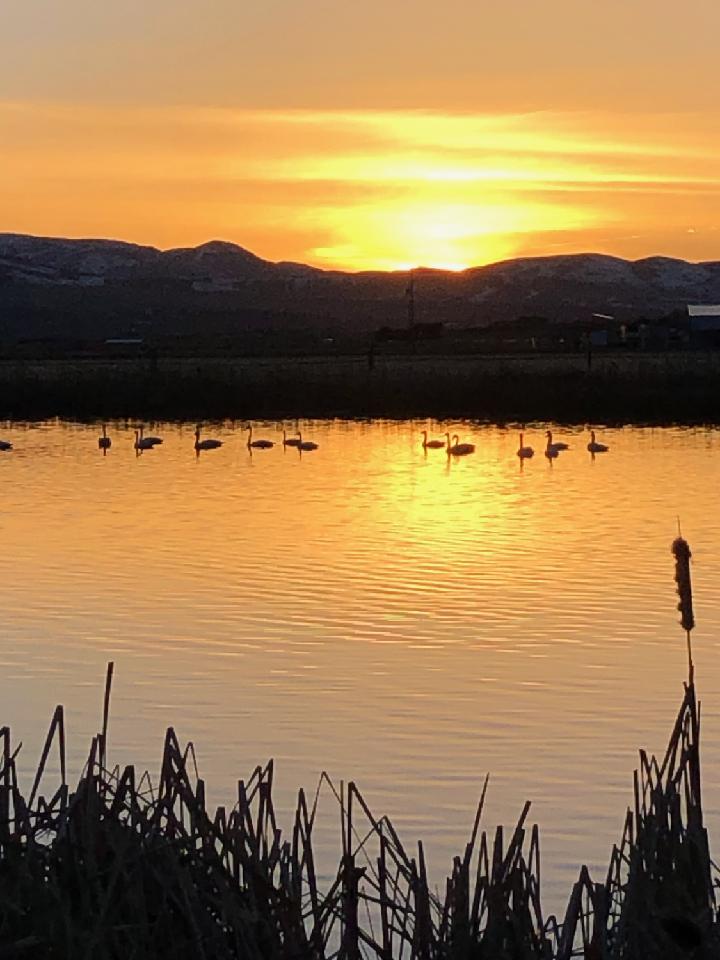
Tundra Swans at Dusk Courtesy & © Mary Heers
Tundra Swans at Dusk
Courtesy & © Mary Heers
Quite unexpectedly, I ran across some other swans the next day who had left the main migratory route and were taking the backroads of Fairview Idaho to forage across the farmer’s fields. I had gone to visit of friend. “Corn,” she said. “They come every year.” Inevitably some corn is left behind by the harvesting machines and these swans were more than happy to clean up the spills. But a 6 o’clock they would lift off and fly to a small stretch of open water by the Fairview cemetery where they could safely spend the night.

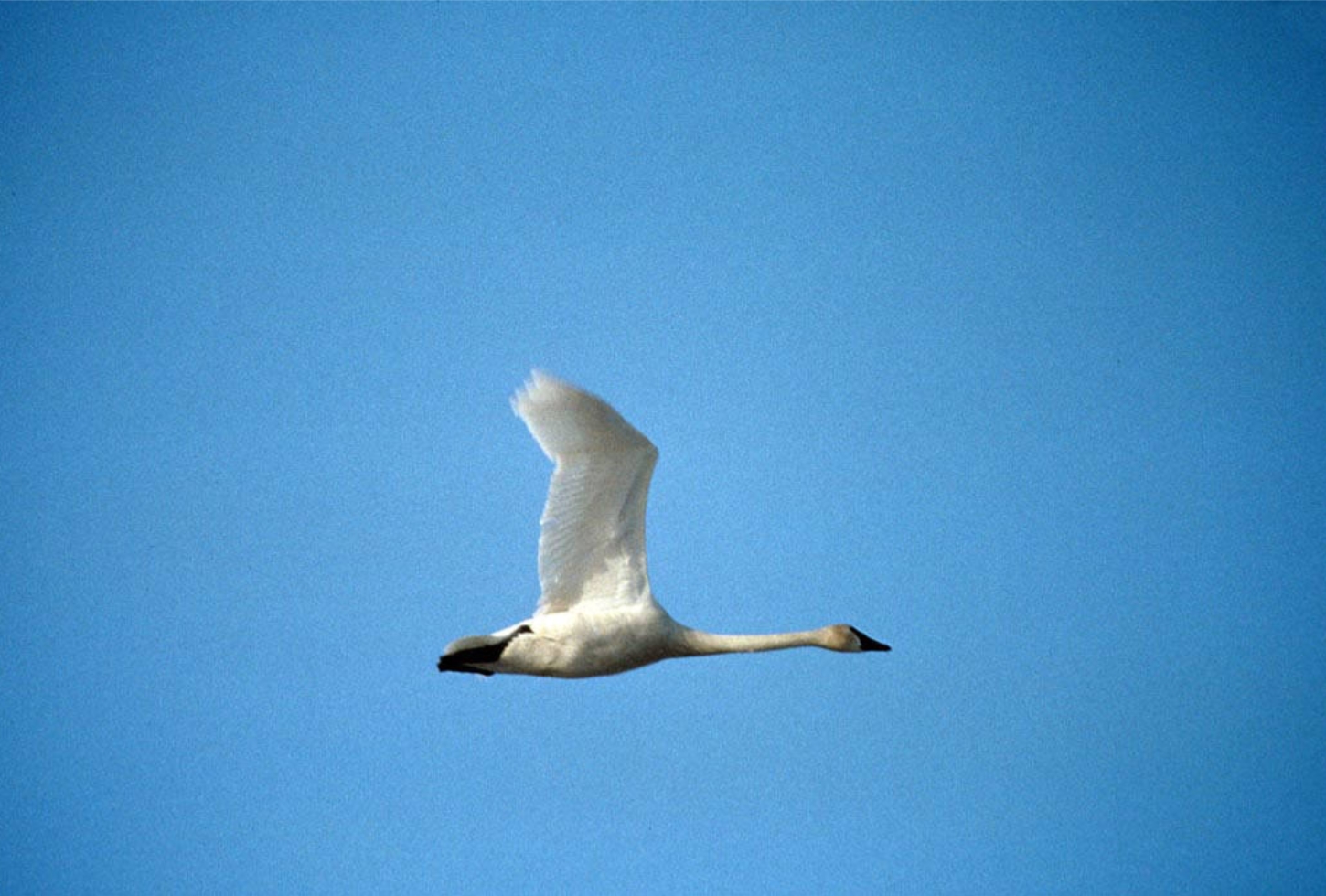
I hightailed it to the cemetery, sat down by the water’s edge, and made myself as small as possible. I waited. Soon the sky filled with incoming swans, some in pairs, some in small groups. They flew in over me so low I could hear the thump of their wings beating and the Whirrzz of the wind through their wing feathers. At the last minute they lowered their large black feet and skidded to a splashy stop The water was soon thick with swans, but these excellent aviators, weighing over 20 lbs and with a wingspan of 6-7 feet, skillfully landed in an open space.

Tundra Swan in Flight Cygnus columbianus Courtesy US FWS Donna A Dewhurst, Photographer
Tundra Swan in Flight
Cygnus columbianus
Courtesy US FWS
Donna A Dewhurst, Photographer
Like many people, I first heard about swans when I read The Ugly Duckling. Hans Christian Anderson spent a year writing this story in 1842. Later in life, when people asked him why he never wrote an autobiography, he said he already had – when he wrote The Ugly Duckling. His message was clear: bullying a youngster just because he looks different is cruel. But the suffering of the young swan as he spent his first winter miserably cold and alone did not preclude a happy ending. Remembering this story is especially poignant today as we are emerging from our own winter of social isolation, and stepping into spring with high hopes for happier, healthier days.

This is Mary Heers and I am Wild About Utah.

Credits:
Photos: Courtesy & Copyright © Mary Heers
Photos: Courtesy US FWS, Donna A Dewhurst and Tim Bowman, Photographers
Featured Audio: Courtesy & Copyright © Kevin Colver, https://wildstore.wildsanctuary.com/collections/special-collections/kevin-colver
Text: Mary Heers, https://cca.usu.edu/files/awards/art-and-mary-heers-citation.pdf
Additional Reading: Lyle Bingham, https://bridgerlandaudubon.org/

Additional Reading

Tundra Swans, All About Birds, The Cornell Lab of Ornithology, Cornell University, https://www.allaboutbirds.org/guide/Tundra_Swan/overview

Wild About Utah, Mary Heers’ Postings

Tundra Swan Pair Cygnus columbianus Courtesy US FWS Tim Bowman, Photographer
Tundra Swan Pair
Cygnus columbianus
Courtesy US FWS
Tim Bowman, Photographer
Strand, Holly, Til Death Do Us Part, Wild About Utah, February 13, 2014, https://wildaboututah.org/tag/monogamy/

Tundra Swan, Utah Bird Profile, UtahBirds.org, https://utahbirds.org/birdsofutah/ProfilesS-Z/TundraSwan.htm
Other Photos: https://utahbirds.org/birdsofutah/BirdsS-Z/TundraSwan.htm

Great Horned Owl

Great Horned Owl and Chick Courtesy US FWS George Gentry, Photographer
Great Horned Owl and Chick
Courtesy US FWS
George Gentry, Photographer
No, I did not hear the owl call my name- meaning my number is up and death is imminent according to some native tribes. But I do hear them call. The great horned owl is also referred to as the “hoot owl”. There are few owl species that hoot in our area, and those who do so are extremely rare.

Great horned owls are great in stature- second only to great grays among N. American owls. Further, they are fierce predators and valiant protectors of their young. Don’t mess with their nest!

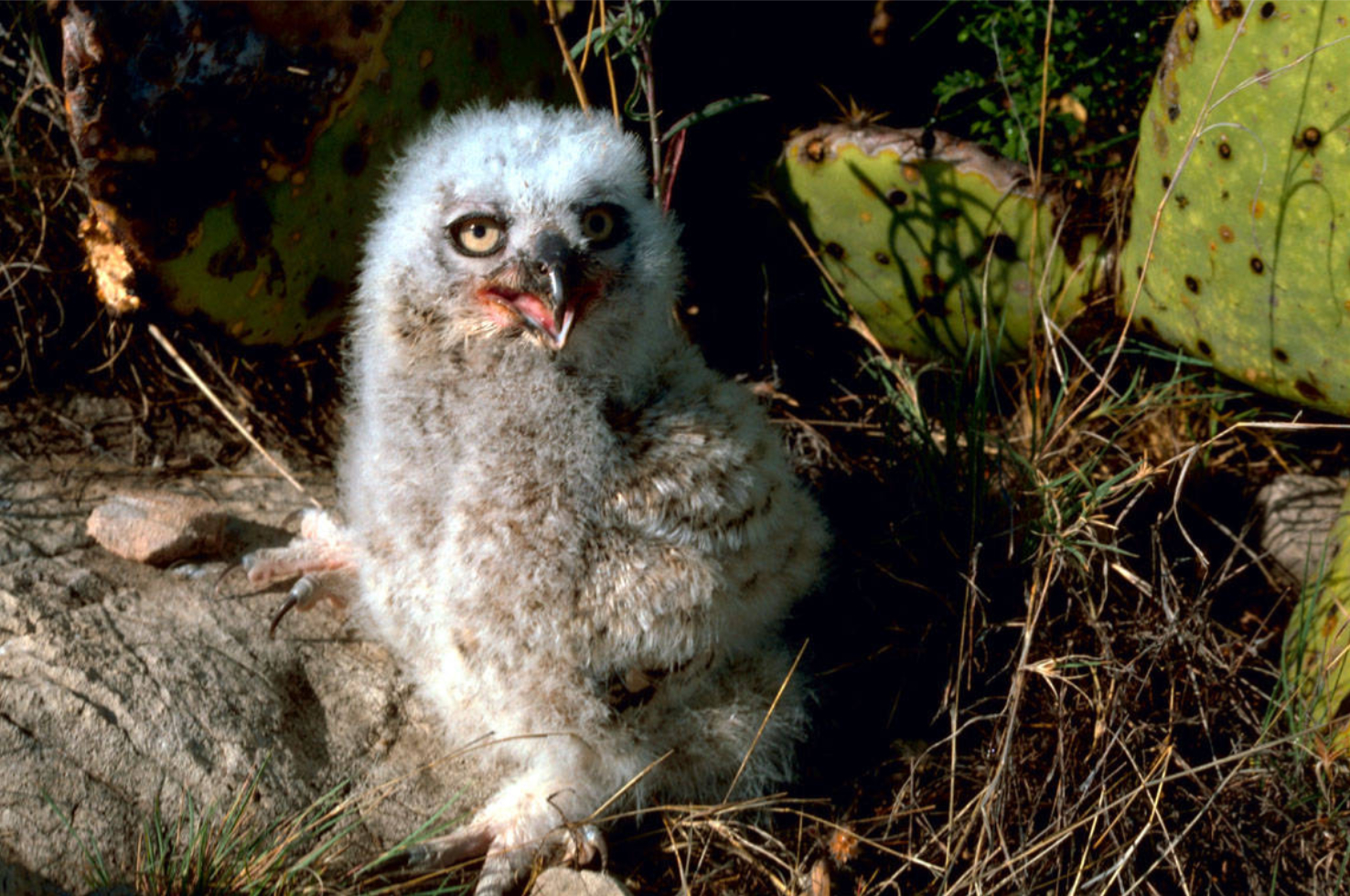
Great Horned Owl Chick Courtesy US FWS Gary Stolz, Photographer
Great Horned Owl Chick
Courtesy US FWS
Gary Stolz, Photographer
Due to its ferocious nature it is often referred to as the “Tiger of the Air”. When established in a territory, the Great Horned Owls drive other owls away, and may eat a few for good measure. They are both nocturnal and diurnal hunters, especially during the breeding season & when they are raising their young. They have a large variety of prey including insects, most small mammals including skunks, foxes, domestic cats, & birds up to size of herons and Redtail hawks. Its prey can often weigh up to 3 times the weight of bird itself.

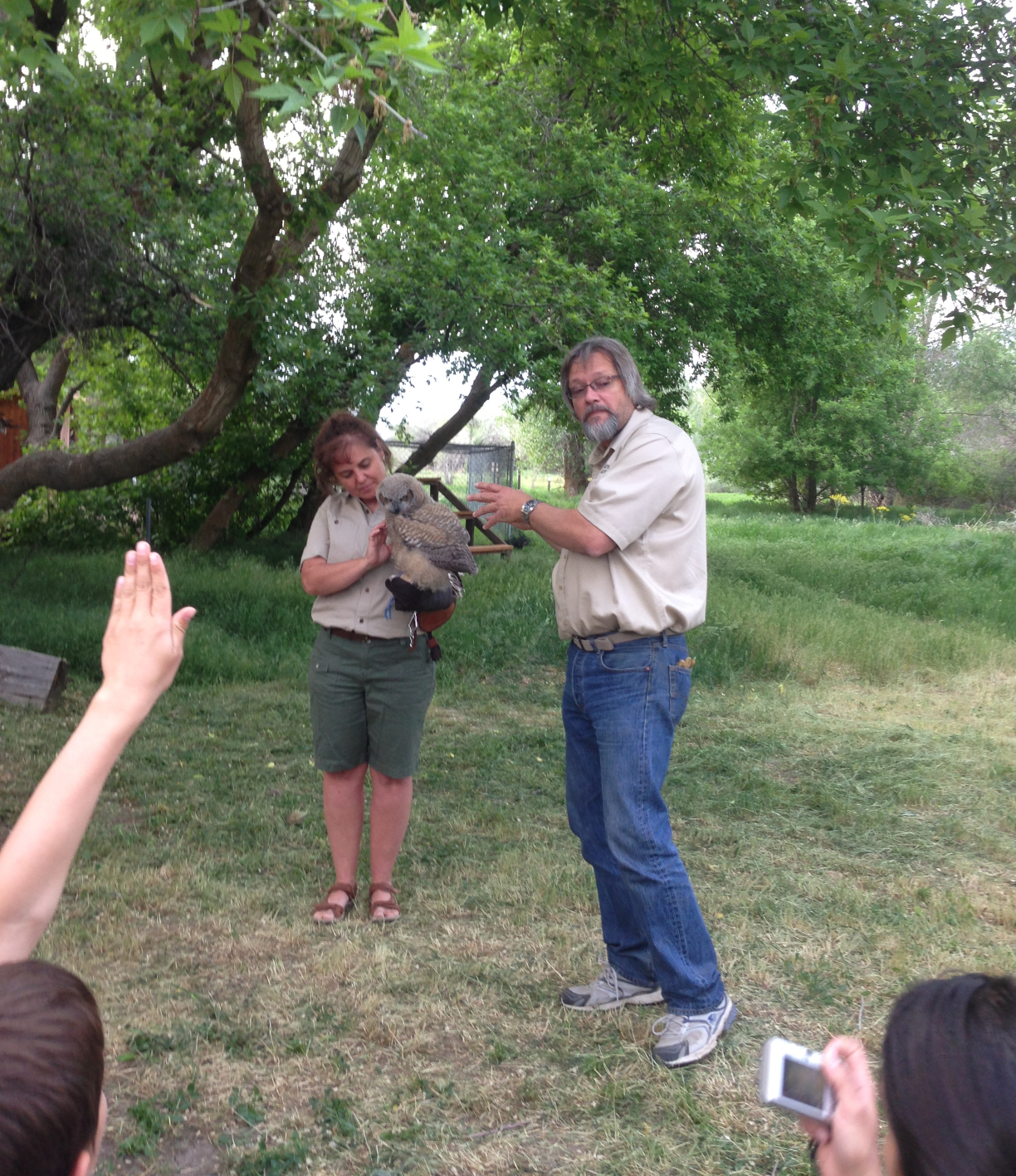
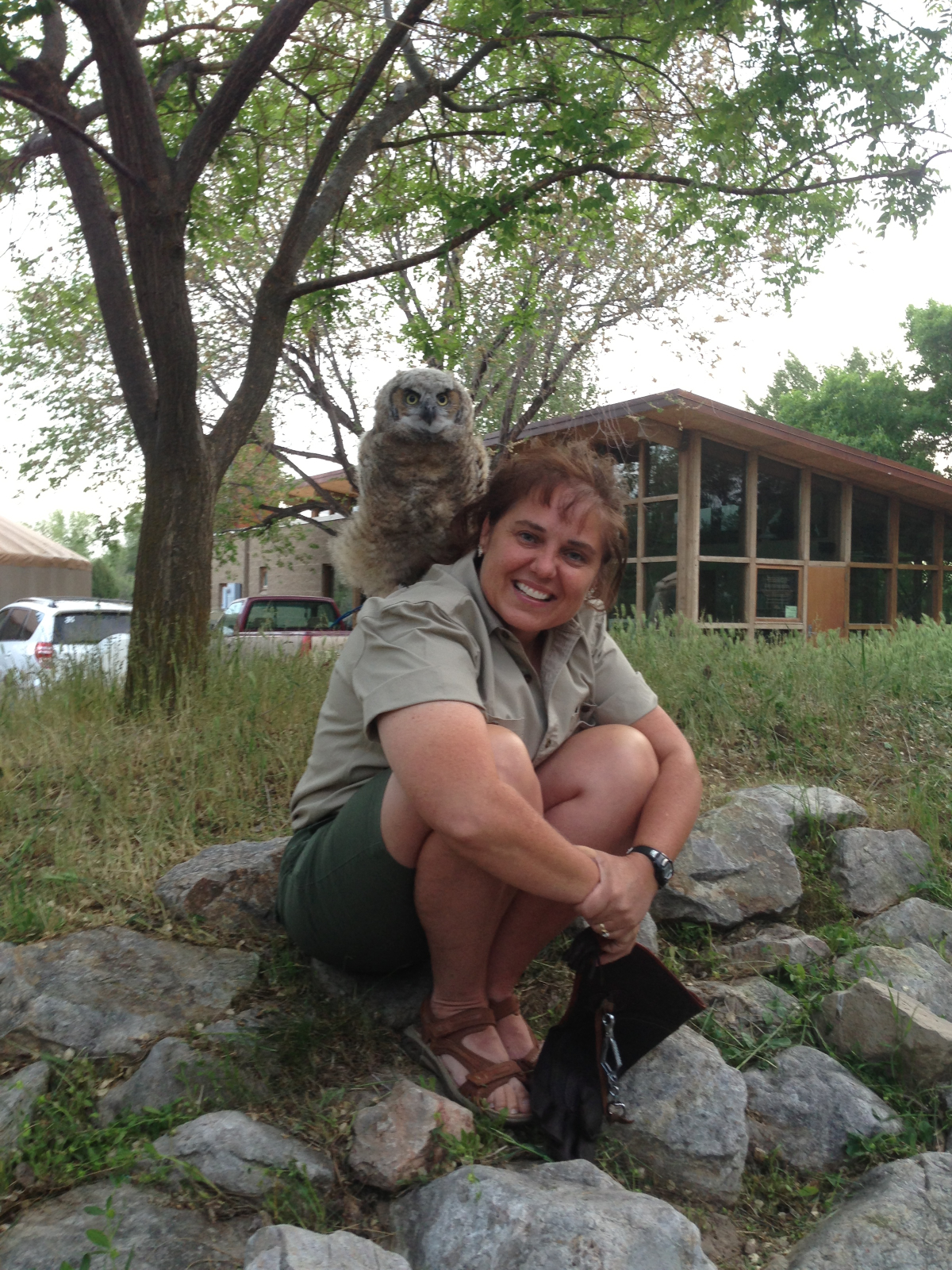
Bryce King and Michelle Groncki with Winston, a Young Great Horned Owl at the Ogden Nature Center, May 16, 2018 Courtesy & © Lyle Bingham, Photographer
Bryce King and Michelle Groncki with Winston, a Young Great Horned Owl at the Ogden Nature Center, May 16, 2018
Courtesy & © Lyle Bingham, Photographer
The Great Horned Owl is found throughout the Americans, from Alaska & Northern Canada down to the southern most tip of South America. It’s found in woodlands, mountains, deserts, coastal swamps, and urban areas which make it unique amongst owls. There was a pair nesting near the Logan Tabernacle for many years. There is only a single species of Great Horned Owl, though there are a large number of subspecies.

Great Horned owls are often monogamous. They usually nest in old nests made by other raptors, often by Red-Tailed Hawks. They have been known to nest in caves, on cliff ledges, rocky outcrops and in cactuses. They usually start breeding very early in comparison to most owls, often from December to March when hooting reaches its peak.

Winston, a Young Great Horned Owl hopped up on Michelle Groncki's Shoulder May 16, 2018 Courtesy & © Lyle Bingham, Photographer
Winston, a Young Great Horned Owl hopped up on Michelle Groncki’s Shoulder, May 16, 2018
Courtesy & © Lyle Bingham, Photographer
In the wild the life expectancy of Great Horned Owl is from 15 to 20yrs. In captivity, their lifespan is usually from 25 to 30yrs, with the oldest recorded individual reaching 42 years. The Ogden Nature Center had an owl named Chitters, who was near 40 years before its spirit flew off. During its long life as an educational bird, Chitters entertained thousands of students in the Ogden, Davis, and Weber school districts.

Several American Indian tribes believe owls are associated with the souls of the dead. When a virtuous person died, they would become a Great Horned Owl. If wicked, they would become a Barn Owl. The Hopis Indians believed that the Great Horned Owl helped their peaches grow. They were believed to be a symbol of divine wisdom by Creek Indians.

I’m sure glad to have these divine, wise birds in my neighborhood!

Great Horned Owl Courtesy US FWS, Karen Laubenstein, Photographer
Great Horned Owl
Courtesy US FWS, Karen Laubenstein, Photographer
Jack Greene for Bridgerland Audubon Society, and I’m wild about Utah!

Credits:

Images: Courtesy US FWS
Audio: Contains Audio Courtesy and Copyright J. Chase and K.W. Baldwin https://upr.org
Text:     Jack Greene, https://bridgerlandaudubon.org/

Additional Reading:

Ogden Nature Center, Bear River Migratory Bird Refuge, US Fish & Wildlife Service, US Bureau of the Interior, https://www.fws.gov/nwrs/threecolumn.aspx?id=2147485206 Last Updated: May 18, 2012

Wright, Becky, Beloved owl ‘Chitters’ at Ogden Nature Center dies, Ogden Standard Examiner, Mar 18, 2013, https://www.standard.net/lifestyle/beloved-owl-chitters-at-ogden-nature-center-dies/article_5f57019c-7279-587e-9983-7b4f5a2d2a48.html

Great Horned Owl, All About Birds, The Cornell Lab of Ornithology, Cornell University, https://www.allaboutbirds.org/guide/Great_Horned_Owl/overview