
At Home in the Dark

At Home in the Dark: Western Screech Owl Fledgling Courtesy and Copyright Katarzyna Bilicka, Photographer
Western Screech Owl Fledgling
Courtesy & © Katarzyna Bilicka, Photographer
All year I wait for the summer evenings. All year I long for the oddity of ‘warm and dark,’ of trilling owls flickering from treetop to treetop, and for the scent of hot baked earth cooling as on a sill. Summer evenings evoke in me joy in being out of doors, living within the intact Eden which lies just below our own preconceptions, and deepening my appetite for life. Summer evenings, those dark arid cradles of Utah’s providence, have other benefits, too.

It’s in the dark that you can live in the footsteps of local literatos. We can heed the words of Utah’s Ed Abbey, that: “There’s another disadvantage to the use of the flashlight: like many other mechanical gadgets it tends to separate a man from the world around him. If I switch it on my eyes adapt to it and I can see only the small pool of light it makes in front of me; I am isolated. Leaving the flashlight in my pocket where it belongs, I remain a part of the environment I walk through and my vision, though limited, has no sharp or definite boundary.”

It is also in the dark that we can allow our eyes a rest from glowing rectangles, and for the rest of our navigational senses to pick up slack. Our ears listen for how sound meanders in the landscape, detecting the clitter clatter of dogs on the deck, or chickens working their scratch. Our nose picks up the scent of a neighbor’s firepit to the east, and when the wind shifts the humidity from another neighbor’s evening watering to the west.

It is in the dark that we can also learn to see that we share spaces with corpuscularities and nocturalites. Those trilling owls, Western Screech Owls to be exact, who emerge from their deadstand cavities and prowl for rodenta. When one spots a human watching it, it watches back, then dances a shimmy-rumba-polka. I imagine that it’s waiting for us to communicate, too.

The dark also brings the insects galore which fill the nights making good on their pollination out of the heat of the day, playing odds with the primroses and their opening hours, and some finding the blood meal they need from undeeted legs, arms, head, feet, and neck. Friends will tell you when there’s a mosquito on your face. Good friends will smack your face for you.

Lastly, the dark gives us our stars. I often need to remind myself that it isn’t that they are out at night, but that they are just no longer obscured by the light of day. The stars are always there, but in day they are dimmed into the blue sky void, and in our city nights given mute by our love of lights which would make Lycurgus roll over in his simple, unmarked grave. That said, they are still there for us to see as we have for as long as life has existed on this earth, but only if we choose to see them. Long ago, looking up and wondering was our choice, and luckily it still is today.

So as your summer progresses and perhaps you find yourself in need of a sigh of relief from woe, I’d invite you to leave your flashlights, glowing rectangles, and worries inside. Step out of doors at dusk and stay into the evening. Hear the music and laughter of a party down the block. Smell the tapestry of worlds that is held in the wind. Feel the mosquitos live because you live. Choose to look up and see infinity in the stars. Know that the dark is not a scary place to be if you learn to see it for what it is and can be.

I’m Patrick Kelly, and I’m Wild About Utah.
 
Credits:

Images: Image Courtesy & Copyright Katarzyna Bilicka, Photographer, all rights reserved
Audio: Contains audio Courtesy & Copyright Friend Weller, Utah Public Radio
Text:    Patrick Kelly, Director of Education, Stokes Nature Center, https://logannature.org
Included Links: Lyle Bingham, Webmaster, WildAboutUtah.org

Additional Reading

Wild About Utah, Posts by Patrick Kelly

Stokes Nature Center in Logan Canyon, https://www.logannature.org/

Abbey, Edward. Desert Solitaire. Touchstone (January 15, 1990) https://www.amazon.com/Desert-Solitaire-Edward-Abbey/dp/0671695886

Western Screech Owl, Overview, All About Birds, The Cornell Lab of Ornithology, https://www.allaboutbirds.org/guide/Western_Screech-Owl/overview

Western Screech Owl, Utah Birds, https://www.utahbirds.org/birdsofutah/ProfilesS-Z/WesternScreechOwl.htm
Featured Article by Eric Huish: https://www.utahbirds.org/featarts/2004/OwlBox/OwlBox1.htm
Gallery Pictures: https://www.utahbirds.org/birdsofutah/BirdsS-Z/WesternScreechOwl.htm


Bobolinks

Bobolink Dolichonyx oryzivorus Courtesy: U.S. Fish & Wildlife Service Steve Maslowski, Photographer
Bobolink
Dolichonyx oryzivorus
Courtesy: U.S. Fish & Wildlife Service
Steve Maslowski, Photographer
Many years have passed and yet I still have vivid memories of the skylark- a joyous bird of the English countryside whose aerial song lifts one’s spirit to mingle with this buoyant beauty. Thankfully, we have our own version of the skylark whose name reflects its unforgettable song.

Washington Irving called the bobolink “the happiest bird of our spring and added that his life seems all song and sunshine”. Emily Dickinson called the bobolink “the rowdy of the meadow for its bubbly, jangling song”. It was immortalized by nineteenth-century American poet William Cullen Bryant, in a poem titled Robert of Lincoln.
Singing on the wing, the bobolinks song can be over ten seconds long with more than one hundred phrases, a remarkable feet! Their lungs are much more efficient than ours. It can store oxygen in air sacs, and as air is exhaled to produce song, the air sacs deliver fresh oxygen to the lungs.

Bobolinks migration is no less remarkable. They return from the tropics each spring, having completed one of the longest migrations of any songbird in the Americas: roughly six thousand miles. Bobolinks fly from northern Argentina to the northern US and Canada. They cross all sorts of hazardous terrain and hundreds of miles of open water. Like many birds, they rely on cues from the stars and sun and from landmarks on the earth to guide them. Additionally, they can sense the earth’s mineral magnetite, thanks to iron oxide in bristles of its nasal cavity and in tissues around the olfactory bulb and nerve.

Alarmingly, like its European cousin, bobolinks have declined in numbers on its North American breeding grounds by over 60% since 1970. It is a Species of Greatest Conservation Concern in most U.S. states and Canadian provinces in which it occurs, and is listed as Threatened under the Species at Risk Act in Canada. Populations are predicted to decline by 30% over the next two decades from habitat loss aggravated by a changing climate.

People have shot Bobolinks as agricultural pests, trapped and sold them as pets in Argentina, and collected them as food in Jamaica. But the main reason for the Bobolink’s decline is land-use change, especially the loss of meadows and hay fields. To improve the Bobolink’s prospects, people can maintain its breeding habitat by mowing fields once nestlings have fledged, by preserving and better managing natural prairies through prescribed burns.

The skylark is facing a stark future in Europe as well. Only 10% remains compared to 1960 numbers. Farmers are being paid to create habit for this iconic bird, perhaps something we should consider for the bobolink.

One of the few breeding populations in Cache Valley exists in an area being threatened with a proposed housing development. We are hopeful the planners will allow this struggling bird species to continue on as their planning proceeds.

Jack Greene for Bridgerland Audubon Society, and I’m wild about Utah’s bobolinks!

Credits:

Nest Picture: Courtesy US FWS, Steve Maslowski, Photographer
Audio: Courtesy and Copyright Kevin Colver, https://wildstore.wildsanctuary.com/collections/special-collections/kevin-colver
Text: Jack Greene, Bridgerland Audubon, https://bridgerlandaudubon.org/
Additional Reading: Lyle W Bingham, Webmaster, and Jack Greene, Author, Bridgerland Audubon, https://bridgerlandaudubon.org/

Additional Reading:

Jack Greene’s Postings on Wild About Utah, https://wildaboututah.org/author/jack/

Bobolink Overview, All About Birds, Cornell Lab of Ornithology, Cornell University, https://www.allaboutbirds.org/guide/Bobolink/overview

Bobolink, Bird of the Week: September 18, 2020, American Bird Conservancy, https://abcbirds.org/bird/bobolink/?gclid=CjwKCAjwrPCGBhALEiwAUl9X058HMZvoFUELlV1kLrB2bv5wMytW2sDIUqOJgD7OYkHDilr3BfqVRRoCgkoQAvD_BwE

Bobolink, Species, eBird, https://ebird.org/species/boboli/L941919

Strand, Holly, Spring Migration, Wild About Utah, https://wildaboututah.org/spring-migration/

Renfrew, R.B., K.A. Peters, J.R. Herkert, K.R. VanBeek, and T. Will. 2019. A full life cycle
conservation plan for Bobolink (Dolichonyx oryzivorus). U.S. Fish & Wildlife Service., https://partnersinflight.org/wp-content/uploads/2019/07/A-Full-Life-Cycle-Conservation-Plan-for-Bobolink.pdf

The Bobolink Project, A research study developed by researchers at the University of Rhode Island, the University of Connecticut, and the University of Vermont. Administered by Mass Audubon, Audubon Vermont, and New Hampshire Audubon, https://www.bobolinkproject.com/

Bobolink Habitat, Advocacy, Our Projects, Bridgerland Audubon, https://bridgerlandaudubon.org/our-projects/advocacy/bobolink-habitat/

Full Moon Serenades

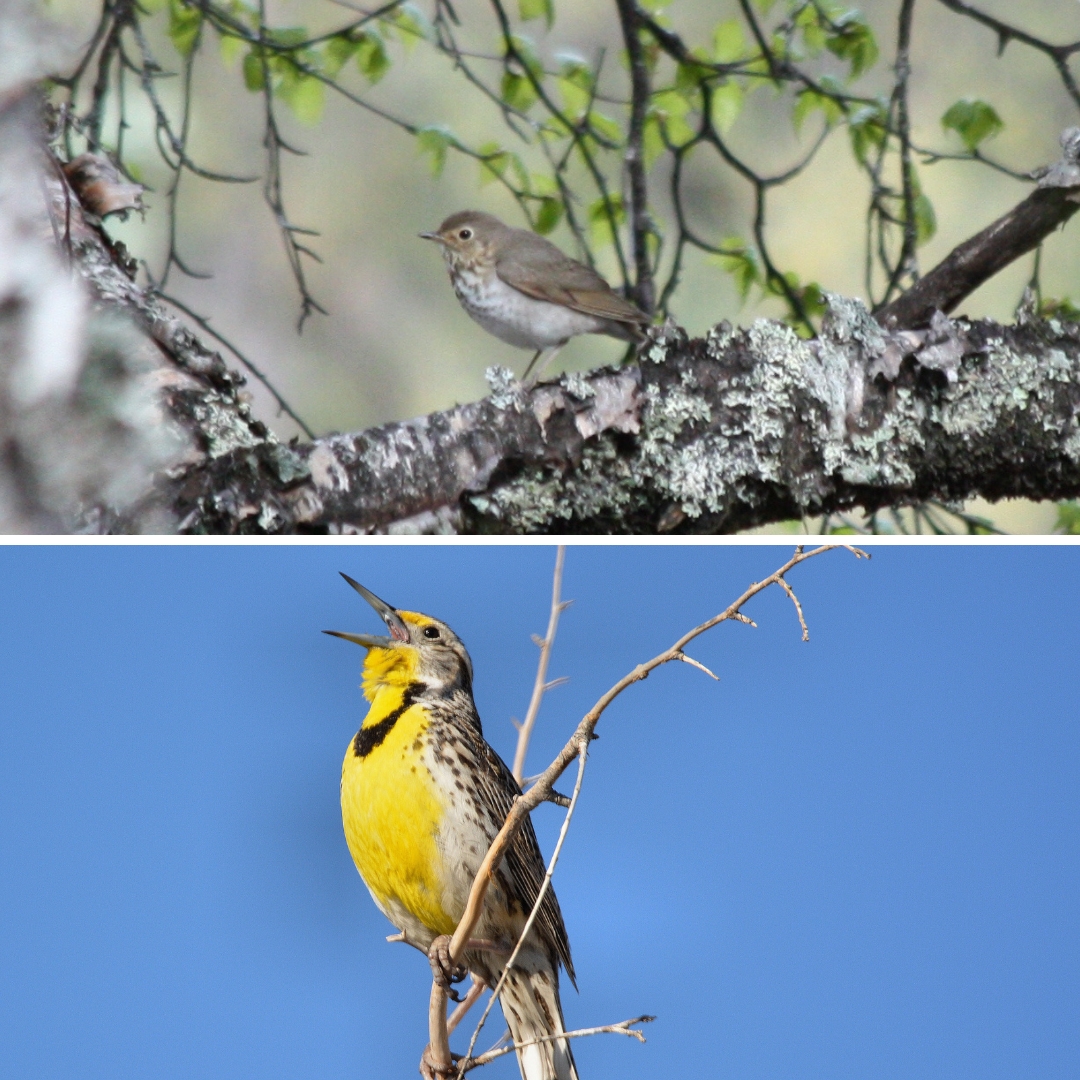
Swainson's Thrush & Western Meadowlark Courtesy US NPS Robbie Hannawacker, Photographer (thrush) Albert Myran, Photographer (meadowlark) Combined by Patrick Kelly
Swainson’s Thrush & Western Meadowlark
Courtesy US NPS
Robbie Hannawacker, Photographer (thrush)
Albert Myran, Photographer (meadowlark)
Combined by Patrick Kelly
The serenades around where I live begin early. Today it was during the full moon at 3am, in a break from the blessed rain. The chorus is mostly of robins, but one voice sticks out as new; a call I do not know; a love letter to curiosity of who could make such a call. I have hope that I’ll be able to find who sings like a Geddy Lee who has found Xanadu. It isn’t the first mystery bird I’ve encountered though.

I do remember my first, how can one not, that first call which bamboozled and hypnotized me years ago, both awakening and soothing that inside of me which makes me human. I used to live in a small cabin in the middle of Alaska, and during the eternal summers I’d hear this bird’s haunting call lull me to sleep. It was a Weddell seal of the woods. A UAP that sang.

At first, I didn’t want to know who it was filling the woods with quicksilver honeydew, drop by drop. I somehow felt that the magic would be lost, that by knowing the source I would ruin the spring. But then one day, the music maker appeareth. He was brown, squat, with a small thin beak, just sitting on a spruce branch at my eye level. When he sang, I found I was not disappointed. The Eden of unknowing bliss was not left behind. Instead, where once I saw an it, now I saw a thou. He was singing. The noble, sylvan Swainson’s Thrush.

This trend continued on for me, and once I moved to Utah, I found even more new strange songs. I learned to let the choir sing from their perches, and wait for them to show themselves. The newest singer I discovered was last summer, out in the last intact meadows which border the Bonneville Shoreline trail in Cache Valley, fast disappearing to the grind of half-acre plots and four-car garages which confuse godliness with gaudiness. In their loss, also deplete becomes their song.

Once I heard this new serenader, an avian Van Halen, I began repeating the trail just to hear his song. Like the thrush, which at this point was many years prior, his song seemed to have no source, it simply emanated from the golden grasses and muted sage which, pressed by wind, created a woven mat of gestalt terroir and echoed off the small crevices which led to the mountainsides.

So days and weeks went by as I hiked with my dogs. I’d keep an ear to the pastures and when I heard him, or his premonition upon the wind, I’d freeze and bend in. And sure enough, a certain day came where on this hike I listened, heard, and then saw him. Speckled brown back, golden chest with a black chevron, perched atop a scrubby little juniper calling into the wind. A Western Meadowlark at work.

So if this summer you hear a new sound in the full moon morning and don’t know who makes it, don’t shy, ignore, nor give up. The best thing you can do is to keep listening and keep waiting, be it your first or just most recent. Eventually the caller will pull the curtain back of their own accord and be revealed. So here’s my wish of good luck to you, that you will find what you’re listening for out in the world.

I’m Patrick Kelly, and I’m Wild About Utah.
 
Credits:

Images: Courtesy US National Park Service(NPS) Robbie Hannawacker, Photographer (thrush) & Albert Myran, Photographer (meadowlark)
Audio: Courtesy US NPS Media / David Betchkal (thrush) & US NPS & MSU Acoustic Atlas/Jennifer Jerrett (meadowlark)
Additional Audio Courtesy & © Kevin Colver, J. Chase and K.W. Baldwin.
Text:    Patrick Kelly, Director of Education, Stokes Nature Center, https://www.logannature.org
Included Links: Patrick Kelly & Lyle Bingham, Webmaster, WildAboutUtah.org

Additional Reading

Wild About Utah, Posts by Patrick Kelly

Stokes Nature Center in Logan Canyon, https://www.logannature.org/

Bonneville Shoreline Trail, Logan Canyon Hiking, Bridgerland Audubon & Cache Hikers, site per Sarah Ohms, https://logancanyonhiking.com/bonneville.htm

Bonneville Shoreline Trail, Cache Hikers, https://www.cachehikers.org/Descriptions/BonnevilleShorelineTrail.html

Bonneville Shoreline Trail, Official Site(2016), https://www.bonnevilleshorelinetrail.org/

Swainson’s Thrush, All About Birds, Cornell Lab of Ornithology, Cornell University, https://www.allaboutbirds.org/guide/Swainsons_Thrush/overview

Swainson’s Thrush, American Bird Conservancy, https://abcbirds.org/bird/swainsons-thrush/

Swainson’s Thrush, UtahBirds.org, https://www.utahbirds.org/birdsofutah/ProfilesS-Z/SwainsonsThrush.htm

Western Meadowlark, All About Birds, Cornell Lab of Ornithology, Cornell University, https://www.allaboutbirds.org/guide/Western_Meadowlark

See Western Meadowlark in Sagebrush Communities in the Intermountain West, Bird Habitat Guide, American Bird Conservancy, https://abcbirds.org/wp-content/uploads/2015/05/SagebrushGuide.pdf

Western Meadowlark, UtahBirds.org, https://www.utahbirds.org/birdsofutah/ProfilesS-Z/WesternMeadowlark.htm

Nibley Firefly Park

Nibley Firefly Park: Luci the Firefly from  The Mystery of Luci’s Missing Lantern by Melissa Marsted and illustrated by Liesl Cannon Courtesy & © Liesl Cannon, Illustrator
Luci the Firefly from
The Mystery of Luci’s Missing Lantern by Melissa Marsted, illust. by Liesl Cannon
Courtesy & © Liesl Cannon, Illustrator
Just imagine waking from a very long sleep into a bright May morning in Cache Valley. This is the story of Luci, a western firefly, told charmingly by Melissa Marsted and illustrated by Liesl Cannon in their new children’s book, The Mystery of Luci’s Missing Lantern. After completing her transition from a larva to an adult firefly, Luci notices she has no light. She flies up Logan Canyon looking for her missing lantern, where the animals she meets encourage her to keep looking. But its a bluebird on top of Mt. Naomi, the highest point in the canyon, who turns Luci around and sends her back to where she was born, the Nibley Firefly Park.

Author Melissa Marsted and Illustrator Liesl Cannon at the Stokes Nature Center Book Signing Courtesy & © Mary Heers
Author Melissa Marsted and Illustrator Liesl Cannon at the Stokes Nature Center Book Signing
Courtesy & © Mary Heers
There Luci finds her light. She sits down near the top of a tall blade of grass, and suddenly males fly by, flashing their lights, trying to get her attention. Luci discovers she can flash back. It’s a party – a big courtship dance.

You can see the story unfold if you visit the Nibley Firefly Park after dark. But please tread carefully. For fireflies, this is their Grand Finale. It has taken two years for them to grow from larvae to flying adults. Now they are choosing a mate. By July they will have laid their eggs in the nearby marshy ground and their life cycle will come to an end.

Any artificial light brought to the scene (such as flashlights and car headlights) seriously disrupts the courtship flashing. If you visit the Nibley Firefly Park this summer, please keep your light to the barest minimum, and – enjoy the party.

This is Mary Heers and I’m Wild About Utah

Credits:
Images: Courtesy & Copyright © Mary Heers
Featured Audio: Courtesy & Copyright
Text: Mary Heers, https://cca.usu.edu/files/awards/art-and-mary-heers-citation.pdf
Additional Reading: Lyle Bingham, https://bridgerlandaudubon.org/

Additional Reading

Western Firefly Project: A Community Science Initiative, Natural History Museum of Utah, https://nhmu.utah.edu/citizen-science/fireflies

Wild About Utah, Mary Heers’ Postings

Bills, Christy, Utah Fireflies, Wild About Utah,Sept 7, 2020, https://wildaboututah.org/utah_fireflies/ AND
Bills, Christy, Fireflies, Wild About Utah, May 15, 2019, https://wildaboututah.org/fireflies/

Hellstern, Ron, June Fireflies, Wild About Utah, June 19, 2017, https://wildaboututah.org/june-fireflies/

Strand, Holly, Firefly light, Wild About Utah, June 20, 2013, https://wildaboututah.org/firefly-light/

Marstad, Melissa C, Author, & Cannon, Liesl, Illustrator, The Mystery of Luci’s Missing Lantern, Lucky Penny Publications, LLC, Mar 16, 2021, https://www.amazon.com/Mystery-Lucis-Missing-Lantern/dp/1945243805