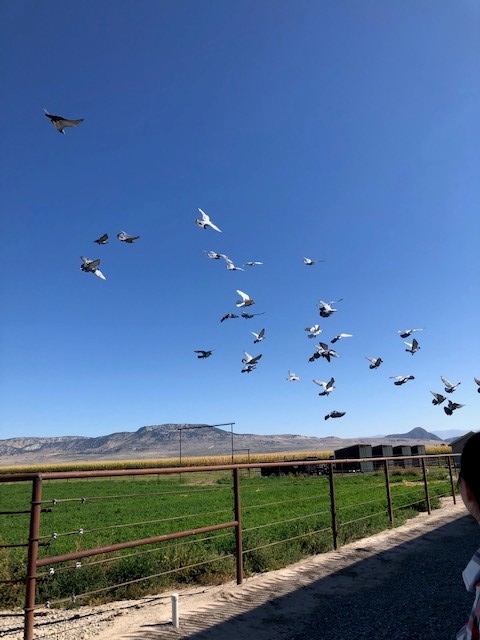
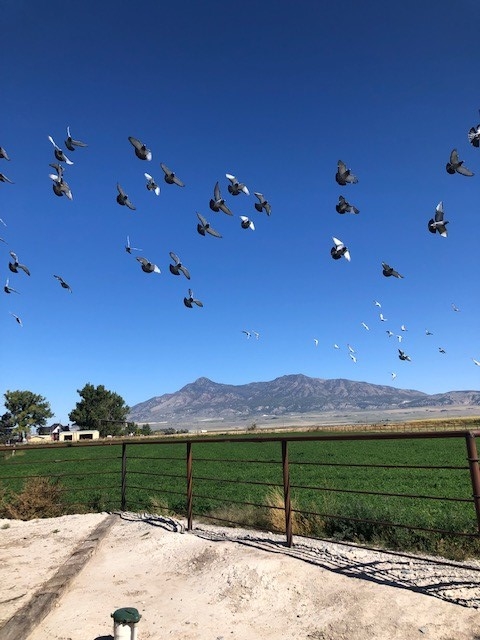
“Here they come!” Derek spotted the lead group of 40 as they flew into view, just over the tops of two trees a few hundred yards away. When the first bird entered the loft, the computer chip in its leg band sent a message to the loft computer. We heard the ping, It was 11:19. The lead group had flown 180 miles in three hours and 19 minutes. That made the average speed close to 55 mph.
I had begun my own journey into this world of avian athletes last summer at the Cache County Fair. I had gone to cheer on my neighbor’s kids who were showing their pigs, and ducked into the bird barn on the way out. I was expecting chickens, but found my self surrounded by pigeons. This encounter soon led me to Hyrum to meet the main exhibitor, Randy Balls. He met me at the door to his house with a big smile. “Do you want to see them fly?” he asked. We spent the next hour sitting on a bench in his backyard, watching his pigeons as they circled and swooped overhead Randy’s love for his birds was contagious, and I guess I shouldn’t be surprised that I now find myself with four homing pigeons of my own in an improvised coop in my backyard.
A desperate message was written and placed in the small canister tied to Cher Ami’s leg. “We are along the road parallel to 276.4 Our own artillery is dropping a barrage directly on us. For heaven’s sake, stop it.” Cher Ami took off. She was hit by bullets that blinded one eye and shot off part of her right leg. But she kept going. She delivered the message to army headquarters, and was credited with saving the lives of one hundred and ninety four American soldiers.
We know the messaging partnership between homing pigeons and humans can be traced all the way back to the pharaohs of ancient Egypt. What we don’t know is exactly how pigeons do it. Somehow they are attuned to the earth’s gravitational fields in ways that humans are not. I like the mystery of it. I like keeping alive the flame of wonder and awe as we continue to learn and interact with the natural world
Decreasing water levels in the southern arm of the Great Salt Lake expose microbialite communities that are normally underwater. Courtesy USGS, Hannah McIlwain, PhotographerI first met the Great Salt Lake in 1964 with two Central Michigan University college buddies on our way to Los Angeles. We heard you could float in its magical waters. Sure enough- it worked and we bobbed in its gentle waves oblivious to the many other virtues of this extraordinary water body. The Great Salt Lake’s Importance
This saltwater marvel is the largest wetland area in the American West. Its 400,000 acres of wetlands provide habitat for over 230 bird species traveling from the tip of South America, north to Canada’s Northwest Territories and as far west as Siberia. These wetlands and surrounding mudflats are vital habitat for 8-10 million individual migratory birds with many species gathering at the Lake in larger populations than anywhere else on the planet.
In 1991 the Great Salt Lake was declared a site of “hemispheric importance,” the highest level of designation given to a site by the Western Hemisphere Shorebird Reserve Network. The Reserve conserves shorebird habitat through a network of key sites across the Americas. Salt Lake receives the largest percentage of the world’s population of migrating Eared Grebes, nearly one-third of Wilson’s Phalaropes, more than half of American Avocets, and 37 percent of Black-necked Stilts. The lake’s shoreline, playas and mudflats also support 21 percent of the North American breeding population of Snowy Plovers, a species identified as one of greatest conservation needs by Utah’s Wildlife Action Plan.
These shorebirds are among nature’s most ambitious, long-distance migrants. But their numbers are dropping quickly. Shorebirds are showing the most dramatic declines among all bird groups. Species that undertake hemispheric migrations rely on specific habitats and food sources to survive, but these resources are increasingly under threat from human disturbance including habitat loss and degradation, over-harvesting, increasing predation, and climate change. As humans have continued to alter the landscape, shorebird populations continue to drop, with accelerated declines in recent decades.
Of 52 shorebird species that regularly breed in North America, 90% are predicted to experience an increase in risk of extinction. This includes 28 species already considered at high risk, and 10 imperiled species that face even greater risk.
At the base of Salt Lake’s food chain are microbialites, underwater reef-like rock mounds created by millions of microbes. These structures and their microbial mats form the base of the entire Great Salt Lake ecosystem, serving as a primary food source for brine shrimp and brine flies, which are the main food source for these aquatic birds. Falling water levels exposing the microbialites to air could trigger a collapse in the lake’s food chain according to a July study by the Utah Geological Survey.
So we humans aren’t the only one’s suffering from our disappearing Lake. Thank goodness we have awakened to this extraordinary resource found on our doorstep with many organizations and agencies attempting to save what remains for our health, wealth, and for the millions of threatened feathered friends that grace our skies, and our lives. Last May, Utah Governor Cox declared 2021 the year honoring shorebirds. We can do our part by taking action on conserving water and energy.
Jack Greene for Bridgerland Audubon Society and I’m wild about Utah and its magnificent great lake.
Written by Hall Crimmel & Dan Bedford, Filmed and Edited by Isaac Goeckeritz, iUtah EPSCor, Rachel Carsen Center Environment & Society,
Based on the book Desert Water; The Future of Utah’s Water Resources edited by Hall Crimmel and published by University of Utah Press, 2014
Wow, I thought. These pelicans are working together to to drive the fish into the shallow water’s edge where they can easily scoop the up And then it got better. Fanning out, the pelicans regrouped in a circle Swimming towards the center, they tightened the noose. And bam! Dip, scoop, knock back some more fish
I was amazed at how soundless and seamless it all was and could have watched for hours, but I was on the one lane auto route at the Bear River Migratory Bird Refuge and the cars behind me were starting to honk their horns, so I reluctantly moved on.
As soon as I got home I plunged into research on this majestic bird, beginning with the bill. When the pelican dips its bill into the water, the lower portion expands into a flexible sac that allows the bird to to scoop up as much as 3 gallons of fish and water. When the pelican cocks back its head, the sac contracts, the water is expelled through a barely open bill, and the fish swallowed. The huge pelican bill, which at first glance looks like a formidable weapon, is actually an exquisitively designed fishing net.
Archeologists have found pelican skulls dating back 30 million years, so this unique bill has definitely passed the test of time.
Back at the refuge I was able to turn into a visitor pull out and pick up the rather stunning bit of information: these pelicans fly in from Gunnison Island in the Great Salt Lake, over the Promontory Mountains, daily to forage for fish. That’s a 30 mile trip each way!
Long before the Mormon pioneers arrived in Utah, pelicans were building their nest on Gunnison Island. They were briefly disturbed when an artist, Albert Lambourne, tried to homestead for a year in 1850, and a guano mining company dropped off a crew – a Pole, a Russian, a Scot and an Englishman- to mine the bird poop. But the operation wasn’t profitable, and when it closed down, the pelicans reclaimed the island. Each March the birds fly in from as far away as Mexico, build their nests, and raise their chicks. The rookery is the largest in the US. In 2017 the pop was estimated to be as high as 20,000.
Back in Cache Valley in 2010, Jordan Falslev built a viewing platform near Benson Marina, The Pelican Perch, as his Eagle scout project. There used to be hundreds of pelicans out there on the water, but when I stopped by last week I didn’t see a single one. Numbers are way down now largely because the dropping water level in the Great Salt Lake have exposed a land bridge to Gunnison Island that allows predators to ravage the nesting site.
You can still catch sight of a pelican in flight in Cache Valley. (Their wingspan is 10 ft. Rudy Gobert, in comparison, has a wingspan of 7 ft 9 in.) But for my money, the best show in town is watching packs of pelicans hunt for fish at the Bear River Migratory Bird refuge.
Mormon Cricket female Anabrus-simplex Courtesy & Copyright Shannon Rhodes, PhotographerChildren’s author George Selden described the impact of a cricket’s chirping in the bustle of a subway station in his book “The Cricket in Times Square” like this: “Like ripples around a stone dropped into still water, the circles of silence spread out. …Eyes that looked worried grew soft and peaceful; tongues left off chattering; and ears full of the city’s rustling were rested by the cricket’s melody.” Combine this musical talent with Jiminy Cricket’s gentle reminder to always listen to my conscience, and it is no wonder that I would drift to sleep on summer evenings enamored with cricket songs. How, I thought, could such a beautifully-sounding insect be the villain in Utah’s legend we know as the Miracle of the Gulls, memorialized in Minerva Teichert paintings and Temple Square monuments?
Decades later, near Fremont Indian State Park, I met a Mormon cricket for the first time. I cringed as I watched thousands of these creatures hopping across the mountain path that afternoon, and I understood how merciful those California gulls must have seemed, swooping in to gobble up the insects, as the Mormon pioneers struggled to develop a defensive, crop-saving plan as newcomers to this land.
Mormon Cricket female Anabrus-simplex Courtesy & Copyright Shannon Rhodes, PhotographerUtah settler Mrs. Lorenzo Dow Young captures a bit of the incident in her 1848 journal entry: “May 27: …today to our utter astonishment, the crickets came by millions, sweeping everything before them. They first attacked a patch of beans…, and in twenty minutes there was not a vestige to be seen. They next swept over peas…; took everything clean.” These hordes of insects were not new to the area, however, as we know that explorer Peter Skene Ogden noted “crickets by millions” in his 1825 journal account over 20 years earlier.
Did you know that Mormon crickets are not crickets, grasshoppers, or cicadas, but large shield-backed katydids that walk or hop rather than fly? Their smooth, shiny exoskeleton can be a variety of colors and patterns, like the reddish-brown female I chased and studied this summer in Fishlake National Forest. They have long antennae, and each female has what looks like a long curving stinger extending from her abdomen. This ovipositor allows her to deposit 100 eggs or more that look like gray or purple rice grains just below the soil surface. The males, on the other hand, lack this structure, but they “sing” as a way to attract females, and reward their mates with protein-packed spermatophore prizes.
Katydid or bush cricket Courtesy & Copyright Shannon Rhodes, PhotographerThese insects can be solitary mountain-dwellers but make headlines when they swarm in huge bands, marching in one direction as omnivores, in search of anything to eat: cultivated crops, succulent forbs, sagebrush and other shrubs, other insects, and even their own kind. Researchers tracking migrations determined they can travel more than 50 miles in a summer, perhaps a mile a day, and for many, including those early Utah settlers and others hoping to shield crops from Mormon cricket devastation, it is a sign of relief to see the last one for the season. They do make for a great story, though.