The Natural Ebbs of the World

The Natural Ebbs of the World: Snow Goose Courtesy Pixabay, Hans Benn, Photographer
Snow Goose
Courtesy Pixabay, Hans Benn, Photographer
I can never tell if the anachronism of daylight savings is ironic. Maybe that’s due to my newly syncopated circadian rhythm. Or maybe it’s all a dream. Or perhaps, it’s somewhere in between.

Either way, it strikes me odd that we take our supposed linear direction on time from circular mechanisms that are unable to change of their own volition, except for once a year where we make morning seem earlier, even though it really isn’t, then in the fall we realize what an odd choice we made and go back on our decision.

Winter then sees us forget about our lapse. The cloud of amnesia, gained through time influencing time, shrouds our minds, so that come spring we’re intellectual infants, fresh as the crisp crocus air.

Now, I am actually not opposed to daylight savings. In fact, I’m very for it, though I differ in how it is implemented. I actually enjoy that, twice a year, our inner apes get to upset the rigid clockwork of clockwork, and use arbitrary tradition to tell our shared system of accountability that it does not have all the sway, and that it is ultimately, itself, an arbitrary tradition. I like that we get to be human in a world that is increasingly machine.

My umbrage with daylight savings, then, is that it isn’t wild enough. A strict date to spring and fall? That doesn’t seem right. It’s too orderly. My vote is that in every town, we pick one critter who wakes then dens, or arrives then leaves, and base our system of time off of something that is actually real, tangible, and unconditional. Maybe for the towns here in Utah, it can be a ground squirrel. Or a swan. Or RV tourists. Instead of having a strict immobile date, we give all time its greatest accountability: the natural ebbs of the world. We give time the context it is itself within.

This system I’d find actually meaningful, and just great fun. Imagine a likeness to groundhog day, twice a year, in every town, with all sorts of menagerie. The message we’ll send is that time doesn’t control us, nor we time. Instead time is controlled by those who are unaware of their own influence. Each living thing would have a potential chance to alter how we conduct ourselves. In this way, daylight savings no longer becomes anachronistic, or even ironic. Instead, daylight savings can become a dialogue with the world; a conversation with our participation in life. Time becomes grounded in reality. I imagine this conversation:

“What time is it?”
“Depends, has the first snow goose arrived?”
“No, but the last leaves fell off the box elder by the post office.”
“Then that explains why Bill isn’t here and we are.”

So this daylight savings, if you or someone you know is grumbling that all of this could be so much easier, just say yes, it could, and pitch them this idea if you’re keen on it, too. Let them see that we don’t have to be where we are, with an inane change of the time based on time, but instead we could change the time based on the world which is alive and vibrant around us each day. We could force ourselves to participate in time, by seeing that who we are depends on where we are and the life which encircles the lives we live. Maybe then, we can lose the ironic anachronism we currently have, and let our circadian rhythms be aligned to those natural forces which run deeper than a calendar date wherever, or whenever, you are.

I’m Patrick Kelly and I’m Wild About Utah.
 
Credits:
Images: Courtesy Pixabay, Hans Benn, Photographer https://pixabay.com/photos/goose-white-snow-goose-flies-4190673/
Audio: Courtesy & © Kevin Colver https://wildstore.wildsanctuary.com/collections/special-collections
Text:    Patrick Kelly, Director of Education, Stokes Nature Center, https://www.logannature.org
Included Links: Patrick Kelly & Lyle Bingham, Webmaster, WildAboutUtah.org

Additional Reading

Wild About Utah, Posts by Patrick Kelly

Stokes Nature Center in Logan Canyon, https://www.logannature.org/

Kokanee

Kokanee flash of red Courtesy & © Mary Heers, Photographer
Kokanee flash of red
Courtesy & © Mary Heers, Photographer
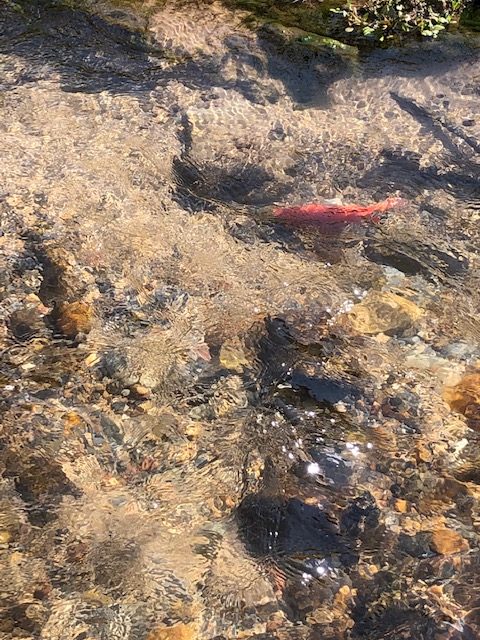
Every fall, tucked away in the southern tip of Cache Valley, and hidden 30 feet below the water surface of Porcupine Reservoir, a drama begins to unfold. The biological clock of the four year old Kokanee salmon ticks over. Childhood is over is over and it is time to spawn. This beautiful silver fish turns red. The jaw of the males elongates and a hump grows on its back. Both the males and females congregate at the inlet where Cinnamon Creek flows into the reservoir. One by one they point their heads upstream and push themselves against the current.

Walking along the creek banks, looking down into the water, it’s impossible not to feel stirred by the spectacle of flashing red bodies fighting against the current. It’s a journey of fits and starts – a quick surge ahead and then a quivering pause. This is a real fight – the life energy of the fish against the relentless current. Just how difficult it is becomes apparent when the current will catch a fish and send it careening down steam until it recovers its balance and starts upstream again.

Beaver dams obstructing Kokanee swimming upstream Courtesy & © Mary Heers, Photographer
Beaver dams obstructing Kokanee swimming upstream
Courtesy & © Mary Heers, Photographer
What we are seeing is a short version of the incredible journey made by their close cousins, the Sockeye Salmon, who travel 900 miles from their birthplace along the tributaries of the Snake River, all the way into the salty ocean, and back again. In contrast, the Kokanee from Porcupine will only travel a few miles, especially this year as beavers have been busy building dams across Cinnamon Creek, and very few Kokanee make it up and over the first few.

Stopped from going further upstream, the female goes to work , using her tail to clear a nest of gravel. She lays her eggs and a nearby male swoops in and covers them with his milt. The female covers the fertilized eggs with more gravel and it is done. The Kokanee life cycle comes full circle, and the adults will die. The eggs are on their own. If all goes well, some will hatch in November. By April they will have grown into fingerlings and will get flushed downstream in the Spring run off. They will then spend the next few years in the reservoir before it is their turn to turn red and point their heads upstream.

The Department of Natural Resources originally stocked Kokanee into the reservoir as a sport fish. I asked a fisherman friend how one goes about catching a Kokanee, and he said you need a boat and a fish finder. The Kokanee live in schools about 30-50 feet below the surface, filling their bellies mostly by filtering zooplankton from the reservoir water. Once the fisherman finds the fish, he trolls right through the middle of the school with a shiny rectangle of metal called a dodger, along with pink and green plastic squid and a bit of colored corn. The fish strike the line out of anger, not out of hunger. “They’re a very tasty fish,” my friend said. “And a beautiful silver. We call it ‘catching chrome'” But for me the most beautiful color of Kokanee will always be the flash of red as it fights its way upstream. And the best taste will be the bit of awe and wonder we get as we catch a glimpse into this unique circle of life as it plays out in our natural world.

Kokanee swimming upstream Courtesy & © Mary Heers, Photographer
Kokanee swimming upstream
Courtesy & © Mary Heers, Photographer
This is Mary Heers and I am Wild About Utah.

Credits:
Photos: Courtesy & Copyright © Mary Heers
Photos: Courtesy
Featured Audio: Courtesy & Copyright © Friend Weller, Utah Public Radio upr.org
Text: Mary Heers, https://cca.usu.edu/files/awards/art-and-mary-heers-citation.pdf
Additional Reading: Lyle Bingham, https://bridgerlandaudubon.org/

Additional Reading

Wild About Utah, Mary Heers’ Wild About Utah Postings

Boling, Josh, Kokanee Salmon in Utah, Wild About Utah, October 9, 2017, https://wildaboututah.org/kokanee-salmon-in-utah/

Strand, Holly, Kokanee Life Cycle, Wild About Utah, September 19, 2013, https://wildaboututah.org/kokanee-life-cycle/

Strand, Holly, Kokanee Salmon, Wild About Utah, October 7, 2008, https://wildaboututah.org/kokanee-salmon/

9 places to see bright red kokanee salmon in Utah this fall, News, Utah Division of Wildlife Resources, Department of Natural Resources, State of Utah, September 1, 2019, https://wildlife.utah.gov/news/utah-wildlife-news/1003-see-red-kokanee-salmon.html

Ross, Crystal, Where to see Utah’s spawning kokanee salmon, Wildlife Blog, Utah Division of Wildlife Resources, August 29, 2019, https://wildlife.utah.gov/news/wildlife-blog/755-where-to-see-utah-s-spawning-kokanee-salmon.html

Fishing Guidebook 2021, Utah Division of Wildlife Resources, Department of Natural Resources, State of Utah, September 1, 2019, https://wildlife.utah.gov/guidebooks/2021_fishing_guidebook.pdf

Sockeye Salmon (Kokanee) – Oncorhynchus nerka, Utah Species, Utah Division of Wildlife Resources, Department of Natural Resources, State of Utah, 2019, https://fieldguide.wildlife.utah.gov/?species=oncorhynchus%20nerka

DeMoss, Jeffrey (with Eli Lucero underwater Kokanee photo), The journey home: Kokanee salmon make annual Cache spawning run, The Herald Journal,
Sep 17, 2015, https://www.hjnews.com/allaccess/the-journey-home-kokanee-salmon-make-annual-cache-spawning-run/article_235386ec-27a5-575f-872b-3702f3ded215.html

Ockey, Natalie, Kokanee Salmon Run in Utah. Utah’s Adventure Family, Last updated September 27, 2020, https://www.utahsadventurefamily.com/kokanee-salmon-run-in-utah/

The Wonders of Bird Migration

The Wonders of Bird Migration: Geese in Formation, Courtesy Pixabay Manfred Antranias Zimmer, Photographer
Geese in Formation
Courtesy Pixabay
Manfred Antranias Zimmer, Photographer
As I watch waves of migrant birds move through our valley, beginning in mid-July with rufous humming birds and a few early shorebirds, followed by raptors pouring over the Wellsvilles mountains in mid-August, then September when many of our songbirds head for the tropics, and lastly in November come the waterfowl- ducks, geese, and swans stream through by the thousands, I am thunderstruck. The remarkable physiology that allows our avifauna to find their way through storm and unimaginable distances to their destinations defies logic. Fraught with peril, it is the most dangerous part of their existence since leaving the nest.

In the past two decades, our understanding of the navigational and physiological feats that enable birds to cross-immense oceans, fly above the highest mountains, or remain in unbroken flight for months has exploded. What has been learned of these migrations is nothing short of extraordinary.

Bird migration entails almost unfathomable endurance, like a sparrow sized sandpiper that flies nonstop from Canada to Venezuela- the equivalent of running 126 consecutive marathons without food, water, or rest- avoiding dehydration by drinking moisture from its own muscles and organs, while orienting itself using the earth’s magnetic field through a form of quantum entanglement that made Einstein queasy.

Crossing the Pacific Ocean in nine days of nonstop flight, as some birds do, leaves little time for sleep, but migrants can put half their brains to sleep for a few seconds at a time, alternating sides- and their reaction time actually improves.

Birds add muscle when and where it’s needed, and shrink it away when the task is completed. Barred godwits lose their entire digestive system for flight. They burn fuel with extraordinary efficiency, qualities that would make endocrinologists, bodybuilders and weight loss gurus salivate. Birds can pack on fat without obesity’s downsides, add muscle when and where it’s needed, and burn fuel with extraordinary efficiency. Most of their fuel comes from omega 3 fatty acids gained by eating certain crustaceans and other invertebrates along the way. These fats also provide water and assist with protein digestion and synthesis

Birds have intricate air sacks connected to their lungs allowing 90% efficiency in capturing oxygen, far beyond the human respiratory system capability. This is combined with super-efficient hemoglobin molecules. Pulmonary embolism, which I recently experienced, is unknown in migratory birds. Might these remarkable beings have something to tell myself and medical science?
Regarding navigation, in addition to sight and smell, it has been recently discovered that when a photon of blue light strikes crypto chrome in the bird’s eyes which it becomes magnetized through quantum entanglement allowing them to see the earth’s magnetic lines. That’s amazing! Much of this information is from “A World on the Wing: The Global Odyssey of Migratory Birds” by Scott Weidensaul, a beautifully written book you must read.

Jack Greene for Bridgerland Audubon Society and I’m wild about Utah

Credits:
The Wonders of Bird Migration
Picture: Courtesy Pixabay Manfred Antranias Zimmer, Photographer
Audio: Courtesy & © Kevin Colver https://wildstore.wildsanctuary.com/
Text: Jack Greene, Bridgerland Audubon, https://bridgerlandaudubon.org/
Additional Reading: Lyle W Bingham, Webmaster, and Jack Greene, Author, Bridgerland Audubon, https://bridgerlandaudubon.org/

Additional Reading:

Jack Greene’s Postings on Wild About Utah, https://wildaboututah.org/author/jack/

Weidensaul, Scott, A World on the Wing: The Global Odyssey of Migratory Birds, W. W. Norton & Company, March 30, 2021, https://www.amazon.com/World-Wing-Global-Odyssey-Migratory/dp/0393608905

Greene, Jack, Migration, Wild About Utah, September 24, 2018, https://wildaboututah.org/migration/

Hellstern, Ron, Autumn Migrations, Wild About Utah, October 16, 2017, https://wildaboututah.org/autumn-migrations/

Cane, James, Ladybird Beetle Migration, Wild About Utah, November 18, 2010, https://wildaboututah.org/ladybird-beetle-migration/

Strand, Holly, Heading South, Wild About Utah, October 28, 2010, https://wildaboututah.org/heading-south/

Strand, Holly, Spring Migration, Wild About Utah, April 28, 2009, https://wildaboututah.org/spring-migration/

Sermons of Birds

Sermons of Birds: Forest in Autumn Courtesy Pixabay.com, HmsFree, Photographer
Forest in Autumn
Courtesy Pixabay.com, HmsFree, Photographer
There is a story I like of an old Zen master who one day was asked to speak wisdom to his acolytes as they were sitting outside. He obliged. He rose and walked to the front of the students. He waited a moment to think carefully about his words, opened his mouth, and then just as he was about to speak, a bird in a nearby tree sang its beautiful warbling song. The master did not interrupt but instead simply listened and waited until the song finished, and the bird had flown away. When it had, he finally spoke: “The sermon has been delivered,” he acknowledged, and took his seat once more.

I think about this story often and dwell on its themes. The true master who is the truest student. The songbird who speaks truth without language. The wisdom elevated by listening to the world without ego.

This time of year, I try to take the lesson of the Zen master and listen to the autumn world around me, the softening sounds of my time on earth. I take pause and hear the breeze which rustles box elders scarlet and shivers aspens gold. The wind which blankets the land and grows it rosy before winter’s snowy slumber.

The birds’ notes, the bearers of great truths, have shifted from their summer selves, too. No longer do they sing for love, but instead call for companions as they find flocks to blunder between fermented crabapple trees with, and telegraph where the good black oil seed is for the benefit of all who husk germ.

I find solidarity with their industry, for I believe we all come from the same inner place. They, doing what is good and right, and I as well. I, too, likely like you, get a hankering, a reckoning to winterize, to preserve, to stock up like a tree’s fattening roots, swollen full with the liquor of next spring’s buds and blossoms. I do it through crisp cider, hot corn chowder, steamed cans, jammed jars, strong mulled toddies, and wool. These are my fruits and fat stores. These are my natural inclinations.

I take from the story of the Zen master, too, that we are all on the same team. Just as the master understood to defer a message of truth to the birds, we can all recognize the truth in what autumn fills us all with: that drive of readiness for spring by ways of winter. That our season of without only can be because of seasons of with, and that our seasons of bounty can only be through the rest with which we are pulled in winter.

So this autumn, I encourage you to listen like the Zen master to the world around you. When it whispers, “put on a sweater and sip hot drinks by the hearth,” do so. When it bellows, “can and jam all of the things for winter is coming and the taste of summer is that season’s delight,” do so as well.

And when the world says, “listen,” in beautiful birdsong, do so, and know that you sing, too, by being who you are to your core.

I’m Patrick Kelly, and I’m Wild About Utah.
 
Credits:
Images: Courtesy Pixabay, HmsFree, Photographer
Audio: Courtesy & © Kevin Colver https://wildstore.wildsanctuary.com/collections/special-collections
Text:    Patrick Kelly, Director of Education, Stokes Nature Center, https://www.logannature.org
Included Links: Patrick Kelly & Lyle Bingham, Webmaster, WildAboutUtah.org

Additional Reading

Wild About Utah, Posts by Patrick Kelly

Stokes Nature Center in Logan Canyon, https://www.logannature.org/