Slow Down, Paddle Backwards! An Educators Reflection on Instructional Style

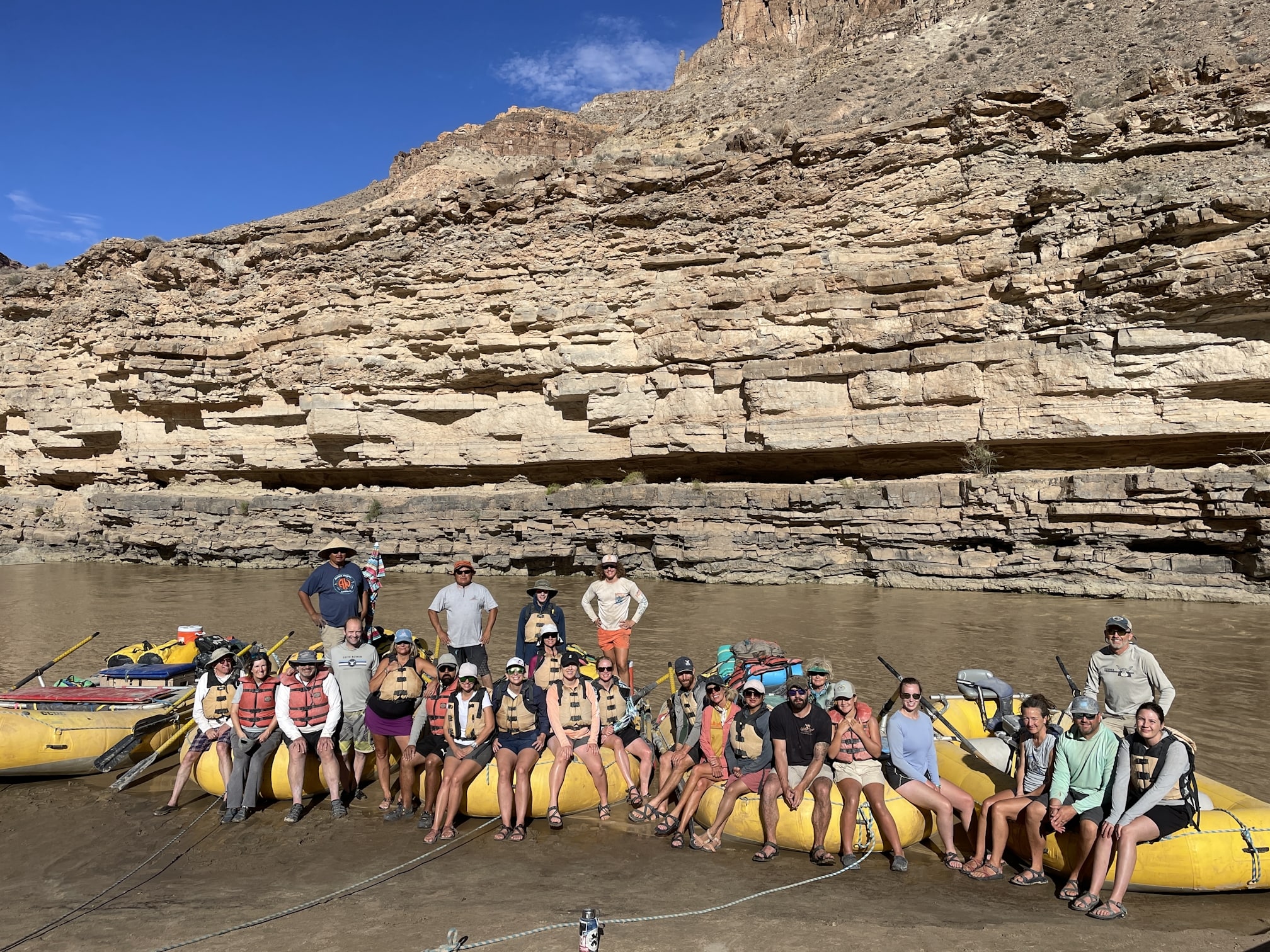
EBLS faculty during a learning retreat to the San Juan River. The rapids called “The Ledge” were located just upstream of this photo. Courtesy & © Joseph Kozlowski, Photographer
EBLS faculty during a learning retreat to the San Juan River. The rapids called “The Ledge” were located just upstream of this photo.
Courtesy & © Joseph Kozlowski, Photographer
On an Edith Bowen Laboratory School teacher professional development retreat last summer rafting the San Juan River, a specific experience made me question my instructional style. I was sitting in the front of what they call a Ducky – a tandem inflatable raft with the passenger in the front and the experienced rower in the rear – with a vibrant and tough 6th grader named Kylie captaining from the rear. Although Kylie was in the captain’s seat, she was not an experienced rower. In fact, she was just learning, and I, from the front, was trying to teach her a thing or two from my very limited knowledge of rowing.

As I sat in the Ducky giving instructions, I reflected on my own instructional style and wondered how I would teach something that I had never taught before? I found myself giving her little challenges like “Try to get the nose of the boat to run straight over that gurgling water boil!” I also found myself showering her with positive, and specific reinforcement such as “I loved the way you corrected the steering by giving a tiny left forward paddle!” However, it wasn’t until we prepared to head down a set of rock smashing rapids called The Ledge that I found the golden nugget of self-knowledge I had been looking for.

Dr. Eric Newell, our guide and true rowing expert on the trip, was leading a separate 16ft. inflatable raft ahead of us. He called us over and was preparing Kylie and I for the upcoming rapid. “Stay pretty close behind me and let me run the rapid first so you can see the line.” All was agreed upon and Dr. Newell expertly launched toward the rapid with Kylie close on his heels. When the rapid was nearly upon us, Dr. Newell shouted backwards from his boat, “Give us a little more space!” In response, I shouted two important phrases back to my own young captain “Slow down,” then without allowing her time to think or react, I yelled “Paddle backwards!”

And this is where I stop the story, for those two phrases ended up being the key to my learning. The first phrase “slow down” was an objective, a goal. It was a problem to be solved and a self-driven adventure to be had by Kylie. You see, Kylie could have made any number of right or wrong decisions in response to the phrase “Slow down!” She could have spun the boat and went upstream, she could have dragged her paddles, or she could have even jumped out of the boat and anchored. There is no knowing, and no absolute safety or certainty in what Kylie could have done in response to the phrase “Slow down!” The only certainty is that she would have had to think, trust herself, and make a decision. In contrast, the second phrase “Paddle backwards!” was a directive, an order. It was a command to be followed and a prescription to be obeyed. There was nothing for Kylie to critically think about in response to this order. She had but one option which was to take the paddle, thrust it into the water, and heave in a reverse direction.

Ultimately, it was the distinction between these two phrases “Slow down!” and “Paddle backwards!” that forced me to reflect on my own instructional style. Am I the type of teacher to challenge my students to think critically by offering open-ended environments that yes, can be risky, but ultimately unmeasurably powerful? Or, do I merely pose teacher-centered directives that precipitate little more critical thinking and decision making than a person on a raft, being told to ‘paddle backwards.’

This is Dr. Joseph Kozlowski, and I am Wild About Utah!
Credits:

Images: Courtesy & Copyright Joseph Kozlowski, Photographer, Used by Permission
Audio: Courtesy & © Friend Weller, https://upr.org/
Text:     Joseph Kozlowski, Edith Bowen Laboratory School, Utah State University https://edithbowen.usu.edu/
Additional Reading Links: Joseph Kozlowski & Lyle Bingham

Additional Reading:

Joseph (Joey) Kozlowski’s pieces on Wild About Utah: https://wildaboututah.org/author/joseph-kowlowski/

San Juan River, Utah Office of Tourism, https://www.visitutah.com/things-to-do/River-Rafting/San-Juan-River

Frisbee Fun!

Frisbee Fun! EBLS Disc Golf and Ultimate Club Courtesy & © Joseph Kozlowski, Photographer
EBLS Disc Golf and Ultimate Club
Courtesy & © Joseph Kozlowski, Photographer
If you’re like me, you’re always on the lookout for new outdoor activities! I would love to draw your attention to a sport that has many names, but that many have not had the pleasure to enjoy. I’m talking about the great hucking and slinging adventure, the sport of roll-aways and tree hits, the family fun activity called Frolf or Frisbee Golf, formally known as Disc Golf.

I first played this sport at 6 years old by tagging along after my father as he navigated the course through a forest and around a lake, starting each hole at a concrete tee pad and counting how many throws it took him to get his disc to settle in the metal basket with dangling chains. Once in a while I would throw a disc, but mostly my little legs tried to keep up on this exciting hike that involved throwing, putting, strategy, patience, and lots of searching through the woods for nearly lost frisbees! Now, 25 years later I still enjoy all the sport has to offer, and one of the primary reasons is because it is an all too easy excuse to get outside and enjoy the different landscapes and environments this great state has to offer.

We Utahns shouldn’t be too unfamiliar with this sport. In 2021, the Professional Disc Golf Association (PDGA) World Championship tournament was held in Ogden at two disc golf courses, Fort Buenaventura and Mulligan’s Golf and Games. History was made at this event when James Conrad, on the final shot of the tournament, curled the disc 247 feet in a single throw to land in the basket; forcing a sudden death play-off, which he won, to become the world champion. This shot is widely accepted as the greatest shot in disc golf history.

According to the PDGA course directory, there are at least 91 disc golf courses throughout our state, and 50 spread along the Wasatch front. Most of these courses are free to play and include exposure to a diverse outdoor experience. Some courses wind and wiggle through heavily wooded areas while others meander through manicured city parks. If you are really up for an outdoor adventure, try one of the extreme mountain courses, like the Solitude Ski resort course, where you launch discs up and down rugged mountainous slopes, sometimes more than 1000 feet in a single throw! Try not to lose too many discs.

In this sport, some people prefer to have just one disc, go out on a beautiful sunny day, and simply enjoy nature while throwing a frisbee; scores don’t need to matter! Other people take a different, more competitive approach to this sport and focus on the dynamics of how each of the many discs fly. They learn that based on disc shape and weight and the technique of their body, they can manipulate the disc to bend and turn, go right or left, skip or roll, or limitless other maneuvers that may be required to get the elusive birdie!

Two years ago, I started an afterschool Disc Golf and Ultimate Club at USU’s Edith Bowen Laboratory School, which was open to all our 3rd-6th grade students. What I experienced was kids passionately enthusiastic about the comradery, the physical activity, and the special wonderment that only objects in flight seem to bring. Each session has hosted around 40 girls and boys and many end up introducing the sport to their own families. It seems there is something special about this sport that naturally draws the love of children.

And so, whether you are looking for something outdoor and active to do on your own, with children, grandchildren, or even a niece or nephew, disc golf might be a soaring success!

This is Joey Kozlowski, and I am Wild About Utah!
Credits:

Images: Courtesy & Copyright Joseph Kozlowski, Photographer, Used by Permission
Audio: Courtesy & © Friend Weller, https://upr.org/
Text:     Joseph Kozlowski, Edith Bowen Laboratory School, Utah State University https://edithbowen.usu.edu/
Additional Reading Links: Joseph Kozlowski

Additional Reading:

Joseph (Joey) Kozlowski’s pieces on Wild About Utah: https://wildaboututah.org/author/joseph-kowlowski/

https://www.pdga.com/course-directory – Helps identify and find courses

https://udisc.com/courses – Helps identify and find courses

https://www.youtube.com/watch?v=eOhO7FfVQlE – Video of the ‘Greatest Shot in History’

What’s On Your List?

What's On Your List? Canoeing in Benson Marina, Benson, Utah Courtesy & Copyright Shannin Kishbaugh, photographer
Canoeing in Benson Marina
Benson, Utah
Courtesy & Copyright Shannin Kishbaugh, photographer

A Leech on Trip Armstrong’s Thumb Courtesy & Copyright Shannon Rhodes, Photographer A Leech on Trip Armstrong’s Thumb
Courtesy & Copyright Shannon Rhodes, Photographer

A Leech Escaping a Container Courtesy & Copyright Shannon Rhodes, Photographer A Leech Escaping a Container
Courtesy & Copyright Shannon Rhodes, Photographer

If I were to ask you to craft a list of words that represent your connection to the natural world, which words immediately pop into your mind? Of course, President Theodore Roosevelt said, “There are no words that can tell the hidden spirit of the wilderness that can reveal its mystery, its melancholy and its charm.” Yet, Brooke Smith published her book “The Keeper of Wild Words” in response to learning that nature words she loved were replaced in the Oxford Junior Dictionary for words like chatroom and voicemail.

Grandmother Mimi tells young Brook, “If we don’t use words, they can be forgotten. And if they’re forgotten, they disappear.”

That voice was the person who gave me this beautiful book, fellow Edith Bowen Laboratory School teacher Shannin Kishbaugh. I invited her with me to talk about wild words.

What words top your list? I would say calm, peaceful, freedom, exploration, and wonder.

My list evolves, but it always has wapiti and mica schist. It includes caddisfly casings on river rocks and cumulonimbus clouds in the sky. I love red-winged blackbirds I saw this morning in the phragmites along the roadside, curlycup gumweed I discovered at Hardware Ranch, stinging nettle walking the banks as a child with my father just off Fireclay Avenue in Murray, and hoodoos in Goblin Valley.

My most recent word is leech. Shannin, when you hear that, what are your words? Uncertainty, fear, dirty, slimy, old documents and uses in medicine. I’ve become a lover of water bugs this year, but still leeches feel extreme.

Well, those are very different words from your nature words. Not long ago at a conference cleverly titled “In Mud” about place-based education for young children, I stood with teachers from Washington state to Washington D.C. While the goal was discussing developing nature inquiry projects based on interest of the students, a colleague saw a dark blob on another’s boot and for the remainder of the workshop, we as educators huddled in a circle playing with the leech like children. It slithered and reached; we gazed in wonder and some apprehension. I realized I’d never spent time appreciating a leech.

There are lots of leech species, including some found only in Utah. They begin life in a cocoon which surprised me, they have suckers that give them the reputation as selfish parasites even though they don’t all suck blood, and they play an important role in the food chain. This spring when we took our first graders out again to explore what lives in the water, this time to Benson Marina of Cutler Reservoir, our students canoed past an osprey nest, captured the cattails in watercolor, and even observed a leech clinging to our guest scientist Trip Armstrong’s thumb. As the students worked, your idea was to collect the words, their exclamations, and offer them back to them to use in writing list poetry.

Let’s end with some of the nouns, adjectives and verbs from their list: “paddle whirlpools, dunking ducks, pelican peace, and ripple reflections.” And of course, “little leech. It was the best feeling. Happiness all around me.”

We are Shannon Rhodes and Shannin Kishbaugh, and we are wild about Utah words.

Credits:

Images: Canoeing – Courtesy & Copyright Shannin Kishbaugh, Photographer
Leeches – Courtesy & Copyright Shannon Rhodes, Photographer
Audio: Courtesy & © Friend Weller, https://upr.org/
Text: Shannon Rhodes, Edith Bowen Laboratory School, Utah State University https://edithbowen.usu.edu/
Additional Reading Links: Shannon Rhodes

Additional Reading:

Wild About Utah Pieces by Shannon Rhodes, https://wildaboututah.org/author/shannon-rhodes/

Andrews, Candice Gaukel. (2009). Nature Words on the Brink of Extinction. https://www.nathab.com/blog/nature-words-on-the-brink-of-extinction/

Black, Riley. (2021). New species of leech found in Utah. https://nhmu.utah.edu/articles/2023/05/new-species-leech-found-utah

Govedich, Fredric R. and Bonnie Bain. (2005). All About the Leeches of Montezuma Well. https://www.nps.gov/moca/learn/nature/upload/montezuma_well_leeches.pdf

Morse, Susan. A Few Words for Nature Nerds. https://www.fws.gov/story/few-words-nature-nerds

Smith, Brooke. (2020). The Keeper of Wild Words. San Francisco: Chronicle Books. https://www.chroniclebooks.com/products/the-keeper-of-wild-words

U.S. Department of the Interior. (2020). The Conservation Legacy of Theodore Roosevelt. https://www.doi.gov/blog/conservation-legacy-theodore-roosevelt

Utah State University Extension. Key to Aquatic Macroinvertebrates in Utah. https://extension.usu.edu/waterquality/macrokey/no-shell/worm-like/

Find the Story

Percy the Utahraptor by Justin Tolman, USU Museum of Geology, https://www.usu.edu/geo/info/geology-museum/ Courtesy & © Shannon Rhodes, Photographer
Percy the Utahraptor
by Justin Tolman
USU Museum of Geology
Courtesy & © Shannon Rhodes, Photographer

Fossil Point in the San Rafael desert near Green River, Utah, Courtesy & © Shannon Rhodes, Photographer Fossil Point in the San Rafael desert near Green River, Utah
https://www.blm.gov/visit/fossil-point-trailhead
Courtesy & © Shannon Rhodes, Photographer

In their picture book “Everywhere, Wonder,” Matthew Swanson and Robbi Behr challenge readers to find a story in places and phenomena both ordinary and extraordinary. Black ants marching in a line have a story just as interesting as red-rock canyons and a footprint on the moon. Sunlight patterns through a window are just as beautiful as Brazilian jungles and wildebeests in Kenyan savannas. They remind us to keep our eyes open and weave the stories of our noticings. As I wander among Utah’s wild wonders, it’s easy.

This spring I realized the fun of finding my wonder story as I stumbled upon the sign for Fossil Point in the San Rafael desert near Green River, Utah. The odds were pretty good, I suspected, that I could find fossils there, but I didn’t know exactly what I was hunting. My eyes are always drawn to the fact-filled stories on interpretive signage, even if I’ve read them before, but at this spot all I knew was the title. No kiosks with hint-filled maps and tips for discovery or guardrail paths making it obvious where to walk. Just a pile of boulders.

Although I wouldn’t consider myself a dino-fanatic, I have been a frequent visitor throughout my life at the Dinosaur National Monument and other Utah fossil museums as well as more dinosaur trackways and quarries not housed in buildings. I’ve read hundreds of dino readers and scanned even more dinosaur books, but here I was without many clues to what I might find. Resisting the urge to look up internet hints, I started up the Fossil Point slope. Was it trilobites the size of dimes and quarters or prehistoric swamp ferns? I will not reveal what I found at Fossil Point so that you can discover the wonder yourself, but it motivated me to catch up on Utah’s contribution to the more than one hundred characters in the dinosaur story, as depicted beautifully in the Dinosaurs of Utah tools at the Utah Geological Survey website.

So many students I’ve met have been fascinated by the T-rex and Utah state fossil Allosaurus, and they know all sorts of theories about how the Utahraptor, our state dinosaur since 2018, might have had feathers and hunted in packs. Fossils provide hints to the size and shape of prehistoric life, but they leave a lot of the colors and textures to the imagination. Tucked in the back corner of the Geology Museum at Utah State University I found another story, this one titled “Percy.” While the stories of Percy’s relatives are preserved in the nine-ton Utahraptor Megablock extracted from the area that is emerging as Utahraptor State Park, this story took sculptor Justin Tolman an astounding 350 hours to create. This incredible replica sports colors resembling my grandbabies’ Easter egg-dying hands as they toddled along the base of Fossil Point with me hunting evidence of a Mesozoic story. It is a story I’m glad I found
almost all on my own.

For Wild About Utah, I am Shannon Rhodes.

Credits:

Images: Courtesy & Copyright Shannon Rhodes, Photographer
Audio: Courtesy & © Friend Weller, https://upr.org/
Text:     Shannon Rhodes, Edith Bowen Laboratory School, Utah State University https://edithbowen.usu.edu/
Additional Reading Links: Shannon Rhodes

Additional Reading:

Wild About Utah Pieces by Shannon Rhodes, https://wildaboututah.org/author/shannon-rhodes/

Bureau of Land Management, Fossil Point trailhead, https://www.blm.gov/visit/fossil-point-trailhead

Rodgers, Bethany, Governor Spencer Cox signs bill to create Utahraptor State Park near Moab. 2021. The Salt Lake Tribune. https://www.sltrib.com/news/politics/2021/03/17/gov-spencer-cox-signs/

Sidwell, Owen. University student sculpts Utahraptor for USU Geology Museum. 2018. Utah Public Radio. https://www.upr.org/arts-and-culture/2018-04-12/university-student-sculpts-utahraptor-for-usu-geology-museum

Swanson, Matthew. Everywhere, Wonder. 2017. Imprint: New York. https://robbiandmatthew.com/everywhere-wonder/

USU Museum of Geology, Come meet Percy the Raptor, https://www.usu.edu/geo/info/geology-museum

Popular Geology: Dinosaurs and Fossils, Utah Geological Survey. https://geology.utah.gov/popular/dinosaurs-fossils/#:~:text=Utah%20also%20contains%20abundant%20fossils,of%20millions%20of%20years%20ago.