Red leaves in autumn: What’s in it for the tree?

Red leaves in autumn: What’s in it for the tree?: Canyon or Big-Toothed Maple leaves in late summer, Acer grandidentatum, Courtesy Michael Kuhns, https://Extension.usu.edu/treebrowser/
Searsh Extension.usu.edu/treebrowser/ for Canyon or Big-Toothed Maple
leaves in late summer
Acer grandidentatum
Courtesy Michael Kuhns

Canyon or Big-Toothed Maple leaves in fall, Acer grandidentatum, Courtesy Michael Kuhns, Extension.usu.eduCanyon or Big-Toothed Maple
leaves in fall
Acer grandidentatum
Courtesy Michael Kuhns

Hi, I’m Holly Strand.

As early as 4th grade, children learn that leaves are green because of the high concentration of chlorophyll relative to other pigments. And that autumn leaves turn color because the breakdown of chorophyll molecules unmasks the yellow, orange and red pigments that remain.

This simple and satisfying explanation has existed for awhile. However, research in the past 15 years has uncovered a much more complicated story. Leaf physiologists jumped from the question, “What makes autumn leaves so colorful?” And started to ask the evolutionary question: “What’s the purpose behind this autumn color fest?” “What’s in it for the tree itself?”

The group of pigments that produce yellow or orange are called carotenoids. The carotenoids are in the leaf throughout the growing season but only become apparent with the breakdown of chlorophyll into colorless metabolites. However, the red pigments—or anthocyanins– are produced in the leaf AFTER much of the chlorophyll is lost. This active production of new anthocyanins led scientists to believe that the pigment must be performing a critical function.

Just what function is still not known but many hypotheses exist. One is that anthocyanins act as a sunscreen shielding leaf tissues against the harmful effects of sunlight. The risk of sun damage is particularly high in fall because of the lack of chlorophyll protection and because there is increased light due to a thinning canopy. Without sun damage, the leaves can continue to absorb nutrients right up to the end.

Another possibility is that anthocyanins function as an antioxidant shield. Plant chloroplasts produce fewer free radicals when shielded from green wavelengths of light. Anthocyanins absorb the green wavelengths. Without anthocyanin, a surplus of superoxides could cause damage to the plant cell structure.

Lastly, there is the coevolution hypotheses. Aphids and other insects feed, carry viruses and bacteria. So red coloration was an adaptation developed by trees designed to lighten their insect load. The red leaves signal to insects that the tree is not a suitable host. The coevolution theory is supported in part because trees with autumn colors tend to be the ones with a history of interaction with aphids. Also, experiments have shown that most aphids strongly prefer green leaves over red leaves. In some cases anthocyanin may be positively correlated with a form of chemical defense.

However, when considering this last theory, remember that species perceive color differently. To the human eye, a tree may be a brilliant autumn shade of red. To the aphid, that same tree might be an indistinguishable gray. Further the insect may be avoiding red leaves because of differences in texture, taste, scent, texture or something else that is important to an aphid.

Whatever the reason is, I hope you are enjoying Utah’s colorful reds and yellows.

For links to current research and a Forest Service update on fall color around the state, go to www.wildaboututah.org.

For Wild About Utah, I’m Holly Strand.

Credits:


Images: Courtesy and Copyright 2003 Michael Kuhns, Extension.usu.edu
Text: Holly Strand

Sources & Additional Reading


USDA Forest Service Fall Colors web site for the Intermountain Region https://www.fs.usda.gov/detail/r4/recreation/?cid=FSBDEV3_016189

Archetti, M., Doring, T. F., Hagen, S. B., Hughes, N. M., Leather, S.
R., Lee, D. W., Lev-Yadun, S., Manetas, Y., Ougham, H. J., Schaberg,
P. G., Thomas, Howard (2009). Unravelling the evolution of autumn
colours: an interdisciplinary approach. Trends in Ecology and
Evolution, 24, (3), 166-173. https://digitalcommons.fiu.edu/cas_bio/38/
[FIU moved to behind a paywall-URL updated 260111-https://fiu-flvc.primo.exlibrisgroup.com/discovery/fulldisplay?docid=cdi_proquest_miscellaneous_66985692&context=PC&vid=01FALSC_FIU:FIU&lang=en&search_scope=MyInst_and_CI&adaptor=Primo%20Central&tab=All40&query=any,contains,Unravelling%20the%20evolution%20of%20autumn%20colours:]

Chittka L, Döring TF (2007) Are Autumn Foliage Colors Red Signals to
Aphids? PLoS Biol 5(8): 187. https://journals.plos.org/plosbiology/article?id=10.1371/journal.pbio.0050187

Lee, David and Kevin S. Gould Why Leaves Turn Red. American
Scientist, Volume 90. 524-531 https://harvardforest.fas.harvard.edu/sites/harvardforest.fas.harvard.edu/files/leaves/2002_11_leaf_article.pdf

Gunnell, JayDee, Reese, Julene, Ask a Specialist: What Causes the Fall Leaves to Change Color?, USU Cooperative Extension, https://extension.usu.edu/htm/news-multimedia/articleID=18662

Aflame with Color

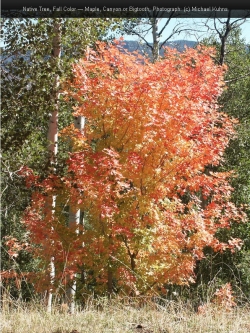
Aflame with Color: Canyon or Big-Toothed Maple In a natural landscape Acer grandidentatum, Courtesy Michael Kuhns Extension.usu.edu
Canyon or Big-Toothed Maple
In a natural landscape
Acer grandidentatum
Courtesy Michael Kuhns
Extension.usu.edu

Holly: Hi, I’m Holly Strand from Stokes Nature Center in beautiful Logan Canyon.

The canyons and valleys of Utah will soon be awash with brilliant fall hues. Cascades of red, orange and gold will blanket the hillsides as the weather turns cooler and morning frost dusts the mountain ridges.

The Canyon Maple is one of Utah’s main sources of autumn color. Like most maple species, its leaves are carved into deep lobes. The leaves are medium-to-bright green now, but soon the entire tree will glow with spectacular color.
Canyon maple is found throughout Utah at medium elevations between 4,500 to 7,500 feet. It tends to grow on lower slopes and canyon bottoms in the mountains in association with Douglas-fir and junipers.

Its scientific name, Acer grandidentatum [AY-ser gran-dih-den-TAY-tum], means “Big Tooth”, referring to the tree’s distinctive lobed leaves with large, toothed margins. In fact, bigtooth maple is another common name for this species.

Canyon or Big-Toothed Maple In a natural landscape Acer grandidentatum  Courtesy Michael Kuhns Extension.usu.edu
Canyon or Big-Toothed Maple
In a natural landscape
Acer grandidentatum
Courtesy Michael Kuhns
Extension.usu.edu

Some think that he canyon maple is related to the sugar maple of the northeastern and midwestern United States,” says forestry professor Mike Kuhns of Utah State University’s Department of Wildland Resources. It’s possible that long ago, the Rocky Mountains rose up and isolated a sugar maple population that eventually evolved into a unique species.

The canyon maple rivals its eastern relatives in fall color but does it produce sap suitable for tasty, syrup-covered waffles and pancakes? Back in 1970s, a group of scientists set out to determine just that. The trees were tapped and yielded plenty of sticky liquid. The color was very light, resembling light honey and the flavor was delicate and fruity, almost like pineapple. However, it was notably less sweet than the northeastern sugar maple. Of 30 panelists from Utah who participated in a taste test, 57 percent preferred eastern sugar maple syrup but the remaining 43 percent preferred canyon maple syrup.

Canyon or Big-Toothed Maple leaves in late summer Acer grandidentatum Courtesy Michael Kuhns
Canyon or Big-Toothed Maple
leaves in late summer
Acer grandidentatum
Courtesy Michael Kuhns

The researchers concluded that while canyon maple sap was not practical for large-scale syrup production it might be enjoyable for individuals to try on a small scale on private land within its habitat range.

Syrup aside, the medium-sized tree thrives in Utah’s residential landscapes, parks and urban areas, as well as in the wild. Its year-round beauty, hardiness and manageable size make it a perennial favorite in the Beehive State.

Thanks to the USU College of Natural Resources for supporting research and development of this Wild About Utah topic.

For Wild About Utah and Stokes Nature Center, I’m Holly Strand.
Credits:

Canyon or Big-Toothed Maple leaves in late summer & fall Acer grandidentatum  Courtesy Michael Kuhns Extension.usu.edu
Canyon or Big-Toothed Maple
leaves in late summer & fall
Acer grandidentatum
Courtesy Michael Kuhns
Extension.usu.edu

Image: Courtesy and Copyright 2003 Michael Kuhns, Extension.usu.edu

Text: Holly Strand & Mary-Ann Muffoletto, Stokes Nature Center

Sources & Additional Reading:


Barker, Phillip A.; Salunkhe, D. K. 1974. Maple syrup from bigtooth maple. Journal of Forestry. 72(8): 491-492. [9065] https://www.ingentaconnect.com/content/saf/jof/1974/00000072/00000008/art00016

Kuhns, Michael. 2003. Canyon Maple: A Tree For the Interior West,” USU Forestry Extension, https://extension.usu.edu/forestry/HomeTown/Select_CanyonMaple.htm [2009, September 16].

Tollefson, Jennifer E. 2006. Acer grandidentatum. In: Fire Effects Information System, [Online]. U.S. Department of Agriculture, Forest Service, Rocky Mountain Research Station, Fire Sciences Laboratory (Producer). Available: https://www.fs.fed.us/database/feis/ [2009, September 16]

Acer grandidentatum – Bigtooth Maple, Water-wise Plants for Utah Landscapes, https://www.waterwiseplants.utah.gov/default.asp?p=PlantInfo&Plant=17

Gall Insects

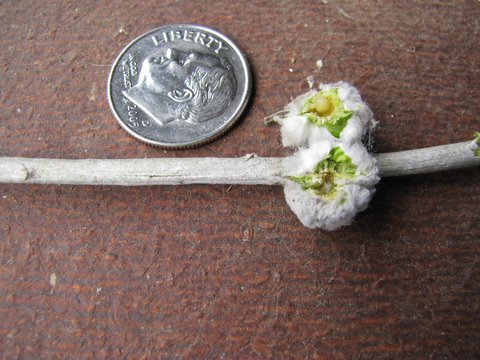
Gall Insects: Click to view Rabbit Brush Galls made by a tephritid fly (Aciurina trixa.) Image courtesy and copyright Jim Cane
Rabbit Brush Galls
made by a tephritid fly Aciurina trixa
Image courtesy and Copyright Jim Cane
Fly identification courtesy Gary Dodson

Does Utah have more Gauls than Caesar conquered? Certainly not Gaulish peoples of the ancient Roman Empire, but yes, galls of the vegetal kind we have aplenty. Galls are small protuberant growths on plants that are induced hormonally by insects, nematodes, and microbes. For its resident juvenile insect, the gall is a sort of edible fortress.

Some plant galls made by insects persist into winter, when they are more apparent to the naturalist’s eye. Looking at just rabbitbrush, you can find a menagerie of galls shaped like peas, pineapples and spindles that were formed from leaves, buds and stems. No growing tissue is immune to galling. The morphology of a gall is often diagnostic for the species of juvenile insect within. Gall-making insects are all tiny and include gall midges and tephritid flies, cynipid gall wasps, various nondescript moths, and any number of aphids and their kin.

One aphid causes the unsightly brown galls on branch tips of blue spruce, a bane to homeowners. Another aphid forms the pea-shaped galls that swell leaf petioles of aspens and cottonwoods. On sagebrush can be found a leaf gall whose soft surface surpasses that of a puppy’s ear. Oaks and willows host a remarkable diversity of galls. One oak gall was formerly used for tanning leather and making inks because it is rich in tannic acids. The Hessian fly is of grave agricultural importance today because its stem galls weaken wheat stems, causing them to lodge over.

Click to view Tephritid fly (Aciurina bigeloviae) galls on Rabbitbrush. Image courtesy and copyright Jim Cane
Tephritid fly Aciurina bigeloviae
galls on Rabbitbrush
Image courtesy and Copyright Jim Cane
Fly identification courtesy Gary Dodson

But these are exceptions; most galls are of little or no ecological or economic importance. For that reason, most galling insects remain understudied by all but a handful of passionate specialists. Finding plant galls is easy, and once you begin to notice them, you will find it hard to stop. There is no guide to Utah’s plant galls, but we list several starting references for you on our web site.

This is Linda Kervin for Bridgerland Audubon Society.

Credits:

Photos: Courtesy and Copyright Jim Cane
Text: Jim Cane, Bridgerland Audubon Society
Additional Reading:
Sagebrush Gall made by the fly Rhopalomyia pomum, https://bugguide.net/node/view/200946
Robert P. Wawrzynski, Jeffrey D. Hahn, and Mark E. Ascerno, Insect and Mite Galls, WW-01009 2005,
University of Minnesota Extension, https://www.extension.umn.edu/distribution/horticulture/dg1009.html

Click to view Willow Cone Gall Midge. Image courtesy and copyright Jim Cane
Willow Cone Gall Midge
Image Courtesy and Copyright Jim Cane

Field Guide to Plant Galls of California and Other Western States by Ron Russo
ISBN: 978-0-520-24886-1 https://www.amazon.com/California-Western-States-Natural-History/dp/0520248864
Gall, Wikipedia, Wikimedia Foundation, Inc., https://en.wikipedia.org/wiki/Gall (Accessed Dec 2010)
Gagné R (1989) The plant-feeding gall midges of North America. Cornell University Press, Ithaca
https://www.amazon.com/Plant-Feeding-Midges-North-America-Comstock/dp/0801419182

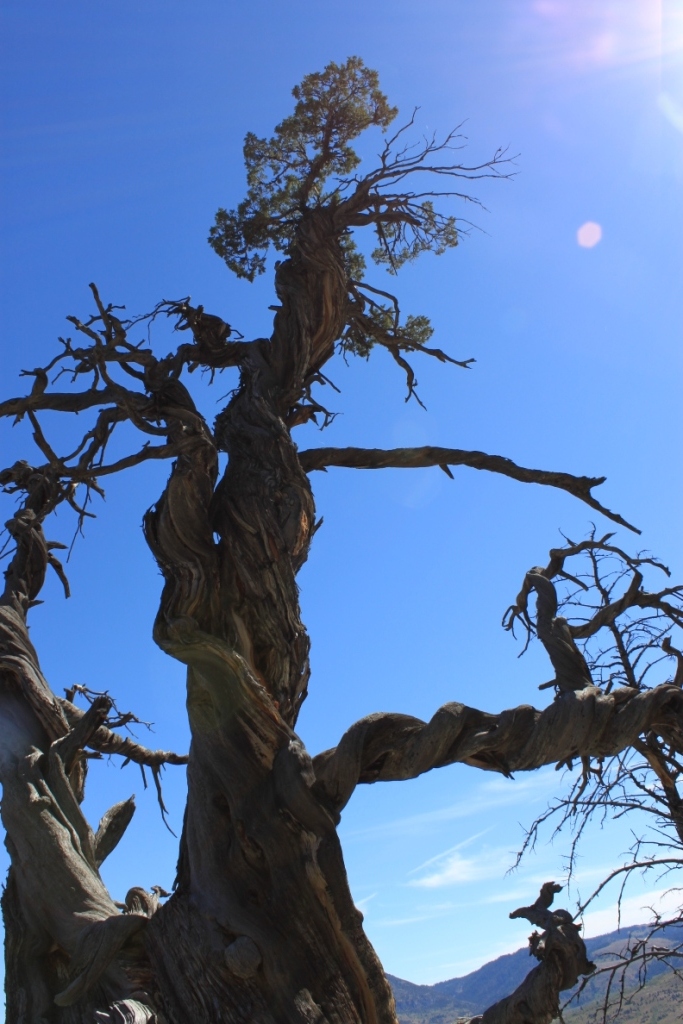
Jardine Juniper

Jardine Juniper
a Rocky Mountain Juniper
Juniperus scopulorum
Courtesy & © 2010 Andrea Liberatore
Stokes Nature Center


Jardine Juniper
a Rocky Mountain Juniper
Juniperus scopulorum
Courtesy & © 2010 Andrea Liberatore
Stokes Nature Center

Hi, I’m Chelsea McMahon and I’m Rose Wiarda from Utah State University’s Department of Environment and Society.

Can you recall watching a tree grow from a seed to a shade-giving giant over your lifetime? Now imagine this happening on a timescale of over 50 generations! Logan Canyon’s Jardine Juniper is a tree that has survived through many centuries of human history. Core samples taken from this gnarled giant reveal its age as an estimated 1500 years old. The Jardine Juniper was discovered in 1923 by Maurice Lindford, a student at Utah State Agricultural College, now Utah State University. Lindford named the tree in honor of fellow alumnus and U.S. Department of Agriculture Secretary William Mason Jardine.

The Jardine Juniper is a Rocky Mountain juniper, one of Utah’s two tree-sized native juniper species. The Rocky Mountain juniper is characterized by bluish-green foliage and bright blue berry-like cones. Native American tribes throughout the Intermountain West and the western Great Plains have traditionally used juniper berries, foliage, and roots for medicinal purposes.

The Jardine Juniper holds a position on Utah’s Big Tree champion list as the largest Rocky Mountain juniper in the state. It also occupies a position on the prestigious National Register of Big Trees. This register, which is maintained by non-profit group American Forests, records the dimensions of the largest trees in the nation. The Jardine Juniper overshadows other trees of its species with a 284-inch diameter and 40-foot height, making it not only the largest in the U.S., but the largest in the world.

Although its current foliage is sparse, the tree is still alive. This hardy sentinel has kept watch over centuries of change in the canyon, witnessing the comings and goings of native Shoshone peoples, the arrival of fur trappers and Mormon settlers, and the development of the canyon as part of the Uintah-Wasatch-Cache National Forest.

If you wish to see this majestic remnant of another age, take a hike! The hike to the Jardine Juniper is about 9 miles round trip and is accessible by the Uintah-Wasatch-Cache National Forest trail 014, the Jardine juniper trail. Wear weather appropriate clothing and bring plenty of water—this hike is steep in places! Above all, enjoy your time in the presence of this impressive vestige of the past and remember that its preservation depends on kind treatment from visitors like you.

I’m Rose Wiarda and I’m Chelsea McMahon for Wild About Utah.
Credits:

Photos: Courtesy & © 2010 Andrea Liberatore, Stokes Nature Center https://logannature.org/
Text:    Rose Wiarda & Chelsea McMahon, USU Environment & Society

Additional Reading:

American Forests National Register of Big Trees: https://www.americanforests.org/our-programs/bigtree/

General info about Jardine Juniper: https://ewb.usu.edu/wp-content/uploads/2010/08/INFO-Jardine-Juniper.pdf

General info about the Rocky Mountain Juniper: https://plants.usda.gov/plantguide/pdf/cs_jusc2.pdf

The Jardine Juniper Trail: https://www.fs.usda.gov/recarea/uwcnf/recreation/recarea/?recid=9376&actid=24

Jardine Juniper Trail, LoganCanyonHiking.com, https://www.logancanyonhiking.com/jardine.htm