Great Basin Bristlecone Pines Utah’s Mountain Sentinels

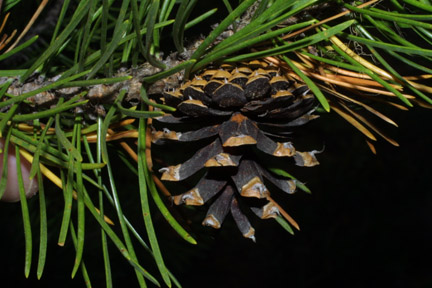
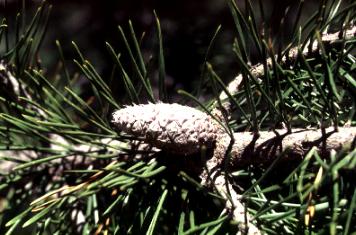
Bristlecone Pine
Photo Courtesy & Copyright
Mark Larese-Casanova, Photographer

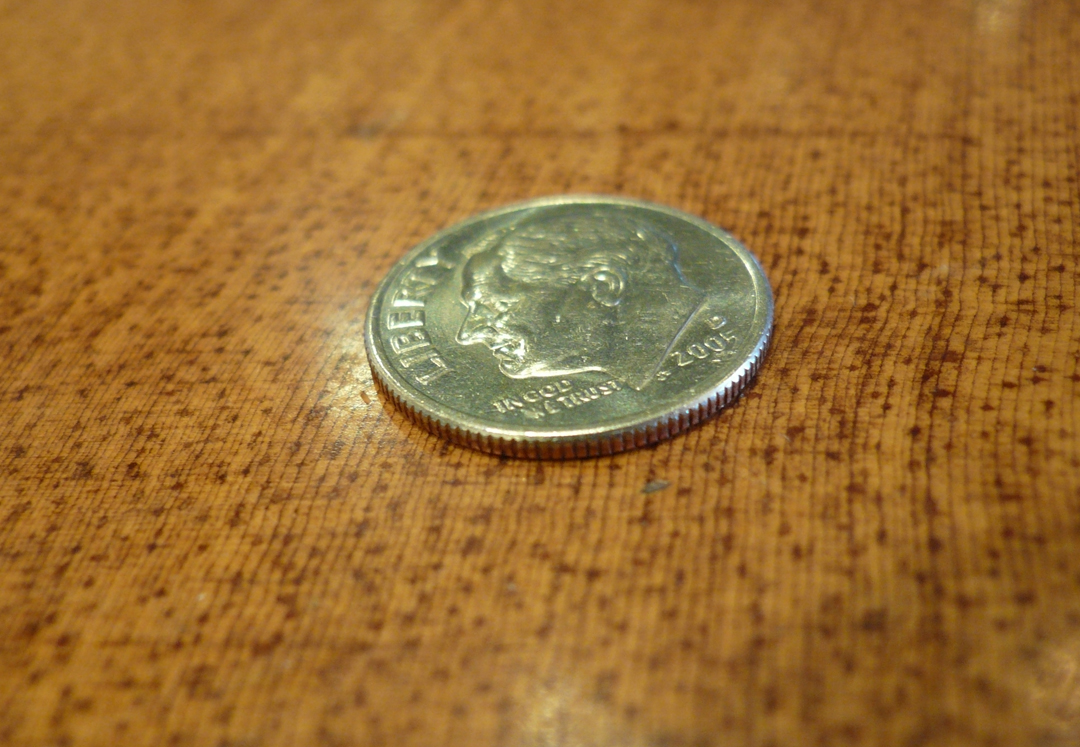
Bristlecone Pine Grain
Compared to a Dime
Photo Courtesy & Copyright
Mark Larese-Casanova, Photographer

Hi, this is Mark Larese-Casanova from the Utah Master Naturalist Program at Utah State University Extension.

Utah’s cold mountaintops, like its hottest deserts, are rather inhospitable to most plants. Although more precipitation falls at higher elevations, colder temperatures prevent much of the water from being used by plants, since most of it falls as snow in winter. High winds also inhibit growth and can contribute to frost or wind damage to plants. Any plants that grow here must be especially hardy.

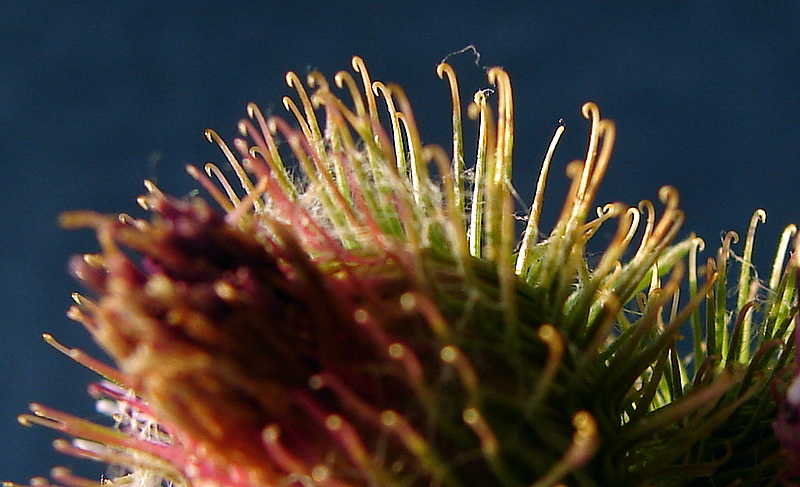
The Great Basin bristlecone pine is a grand sentinel of our rocky, high mountain ridges. Its shorter needles are grouped in bundles of five, and grow densely at the end of the branches, creating a ‘bottlebrush’ or ‘foxtail’. However, the growth of the wood is the most interesting aspect of the Great Basin bristlecone pine. For a tree, each ring represents one year of growth. Because of the colder temperatures and shorter growing season, each growth ring of a bristlecone pine is particularly small, usually around 1/32th of an inch. The tight growth rings result in especially dense, resinous wood that is resistant to decay and insects.

At higher elevations, a bristlecone pine’s growth form becomes more twisted and contorted by the wind. Over time, much of the tree may die, and the living portion may simply be a strip of bark up the trunk and just a few branches.

These adaptations allow the Great Basin bristlecone pine to live an exceptionally long life despite such harsh conditions. It is common for a bristlecone pine to live for thousands of years, and the oldest recorded specimen was aged at approximately 5,000 years old. That means it germinated from seed a few hundred years before the first Egyptian pyramid was even built! Bristlecone pines can even remain standing for thousands of years after they die. Growth ring patterns can be compared between living and dead bristlecone pines to reveal a chronology of our climate for the past seven, eight, maybe ten thousand years!

To see bristlecone pines in Utah, hike the Bristlecone Pine Trail in Bryce Canyon National Park or the Ramparts Trail at Cedar Breaks National Monument. Be sure to take only photos, and not wood or cones. Bristlecone pines will be around a lot longer than we will, and they could use all the help they can get.

For Wild About Utah, I’m Mark Larese-Casanova.

Credits:
Images: Courtesy & Copyright Mark Larese-Casanova
Text:     Mark Larese-Casanova, Utah Master Naturalist Program at Utah State University Extension.


Additional Reading:

Lanner, R.M. 2007. The Bristlecone Book: A Natural History of the World’s Oldest Trees. Mountain Press Publishing Company.

Cohen, M. P. 1998. A Garden Of Bristlecones: Tales Of Change In The Great Basin. University of Nevada Press.

USA National Phenology Network

Courtesy USA National Phenology Network

The study of recurring plant and animal life cycle events is phenology. It is the calendar of nature. This includes when plants flower, when birds migrate and when crops mature. Phenology is relevant to interactions between organisms, seasonal timing and large-scale cycles of water and carbon. Phenology is important to us for many reasons. Farmers need to know when to plant and harvest crops and when to expect pests to emerge. Resource managers use it to monitor and predict drought and assess fire risk. Vacationers want to know when the best fall colors will be or when the wildflower blooms will peak. Timing varies but we can discern patterns.

The USA National Phenology Network monitors the influence of climate on the phenology of plants, animals and landscapes. They encourage people to observe phenological events such as flowering, migrations and egg laying. The Phenology Network provides a place to enter, store and share these observations, which are then compiled and analyzed nationwide. Participants range from individual observers in their own backyards to professional scientists monitoring long-term plots. My husband and I monitor leafing and flowering of lilacs, a key species in the program.

These observations support a wide range of decisions made routinely by citizens, managers, scientists and others. This includes decisions related to allergies, wildfires, pest control, and water management.

I urge you to participate. The National Phenology Network has many public, private and citizen partners. It is a great way to become involved in a nation-wide effort to better understand our environment. All this information and much more is available at the National Phenology website, to which there is a link from our Wild About Utah website.

This is Linda Kervin for Bridgerland Audubon Society.

Credits:

Text: Linda Kervin, Bridgerland Audubon Society
Additional Reading:

Linda Kervin’s pieces on Wild About Utah

Phenology Tools for Community Science
USA National Phenology Network, https://www.usanpn.org/
Nature’s Notebook Education Program, US National Phenology Network, https://www.usanpn.org/nn/education

North American Bird Phenology Program, USGS Patuxent Wildlife Research Center, https://www.pwrc.usgs.gov/bpp/BecomeAParticipant.cfm

eBird, https://www.ebird.org/

iNaturalist, https://www.inaturalist.org/

Gall Insects

Rabbit Brush Galls
made by a tephritid fly Aciurina trixa
Image courtesy and Copyright Jim Cane
Fly identification courtesy Gary Dodson

Does Utah have more Gauls than Caesar conquered? Certainly not Gaulish peoples of the ancient Roman Empire, but yes, galls of the vegetal kind we have aplenty. Galls are small protuberant growths on plants that are induced hormonally by insects, nematodes, and microbes. For its resident juvenile insect, the gall is a sort of edible fortress.

Some plant galls made by insects persist into winter, when they are more apparent to the naturalist’s eye. Looking at just rabbitbrush, you can find a menagerie of galls shaped like peas, pineapples and spindles that were formed from leaves, buds and stems. No growing tissue is immune to galling. The morphology of a gall is often diagnostic for the species of juvenile insect within. Gall-making insects are all tiny and include gall midges and tephritid flies, cynipid gall wasps, various nondescript moths, and any number of aphids and their kin.

One aphid causes the unsightly brown galls on branch tips of blue spruce, a bane to homeowners. Another aphid forms the pea-shaped galls that swell leaf petioles of aspens and cottonwoods. On sagebrush can be found a leaf gall whose soft surface surpasses that of a puppy’s ear. Oaks and willows host a remarkable diversity of galls. One oak gall was formerly used for tanning leather and making inks because it is rich in tannic acids. The Hessian fly is of grave agricultural importance today because its stem galls weaken wheat stems, causing them to lodge over.

Tephritid fly Aciurina bigeloviae
galls on Rabbitbrush
Image courtesy and Copyright Jim Cane
Fly identification courtesy Gary Dodson

But these are exceptions; most galls are of little or no ecological or economic importance. For that reason, most galling insects remain understudied by all but a handful of passionate specialists. Finding plant galls is easy, and once you begin to notice them, you will find it hard to stop. There is no guide to Utah’s plant galls, but we list several starting references for you on our web site.

This is Linda Kervin for Bridgerland Audubon Society.

Credits:

Theme: Courtesy & Copyright Don Anderson as performed by Leaping Lulu
Photos: Courtesy and Copyright Jim Cane
Text: Jim Cane, Bridgerland Audubon Society
Voice: Linda Kervin, Bridgerland Audubon Society

Additional Reading:

Sagebrush Gall made by the fly Rhopalomyia pomum, https://bugguide.net/node/view/200946
Robert P. Wawrzynski, Jeffrey D. Hahn, and Mark E. Ascerno, Insect and Mite Galls, WW-01009 2005,
University of Minnesota Extension, https://www.extension.umn.edu/distribution/horticulture/dg1009.html

Willow Cone Gall Midge
Image Courtesy and Copyright Jim Cane

Field Guide to Plant Galls of California and Other Western States by Ron Russo
ISBN: 978-0-520-24886-1 https://www.amazon.com/California-Western-States-Natural-History/dp/0520248864
Gall, Wikipedia, Wikimedia Foundation, Inc., https://en.wikipedia.org/wiki/Gall (Accessed Dec 2010)
Gagné R (1989) The plant-feeding gall midges of North America. Cornell University Press, Ithaca
https://www.amazon.com/Plant-Feeding-Midges-North-America-Comstock/dp/0801419182

Autumn Leaf Color Change

Fall color in Logan Canyon
Courtesy & Copyright 2007 Linda Kervin

In autumn, the days shorten noticeably and chilly dawns become the norm across most of Utah. Leafy plants now prepare for winter. Their summer of intense metabolic activities gradually give way to winter’s dormancy. Photosynthesis and respiration shut down as nutrients and sugars are withdrawn from leaves, to be shunted to the stem and roots for storage. But how do they anticipate the change in seasons so that they are ready for the rigors of winter?

Photosynthetic plants have a diverse array of pigments that they use to capture energy from most of the spectrum of visible sunlight. Chlorophyll is the most abundant, but its light gathering effectiveness is limited to a narrow band of the light spectrum. Plants employ many additional pigments to capture the energy available from other wavelengths of sunlight. These accessory pigments are brilliantly colored but masked by the sheer abundance of green chlorophyll.

Fall color in Logan Canyon
Courtesy & Copyright 2007 Linda Kervin

One of these pigments, phytochrome, serves as a timekeeper for the plant. When phytochrome absorbs energy in the red band of sunlight, it helps to activate a number of developmental processes in the plant. As the nights lengthen in the fall, there are fewer hours of sunlight to activate the phytochrome and so it transforms to inhibit those same developmental processes.

One result is that chlorophyll is broken down and its components are moved to storage for use in the following spring. Essential nutrients, such as nitrogen and phosphorus, are likewise withdrawn from foliage for later use. With chlorophyll gone, the other colorful leaf pigments are revealed. Now maples, aspens, sumacs and more blaze for a few weeks of riotous glory.

This is Linda Kervin for Bridgerland Audubon Society.

Credits:

Photos: Courtesy & Copyright Linda Kervin

Text: Linda Kervin and Jim Cane, Bridgerland Audubon Society

Additional Reading:

Chemistry of Autumn Leaf Color, How Fall Colors Work, About.com: Chemistry, https://chemistry.about.com/library/weekly/aa082602a.htm

Why Do Leaves Change Color in the Fall?, Anne Marie Helmenstine, Ph.D., About.com: Chemistry, https://chemistry.about.com/od/howthingsworkfaqs/f/fallleafcolor.htm

“Autumn: a season of change” (2000) by Peter J. Marchand, https://www.amazon.com/Autumn-Season-Peter-J-Marchand/dp/0874518709

Where to see autumn leaves in Utah:

  • U.S. 89, Logan Canyon, Brigham City to Logan, Logan to Bear Lake
  • State Route 39, Monte Christo Summit, east of Huntsville
  • State Route 190, Big Cottonwood Canyon, east of Salt Lake City, including Guardsman Pass
  • State Route 210, Little Cottonwood Canyon, east of Salt Lake City
  • State Route 92, the Mount Timpanogos loop a.k.a. the Alpine loop, north, east of Provo
  • State Route 150, the Mirror Lake road, east of Kamas
  • U.S. 40, Daniels Summit, east of Heber City
  • Vernal, Red Cloud Loop (See Dinoland.com)
  • Flaming Gorge – Unitas, State Route 191 and State Route 44
  • State Route 132 Payson to Nephi, the Nebo Loop
  • State Route 31, the Wasatch Plateau, east of Fairview
  • State Route 12, over Boulder Mountain, between Torrey and Boulder (likely the most spectacular of all)
  • The La Sal Mountain loop, east of Moab
  • The Abajo Mountain loop, west of Monticello
  • The canyons of the Escalante River, Grand Staircase-Escalante National Monument, southeast of Escalante

List sources:
Aspens and Fall Foliage in Utah, Jeffrey Otis Schmerker, 2001, https://www.utah.com/schmerker/2001/fall_foilage.htm
Ogden Valley Business Association, https://www.utahfallcolors.com

Fall Colors Tour, Utah in the Fall is a blast of color!, https://www.utah.com/byways/fallcolorstour.htm

National Forest Fall Color Hotline, 1-800-354-4595,https://www.fs.fed.us/r4/conditions/fallcolors.shtml