Shrubby-Reed Mustard: The Best Little Plant You’ve Never Heard of

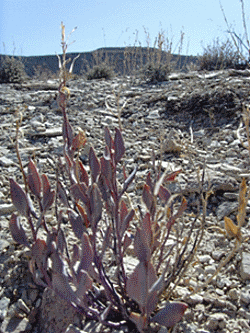
Shrubby-Reed Mustard Bush, Hesperidanthus suffrutescens
Shrubby-Reed Mustard Bush
Hesperidanthus suffrutescens
Courtesy & Copyright Matt Lewis

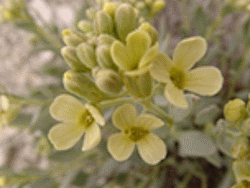
Shrubby-Reed Mustard Blossoms, Hesperidanthus suffrutescens Shrubby-Reed Mustard Blossoms
Hesperidanthus suffrutescens
Courtesy & Copyright Matt Lewis

Shrubby-Reed Mustard Blossoms Closeup, Hesperidanthus suffrutescens Shrubby-Reed Mustard Blossoms
Hesperidanthus suffrutescens
Courtesy & Copyright Matt Lewis

Tucked into isolated pockets of the Uintah Basin’s arid wildlands is the best little plant you’ve never heard of. Known to exist only in Duchesne and Uintah Counties, Shrubby-reed Mustard seems to occupy only the semi-barren “islands” of white shale in areas of the Green River Formation’s Evacuation Creek region. The endangered plant features thick, almost succulent, blue-green leaves and small yellow flowers.

“The habitat of Shrubby-reed Mustard is visually striking,” says USU alum Matt Lewis, a botanist with the Bureau of Land Management in Vernal, Utah. “It grows in very shallow, fine-textured soils and shale fragments that form narrow bands in the desert shrub community.”

Among the first plants to flower in spring, the perennial herb is visited by large number of insects, including many native bee species that forage for pollen. Scientists believe these bees may be critical in the plant’s reproduction and survival.

Lewis says the plant, also known as Toad-Flax Cress and Uintah Basin Waxfruit, offers an understated beauty to the stark landscape. With a shrub-like form and multiple stems, Shrubby-reed Mustard grows to about 20 centimeters in height. Its leaves, which feel almost like leather, change to a bright purple in the fall.

The plant is also enticingly fragrant, Lewis says. “Its scent reminds me of roses mixed with apples and pears.”

Despite its fragile status, Shrubby-reed Mustard is a long-lived plant. USU ecologist Geno Schupp says some individual plants may be one hundred years old.

The elusive species has outlived scientists’ attempts to classify it and has undergone several taxonomic changes. It currently boasts the scientific name Hesperidanthus suffrutescens, placing it solidly in the mustard family.

Lewis knows of no history of Shrubby-reed Mustard as a culinary or medicinal herb, though documented reports of such uses for mustard plants date back to ancient times. The plant appears to provide welcome forage for some four-legged creatures, he says, as he recently witnessed plants that had been grazed completely and ripped from the ground.

“Whether that was due to livestock or native ungulates, I’m not sure.”

Credits:
Images: Courtesy & Copyright Matt Lewis
Text:     Mary-Ann Muffoletto, Utah State University College of Natural Resources
Credits:
Matt Lewis, botanist, Bureau of Land Management, Vernal, Utah.
Eugene “Geno” Schupp, professor, USU Department of Wildland Resources.

Additional Reading:

https://www.fws.gov/mountain-prairie/factsheets/ShrubbyReed-mustardFactSheet.pdf

https://www.fws.gov/mountain-prairie/species/plants/shrubbyreedmustard/5YearReview2010.pdf

Three-leaf Sumac

Three-Leaf-Sumac Rhus-trilobata, Photo courtesy Hansen's Northwest Native Plant Database, nwplants.com, Licensed Creative Commons Attribution-ShareAlike 3.0 Unported License
Three-Leaf-Sumac Rhus-trilobata
Photo courtesy Hansen’s Northwest Native Plant Database, nwplants.com Licensed under Creative Commons Attribution-ShareAlike 3.0 Unported License
Many think of the desert as a hot, dry, barren, and unforgiving place. However, Utah’s deserts are chock full of interesting and diverse plants and animals! One such plant, which grows throughout much of Utah, is rhus trilobata or three-leaf sumac.

Three-leaf sumac is a widespread deciduous shrub in the Rhus genus, meaning “with three leaflets,” or “trifoliate leaves.” Others in this genus include Rhus aromoatica and the infamous western poison oak. The leaves of this shrubby-type plant are toothed, feel stiff and they give off quite a strong scent when crushed. The strong smell of crushed three-leaf sumac leaves has earned it the nickname “skunkbush” as well as “ill-scented sumac.”

Three-leaf sumac is a low spreading, many-branched deciduous shrub, usually no more than 3 feet high but spreading as much as 8 feet wide. The small, trifoliate leaves and the branches are fuzzy. Given its many branches, three-leaf sumac provides both nesting material and structure for native bees. Flowers are yellowish and found in clustered spikes. They are followed by bright crimson to reddish, sticky berries. The fall foliage adds an extra pop of color to the landscape.

Three-Leaf-Sumac Rhus-trilobata, Photo courtesy Hansen's Northwest Native Plant Database, nwplants.com, Licensed Creative Commons Attribution-ShareAlike 3.0 Unported License
Three-Leaf-Sumac Rhus-trilobata
Photo courtesy Hansen’s Northwest Native Plant Database, nwplants.com Licensed under Creative Commons Attribution-ShareAlike 3.0 Unported License
Historically, three-leaf sumac has been used for medicinal and other purposes. The bark can be chewed or brewed into a drink for cold symptoms. Flexible branches were traditionally used for twisting into basketry and rugs. In fact, three-leaf sumac was a close contender to willow in desirability for basket-making. This common use of the plant earned it another nickname of “basketbush.”

My favorite part of three-leaf sumac, however, are the slightly hairy and sticky berries. Although historically eaten for gastrointestinal pain and toothache, the berries have a delicious sour flavor and can be eaten plain or used in oatmeal, ice cream, steeped in tea, or soaked in cold water to make a beverage similar to lemonade. These berries are high in vitamin C and have earned three-leaf sumac the additional nicknames of “sourberry” “lemonade bush” and “lemonade berry.” Other nicknames for this multi-purpose plant include squawbush, desert sumac, or scented sumac.

Regardless of which nickname you choose for three-leaf sumac, give the berries a try and see for yourself what you think! Be sure, however, that you properly identify the plant to avoid potential illness that can be caused by misidentification! One great resource that can help is the field guide “Rocky Mountain States: Wild Berries & Fruits.”

Three-Leaf-Sumac Rhus-trilobata, Photo courtesy Hansen's Northwest Native Plant Database, nwplants.com, Licensed Creative Commons Attribution-ShareAlike 3.0 Unported License
Three-Leaf-Sumac Rhus-trilobata
Photo courtesy Hansen’s Northwest Native Plant Database, nwplants.com Licensed under Creative Commons Attribution-ShareAlike 3.0 Unported License
For Utah State University Extension Sustainability, this is Roslynn Brain.

Credits:
Images: Courtesy Hansen’s Northwest Native Plant Database, nwplants.com, https://www.nwplants.com/business/catalog/rhu_tri.html,
Creative Commons Attribution-ShareAlike 3.0 Unported License
Text:     Roslynn Brain, Utah State University Extension Sustainability

Additional Reading:

Rhus trilobata, Three-leaf Summac, Plants of the Southwest, https://plantsofthesouthwest.com/products/rhus-trilobata?variant=11501394117

Rhus trilobata, Three-leaf Summac, Plant Database, Natural Resources Conservation Service, USDA, https://plants.usda.gov/core/profile?symbol=rhtr

Rhus trilobata, Three-leaf Summac, Lady Bird Johnson WildflowerCenter, University of Texas at Austin, https://www.wildflower.org/plants/result.php?id_plant=RHTR

Ancient Native Plant Relationships

Ancient Native Plant Relationships: Ephedra, Ephedra viridis Coville
Ephedra
Ephedra viridis Coville
Courtesy USDA, NRCS. 2016. The PLANTS Database (https://plants.usda.gov, 6 February 2016). National Plant Data Team, Greensboro, NC 27401-4901 USA., BLM Photographer

Hi I’m T.J. Knudson and I’m Gilbert Young.

Stretching from the snowy peaks of the Wellsville Mountains, south to the sandstone shadows of Beaver Dam Wash, an ancient, native relationship provided unity to the diverse landscape. It is admired in the haunting tune of a wind pipe, it comports like a wool blanket; and its tapestry goes beyond the cliff art at Potash, and preceded John Wesley Powell and Brigham Young.

The Ute, Shoshone, Piute, Goshute, and Navajo cultures each echo today an enduring sustaining relationship bonded to the reliable plant life in a diverse land. this relationship sustained our state’s ancient culture, but little is understood about these gifted craftsmen in utilizing the materials and fibers.

In southeast Utah, the shepherd Navajo nation found a companion in the Prickly-Pear Cactus. Despite his short stature and sharp countenance, this ally was able to provide a fleshy, refreshing fruit. After rolling repeatedly through the direct to lose his spines, and soaking in water; there sparks a reaction of the most spectacular die; which was often orchestrated into many shades of red. Despite his stature on the lonely desert floor, the prickly pear creates a color that epitomizes the Navajo beauty and lives on to future generations.

As our ancient travelers would ascend upward into the hills, they would spend time in the Pinyon/Juniper woodland to collect pine nuts. Natives would also search for three other valuable resources: pine pitch, firewood and shelter materials. Underneath the pines and junipers plentiful sumac, can be found; the sumac branches provide the means to develop a midnight-black die and was also an essential basketry material. The third element needed to create this black color was ocher (okerr), a yellow mineral abundant in Navajo territory. The Pinyon-Juniper woodland met the needs of native people, much like modern superstores. Like these plants working together as a team, we all have an opportunity to join others in creating a unified community.

Prickly Pear Cactus, Opuntia ficus-indica
Prickly Pear Cactus
Opuntia ficus-indica
Courtesy US FWS

Across the canyons, a lone plant is found that nursed and comforted tribes long before the hospitals and prescriptions. Ephedra was a medicinal hero, when sharp cold winds swept the valleys. It could be boiled into a delicious tea that combated the common cold, allowing airways freedom of congestion. Also known as Brigham Tea, Natives shared this knowledge to the early Utah Pioneers in their time of need. The evergreen stems of Ephedra offer healing and a comfort that aided the native people and settlers. We also have the ability to heal our souls by intimately connecting ourselves to nature’s bounteous gifts. We can also provide healing to those who are in need of comfort and guidance.

If the past could speak to us today, it would remind us of connections and relationships that have been forgotten. Our hope today is that you may connect with these ancient relationships for yourselves. For more information, check out the Wild About Utah website.

For Wild About Utah this is T.J. Knutson and Gilbert Young.

Credits:
Images: Courtesy , Photographer
Text:     T.J. Knutson and Gilbert Young.


Additional Reading:

A Safari through Utah’s Ice Age

A Safari through Utah’s Ice Age: Wave-cut platforms from Lake Bonneville preserved on Antelope Island, Great Salt Lake, Utah., Photo Courtesy Wikimedia, Mark A. Wilson (Department of Geology, The College of Wooster), Photographer
Wave-cut platforms from
Lake Bonneville preserved on
Antelope Island, Great Salt Lake, Utah.
Photo Courtesy Wikimedia, Mark A. Wilson (Department of Geology, The College of Wooster), Photographer

Ground sloth of the Pleistocene
Paramylodon harlani
Texas Memorial Museum
University of Texas at Austin.
Photo Courtesy Wikimedia
Licensed CCA Share Alike 3.0 Unported

Lake Bonneville compared to the
State of Utah.
Photo Courtesy https://wildlife.utah.gov/gsl/history/


Hi, I’m Ru Mahoney with Stokes Nature Center in Logan Canyon. As winter approaches I find myself anticipating the first really good snow, when our valley floors and mountain passes will be transformed overnight, relinquishing autumn’s riot of color for a glacial monochrome. As little as 12,000 years ago winter white was Utah’s perennial favorite, donned at the launch of the Pleistocene Epoch, a roughly 2 million year long period (give or take 10,000 years) marked by widely recurring glaciations.

The west has a reputation for being vast, but Ice Age Utah was even bigger. The mountains where higher and sharper. And the Great Salt Lake was submerged beneath the glacial waters of Lake Bonneville. At its largest, this massive body of water covered 20,000 square miles and was more than 980 feet deep. To put that into perspective, that measures about 9.5 million football fields wide by 4.5 Salt Lake Temples deep. And the Ice Age wildlife? Well it was much more akin to an African safari than anything you’re likely to find on your favorite shoreline trail these days.

The megafauna of Pleistocene Utah included a menagerie of beasts that are the stuff of legend. Familiar species like bison and big-horn sheep grazed among herds of mammoths and mastodons. Camels and horses – destined for extinction in North America – were the prehistoric prey of dire wolves and saber-toothed cats. Giant ground sloths the size of modern day elephants stood on two powerful hind legs to browse on shoreline foliage. And herds of muskoxen kept a wary eye on Arctodus, the Short-faced bear, a formidable predator more than 50% larger than any bear species living today.

The last 30,000 years of Utah’s Ice Age were characterized by increasingly volatile shifts in climate. The changing norms in temperature and abundance of liquid water created cyclical periods of transitioning habitat. Forests and forest dwellers gave way to deserts and their specialist species, before shifting back to forests again, all in mere millennia. While nomadic and highly adaptable species like muskoxen eventually moved north to more stable climates, the less adaptable fauna of the Ice Age were increasingly relegated to sharing shoreline habitat diminished by the swollen banks of Lake Bonneville.

As fluctuating glaciers pushed southward and then retreated, canyons like Big and Little Cottonwood were gouged into existence. Spring and summer glacier melt carried an abundance of freshwater into the lake, sometimes sweeping along with it the remains of prehistoric animals that had not lasted through the winter, laying them to rest in shoreline deltas where their fossilized remains are now uncovered and studied in alluvial sediment. For many of Utah’s Ice Age animals, the end of the Pleistocene brought extinction.

Today the ancient shoreline of Lake Bonneville is one of the most distinguishable geological features along the Wasatch front. This “bench”, as it’s now commonly known, is easily identifiable in cities all along the Wasatch and frequently boasts fine homes and even finer views. Which might go to show that lakeside property retains its value whether the lake is still there or not. So as you enjoy a winter hike or cross country ski along a shoreline trail this season, think about Utah’s last Ice Age and how our rich fossil record, with some of earth’s largest land mammals, paints a picture of an even wilder west.

For Wild About Utah and Stokes Nature Center, I’m Ru Mahoney.

A Safari through Utah’s Ice Age-Credits:
Image1: Courtesy Wikimedia, Mark A. Wilson (Department of Geology, The College of Wooster), Photographer
Image2: Courtesy Wikimedia,as licensed through Creative Commons Attribution-Share Alike 3.0 Unported
Image3: Courtesy https://wildlife.utah.gov/gsl/history/
Text:     Ru Mahoney, Stokes Nature Center in Logan Canyon.

A Safari through Utah’s Ice Age-Additional Reading:
https://geology.utah.gov/popular/general-geology/ice-age/ice-age-animals-of-utah/

https://serc.carleton.edu/vignettes/collection/37942.html

https://hugefloods.com/Bonneville.html

https://geology.utah.gov/surveynotes/archives/snt42-3.pdf

https://geology.utah.gov/surveynotes/articles/pdf/pleistocene_fossils_42-3.pdf