Pickleweed in Cache Valley Courtesy & Copyright 2010 Linda Kervin
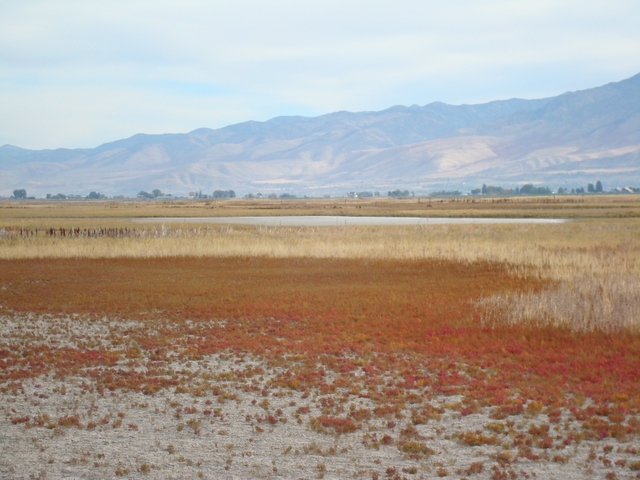
Utah’s mountains and foothills blaze with the brilliant foliar colors of aspens, maples, sumacs and more. But autumn colors can be found in less likely habitats too, even across our flat, desolate salt pans. There the usually drab stage has been given a splash of deep, dusty rose color by its sole botanical performers, the pickleweeds.
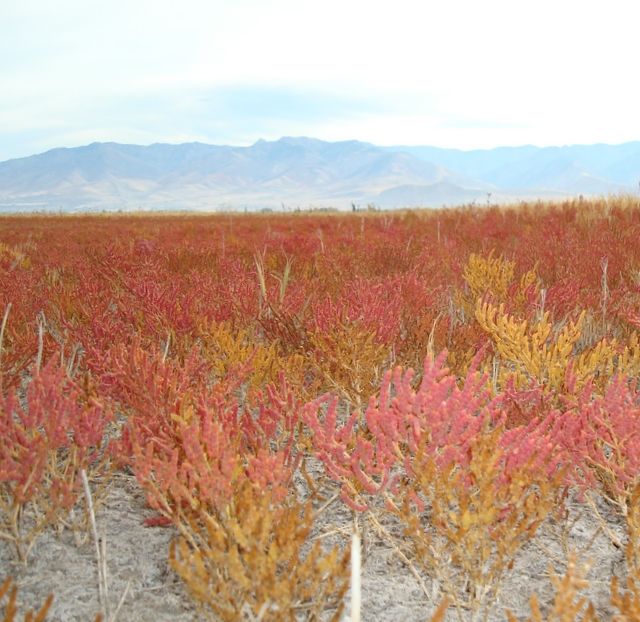
Also known as glassworts or samphire, our two species of pickleweed are in the genus Salicornia. They belong to the same plant family as beets, chard and spinach., but you’d never guess that from their appearance. The ankle-high Salicornia’s leaves are reduced to tiny scales that hug the green, branching, cylindrical stems. Pickleweeds are halophytic, or salt loving. Due to their unique physiology, they can thrive in extremely saline environments that kill normal plants. Pickleweed roots filter out some of the salt before it can move into the plant. The remaining excess salt is stored in balloon-like cavities in their cells called vacuoles. When its vacuole is full, a cell ruptures, and newer younger cells continue to accumulate incoming salt.
Pickleweed in Cache Valley Courtesy & Copyright 2010 Linda Kervin
The common name, pickleweed, derives from the taste of the salt stored in the vacuoles of the succulent, crisp stems. You may be surprised to learn that gourmet websites report that pickleweeds are all the rage in Europe as a salad garnish or pickled vegetable.
[Kevin Colver recording: Songbirds of the Southwestern Canyon Country]
In the Great Basin, winter flocks of Horned Larks forage in the snow for Salicornia’s tiny oil-rich seeds as do other birds. The seeds’ proteins and oils are valuable dietary supplement in the sparse salt pan habitat where the picklweed’s unique physiological adaptations allow them to thrive. If your travels this fall take you by a salt pan, take the time to enjoy the rosy glow of the humble pickleweed or view pictures on the Wild About Utah website.
Pickleweed in Cache Valley Courtesy & Copyright 2010 Linda Kervin
This is Linda Kervin for Bridgerland Audubon Society. Credits:
Photos: Courtesy & Copyright Linda Kervin
Text: Jim Cane and Linda Kervin, Bridgerland Audubon Society
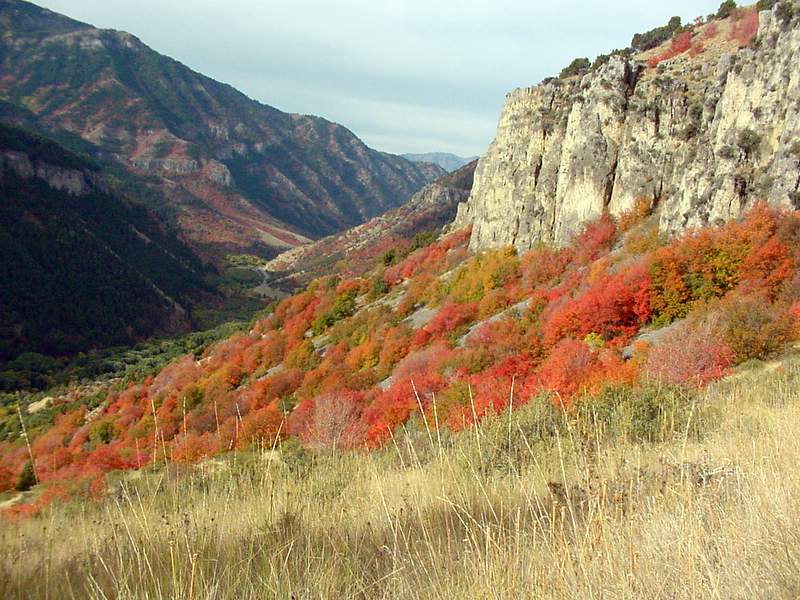
Fall color in Logan Canyon Courtesy & Copyright 2007 Linda Kervin
Fall color in Logan Canyon Courtesy & Copyright 2007 Linda Kervin
In autumn, the days shorten noticeably and chilly dawns become the norm across most of Utah. Leafy plants now prepare for winter. Their summer of intense metabolic activities gradually give way to winter’s dormancy. Photosynthesis and respiration shut down as nutrients and sugars are withdrawn from leaves, to be shunted to the stem and roots for storage. But how do they anticipate the change in seasons so that they are ready for the rigors of winter?
Photosynthetic plants have a diverse array of pigments that they use to capture energy from most of the spectrum of visible sunlight. Chlorophyll is the most abundant, but its light gathering effectiveness is limited to a narrow band of the light spectrum. Plants employ many additional pigments to capture the energy available from other wavelengths of sunlight. These accessory pigments are brilliantly colored but masked by the sheer abundance of green chlorophyll.
One of these pigments, phytochrome, serves as a timekeeper for the plant. When phytochrome absorbs energy in the red band of sunlight, it helps to activate a number of developmental processes in the plant. As the nights lengthen in the fall, there are fewer hours of sunlight to activate the phytochrome and so it transforms to inhibit those same developmental processes.
One result is that chlorophyll is broken down and its components are moved to storage for use in the following spring. Essential nutrients, such as nitrogen and phosphorus, are likewise withdrawn from foliage for later use. With chlorophyll gone, the other colorful leaf pigments are revealed. Now maples, aspens, sumacs and more blaze for a few weeks of riotous glory.
This is Linda Kervin for Bridgerland Audubon Society.
Credits:
Photos: Courtesy & Copyright Linda Kervin
Theme: Courtesy & Copyright Don Anderson as performed by Leaping Lulu
Text: Linda Kervin and Jim Cane, Bridgerland Audubon Society
Voice: Linda Kervin
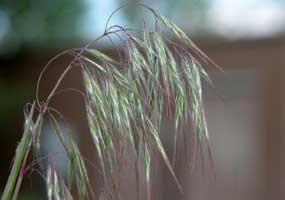
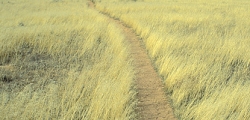
A grassland inundated by cheatgrass Photo Courtesy NPS Neal Herbert, Photographer Hi, this is Mark Larese-Casanova from the Utah Master Naturalist Program at Utah State University Extension.
It’s difficult to visit a landscape in the West without encountering cheatgrass. While cheatgrass’ small stature might make it hard to notice, it’s impossible to forget its sharp, spiny seeds. One hike through a cheatgrass meadow can render a good pair of socks unsalvageable.Encountering Cheatgrass
Although cheatgrass, a nonnative grass scientifically known as Bromus tectorum, is an annual grass- germinating, growing, producing seeds, and dying each year- it is particularly effective at colonizing disturbed areas because it grows and produces seeds much earlier in the spring than many perennial native grasses. Cheatgrass monopolizes water and nutrients by germinating and establishing itself during the previous fall and winter, when many native plants have become dormant. Over time, cheatgrass has become the dominant ground cover in many of Utah’s sagebrush ecosystems.
The dense, dry, fine stalks of cheatgrass, which sets seeds and dries out by June, are particularly flammable fuel for wildfires. Fire roars through the carpet-like cover of cheatgrass, and wildfires are now at least twice as frequent as they were in the 1800’s. This has caused a loss of sagebrush habitat that is particularly important to a wide diversity of wildlife. More frequent fires create an even greater challenge for rare species such as the black-footed ferret and desert tortoise to survive. Native grasses are slower to recover from fire, and cheatgrass is particularly effective at recolonizing burned areas. Utah State University researchers Dr. Peter Adler and Aldo Compagnoni have found that reduced snowpack and warmer temperatures promote the growth of cheatgrass, which could potentially increase its distribution and fire risk into previously colder areas of Utah.
Researchers and managers are continually working to find ways to control cheatgrass in Utah. Effective control usually involves a combination of mechanical pulling or tilling, grazing, burning, spraying with a chemical herbicide, and replanting with native grasses. USU researchers Dr Eugene Schupp and his former graduate student Jan Summerhays found that applying a pre-emergent herbicide to prevent the germination of cheatgrass seeds, as well as temporarily limiting Nitrogen in the soil, gave native grasses and perennials a better chance of establishing. When faced with such a large management problem in Utah and throughout the West, we can use all of the helpful tools we can get.
For Wild About Utah, I’m Mark Larese-Casanova.
Credits:
Images: Courtesy NPS, Neal Herbert Photographers
and NPS, USDA Forest Service, Bugwood.org, Tom Heutte Photographer
Text: Mark Larese-Casanova, Utah Master Naturalist Program at Utah State University Extension.
Additional Reading:
Beck, George. Cheatgrass and Wildfire. Fact Sheet No. 6.310. Colorado State University Extension. https://www.ext.colostate.edu/pubs/natres/06310.html
Cheatgrass. Range Plants of Utah. https://extension.usu.edu/range/Grasses/cheatgrass.htm
Hi, I’m Holly Strand from the Quinney College of Natural Resources at Utah State University.
More and more you are likely to hear this sound in Utah yards, parks and fields. [Eurasian Collared Dove, Courtesy Ryan O’Donnell, www.xeno-canto.org/98068] That’s the call of the Eurasian collared dove. Originally from Asia, this dove has been expanding its territory around the world at an incredible rate. The first sighting in Utah was in Orem in 1997. And now the doves are everywhere. So far, it doesn’t look like our native mourning dove is affected. But such rapid population explosions rarely occur without some sort of undesirable ecological consequence.
In America, the Eurasian collared dove is an invasive species. But not all non-native species are invasive. “Invasive” only applies when species spread far beyond the area where they are first introduced. Luckily, not all invasive species turn out to be serious pests. Ecologist Mark Williamson suggested the tens rule. About 10% of introduced species establish lasting populations and 10% of those go on to become problems.
There’s a long list of Eurasian invasives in Utah. Among them is the highly flammable cheat grass that comes from southwestern Asia. Those massive clouds of starlings? They come from Europe. Tamarisk from Eurasian deserts lines the Colorado River and tributaries. The common carp is an unwelcome Eurasian colonist of our lakes and large rivers. And the American west’s iconic tumbleweed is an invader from the Russian steppe.
Why so many invaders from Eurasia? Well for the last 500 years, there has been a net outflow of Eurasians—especially Europeans—to other parts of the world. And this human population carried its biological baggage along with it—in the form of animals, plants and diseases. Some ecologists believe that the physical geography and human history of Eurasia has conditioned its species in such a way that they will consistently outcompete the species of other continents. But that’s debatable. For in the last decades the New World has started to lob some pretty competitive species over to Eurasia.
For example, the American mink was brought to the Eurasian continent in the 1920s for use on fur farms. But–because of deliberate releases and accidental escapes–the mink is now common in the European wild. And it’s a pest. The American mink is taking the place of the European mink which is now threatened with extinction. Furthermore, the American mink is gobbling up populations of many ground-nesting birds.
Unless you are involved in agriculture, you might not have heard of the Colorado potato beetle. But potato growers around the globe know this striped orange and brown beetle from the American southwest very well. It has a voracious appetite for potato leaves and quickly develops resistance to any chemicals used against it.
And a final example: the American bullfrog is considered one of the world’s most damaging invasives. The bullfrog does amazingly well in a variety of habitats –even artificial ones like millponds, irrigation ditches and reservoirs. Its incredible adaptability helps it spread and outcompete native frogs. Moreover, it has been transmitting a deadly fungus to previously unaffected populations of frogs, toads and salamanders.
Thanks to Lyle Bingham for information on the Eurasian collared dove. And to Ryan ODonnell for his audio recording from xeno-canto.org. For more information on the Eurasian collared dove and other invasive species go to www.wildaboututah.org.
For Wild About Utah, and the Quinney College of Natural Resouces, I’m Holly Strand.
Credits:
Theme: Courtesy & Copyright Don Anderson Leaping Lulu
1. Photographer Joy Viola, Northwestern University, Bugwood.org https://www.invasive.org/browse/detail.cfm?imgnum=5413582
2. USDA ARS Photo Unit, USDA Agricultural Research Service, Bugwood. https://www.insectimages.org/browse/detail.cfm?imgnum=1321015
Audio of Eurasian collared dove:
Ryan P. O’Donnell, XC98068. Accessible at www.xeno-canto.org/98068.
Creative Commons Attribution-NonCommercial-NoDerivs 2.5
Text & Voice: Stokes Nature Center: Holly Strand
Sources & Additional Reading:
Bingham, Lyle. 2009. The New Dove in the Neighborhood. Wild About Utah Program https://wildaboututah.org/the-new-dove-in-the-neighborhood/ October 8, 2009.
di Castri F. 1989. History of biological invasions with special emphasis on the Old World. In: Drake JA, Mooney HA, di CastriF, Groves RH, Kruger FJ, Rejma´nek M, Williamson M, eds. Biological invasions: a global perspective. Chichester, UK: John Wiley and Sons.
European Environment Agency, 2012. The impacts of invasive alien species in Europe EEA Technical report No. 16/2012. EEA, Copenhagen.
National Invasive Species Information Center (NISIC): Gateway to invasive species information; covering Federal, State, local, and international sources.
https://www.invasivespeciesinfo.gov/index.shtml
Simberloff, Daniel. 2013. Invasive Species: What Everyone Needs to Know. Oxford University Press