Capitol Reef

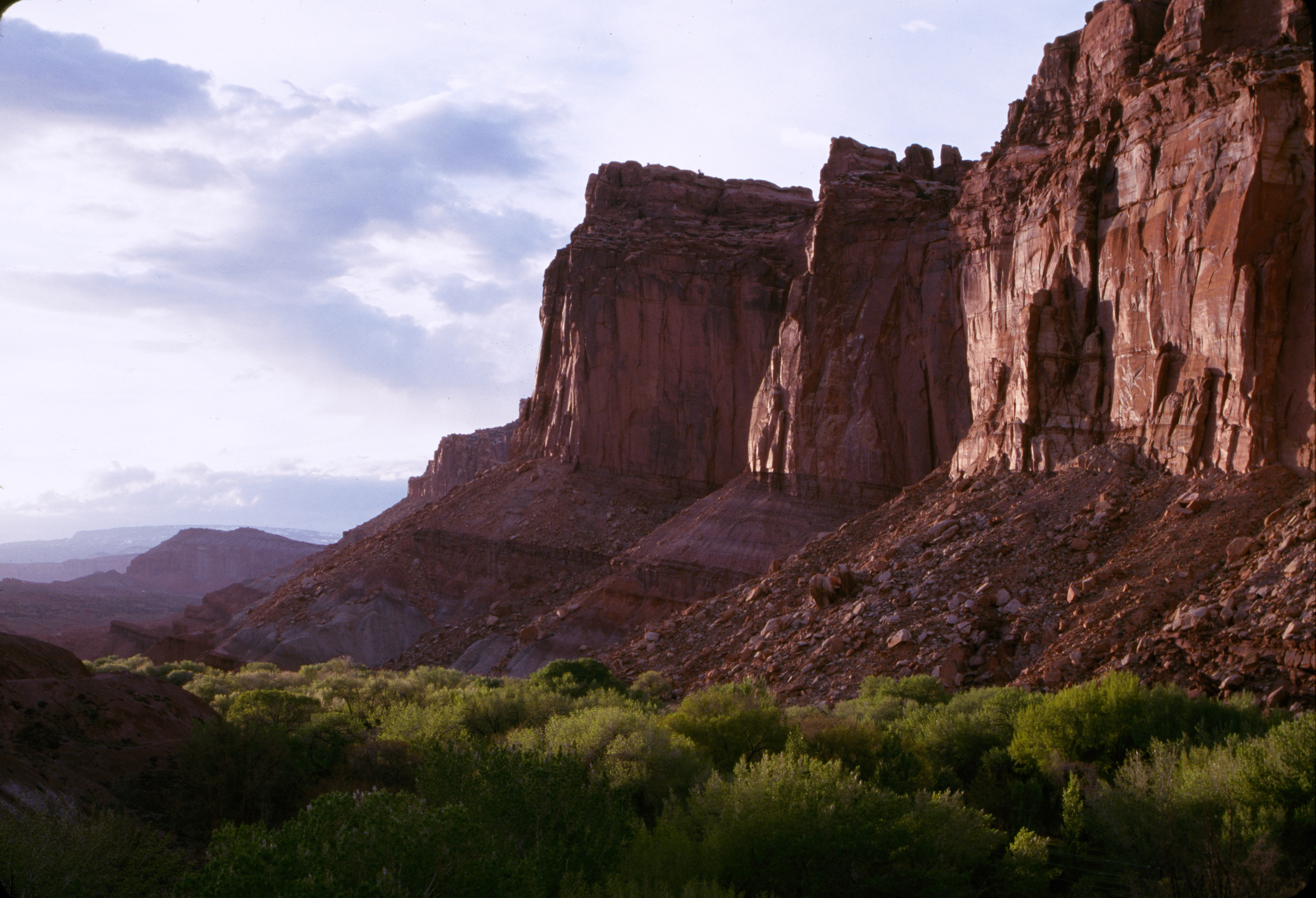
Fruita and the Wingate Cliffs
Capitol Reef National Park
Photo Courtesy US NPS

Orchard
Capitol Reef National Park
Photo Courtesy US NPS

Early settlers to the landscape we know as Capitol Reef National Park in south-central Utah planted cherry, apricot, peach, pear, apple, and walnut trees as a cash crop for survival along the Fremont River bottoms. Visitors today are often surprised by the fruit trees in light of the surrounding desert climate, and campers can pick apples and peaches from their campsites in the orchards. But the green fields and fruit trees also attract deer, marmots, and other small critters, which are easy to spot and are comfortable with humans in their environment.

Though the deer roam free in the tall grass between apple trees, there are other species that are a bit more dangerous lurking nearby. Mountain lions and black bears skillfully stalk around this historic district of Fruita without being seen. Mountain lions have been spotted within a half-mile of the popular campground, yet little is known about the species within the confines of Capitol Reef. With so many questions unanswered about the predator and prey relationship in the unique landscape, the park has received a Disney Nature Impact Grant to enlighten us.

Lori Rome, the park’s chief of interpretation, says, “We are setting up 10-20 infrared motion detected camera traps in surrounding areas. This is a non-invasive way to learn basic information about the species.”

The cameras will provide useful evidence and reveal the patterns of the quiet predators in the park. The public will be engaged through a citizen science project using social media and public interpretive programming, for example helping to survey deer populations.

If you’ve seen Disney Nature’s movie Bears, you, too, helped contribute to the Disney Nature Impact Grants program. Fourteen national parks are receiving funding via proceeds from the movie. Disney Nature has pledged a contribution to the National park Foundation, the official charity of America’s national parks, through the Disney Worldwide Conservation Fund, for each person who saw the film during its first week in theaters.

This type of support helps preserve and protect Capitol Reef and the rest of the National Park System. The Disney Nature Impact Grant enables parks to conduct much-needed conservation projects, such as studying mountain lions at Capitol Reef.

Each park selected to receive a grant through this program had to demonstrate a clear need for the money, and how it would make a profound difference in habitat restoration, wildlife protection or conservation research. With this assistance, we should be able understand predator’s actions in Capitol Reef National Park.

For Wild About Utah and National Parks Traveler, I’m Kurt Repanshek.

Credits:
Image: Courtesy and Copyright Kurt Repanshek, www.nationalparkstraveler.com
Text:     Kurt Repanshek, NationalParksTraveler.com.


Additional Reading:

Capitol Reef And 13 Other National Parks Receive Impact Grants From Disney Nature’s Movie “Bears”, Submitted by Carli Jones, June 26, 2014, NationalParksTraveler.comhttps://www.nationalparkstraveler.com/2014/06/capitol-reef-and-13-other-national-parks-receive-impact-grants-disney-natures-movie-bears25263

Capital Reef National Park, https://www.nationalparkstraveler.com/park/capitol-reef-national-park

Capital Reef National Park, https://www.nps.gov/care/index.htm

Mammals in Capital Reef National Park, https://www.nps.gov/care/naturescience/mammalchecklist.htm
Amphibians in Capital Reef National Park, https://www.nps.gov/care/naturescience/amphibians.htm
Fish in Capital Reef National Park, https://www.nps.gov/care/naturescience/fish.htm
Birds in Capital Reef National Park, https://www.nps.gov/care/naturescience/birds.htm
Reptiles in Capital Reef National Park, https://www.nps.gov/care/naturescience/reptiles.htm

A Safari through Utah’s Ice Age

Wave-cut platforms from
Lake Bonneville preserved on
Antelope Island, Great Salt Lake, Utah.
Photo Courtesy Wikimedia, Mark A. Wilson (Department of Geology, The College of Wooster), Photographer

Ground sloth of the Pleistocene
Paramylodon harlani
Texas Memorial Museum
University of Texas at Austin.
Photo Courtesy Wikimedia
Licensed CCA Share Alike 3.0 Unported

Lake Bonneville compared to the
State of Utah.
Photo Courtesy https://wildlife.utah.gov/gsl/history/


Hi, I’m Ru Mahoney with Stokes Nature Center in Logan Canyon. As winter approaches I find myself anticipating the first really good snow, when our valley floors and mountain passes will be transformed overnight, relinquishing autumn’s riot of color for a glacial monochrome. As little as 12,000 years ago winter white was Utah’s perennial favorite, donned at the launch of the Pleistocene Epoch, a roughly 2 million year long period (give or take 10,000 years) marked by widely recurring glaciations.

The west has a reputation for being vast, but Ice Age Utah was even bigger. The mountains where higher and sharper. And the Great Salt Lake was submerged beneath the glacial waters of Lake Bonneville. At its largest, this massive body of water covered 20,000 square miles and was more than 980 feet deep. To put that into perspective, that measures about 9.5 million football fields wide by 4.5 Salt Lake Temples deep. And the Ice Age wildlife? Well it was much more akin to an African safari than anything you’re likely to find on your favorite shoreline trail these days.

The megafauna of Pleistocene Utah included a menagerie of beasts that are the stuff of legend. Familiar species like bison and big-horn sheep grazed among herds of mammoths and mastodons. Camels and horses – destined for extinction in North America – were the prehistoric prey of dire wolves and saber-toothed cats. Giant ground sloths the size of modern day elephants stood on two powerful hind legs to browse on shoreline foliage. And herds of muskoxen kept a wary eye on Arctodus, the Short-faced bear, a formidable predator more than 50% larger than any bear species living today.

The last 30,000 years of Utah’s Ice Age were characterized by increasingly volatile shifts in climate. The changing norms in temperature and abundance of liquid water created cyclical periods of transitioning habitat. Forests and forest dwellers gave way to deserts and their specialist species, before shifting back to forests again, all in mere millennia. While nomadic and highly adaptable species like muskoxen eventually moved north to more stable climates, the less adaptable fauna of the Ice Age were increasingly relegated to sharing shoreline habitat diminished by the swollen banks of Lake Bonneville.

As fluctuating glaciers pushed southward and then retreated, canyons like Big and Little Cottonwood were gouged into existence. Spring and summer glacier melt carried an abundance of freshwater into the lake, sometimes sweeping along with it the remains of prehistoric animals that had not lasted through the winter, laying them to rest in shoreline deltas where their fossilized remains are now uncovered and studied in alluvial sediment. For many of Utah’s Ice Age animals, the end of the Pleistocene brought extinction.

Today the ancient shoreline of Lake Bonneville is one of the most distinguishable geological features along the Wasatch front. This “bench”, as it’s now commonly known, is easily identifiable in cities all along the Wasatch and frequently boasts fine homes and even finer views. Which might go to show that lakeside property retains its value whether the lake is still there or not. So as you enjoy a winter hike or cross country ski along a shoreline trail this season, think about Utah’s last Ice Age and how our rich fossil record, with some of earth’s largest land mammals, paints a picture of an even wilder west.

For Wild About Utah and Stokes Nature Center, I’m Ru Mahoney.

Credits:
Image1: Courtesy Wikimedia, Mark A. Wilson (Department of Geology, The College of Wooster), Photographer
Image2: Courtesy Wikimedia,as licensed through Creative Commons Attribution-Share Alike 3.0 Unported
Image3: Courtesy https://wildlife.utah.gov/gsl/history/
Text:     Ru Mahoney, Stokes Nature Center in Logan Canyon.

Additional Reading:
https://geology.utah.gov/popular/general-geology/ice-age/ice-age-animals-of-utah/

https://serc.carleton.edu/vignettes/collection/37942.html

https://hugefloods.com/Bonneville.html

https://geology.utah.gov/surveynotes/archives/snt42-3.pdf

https://geology.utah.gov/surveynotes/articles/pdf/pleistocene_fossils_42-3.pdf

Pickleweed Spendor

Click for a closer view of Pickleweed in Cache Valley, Courtesy and Copyright 2010 Linda Kervin
Pickleweed in Cache Valley
Courtesy & Copyright 2010 Linda Kervin

Utah’s mountains and foothills blaze with the brilliant foliar colors of aspens, maples, sumacs and more. But autumn colors can be found in less likely habitats too, even across our flat, desolate salt pans. There the usually drab stage has been given a splash of deep, dusty rose color by its sole botanical performers, the pickleweeds.

Also known as glassworts or samphire, our two species of pickleweed are in the genus Salicornia. They belong to the same plant family as beets, chard and spinach., but you’d never guess that from their appearance. The ankle-high Salicornia’s leaves are reduced to tiny scales that hug the green, branching, cylindrical stems. Pickleweeds are halophytic, or salt loving. Due to their unique physiology, they can thrive in extremely saline environments that kill normal plants. Pickleweed roots filter out some of the salt before it can move into the plant. The remaining excess salt is stored in balloon-like cavities in their cells called vacuoles. When its vacuole is full, a cell ruptures, and newer younger cells continue to accumulate incoming salt.

Click for a closer view of Pickleweed in Cache Valley, Courtesy and Copyright 2010 Linda Kervin
Pickleweed in Cache Valley
Courtesy & Copyright 2010 Linda Kervin

The common name, pickleweed, derives from the taste of the salt stored in the vacuoles of the succulent, crisp stems. You may be surprised to learn that gourmet websites report that pickleweeds are all the rage in Europe as a salad garnish or pickled vegetable.

[Kevin Colver recording: Songbirds of the Southwestern Canyon Country]

In the Great Basin, winter flocks of Horned Larks forage in the snow for Salicornia’s tiny oil-rich seeds as do other birds. The seeds’ proteins and oils are valuable dietary supplement in the sparse salt pan habitat where the picklweed’s unique physiological adaptations allow them to thrive. If your travels this fall take you by a salt pan, take the time to enjoy the rosy glow of the humble pickleweed or view pictures on the Wild About Utah website.

Click for a closer view of Pickleweed in Cache Valley, Courtesy and Copyright 2010 Linda Kervin
Pickleweed in Cache Valley
Courtesy & Copyright 2010 Linda Kervin

This is Linda Kervin for Bridgerland Audubon Society.
Credits:

Photos: Courtesy & Copyright Linda Kervin

Text: Jim Cane and Linda Kervin, Bridgerland Audubon Society

Additional Reading:

https://plants.usda.gov/java/profile?symbol=SALIC

https://en.wikipedia.org/wiki/Salicornia_oil

https://www.efloras.org/florataxon.aspx?flora_id=1&taxon_id=129055

https://people.westminstercollege.edu/faculty/tharrison/gslplaya99/pickleweed.htm

Autumn Leaf Color Change

Click for a closer view of Fall color in Logan Canyon, Courtesy and Copyright Linda Kervin
Fall color in Logan Canyon
Courtesy & Copyright 2007 Linda Kervin

Click for a closer view of Fall color in Logan Canyon, Courtesy and Copyright Linda Kervin Fall color in Logan Canyon
Courtesy & Copyright 2007 Linda Kervin

In autumn, the days shorten noticeably and chilly dawns become the norm across most of Utah. Leafy plants now prepare for winter. Their summer of intense metabolic activities gradually give way to winter’s dormancy. Photosynthesis and respiration shut down as nutrients and sugars are withdrawn from leaves, to be shunted to the stem and roots for storage. But how do they anticipate the change in seasons so that they are ready for the rigors of winter?

Photosynthetic plants have a diverse array of pigments that they use to capture energy from most of the spectrum of visible sunlight. Chlorophyll is the most abundant, but its light gathering effectiveness is limited to a narrow band of the light spectrum. Plants employ many additional pigments to capture the energy available from other wavelengths of sunlight. These accessory pigments are brilliantly colored but masked by the sheer abundance of green chlorophyll.

One of these pigments, phytochrome, serves as a timekeeper for the plant. When phytochrome absorbs energy in the red band of sunlight, it helps to activate a number of developmental processes in the plant. As the nights lengthen in the fall, there are fewer hours of sunlight to activate the phytochrome and so it transforms to inhibit those same developmental processes.

One result is that chlorophyll is broken down and its components are moved to storage for use in the following spring. Essential nutrients, such as nitrogen and phosphorus, are likewise withdrawn from foliage for later use. With chlorophyll gone, the other colorful leaf pigments are revealed. Now maples, aspens, sumacs and more blaze for a few weeks of riotous glory.

This is Linda Kervin for Bridgerland Audubon Society.

Credits:

Photos: Courtesy & Copyright Linda Kervin
Theme: Courtesy & Copyright Don Anderson as performed by Leaping Lulu
Text: Linda Kervin and Jim Cane, Bridgerland Audubon Society
Voice: Linda Kervin

Additional Reading:

Linda Kervin’s pieces on Wild About Utah

Chemistry of Autumn Leaf Color, How Fall Colors Work, About.com: Chemistry, https://chemistry.about.com/library/weekly/aa082602a.htm

Why Do Leaves Change Color in the Fall?, Anne Marie Helmenstine, Ph.D., About.com: Chemistry, https://chemistry.about.com/od/howthingsworkfaqs/f/fallleafcolor.htm

“Autumn: a season of change” (2000) by Peter J. Marchand, https://www.amazon.com/Autumn-Season-Peter-J-Marchand/dp/0874518709

Where to see autumn leaves in Utah:

  • U.S. 89, Logan Canyon, Brigham City to Logan, Logan to Bear Lake
  • State Route 39, Monte Christo Summit, east of Huntsville
  • State Route 190, Big Cottonwood Canyon, east of Salt Lake City, including Guardsman Pass
  • State Route 210, Little Cottonwood Canyon, east of Salt Lake City
  • State Route 92, the Mount Timpanogos loop a.k.a. the Alpine loop, north, east of Provo
  • State Route 150, the Mirror Lake road, east of Kamas
  • U.S. 40, Daniels Summit, east of Heber City
  • Vernal, Red Cloud Loop (See Dinoland.com)
  • Flaming Gorge – Unitas, State Route 191 and State Route 44
  • State Route 132 Payson to Nephi, the Nebo Loop
  • State Route 31, the Wasatch Plateau, east of Fairview
  • State Route 12, over Boulder Mountain, between Torrey and Boulder (likely the most spectacular of all)
  • The La Sal Mountain loop, east of Moab
  • The Abajo Mountain loop, west of Monticello
  • The canyons of the Escalante River, Grand Staircase-Escalante National Monument, southeast of Escalante

List sources:
Aspens and Fall Foliage in Utah, Jeffrey Otis Schmerker, 2001, https://www.utah.com/schmerker/2001/fall_foilage.htm

Ogden Valley Business Association, https://www.utahfallcolors.com

Fall Colors Tour, Utah in the Fall is a blast of color!, https://www.utah.com/byways/fallcolorstour.htm

National Forest Fall Color Hotline, 1-800-354-4595,https://www.fs.usda.gov/detail/r4/recreation/?cid=fsbdev3_016189