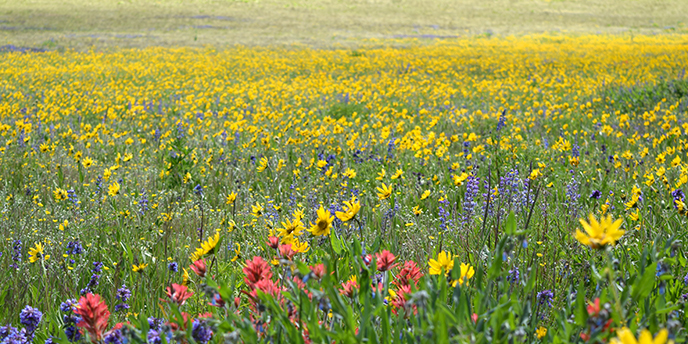
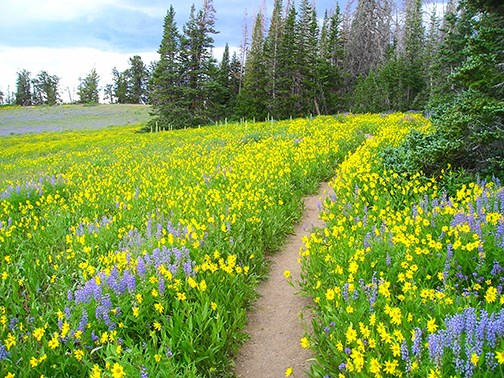
Annual Wildflower Festival Cedar Breaks National Monument Courtesy National Park Service, Cedar Breaks National Monument“Hey, stop the truck!” my wife called from the passenger seat, her nose pressed against the window. I already knew what this was about; she was out the door before the dust had cleared the hood, kneeling in the grass. While she hovered over something newly found with purple petals, I stared out across the high, open meadow of blooming wildflowers, the urge to run surging into my feet. I turned at her exclamation several seconds later, half a football field of colored space between us now. Arms spread wide; grins from ear to ear. In a field of wildflowers, we were kids again.
Scientists call it neoteny, the retention of juvenile features in the adult of a species—basically, the harboring of a playful nature into adulthood. The research into the benefits of play, especially outdoor play, is becoming more replete by the day. In humans, play puts the right hemisphere of the brain into gear, that portion responsible for artistic and creative notions, imagination and insight, and holistic thought. The cerebellum and frontal lobes light up as well, increasing attunement to coordination, executive functioning, and contextual memory development. Neoteny, scientists say, is the key to a species’ adaptability and, therefore, its survival.
Alpine Pond Upper Flowers Cedar Breaks National Monument Courtesy National Park Service, Cedar Breaks National MonumentWild neoteny could be the term used to describe the human affinity to explore one’s natural surroundings, to wander off into the hills in search of something new and interesting, to learn the nuance of a place and to gain some intimacy with it—to call it home. We do that, I think, when we go on hikes into the wild hinterlands, catapult ourselves down the turbulent waters of our rivers, or climb the rock faces we stumble upon. It’s an adrenaline rush to be sure, a high on life as they say; but it’s also an act of survival—and of remaining human.
Robin Moore, a professor at North Carolina State University, says “the natural environment is the principle source of sensory stimulation….” “Sensory experiences,” he says, “link [our] exterior world with [our] interior, hidden, affective world.” The outdoor environment is a medium of human connection where, as Moore puts it, the “freedom to explore and play…through the senses…is essential for healthy development….” Dr. Stuart Brown, clinical researcher and founder of The National Institute for Play, behooves us in his Ted Talk on the subject to explore our individual histories of play. If you close your eyes and imagine yourself at play, where are you? The open water, a deep forest, a mountain peak, or maybe a field of wildflowers?
In his national bestseller, Last Child in the Woods, Richard Louv calls nature a “reset button.” It is the place where we are reminded of ourselves and our purpose. Australian musician Xavier Rudd sings, “Take a stroll to the nearest water’s edge/Remember your place.” It’s often proffered that in a time of industrial expectation and hyper-communication, we need the wild spaces more than ever. There’s some truth to that; but I think I’d go play there anyway, even if it wasn’t to escape the, quote-unquote, “workaday life.” I’m most human when I’m running through a field of blooming wildflowers.
I’m Josh Boling, and I’m Wild About Utah.
Credits:
Photos: Courtesy US National Park Service, Cedar Breaks National Monument
Text: Josh Boling, 2018
A Guide to the Trees of Utah and the Intermountain West Michael Kuhns, Author Utah State University Press Photo taken of personal copy by Ron Hellstern, Photographer Used with permissionIf you are fortunate to live, or even work, near trees enjoy the many benefits they provide. Perhaps you learned something about them in a biology class you took long ago. But do you know what kind of trees you are looking at now? Consider a few basic elementary tips to help you identify what you are observing. And please understand this will be a generalization.
There are 865 tree species in North America. Your best bet to identify them is to get a Western or Utah Field Guide that includes a dichotomous key, which simply means you are given two choices of characteristics to begin your identification process. Once you make a choice, two more characteristics are presented and you continue making choices until you can identify the tree you are observing. Today, I’ll concentrate on the native and naturalized trees of Utah.
Let’s start with Utah Conifers, the gymnosperm trees that bear cones. Inspecting the needles will help you “at least” identify the genus to which they belong. Remember the first letter of Firs, Spruce and Pines to provide a hint to their species:
FIRS have flat and friendly needles to the touch. Common Utah firs include White, Subalpine, and Douglas Fir (which really isn’t a fir, but can be recognized by its cone which looks like little tails on the bracts extending out from under the cone scales.
SPRUCE trees have sharp and square needles. Trying to shake hands with a spruce can be painful, but their individual needles can be rolled between your thumb and finger. Utah has the Blue and Engelmann Spruce.
PINES have packets of two or more needles bundled together as they grow out of the twig. Common pines in Utah include the Bristlecone, Limber, Lodgepole, Pinyon, and Ponderosa.
JUNIPERS have scaley, twiggy leaves and grow in the rocky soils and dry plains and hills where we have either Utah Juniper or Rocky Mountain Juniper. They are quite similar but Utah Junipers have gray bark and yellow-green needles. The Rocky Mountain trees have reddish-brown bark and gray-green needles.
Broadleaf Trees are a little trickier. This is where your dichotomous key and field guide can really help. Once again, I’ll only concentrate on generalities.
MAPLES are palmately lobed, meaning they have leaves that are shaped like hands with very pointy fingers. Look for Rocky Mountain Maple, Bigtooth Maple and Box Elder.
OAKS have leaves that look like rounded lobes all along their edges. Some people say they remind them of feathers.
Here are a few of many qualities of leaves to consider:
Leaf shape – Are they oval, linear, oblong or another shape?
Do they grow opposite or alternate on branches?
Are there single or compound leaves?
Are the margins smooth, serrated like a steak knife, or have another edge?
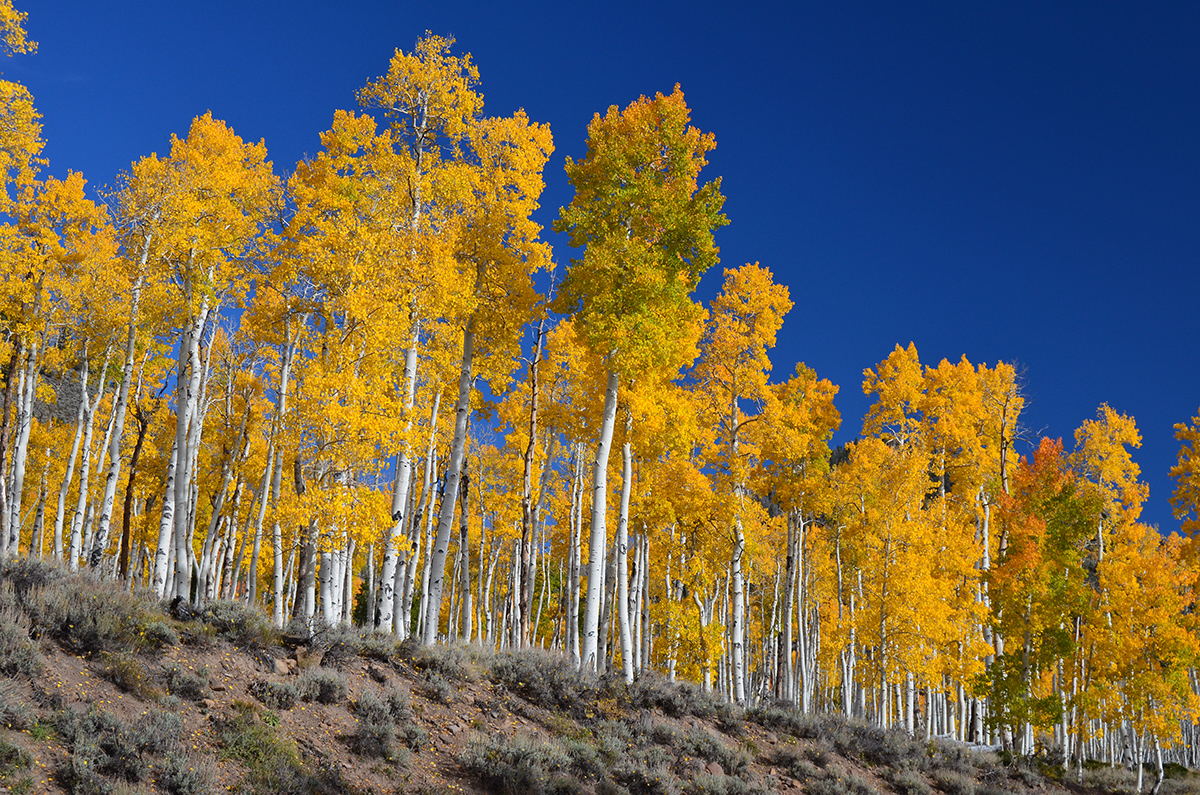
Remember, you might be looking at a tree from another country sold at a retail nursery store. Pando, the worlds largest known organism at Fishlake in central Utah Image courtesy USDA Forest Service J Zapell, PhotographerIn closing, I’ll remind Utahns that the Quaking Aspen was designated as our State Tree in 2014. To its credit, the largest aspen colony, named Pando the Trembling Giant, is in Utah near Fishlake and is a single collection of more than 70,000 trunks connected to a single root system.
That is another reason I am Wild About Utah. This is Ron Hellstern.
Credits:
Images: Courtesy & Copyright Utah State University Press an imprint of University Press of Colorado
Photo of personal copy of the book taken by Ron Hellstern
Image: Pando Aspen Colony, Courtesy USDA Forest Service, J Zapell, Photographer
Text: Ron Hellstern, Cache Valley Wildlife Association
Clear Creek in the Spring Courtesy & Copyright Holly Strand, PhotographerSummer’s heat has turned on. It was evident in a dramatic fashion as I ran a ridge in N. Utah where the early am temps were near 70 degrees, flowers had faded, and the absence of bird song. As I descended to the canyon bottom the temperature dropped a solid 20 degrees and bird voices returned where yellow warblers were competing with lazuli buntings for top songster. I had entered the riparian, or river side biotic community- from the burnt brown of cheat grass above to the lush “green zone” below supporting abundant life in our desert state. I won’t be running ridge tops any time soon!
Throughout the Intermountain West and Great Basin, these givers of life are critical areas for water, wildlife, agriculture, and recreation. About 80 % of all animal life is dependent on stream side habit sometime during its life cycle. As a birder and botanist, this is where I spend much of my time documenting and enjoying the abundance.
On a recent, brief bird survey along the Logan River golf course trail, I recorded 33 species with another ten or so known to nest in this river corridor. I’m planning to prepare a bird checklist for golfers to add more “birdies” to their score card.
Many of these special places have been seriously degraded through invasion of exotic species, agricultural practices, various forms of development, and channelization. But help is on the way.
The Logan River Task Force is one excellent example. Launched in 2016, the task force is well on its way to restoring a much healthier, biologically rich river system. Replacing crack willow, a Eurasian non-native tree, with native cottonwood and willow accompanied by a rich understory of shrubs, will significantly enhance the biodiversity along the floodplain. Another major change is underway as they replace the straight, channelized portion of the river to its meandering original channel. This will create more pools for fish, wetlands for flood control and filtering, while improving aesthetics and recreation opportunity.
In an earlier WAU reading, I mentioned the good work being done by western boxelder ranchers reintroducing beaver whose dams will assist with maintaining stream flow and water quality along with improved fish and wildlife habitat. I’m aware of the same occurring on a Mink Creek ranch in SE Idaho.
The world appears to be awakening to the many values of these critical wildlife and water quality riparian zones, as I awoke to the same on my early morning run.
This is Jack Greene and I’m Wild about Utah!!
Credits:
Images: Holly Strand
Audio: Courtesy and Copyright Kevin Colver
Text: Jack Greene
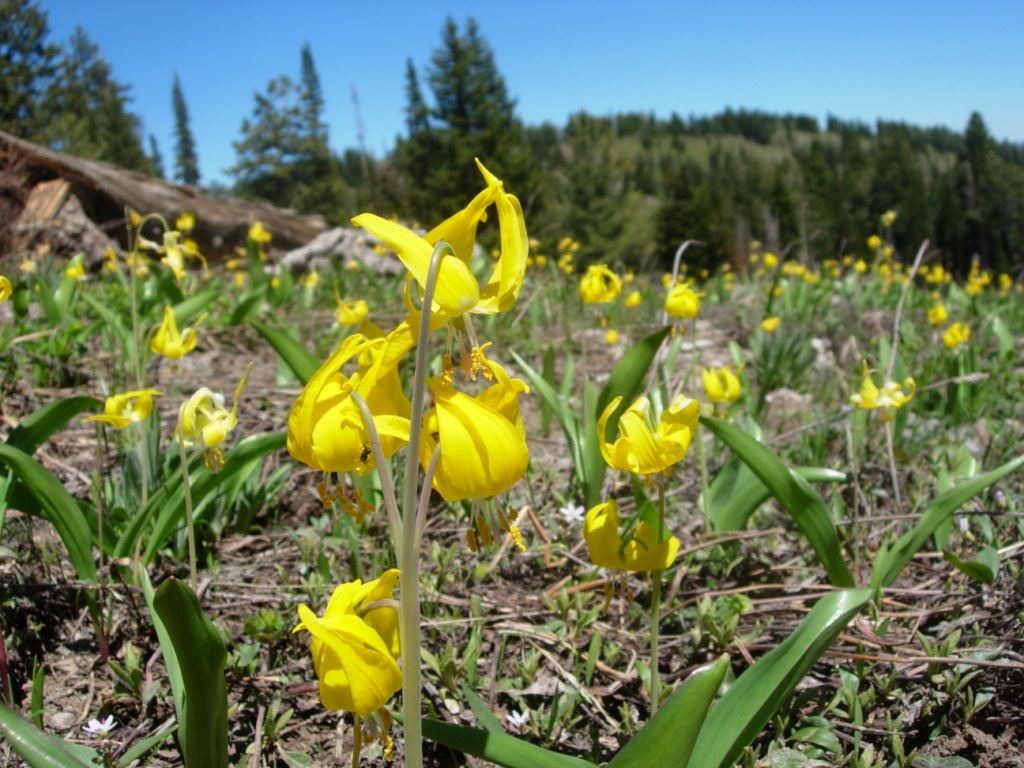
Glacier Lilies, Courtesy Andrea Liberatore, PhotographerI doubt there was a song left unsung as I worked my way up Birch Canyon early am. Testosterone laden birds filled the morning with delight. Robins, finches, meadow larks, song sparrows- what a marvelous symphony! I breathed deeply to fully absorb air filled with titillating odors from last night’s gentle spring rain- nature’s perfume, free and priceless.
Waters surging down Summit and Birch creeks released from winter’s cold grip. Further along, I take notice of recent bloom- glacier lilies exploding with bluebells soon to follow. Yellow bells in sage with promise of early Indian paintbrush. Arrowleaf balsamroot and penstemon only a few weeks away.
Thanks to earth’s 23 degree tilted axis spring is in full swing! This combined with the annual journey around our medium sized star brings the rebirth once again. How boring it would be had it been a tilt of zero degrees- negating our seasonal change. We complain as temperatures swing wildly from 60 degree days plummeting to 30’s in the course of a few hours. But please don’t despair- it may return to pleasantness almost as quickly.
I would not care to be a meteorologist in San Diego where temperatures rarely deviates more than a few degrees, winds are calm, and precipitation comes primarily during winter in dribbles. I relish the beauty and drama of a cumulonimbus cloud burst pummeling me with a deluge of rain pushed by strong wind spawned by a warm, moist air mass colliding with another cool and dry. Grand symbols crashing as lightening energizes countless trillion molecules of nitrogen and oxygen. How could something minute as a gas particle make such a ruckus! Miracles abound.
A spring trek across Zion N.P. last week to welcome spring on the south end. Townsend solitaires, scrub and Steller jays, mountain chickadees, and courtship drumming of woodpecker species were there to welcome me. White throated swifts launched from towering cliffs with occasional canyon wrens emitting cascading, descending notes from their vertical realm.
All three species of nuthatches were present- white and red breasted with small flocks of gregarious pygmies in ponderosa pine forest, busily searching bark crevasses for delectable grubs and insect eggs.
Indian potato and spring beauty were found among the sage near 8000 feet beneath lava point. These delectables were enjoyed by Native Americans. I sampled a few flowers leaving the mini-potato like roots undisturbed. I enjoyed waterleaf stems growing in hardwood forested areas.
After 36 miles of sublime scenery beyond comprehension, I descended into throngs of park visitors from many distant lands evident by their strange dialects. There are no down seasons in Zion these days that I once enjoyed years ago while working as a park seasonal. But the stunning beauty remains, with new greenery showing on cottonwood and boxelder in contrast to the warm glow of massive cliff.
Please don’t inquire of me which season I enjoy most.
This is Jack Greene and I’m wild about Utah!!
Credits:
Pictures: Courtesy & Copyright Andrea Liberatore
Text: Jack Greene, Bridgerland Audubon Society