Fall Colors along the Nebo Loop between Payson, UT and HWY 132 between Nephi and Fountain Green. Courtesy USDA Forest Service
There are people who can capture beautiful scenery by painting on canvas, using film photography, and with digital technology. And these forms of art can be visually stunning. But there is a unique perspective of visualizing when written words are read, allowing one’s mind to see not only the exterior of a scene, but the interior heart intended by the writer.
What memories does your mind recall as you listen to the words of these renowned authors about the poetry of the forest?
Robert Louis Stevenson – …it is not so much for its beauty that the forest makes a claim upon men’s hearts, as for that subtle something, that quality of the air, that emanation from the old trees, that so wonderfully changes and renews a weary spirit.
John Fowles – In some mysterious way woods have never seemed to me to be static things. In physical terms, I move through them, yet in metaphysical ones, they seem to move through me.
Walt Whitman – Why are there trees I never walk under but large and melodious thoughts descend upon me?
William Wordsworth – One impulse from a vernal wood may teach you more of man, of moral evil and of good, than all the sages can.
Marcel Proust – We have nothing to fear and a great deal to learn from trees, that vigorous and Pacific tribe which without stint produces strengthening essences for us, soothing balms, and in whose gracious company we spend so many cool, silent and intimate hours.
Washington Irving – As the leaves of trees are said to absorb all noxious qualities of the air, and to breathe forth a purer atmosphere, so it seems to me as if they drew from us all sordid and angry passions and breathed forth peace and philanthropy. There is a severe and settled majesty in woodland scenery that enters into the soul, and dilates and elevates it, and fills it with noble inclinations.
James Henry Leigh Hunt – They refresh the commonplaces of life, shed a harmony through the busy discord, and appeal to those first sources of emotion, which are associated with the remembrance of all that is young and innocent. They seem also to present us with a portion of the tranquility we think we are laboring for.
Harold Monro – One summer afternoon, you find some lonely trees. Persuade your mind to drowse. Then, as your eyelids close, and you still hover into those three stages of a darkening doze, this side the barrier of sleep,…..pause. In that last clear moment open quick your sight toward where the green is bright and thick. Be sure that everything you keep to dream with is made out of trees.
Plantng a Tree Coutesy USDA Forest Service*Lucy Larcom – He who plants a tree plants a hope.
Henry David Thoreau – In wildness is the preservation of the world. Silence alone is worthy to be heard.
English Proverb – He that plants trees loves others beside himself.
Great Salt Lake Phragmites Courtesy & Copyright Karin KettenringThose unfamiliar with the history of the Utah’s wetlands may see Phragmites and say, “What a beautiful, elegant plant! It looks so graceful blowing along the shore.”
However, the plant’s attractiveness and ability to absorb pollutants may not compensate for its negative impacts.
Phragmites is an invasive perennial grass that now thrives in much of the wetlands around the Great Salt Lake and other marshes in northern Utah. It grows in dense clusters and normally reaches 5 to 10 feet in height. If the conditions are right it can reach 15 feet.
The patches of grass are so dense that wetland managers are called out each year to rescue duck hunters – who are lost in the Phragmites.
Karin Kettenring, associate professor of wetland ecology in the Department of Watershed Sciences at USU and her research team have been studying Utah Phragmites for the past decade.
Kettenring explains why Phragmites is a concern, “We fear it is fundamentally changing the habitat of Great Salt Lake wetlands which are renowned for being a home for migratory birds including waterfowl and shore birds.”
The exotic grass most likely started in the Great Salt Lake wetlands after the flooding of 1983. The flood washed out the marshes. When the water levels receded, the salty water had destroyed all the native vegetation in the wetlands. Phragmites then moved in. By 2011, the exotic grass had spread over 24,000 acres.
Mowing Phragmites Courtesy & Copyright Karin KettenringScientists believe humans inadvertently brought Phragmites to Utah, since birds don’t migrate East and West, and the birds usually don’t eat the seeds. Someone’s boat may have transported the seeds into Utah. They sat dormant in the soil until the conditions were perfect, then the spread of Phragmites began.
Today an average small patch of Phragmites, about 20 feet square, can spread a couple yards a year just from the stems it sends out above and below the ground. However, research has shown it’s not the stems that cause the most reproduction – but the seeds.
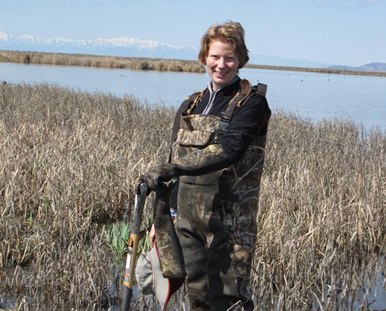
Karin_Kettenring-in-the-Great-Salt-Lake-Wetlands Courtesy & Copyright Karin KettenringKaren Mock, associate professor in the Department of Wildland Resources and a long-term collaborator on this project helped Kettenring with the genetic work.
They tested the genetics of a lot of Phragmites pulled from the same patches and found many different genotypes – proving the plants came from different seeds, not the stems of neighboring plants.
With these results, Kettenring’s lab discovered the best way to control the invasive grass is to first control the seed production by mowing the grass mid-summer to keep it from spreading. Then in the fall spraying the area with herbicide three years in a row. An herbicide approved for use in wetlands can be used – such as Rodeo.
If the Phragmites has been there only a few years then the seeds of the native vegetation will still be in the soil, and they’ll come back on their own.
However, if the Phragmites has been there for a long time then re-seeding of native plants will be necessary.
To determine the best way to re-seed wetlands, Kettenring partnered with Utah Division of Wildlife Resources, Utah Division of Forestry, Fire & State Lands and David England – one of Kettenring’s past graduate students. England has spent extensive time in the lab determining how to help seeds germinate.
Emily Martin, Kettenring’s current graduate student will also help with the UDWR reseeding as she searches for techniques to make seeding more effective.
Ultimately their goal is to restore native plant communities to keep Phragmites from coming back and restore habitat for important migratory birds.
This is Shauna Leavitt and I’m Wild About Utah.
Credits:
Photos: Courtesy & Copyright Karin Kettenring
Audio: Courtesy and Copyright Kevin Colver
Text: Shauna Leavitt
Sources & Additional Reading
How to control Phragmites
Kettenring, Karin, Rupp, Larry, Whitesides, Ralph, Hazelton, Eric, Phragmites Control at the Urban/Rural Interface, 2014, https://works.bepress.com/karin_kettenring/92/
Video: USU researchers mowing Phragmites in the Great Salt Lake wetlands. The passenger is Chad Cranney a past graduate student of Karin Kettenring’s: https://bft.usu.edu/rqcq9
I love the four seasons. Having spent my 72 years residing in the mid latitudes, I’ve learned to celebrate each of our seasons, but especially spring!
This is the rebirth flush with abundant water, new greenery, and air filled with bird song and sweet aromas as new flowers perfume the air hoping to lure in a pollinator.
With mid-April upon us and our 42 degree latitude, spring is in full swing here in northern Utah! Winter departs grudgingly slapping us with snow squalls intermingled with glorious, early summer days, a wild roller coaster ride which I truly enjoy!
I’m an avid phenology follower. Phenology is the study of how life adapts to seasonal changes. I revel in the first floral bloom, the first neotropical birds returning from Latin America with a heart full of song, and newly emerged, gaudy butterflies.
With a relatively stable climate, until recently, the timing of these events has evolved to near perfection
Let’s take a closer look at some of these phenomena. I’ll begin with our neotropical birds such as lazuli buntings, yellow warblers, and Western tanagers to mention a few. These species spend over half of their year in Mexico, Central and South America flying thousands of miles to for the breeding and nesting season in the Intermountain West. This may seem a bit extreme for these tiny flurries of life.
On closer inspection, you will find they have good reason for this daunting and dangerous task. The tropics have a relatively stable climate without the dramatic seasonal change that we experience. This results in relatively stable populations of flowers and insects, the primary food sources for most species. Further, the ratio of daylight to darkness is nearly constant with 12 hours of each. Our days lengthen as we journey toward summer solstice with nearly 16 hours of daylight! This allows a burst of energy to flow through ecosystems resulting in eruptive populations of insects and floral bloom. It also offers long hours of daylight for parents to gather food for their young which grow rapidly toward fledglings, thus reducing the possibility of predation and also preparing them for the arduous flight south as fall approaches.
Let’s examine flowers and insects. With our very warm winter and spring, I was expecting a much earlier arrival of both and was not disappointed. I counted 17 species of flowers by the second week of April! And butterflies were on a similar schedule with 9 different species during the last week of March- remarkably early! Although delighted, it occurred to me that returning birds may not be so pleased. If the flowers begin to fade, and insects begin their downward slide at the peak of birds rearing their young, trouble is afoot! A five year Audubon study revealed that 1/3 of our birds are predicted to be severely impacted by these rapid climate shifts.
On a more positive note, spring will continue as will bird song, vernal waterfalls, eruptions of wildflowers and butterflies. And spring repeats itself as we move to higher elevations. As cornices on our mountain ridges recede, up pops flowers for yet another spring bloom, and with them butterflies, bees, and birds!
Whether you live in a desert, a city, a suburb or a farm, your life would change if you lived in a world without trees. You may be a person who appreciates their ecological connections, or have complete disregard for them. As William Blake said, “The tree, which moves some to tears of joy, is in the eyes of others only a green thing which stands in the way.1”
So, take a moment and consider the way the world would look, and function, without trees. Currently, forests cover about 30% of the Earth’s land surface. But that’s a loss of 1/3 of all trees just since the beginning of the industrial era. The top five largest forests are located in Russia, Brazil, Canada, the U.S., and China.
Whether you think climate change is natural or human-caused, it affects forests by altering the intensity of fires, creating windstorms, changing precipitation, and enabling introduced species to invade. And the World Resources Institute estimates that tens of thousands of forested acres are destroyed every day.
Sometimes even fragmenting forests can produce harmful results as die-backs occur along the edges, and certain wildlife species will not breed unless they live in large tracts of forested areas. It has been said that roads, which are a cause of fragmentation, are the pathways to forest destruction.
Most people know that trees take in Carbon Dioxide for growth, and release Oxygen via photosynthesis. But trees also remove many air pollutants, provide cooling shade and protection from wind and the sun’s harmful Utra-Violet rays. They can be used as privacy screens, they prevent soil erosion, and are the foundation of wildlife habitat on land. Some provide food, can provide serenity and solitude, and have been proven to reduce stress levels. Their fallen leaves decompose into valuable soil. They reduce the Heat-Island Effect in cities, and are more resistant to climate change impacts. Research has shown they improve retail shopping areas, and speed recovery time for those in health care centers.
For the budget-conscious folks, a mature tree can raise home-property values by as much as $5000. And think about those beautiful Autumn colors.
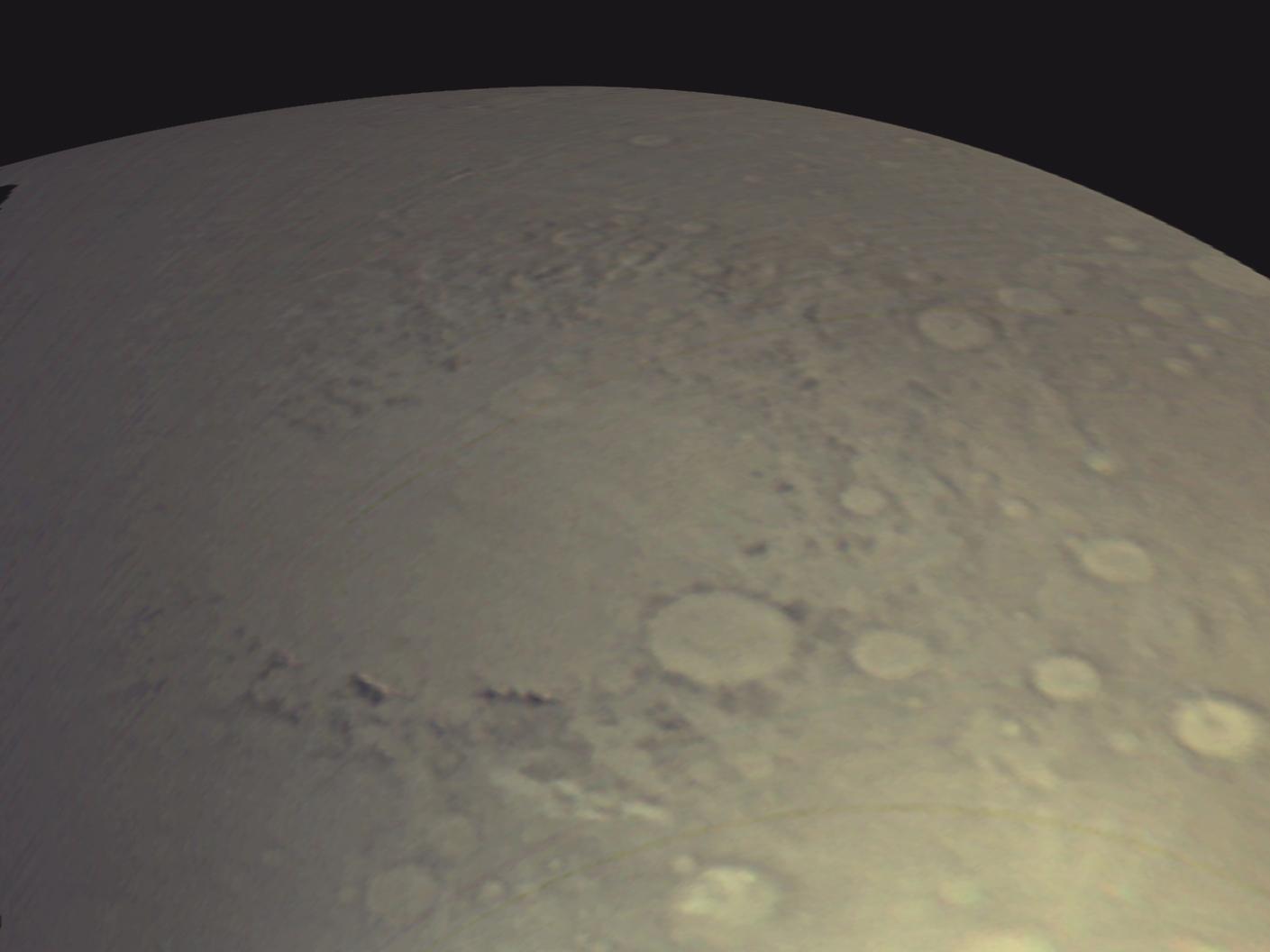
View of Argyre Basin on Mars Courtesy NASA/JPL Caltech Composed from images taken by the Mars Color Imager (MARCI) camera on NASA’s Mars Reconnaissance OrbiterAlthough there seems to be a number of humans who would volunteer to live on planet Mars, would we really want planet Earth to mirror that treeless image?
Perhaps a re-evaluation of trees is warranted. Ponder these imaginative thoughts penned by well-known writers:
Ralph Waldo Emerson: At the gates of the forest, the surprised man of the world is forced to leave his city estimates of great and small, wise and foolish. The knapsack of custom falls off his back.
William Henry Hudson: When one turned from the lawns and gardens into the wood it was like passing from the open sunlit air to the twilight and still atmosphere of a cathedral interior.
Stephanie June Sorrrell: Let me stand in the heart of a beech tree, with great boughs all sinewed and whorled about me. And, just for a moment, catch a glimpse of primeval time that breathes forgotten within this busy hurrying world.
One way for us to resolve tree issues, is to plant them. And the best time to plant a tree was twenty years ago. But the next best time to plant them is today.
“Silence alone is worthy to be heard.” – Henry David Thoreau
This is Ron Hellstern, and I am Wild About Utah.
Credits:
Images: Courtesy
Text: Ron Hellstern, Cache Valley Wildlife Association