Beavers: The Original Army Corps of Engineers

Beavers: The Original Army Corps of Engineers: Click for larger picture, Beaver with branch in water, Courtesy US FWS
Beaver with branch in water
Courtesy US FWS,
Steve Hillebrand, Photographer


Hi, I’m Holly Strand from Stokes Nature Center in beautiful Logan Canyon.

Beavers and beaver dams are a common feature of the Utah landscape. You’ll see the dams on smaller streams and side channels, constructed of branches, downed trees and mud. The still, deep water of the resulting pond creates ideal conditions for a beaver lodge. Beavers can escape and hide from predators by slipping into the pond and disappearing into the lodge. Beavers also use their ponds to cache their favorite
food—aspen and willow.

Because of their tree cutting and dam making skills, humans tend to have two divergent opinions of beavers: 60-pound nuisance or environmental engineer.

Click for larger picture, Beaver Lodge, Courtesy US FWS
Beaver lodge
Courtesy US FWS
Hans Stuart, Photographer

Beavers are considered a nuisance when they gnaw down trees that humans want to keep. Dams can flood roads or stop up irrigation canals. When beaver activity conflicts with human interests, they—the beavers–are likely to be trapped and killed.

However, beaver activity has many positive environmental consequences that we are just beginning to appreciate. Wetlands created by beaver dams help soak up sediments, improving downstream water quality. Because of beaver dams, the winter snowpack isn’t lost in a short spring pulse, This results in a more constant stream flow through the summer –and that’s important as Utah’s climate is predicted to become drier. Finally, beaver dams enhance habitat for many other fish and wildlife species and plants.

Click for larger picture, Beaver in pond, Courtesy US FWS
Beaver in pond
Courtesy US FWS
Steve Hillebrand, Photographer

According to Dr. Joe Wheaton, a geomorphologist at Utah State University, there’s a lot of untapped potential for employing beaver engineers in stream and floodplain restoration. Say you want to restore a stream by reconnecting it with its floodplain. You need to excavate channels, redirect stream flow, revegetate and nurture the
area for a long period of time. To accomplish this, you often need a
number of highly trained professionals and some large Tonka toys.

Alternatively –under the right conditions– you might transplant a
colony of beavers and let them apply their vigorous work ethic to your
landscape and get quite satisfying results.

Recognizing that nuisance beavers can be rehabilitated into hard
working wetland engineers and stream habitat restorationists, the Utah
Division of Wildlife Resources has rolled out the state’s first beaver
management plan in 2010. This plan encourages live trapping of entire
families of beavers in nuisance areas and moves them to specific sites where their
environmental services can be appreciated and put to use.

Click for larger picture, Beaver in snow, Courtesy US FWS
Beaver in snow
Courtesy US FWS

Thanks to the USU College of Natural Resources for supporting this Wild about Utah topic.

For Wild About Utah and Stokes Nature Center, I’m Holly Strand.

Credits:
Images:
Text: Stokes Nature Center: Holly Strand

Sources & Additional Reading


ARKive Images of Life on Earth, Information Sheet on Castor Canadensis (including some outstanding videos) https://www.arkive.org/ – (BBC Natural History Unit)

  • American Beaver – Overview
  • American Beaver in the Lodge with Young
  • American beaver felling trees and storing food for the winter
  • American beaver scaring moose away from its lodge
  • American beaver returning to its lodge with food

  • Collen, P. and R.J. Gibson. 2001. The general ecology of beavers (Castor spp.), as related to their influence on stream ecosystems and riparian habitats, and the subsequent effects on fish – a review. Reviews in Fish Biology and Fisheries 10: 439–461, 2001. https://web.archive.org/web/20230202160926/https://www.researchgate.net/publication/227028536_The_general_ecology_of_beavers_Castor_spp_as_related_to_their_influence_on_stream_ecosystems_and_riparian_habitats_and_the_subsequent_effects_on_fish_-_A_review [ Accessed May 1, 2010]

    Prettyman, B. 2009. Utah wildlife: Leave it to the beavers. Article in Salt Lake Tribune, October 16, 2009. https://www.sltrib.com/ci_13570110 [ Accessed April 29, 2010]

    Smithsonian Castor Canadensis Information Page https://www.mnh.si.edu/mna/image_info.cfm?species_id=32 [ Accessed April 29, 2010]

    Big Bend Habitat Restoration Project: A Natural Work of Heart, Open Spaces-A Talk on the Wild Side, US FWS, https://www.fws.gov/news/blog/index.cfm/2016/3/25/Big-Bend-Habitat-Restoration-Project-A-Natural-Work-of-Heart [Accessed March 31, 2016]

    Beaver Dams Strengthened by Humans Help Fish Rebound
    60-Second Science – July 25, 2016 – By Jason G. Goldman02:29 https://www.scientificamerican.com/podcast/episode/beaver-dams-strengthened-by-humans-help-fish-rebound/ Also available through the podcast https://itunes.apple.com/us/podcast/60-second-science/id189330872?mt=2

    Goldfarb, Ben, Eager: The Surprising, Secret Life of Beavers and Why They Matter, Chelsea Green Publishing, March 8, 2019, https://www.amazon.com/Eager-Surprising-Secret-Beavers-Matter/dp/1603589082/ref=asc_df_1603589082/

    Wildfires in Utah

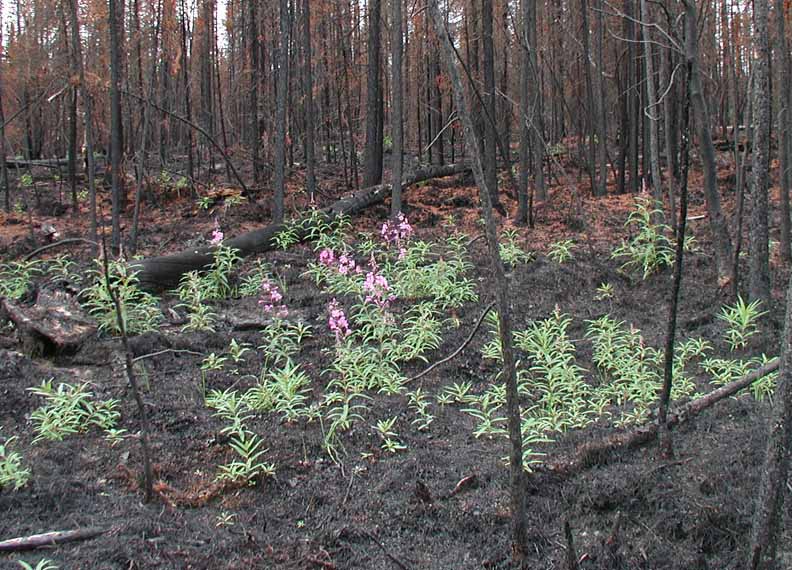
    Wildfires in Utah: Click to view larger image of Fireweed growing in burned area, Photo Courtesy US FWS, U.S. Fish and Wildlife Service
    Fireweed Grows in Burned Area
    Photo Courtesy
    U.S. Fish and Wildlife Service

    Hi, this is Mark Larese-Casanova from the Utah Master Naturalist Program at Utah State University Extension.

    Prior to settlement by the pioneers at the end of the 19th century, wildfires were relatively common throughout the mountains of Utah. Wildfires were a result of natural disturbance, such as lightning strikes, but many were purposely set by Native Americans. Wildfires restarted the cycle of forest succession and also created a mosaic of plant communities across the landscape.

    Although Utah’s changing climate has had a major influence, human factors have considerably altered the natural fire regime over the past 150 years. Fire frequency slowly declined prior to settlement by the pioneers due to a period of global cooling; however, fire activity increased considerably to its highest point during the settlement period between 1856 and 1909. This increase was linked to the dramatic growth in human population and activity, which lead to increased surface fuel from extensive timber harvesting, and inevitably to more ignition sources for more frequent fires.

    Between 1910 and 1990, there was a dramatic decline in wildfires throughout Utah, despite the gradual increase in global temperatures. This was due to intensive livestock grazing, habitat fragmentation as a result of development, agricultural expansion, and effective fire suppression. As a result, shade-intolerant trees that relied on fire for regeneration, such as aspen and lodgepole pine, were often replaced by long-lived, shade-tolerant trees, such as spruce and fir. In general, this resulted in a gradual decline in diversity of plant communities.

    As a result, more homogenous forests that are densely populated with trees and accumulated fuels are more susceptible to intense fires that burn hotter and are more difficult to control. In 2007, Utah had a record-setting fire season that burned over 629,000 acres, including the 363,000-acre Milford Flat Fire. We’re halfway through the fire season this year, and approximately 400,000 acres have burned in Utah, costing over $47,000,000 to control. Additionally, wildfires that have burned about three-quarters of the acreage this year were classified as large in size. It seems that increased temperatures, decreased snowpack, and a century of land use and management has resulted in a dangerous wildfire situation in Utah and much of the West. It will take some creative management strategies, such as sustainable timber harvesting or prescribed fires, to tackle this ongoing issue if we want to limit the risk and cost of larger and more frequent wildfires.

    For Wild About Utah, I’m Mark Larese-Casanova.

    Credits:

    Images: Courtesy U.S. Fish and Wildlife Service, images.fws.gov

    Text:     Mark Larese-Casanova, Utah Master Naturalist Program at Utah State University Extension.
    Additional Reading:

    Madany, M. H., and N. E. West. (1983). Livestock grazing-fire regime interactions within montane forests of Zion National Park, Utah. Ecology 64:661-667., https://www.jstor.org/discover/10.2307/1937186?uid=3739928&uid=2&uid=4&uid=3739256&sid=21100946519023

    Neugebauer, C. (Jul 15, 2012). Burning through money: the cost of Utah wildfires. Salt Lake Tribune., https://www.sltrib.com/sltrib/news/54485976-78/fire-fires-cost-costs.html.csp

    Utah Fire Info webpage: https://www.utahfireinfo.gov/

    Williams, J., D. Albright, A.A. Hoffmann, A. Eritsov, P.F. Moore, J.C.M. de Morais, M. Leonard, J.S. Miguel-Ayanz, G. Xanthopoulos, P. van Lierop. (2011). Findings and implications from a coarse-scale global assessment of recent mega-fires. 5th International Wildland Fire Conference. Sun City, South Africa., https://www.fao.org/docrep/014/am663e/am663e00.pdf

    Live Worldwide Network for Lightning and Thunderstorms in Real Time, Blitzortung, https://en.blitzortung.org/live_lightning_maps.php?map=30

    A Modern Day Phoenix

    “Phoenix,” an immature Golden Eagle
    Aquila chrysaetos
    Courtesy Wildlife Rehabilitation Center of Northern Utah (WRCNU.org)

    Elk Bath
    From a 2000 fire in the
    Bitterroot National Forest in Montana

    Courtesy Wikimedia &
    USDA Forest Service
    John McColgan, Photographer

    Hi, I’m Holly Strand.

    You may have heard about the golden eagle nestling that was badly burned during a recent Utah wildfire. Its nest was totally destroyed, but the little eagle had fallen to the ground and survived. After the fire, he was found by Kent Keller, a volunteer for Utah’s Div. of Natural Resources, who had banded the young eagle a month before. The eagle was dehydrated—his feathers, face, and feet were badly burned. So Keller obtained a permit from wildlife officials to intervene. Now in the care of the Wildlife Rehabilitation Center of Northern Utah the eagle is recovering rapidly. Even so, it will take a while for the damaged feathers to be replaced by healthy new ones. Phoenix–as is he was aptly named–won’t learn to fly for at least another year.

    With this and other fire-related stories in the news, I‘ve been wondering about the fate of animals caught in wildfires. Scientific observations of animal behavior during fire events are rare. But by conducting post-fire surveys, and comparing results with unburned areas, some researchers have been able to piece together an idea of who survives, who dies and who thrives.

    Obviously, faster and more mobile animals have the advantage. Birds can fly away and most mammals can outrun the spreading flames. Spring fires can be disastrous, destroying birds who haven’t fledged –like Phoenix– or mammals who are still too immature to escape. Fortunately, fires are more frequent in mid to late summer when little ones have matured.

    If a fire moves through an area quickly, without superheating the ground, dormant animals or those hiding in burrows can survive. The surrounding soil provides plenty of insulation. Soil also protects most soil macrofauna and the pupae of many insects.

    Animals that live their lives totally or partially in the water may not suffer at all during a fire. However, smaller bodies of water, such as streams, can quickly heat up fairly quickly. Oxygen loss is a problem as well. And fire-fighting chemicals dumped from the air can end up in water, killing fish, frogs and other animals.

    Indirectly, the alteration of habitat by fire can also restructure animal populations. Interestingly, there are quite a lot of animals that benefit from post-fire habitats. For example, the insect population above ground may plummet during a fire, but then increase above pre-fire levels when fresh young plants start to grow back. Burned trees are attractive to certain beetles as breeding sites. An increase in beetles is a windfall for the woodpeckers that devour them. Swallows and flycatchers use burned dead trees as perch sites. They survey from on high and then swoop to catch their insect dinner. Seed eating birds like Clark’s Nutcracker, gobble up conifer seeds when cones open in response to fire.

    Among mammals, ground squirrels, pocket gophers and deer mice generally increase after severe fires. Even large herbivores such as pronghorn or deer may benefit from the increased food and nutrition on recent burns. In turn, predators of these creatures enjoy a bumper crop as well.

    For images of Phoenix the recovering golden eagle and a link to the Wildlife Rehabilitation Center of Northern Utah go to www.wildaboututah.org.

    For Wild About Utah, I’m Holly Strand.

    Credits:

    Images: Courtesy Wikimedia, Louis Agassiz Fuertes, Gavin Keefe Schaefer and Dave Menke, US FWS images.fws.gov
    Text: Holly Strand

    Sources & Additional Reading:


    Baker, William L. 2009. Fire ecology in Rocky Mountain Landscapes. Washington, DC: Island Press.https://islandpress.org/ip/books/book/islandpress/F/bo7019409.html

    Bradley, Anne F.; Noste, Nonan V.; Fischer, William C. 1992. Fire ecology of forests and woodlands in Utah. Gen. Tech. Rep. INT-287. Ogden, UT: U.S. Department of Agriculture, Forest Service, Intermountain Research Station. https://www.fs.fed.us/rm/pubs_int/int_gtr287.pdf

    Hutto, RL. 1995. Composition of bird communities following stand-replacement fires in northern Rocky-Mountain (USA) conifer forests in Conservation Biology Volume: 9 Issue: 5 Pages: 1041-1058 https://www.fsl.orst.edu/ltep/Biscuit/Biscuit_files/Refs/Hulto%20CB1995%20fire%20birds.pdf

    Wildlife Rehabilitation Center of Northern Utah https://wrcnu.org/

    Cryptobiotic Soil Crusts

    Click to view larger image of Cryptobiotic Soil Crust, Photo Courtesy and Copyright Mark Larese-Casanova
    Cryptobiotic Soil Crust
    Photo Courtesy & Copyright 2009
    Mark Larese-Casanova

    Hi, this is Mark Larese-Casanova from the Utah Master Naturalist Program at Utah State University Extension.

    Looking out over a Utah desert, we might see relatively few plants- perhaps some sagebrush, maybe a few junipers or Joshua trees, or even some small wildflowers or cacti. What is less noticeable, though, is the living soil crust that holds this entire landscape together. It’s not just sand, but rather an important and vast partnership between bacteria, lichens, algae, and fungi. These soil crusts are often referred to as ‘cryptobiotic’, which means ‘living in suspended animation’. This is a fitting description, considering that water can be so rare in Utah’s deserts.

    Cyanobacteria, which is often called blue-green algae, is the backbone of cryptobiotic soil crust. Vast networks of long, microscopic filaments of cyanobacteria and fungi grow in length when they are wet, and leave behind a casing that literally binds the soil together. So, what might otherwise be loose sand not only is less likely to be washed away by water or blown away by wind, but also is able to hold much more water for plants.

    Click to view larger image of Cryptobiotic Soil Crust, Photo Courtesy and Copyright Mark Larese-Casanova
    Cryptobiotic Soil Crust
    Photo Courtesy & Copyright 2009
    Mark Larese-Casanova

    Cyanobacteria is also extremely useful to desert landscapes for its ability to take Nitrogen out of the air and make it available to plant roots in the soil. Desert soils typically have relatively low nutrients, so this is especially important to desert plants.

    In many Utah deserts, cryptobiotic soil crusts can cover up to 70% of the ground surface. Old soil crust can often look like small mountain ranges with black or white peaks inhabited by lichens or mosses. The little valleys in between the tiny mountains of crust are perfect spots for the seeds of desert plants to grow. Over time, the above ground crust can grow up to ten centimeters, or four inches, thick!

    However, cryptobiotic soil crust grows at an alarmingly slow rate of about one millimeter per year. So, any soil crust that is disturbed can take a very long time to recover. Depending on the amount of moisture a desert receives, it can take anywhere between 20 and 250 years for soil crust to grow back.

    Next time you’re out in the desert, kneel down and have a close look at the telltale peaks and valleys of cryptobiotic soil crust. If you bring a magnifying glass, you just might be able to see some of the lichens and mosses. Be sure to stay on trail, though, and whatever you do, don’t bust that crust!

    For Wild About Utah, I’m Mark Larese-Casanova.

    Credits:

    Images: Courtesy and copyright Mark Larese-Casanova
    Text:     Mark Larese-Casanova, Utah Master Naturalist Program at Utah State University Extension.
    Additional Reading:

    US Department of Interior. 2001. Biological Soil Crusts: Ecology and Management. Bureau of Land Management Technical Reference 1730-2., https://www.blm.gov/nstc/library/pdf/CrustManual.pdf
    Rosentreter, R., M. Bowker, and J. Belnap. 2007. A Field Guide to Biological Soil Crusts of Western U.S. Drylands. U.S. Government Printing Office, Denver, Colorado., https://www.soilcrust.org/