A World Without Trees

Whether you live in a desert, a city, a suburb or a farm, your life would change if you lived in a world without trees. You may be a person who appreciates their ecological connections, or have complete disregard for them. As William Blake said, “The tree, which moves some to tears of joy, is in the eyes of others only a green thing which stands in the way.1

So, take a moment and consider the way the world would look, and function, without trees. Currently, forests cover about 30% of the Earth’s land surface. But that’s a loss of 1/3 of all trees just since the beginning of the industrial era. The top five largest forests are located in Russia, Brazil, Canada, the U.S., and China.
Whether you think climate change is natural or human-caused, it affects forests by altering the intensity of fires, creating windstorms, changing precipitation, and enabling introduced species to invade. And the World Resources Institute estimates that tens of thousands of forested acres are destroyed every day.

Sometimes even fragmenting forests can produce harmful results as die-backs occur along the edges, and certain wildlife species will not breed unless they live in large tracts of forested areas. It has been said that roads, which are a cause of fragmentation, are the pathways to forest destruction.

Most people know that trees take in Carbon Dioxide for growth, and release Oxygen via photosynthesis. But trees also remove many air pollutants, provide cooling shade and protection from wind and the sun’s harmful Utra-Violet rays. They can be used as privacy screens, they prevent soil erosion, and are the foundation of wildlife habitat on land. Some provide food, can provide serenity and solitude, and have been proven to reduce stress levels. Their fallen leaves decompose into valuable soil. They reduce the Heat-Island Effect in cities, and are more resistant to climate change impacts. Research has shown they improve retail shopping areas, and speed recovery time for those in health care centers.

For the budget-conscious folks, a mature tree can raise home-property values by as much as $5000. And think about those beautiful Autumn colors.

View of Argyre Basin on Mars Courtesy NASA/JPL Caltech https://wildaboututah.org/wp-admin/upload.php?item=8521
View of Argyre Basin on Mars
Courtesy NASA/JPL Caltech
Composed from images taken by the Mars Color Imager (MARCI) camera on NASA’s Mars Reconnaissance Orbiter
Although there seems to be a number of humans who would volunteer to live on planet Mars, would we really want planet Earth to mirror that treeless image?

Perhaps a re-evaluation of trees is warranted. Ponder these imaginative thoughts penned by well-known writers:
Ralph Waldo Emerson: At the gates of the forest, the surprised man of the world is forced to leave his city estimates of great and small, wise and foolish. The knapsack of custom falls off his back.

William Henry Hudson: When one turned from the lawns and gardens into the wood it was like passing from the open sunlit air to the twilight and still atmosphere of a cathedral interior.

Stephanie June Sorrrell: Let me stand in the heart of a beech tree, with great boughs all sinewed and whorled about me. And, just for a moment, catch a glimpse of primeval time that breathes forgotten within this busy hurrying world.

One way for us to resolve tree issues, is to plant them. And the best time to plant a tree was twenty years ago. But the next best time to plant them is today.

“Silence alone is worthy to be heard.” – Henry David Thoreau

This is Ron Hellstern, and I am Wild About Utah.

Credits:
Images: Courtesy
Text: Ron Hellstern, Cache Valley Wildlife Association

Additional Reading

Upton, John, Could Common Earthly Organisms Thrive on Mars?, Pacific Standard, May 21, 2014, https://psmag.com/environment/mars-81952

Voak, Hannah, A World Without Trees, Science in School, https://books.google.com/books/about/The_Marriage_of_Heaven_and_Hell.html?id=YUa8AQAAQBAJ

Hudson, William Henry, The Book of a Naturalist, p4, https://books.google.com/books?id=NA4KAAAAMAAJ&pg=PA4&lpg#v=onepage&q&f=false

https://forestry.usu.edu/

Wilderglyphs

A Tree Wilderglyphs Josh Boling WildUtah032618
A Tree Wilderglyphs
Courtesy & © Josh Boling
Glyph: a word that might evoke images in the mind of ancient Egyptian pictures recounting the trials and triumphs of pharaohs and their people; or Native American rock art meaningfully pecked into a sandstone wall, directing desert travelers toward water. There are others, too, all around us, hiding in plain sight. They are perhaps less noticed because they are not made by humans, but instead by the elements and the wilds. I call them wilderglyphs.

Wilderglyphs come in all shapes, patterns, colors, and forms- as varied as the consortium of elemental forces and ingredients that created them. They’re easy to spot as well because the wilderglyph hunter need only look for artworks created by the happenstances of nature. I once found a particularly interesting evergreen snag while backpacking in the Sierras. It reminded me of a demon with its glaring, fire-scarred, knot-hole eyes and menacing dreads of burnt and broken branches. Like ancient Egyptian hieroglyphs, this wilderglyph told a story of its place- a fiery moment in time captured temporarily in the flesh of the once-living.

Ice Patterns Wilderglyphs Josh Boling WildUtah032618
Ice Pattern Wilderglyph
Courtesy & © Josh Boling
My favorite that I’ve found was also the most fleeting. Searching through the snowy and isolated redrock of Canyonlands National Park for a rumored set of Anasazi ruins, I happened upon a shallow ice puddle tucked under a ledge of sandstone. The ice was something like I had never seen before- patterned with concentric rings similar to those of a tree stump. At first, I thought maybe something had fallen into the once-liquid puddle of water (a pebble perhaps), rippling its loosed energy outward at the exact moment the puddle froze; but, more likely the shallow puddle froze rapidly and contracted radially as temperatures continued to plummet, leaving concentric fractures in the ice face. I left the curious thing behind for maybe an hour to continue my search; when I returned, both the ice and its mysterious message had melted away.

There are more than just stories written into wilderglyphs, though. There is a certain science to them that, if known, can be useful to finding one’s way within the less familiar places we visit.
While descending a slot canyon, one of our party slid his hand along the water-worn wall and then back the other way. “Hey!” came his cry of discovery. He had found that, in one direction (downstream), the wall was smooth and unadorned with blemishes; but, in the other direction (upstream), the sandstone wall was as rough and coarse as sandpaper, providing us with a subtle and very general orientation of the area’s watershed. If lost in the canyons of southern Utah, one could at least know, even in the dark, in which direction he or she might find a larger, main drainage and possibly a way out.

In his celebrated book, Finding Your Way Without Map or Compass, the acclaimed orienteer and aviator Harold Gatty references many such wilderglyphs as navigatory resources. In one chapter, he discusses the useful “signpost ant” and its “compass anthills.” “When their mounds are built in open ground,” Gatty says, “they are oriented most accurately to the southeast, so much so that the native humans of the area often use them to pick up bearings when they are lost in a fog or away from home.” Perhaps more applicable to the Utah traveler are Gatty’s discussions of wind and sand. The orientation of sand dunes and the wind-blown ripples across their faces can divulge direction as readily as a compass if the direction of a prevailing wind is known.

The beauty of wilderglyphs are in their conspicuous subtlety. They are a reminder to us that despite the somewhat chaotic progress of human civilization, the Earth and its faculties persevere readily discernible to those who are able and willing to look.

I’m Josh Boling, and I’m Wild About Utah.

Credits:
Photos: Courtesy & Copyright Josh Boling
Text: Josh Boling, 2017

Sources & Additional Reading

Dasgupta, Shreya, The 15 most amazing landscapes and rock formations, BBC, Feb 5, 2015,
https://www.bbc.com/earth/story/20150205-the-15-most-amazing-landforms

vibills, 11 Natural Geological Formations That Are Absolutely Too Weird To Be Real, Buzzfeed, Jan 1, 2014,
https://www.buzzfeed.com/vibills/11-natural-geological-formations-that-are-absolute-hfde

Wierd Google Earth, Archives for Natural formations, WeirdGoogleEarth.com, https://www.weirdgoogleearth.com/category/natural-formations/

Sixty In-stream Habitat Structures in Four Days: Demonstrating Creek Restoration Techniques

In-stream Habitat Structures: Crews from multiple agencies gather in the encroaching pinyon-juniper forest to begin building the in-stream structures in Birch Creek, UT. Courtesy & Copyright Shauna Leavitt, Photographer
Crews from multiple agencies gather in the encroaching pinyon-juniper forest to begin building the in-stream structures in Birch Creek, UT.
Courtesy & Copyright Shauna Leavitt, Photographer
The job of building 60 in-stream habitat structures in one week seems like a daunting task. But an energetic group of 16 natural resource managers, researchers and volunteers, finish all 60 in four days.

The crew members come from numerous agencies including the Bureau of Land Management, Utah Division of Wildlife Resources, the National Forest Service, interagency firefighting hotshots, and Utah State University.
The purpose of the project is to demonstrate how effective various in-stream structures are at improving habitat for Bonneville cutthroat trout and restoring riparian habitat on a two-mile stretch of Utah’s Birch Creek, located southeast of Beaver, Utah.

In-stream Habitat Structures: Crews from multiple agencies building in-stream structures to restore Birch Creek. Courtesy & Copyright Shauna Leavitt, Photographer
Crews from multiple agencies building in-stream structures to restore Birch Creek. Courtesy & Copyright Shauna Leavitt, Photographer
At one time Birch Creek was rich with beaver, riparian vegetation and diverse in-stream habitat making it an ideal home for Bonneville Cutthroat trout and sage grouse.

The beaver are now gone, and the once woody riparian vegetation has been largely replaced by an encroaching pinyon-juniper forest. The creek is one narrow ditch-like channel.

According to Joseph Wheaton, Associate Professor in the Department of Watershed Sciences and Principal Investigator, “Without the help [of man-made structures or beaver dams] recovery from this type of degradation could take centuries.”

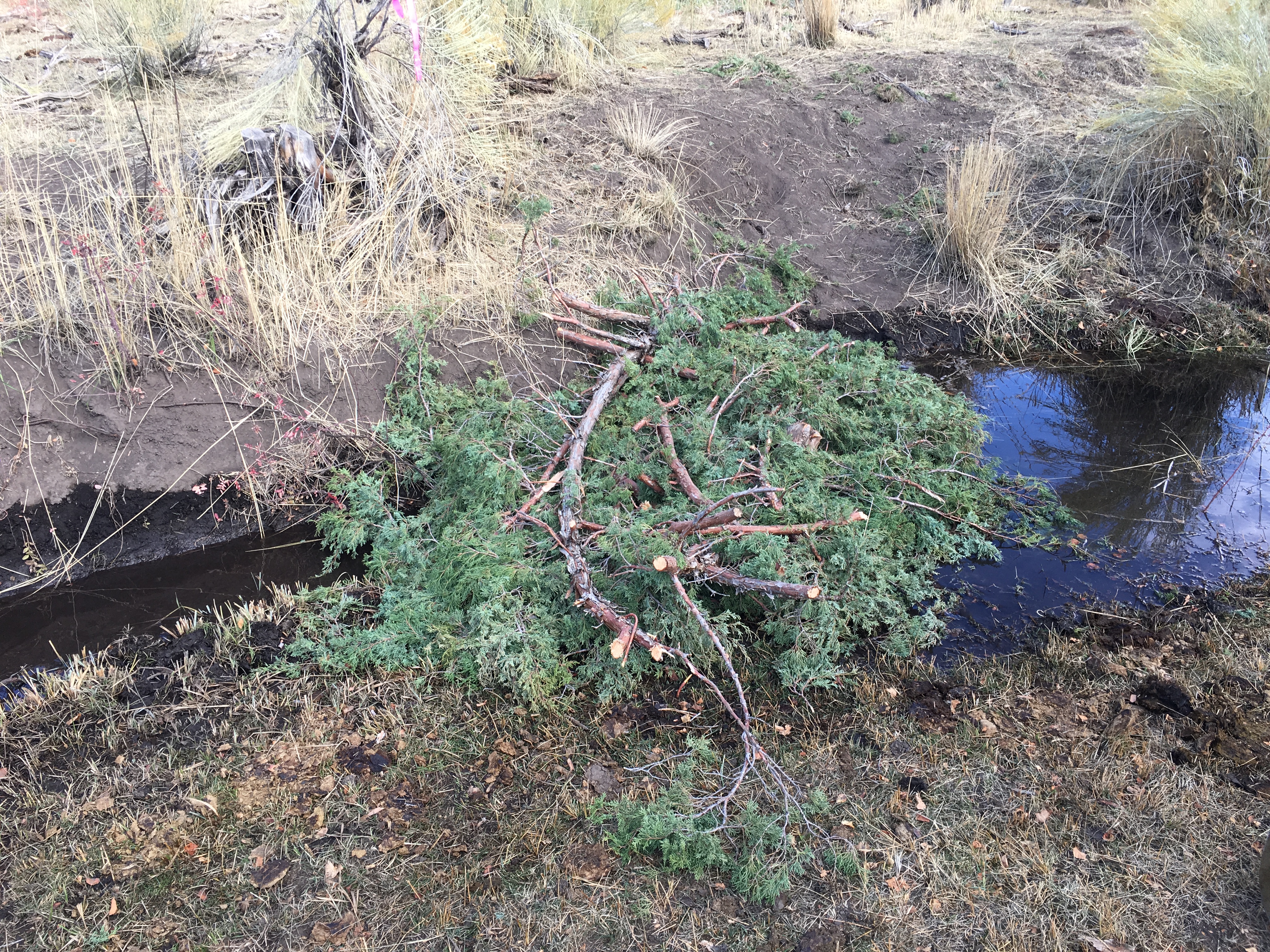
The crews built a variety of simple structures, some designed to mimic beaver dams and others to imitate natural accumulations of wood and debris jams.

In-stream Habitat Structures: An in-stream structure build from juniper branches, cobble, gravel and mud. Courtesy & Copyright Shauna Leavitt, Photographer
An in-stream structure build from juniper branches, cobble, gravel and mud. Courtesy & Copyright Shauna Leavitt, Photographer
The largest structures are built with an excavator. The machine pulls up large junipers and drops them in the stream so the water can run over, around and through the juniper and its root wads.
Wheaton explains, ”By putting the [Juniper} in the channel we’re making habitat for fish and at the same time raising water tables, which support a whole range of riparian vegetation and wetland vegetation.”
Another structure is the Beaver Dam Analogues (BDAs), which is a simple, cost-effective method of using posts and juniper branches then adding rocks and mud to partially plug up the deliberately leaky dams, designed to be passable to fish.

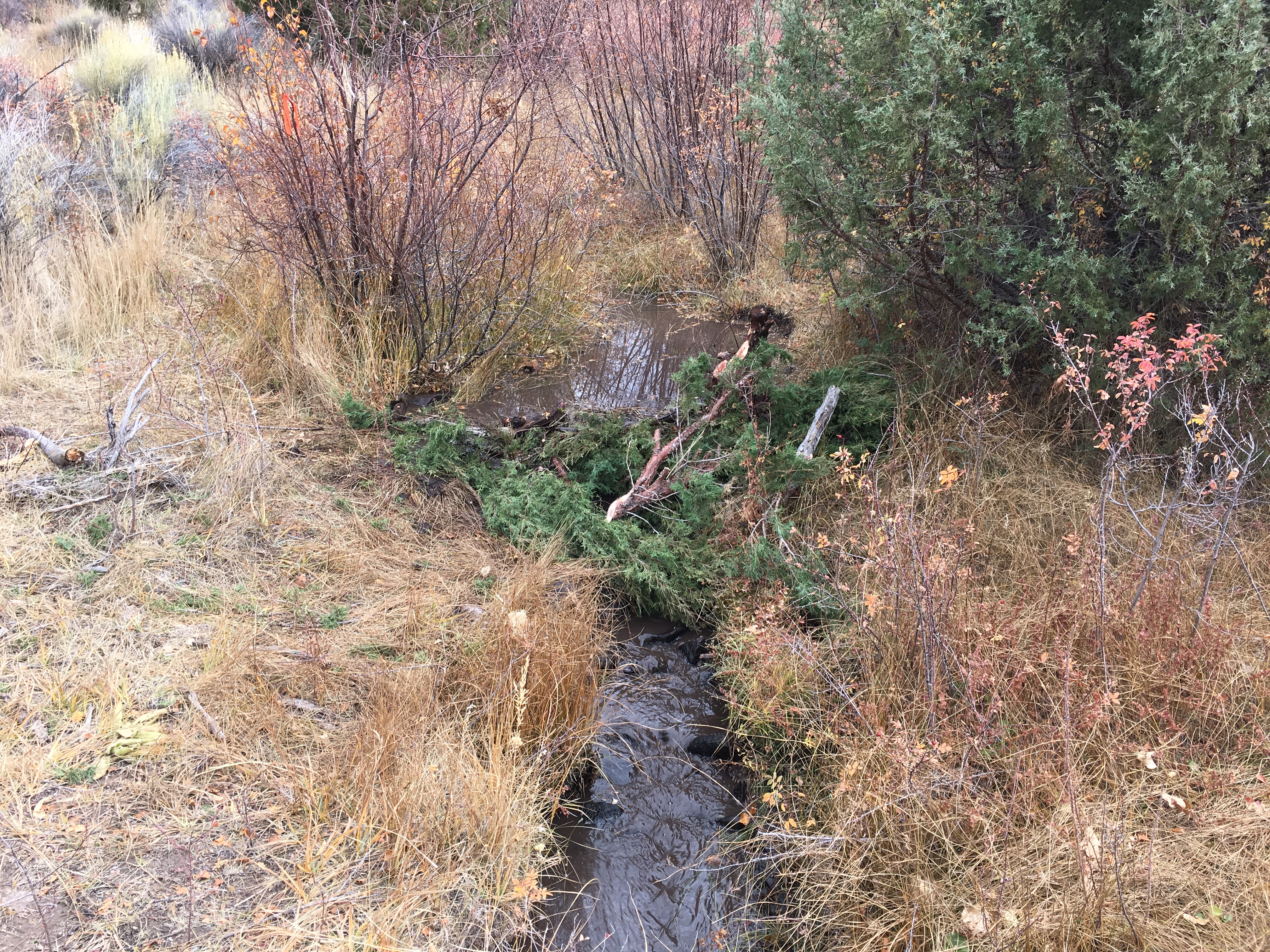
In-stream Habitat Structures: A pool forming behind a newly build in-stream habitat structure. Courtesy & Copyright Shauna Leavitt, Photographer
A pool forming behind a newly build in-stream habitat structure. Courtesy & Copyright Shauna Leavitt, Photographer
Crews see immediate improvements after each structure is built. New pools form, old-channels that haven’t seen water for decades begin to flow parallel to the main channel, and formerly dry floodplains become wet sponges and wetlands.

These wet sponges will release their water later in the season providing additional moisture in dryer times.
Justin Jimenez, Fisheries Riparian Program Manager with Bureau of Land Management explains why these pools are essential, “We’re working to improve the habitat for native fish by increasing the pool frequency and depth. The depth provides thermal cover.” Which is cooler for summer rearing habitat, and warmer for winter survival.
Before this project began, downstream water-rights holders were concerned about how these structures would impact water for irrigation.

In response to their concerns, Gary O’Brien, a Geomorphologist in the Fluvial Habitat Center at USU installed a common measuring device called a V-notch weir at the top and bottom the of the two-mile stretch to measure the discharge of the stream.

According to O’Brien, “once all the structures fill their pools and the system adjusts for infiltration, we expect the top and the bottom weirs to measure a relatively consistent discharge.”
By the addition of a pressure transducer in the pool behind the weirs, O’Brien will have continuous flow of data at every stage.

With these readings the ranchers can be kept up-to-date on the impact the structures are having on the water resources. The agencies have agreed to remove the structures if gaging shows the structures are negatively impacting downstream water users.

Throughout the project, UDWR, BLM and the USFS will be monitoring cutthroat trout response, and USU will be monitoring how the habitat responds and changes through time.

By monitoring the responses, managers and researchers will be able to make more informed decisions about which types and mix of structures can be most effectively used to restore similar streams cheaply across the state.

This is Shauna Leavitt for Wild About Utah.

Credits:
Photos: Courtesy and Copyright Shauna Leavitt
Text: Shauna Leavitt

Sources & Additional Reading

Streams & Rivers Restoration, Restoration Center, NOAA Habitat Conservation, National Marine Fisheries Service,
https://habitat.noaa.gov/restoration/techniques/srrestoration.html

White, Courtney, Thinking Like a Creek, originally published by The Carbon Pilgrim, March 6, 2014,
https://resilience.org/stories/2014-03-06/thinking-like-a-creek/

Stream Restoration, United States Department of Agriculture(USDA), Natural Resources Conservation Service(NRCS),
https://nrcs.usda.gov/wps/portal/nrcs/main/national/water/manage/restoration/

Rubenstein, Marcus, CPESC, Stream Restoration, Purpose Practice and Methods, Southeast Storm Water Association,
https://seswa.org/assets/Services/Annual-Conference/2010/11%20-%20stream%20restoration%20%20methods%20purpose%20and%20practices%20rubenstein.pdf

Talking Dirt

Talking Dirt: There are over four billion micro-organisms in a teaspoon of healthy soil. Courtesy King County, WA
There are over four billion micro-organisms in a teaspoon of healthy soil.
Courtesy King County, WA
It’s time to talk dirt- and I’m not talking politics, but real, factual dirt! Of all our amazing planets ecosystems, there is one that rises above all others. It’s the one your home is standing on, the one you don’t want your kids to track in the house. By now you’ve probably guessed it!

The diversity and abundance of life that exists within soil is greater than in any other ecosystem. A ‘biological universe’ exists in a gram of soil. Soil biota within this tiny universe transform energy, create and modify their habitat, influence soil health, and aid in the regulation of greenhouse gases. There are more microbes in a teaspoon of soil than there are people on the earth. We’re talking such characters as bacteria, fungi, protozoa, nematodes, earthworms, and arthropods. No wonder kids are so drawn to this miraculous stew of life! My one year old granddaughter can’t resist a mouthful given the opportunity! So let’s dive into a handful of soil.

Biogeochemical Cycling Courtesy USGS, Public Domain https://www.usgs.gov/media/images/biogeochemical-cycling-diagram-showing-climatic-processes-hydrologic
Biogeochemical Cycling
Courtesy USGS, Public Domain
https://www.usgs.gov/media/images/biogeochemical-cycling-diagram-showing-climatic-processes-hydrologic
The majority of life on Earth is dependent upon six critical elements: hydrogen, carbon, nitrogen, phosphorus, oxygen, and sulfur that pass through, and are transformed by, soil organisms. This process, called biogeochemical cycling, is defined as the transformation and cycling of elements between non-living and living matter. These processes are dependent upon life in the soil.

Although we understand the vital services that these organisms provide by breaking down organic debris and recy¬cling nutrients, scientists have only begun to study the rich and unique diversity that is a part of the soil ecosystem. Of particular interest for myself is understanding the functions of certain fungi and their roles in storing atmospheric carbon dioxide.

As you may have heard in past WAU readings, climate change is a major threat to Utah’s wildlife including birds, cold water fish, pollinators, and pica.

Conservation Tillage: Minimizing tillage and maintaining a crop residue on the soil surface can greatly reduce erosion impacts Agricultural Management Practices for Water Quality Protection--Watershed Academy Web, Courtesy US EPA
Conservation Tillage:
Minimizing tillage and maintaining a crop residue on the soil surface can greatly reduce erosion impacts
Agricultural Management Practices for Water Quality Protection–Watershed Academy Web, Courtesy US EPA
And here’s where our farms and ranches have the opportunity to play a crucial role beyond feeding us.
Deploying what’s called regenerative agricultural practices like tillage reduction, cover crops, companion planting, planned grazing, and keyline plowing—will not only improve soil quality making it more resilient to climate conditions like flooding and drought, but also increase soil’s organic matter which require less fertilizer. This in turn, means less runoff into waterways and greater profitability for farmers.

Perhaps most important of all, managing farms this way actually draws carbon out of the atmosphere. If all cropland in the U.S. was farmed using these regenerative practices, the greenhouse gas reduction would be equivalent to eliminating nearly 90 percent of our country’s cars. And now some states are considering economic incentives like tax breaks for carbon sequestration farming, and enlisting Farm Bureaus to provide additional support. Will Utah be next?

This is Jack Greene writing and reading for Wild About Utah.

Fortuna, A. (2012) The Soil Biota. Nature Education Knowledge 3(10):1, https://www.nature.com/scitable/knowledge/library/the-soil-biota-84078125

Biogeochemical Cycles, U.S. Global Change Research Program, https://nca2014.globalchange.gov/report/sectors/biogeochemical-cycles#intro-section-2

How do microbial mats work? Microbial Mat Biogeochemical Cycling, NASA Ames Research Center, https://spacescience.arc.nasa.gov/microbes/about/microbial.html

Biogeochemical Cycling, Center for Forested Wetlands Research, Southern Research Station, USDA Forest Service, https://www.srs.fs.usda.gov/charleston/research/biogeochemical/

Subsurface Biogeochemical Research Program, Climate and Environmental Sciences Division, Office of Biological and Environmental Research, U.S. Department of Energy, https://doesbr.org/

The Carbon Cycle, NASA Earth Observatory, EOS Project Science Office, NASA Goddard Space Flight Center, https://earthobservatory.nasa.gov/Features/CarbonCycle/