Jack Loves the Four Seasons

Red Admiral Butterfly, Thomas G. Barnes, US FWS Digital Library
Red Admiral Butterfly
Thomas G. Barnes
US FWS Digital Library

Glacier Lilies
Erythronium grandiflorum
Copyright © 2010 Andrea Liberatore


I love the four seasons. Having spent my 72 years residing in the mid latitudes, I’ve learned to celebrate each of our seasons, but especially spring!

This is the rebirth flush with abundant water, new greenery, and air filled with bird song and sweet aromas as new flowers perfume the air hoping to lure in a pollinator.

With mid-April upon us and our 42 degree latitude, spring is in full swing here in northern Utah! Winter departs grudgingly slapping us with snow squalls intermingled with glorious, early summer days, a wild roller coaster ride which I truly enjoy!
I’m an avid phenology follower. Phenology is the study of how life adapts to seasonal changes. I revel in the first floral bloom, the first neotropical birds returning from Latin America with a heart full of song, and newly emerged, gaudy butterflies.

With a relatively stable climate, until recently, the timing of these events has evolved to near perfection
Let’s take a closer look at some of these phenomena. I’ll begin with our neotropical birds such as lazuli buntings, yellow warblers, and Western tanagers to mention a few. These species spend over half of their year in Mexico, Central and South America flying thousands of miles to for the breeding and nesting season in the Intermountain West. This may seem a bit extreme for these tiny flurries of life.

On closer inspection, you will find they have good reason for this daunting and dangerous task. The tropics have a relatively stable climate without the dramatic seasonal change that we experience. This results in relatively stable populations of flowers and insects, the primary food sources for most species. Further, the ratio of daylight to darkness is nearly constant with 12 hours of each. Our days lengthen as we journey toward summer solstice with nearly 16 hours of daylight! This allows a burst of energy to flow through ecosystems resulting in eruptive populations of insects and floral bloom. It also offers long hours of daylight for parents to gather food for their young which grow rapidly toward fledglings, thus reducing the possibility of predation and also preparing them for the arduous flight south as fall approaches.

Let’s examine flowers and insects. With our very warm winter and spring, I was expecting a much earlier arrival of both and was not disappointed. I counted 17 species of flowers by the second week of April! And butterflies were on a similar schedule with 9 different species during the last week of March- remarkably early! Although delighted, it occurred to me that returning birds may not be so pleased. If the flowers begin to fade, and insects begin their downward slide at the peak of birds rearing their young, trouble is afoot! A five year Audubon study revealed that 1/3 of our birds are predicted to be severely impacted by these rapid climate shifts.

On a more positive note, spring will continue as will bird song, vernal waterfalls, eruptions of wildflowers and butterflies. And spring repeats itself as we move to higher elevations. As cornices on our mountain ridges recede, up pops flowers for yet another spring bloom, and with them butterflies, bees, and birds!

Credits:

Pictures: Courtesy Dr. Thomas G. Barnes, US FWS
Pictures Lilies: Copyright © 2010 Andrea Liberatore
Audio: Courtesy and Copyright Kevin Colver
Text: Jack Greene, Bridgerland Audubon Society

Additional Reading:

Kervin, Linda, USA National Phenology Network, Wild About Utah, July 2, 2009, https://wildaboututah.org/usa-national-phenology-network/

Hellstern, Ron, Journey North, Wild About Utah, March 19, 2018, https://wildaboututah.org/journey-north/

Greene, Jack, I Love the Four Seasons, Wild About Utah, May 3, 2015, https://wildaboututah.org/i-love-the-four-seasons/

Conners, Deanna, Why Earth has 4 seasons, EarthSky.org, September 20, 2016, https://earthsky.org/earth/can-you-explain-why-earth-has-four-seasons
A World Without Trees

Whether you live in a desert, a city, a suburb or a farm, your life would change if you lived in a world without trees. You may be a person who appreciates their ecological connections, or have complete disregard for them. As William Blake said, “The tree, which moves some to tears of joy, is in the eyes of others only a green thing which stands in the way.1”

So, take a moment and consider the way the world would look, and function, without trees. Currently, forests cover about 30% of the Earth’s land surface. But that’s a loss of 1/3 of all trees just since the beginning of the industrial era. The top five largest forests are located in Russia, Brazil, Canada, the U.S., and China.
Whether you think climate change is natural or human-caused, it affects forests by altering the intensity of fires, creating windstorms, changing precipitation, and enabling introduced species to invade. And the World Resources Institute estimates that tens of thousands of forested acres are destroyed every day.

Sometimes even fragmenting forests can produce harmful results as die-backs occur along the edges, and certain wildlife species will not breed unless they live in large tracts of forested areas. It has been said that roads, which are a cause of fragmentation, are the pathways to forest destruction.

Most people know that trees take in Carbon Dioxide for growth, and release Oxygen via photosynthesis. But trees also remove many air pollutants, provide cooling shade and protection from wind and the sun’s harmful Utra-Violet rays. They can be used as privacy screens, they prevent soil erosion, and are the foundation of wildlife habitat on land. Some provide food, can provide serenity and solitude, and have been proven to reduce stress levels. Their fallen leaves decompose into valuable soil. They reduce the Heat-Island Effect in cities, and are more resistant to climate change impacts. Research has shown they improve retail shopping areas, and speed recovery time for those in health care centers.

For the budget-conscious folks, a mature tree can raise home-property values by as much as $5000. And think about those beautiful Autumn colors.

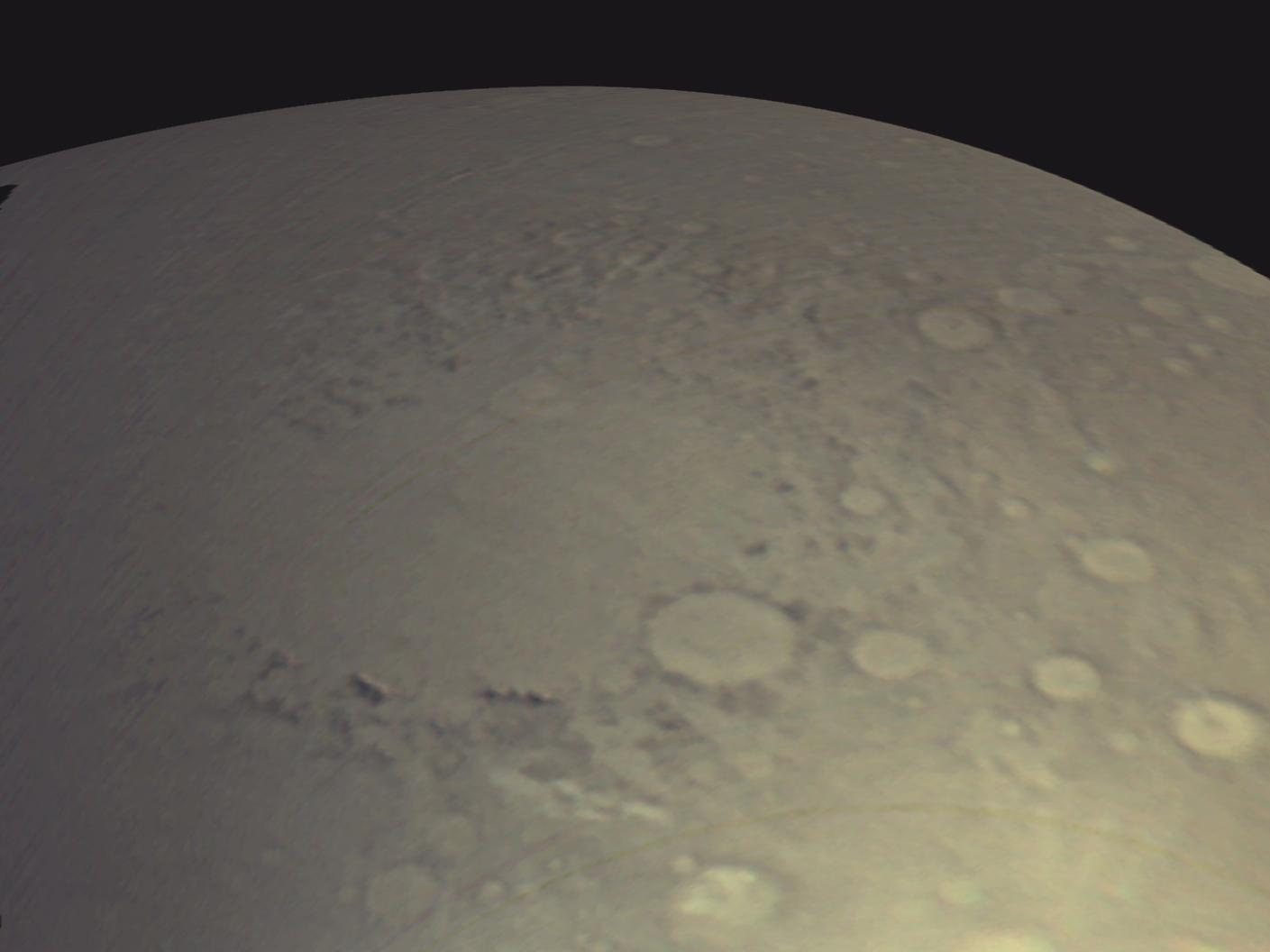
View of Argyre Basin on Mars Courtesy NASA/JPL Caltech https://wildaboututah.org/wp-admin/upload.php?item=8521
View of Argyre Basin on Mars
Courtesy NASA/JPL Caltech
Composed from images taken by the Mars Color Imager (MARCI) camera on NASA’s Mars Reconnaissance Orbiter
Although there seems to be a number of humans who would volunteer to live on planet Mars, would we really want planet Earth to mirror that treeless image?

Perhaps a re-evaluation of trees is warranted. Ponder these imaginative thoughts penned by well-known writers:
Ralph Waldo Emerson: At the gates of the forest, the surprised man of the world is forced to leave his city estimates of great and small, wise and foolish. The knapsack of custom falls off his back.

William Henry Hudson: When one turned from the lawns and gardens into the wood it was like passing from the open sunlit air to the twilight and still atmosphere of a cathedral interior.

Stephanie June Sorrrell: Let me stand in the heart of a beech tree, with great boughs all sinewed and whorled about me. And, just for a moment, catch a glimpse of primeval time that breathes forgotten within this busy hurrying world.

One way for us to resolve tree issues, is to plant them. And the best time to plant a tree was twenty years ago. But the next best time to plant them is today.

“Silence alone is worthy to be heard.” – Henry David Thoreau

This is Ron Hellstern, and I am Wild About Utah.

Credits:
Images: Courtesy
Text: Ron Hellstern, Cache Valley Wildlife Association

Additional Reading

Upton, John, Could Common Earthly Organisms Thrive on Mars?, Pacific Standard, May 21, 2014, https://psmag.com/environment/mars-81952

Voak, Hannah, A World Without Trees, Science in School, https://books.google.com/books/about/The_Marriage_of_Heaven_and_Hell.html?id=YUa8AQAAQBAJ

Hudson, William Henry, The Book of a Naturalist, p4, https://books.google.com/books?id=NA4KAAAAMAAJ&pg=PA4&lpg#v=onepage&q&f=false

https://forestry.usu.edu/

Wilderglyphs

A Tree Wilderglyphs Josh Boling WildUtah032618
A Tree Wilderglyphs
Courtesy & © Josh Boling
Glyph: a word that might evoke images in the mind of ancient Egyptian pictures recounting the trials and triumphs of pharaohs and their people; or Native American rock art meaningfully pecked into a sandstone wall, directing desert travelers toward water. There are others, too, all around us, hiding in plain sight. They are perhaps less noticed because they are not made by humans, but instead by the elements and the wilds. I call them wilderglyphs.

Wilderglyphs come in all shapes, patterns, colors, and forms- as varied as the consortium of elemental forces and ingredients that created them. They’re easy to spot as well because the wilderglyph hunter need only look for artworks created by the happenstances of nature. I once found a particularly interesting evergreen snag while backpacking in the Sierras. It reminded me of a demon with its glaring, fire-scarred, knot-hole eyes and menacing dreads of burnt and broken branches. Like ancient Egyptian hieroglyphs, this wilderglyph told a story of its place- a fiery moment in time captured temporarily in the flesh of the once-living.

Ice Patterns Wilderglyphs Josh Boling WildUtah032618
Ice Pattern Wilderglyph
Courtesy & © Josh Boling
My favorite that I’ve found was also the most fleeting. Searching through the snowy and isolated redrock of Canyonlands National Park for a rumored set of Anasazi ruins, I happened upon a shallow ice puddle tucked under a ledge of sandstone. The ice was something like I had never seen before- patterned with concentric rings similar to those of a tree stump. At first, I thought maybe something had fallen into the once-liquid puddle of water (a pebble perhaps), rippling its loosed energy outward at the exact moment the puddle froze; but, more likely the shallow puddle froze rapidly and contracted radially as temperatures continued to plummet, leaving concentric fractures in the ice face. I left the curious thing behind for maybe an hour to continue my search; when I returned, both the ice and its mysterious message had melted away.

There are more than just stories written into wilderglyphs, though. There is a certain science to them that, if known, can be useful to finding one’s way within the less familiar places we visit.
While descending a slot canyon, one of our party slid his hand along the water-worn wall and then back the other way. “Hey!” came his cry of discovery. He had found that, in one direction (downstream), the wall was smooth and unadorned with blemishes; but, in the other direction (upstream), the sandstone wall was as rough and coarse as sandpaper, providing us with a subtle and very general orientation of the area’s watershed. If lost in the canyons of southern Utah, one could at least know, even in the dark, in which direction he or she might find a larger, main drainage and possibly a way out.

In his celebrated book, Finding Your Way Without Map or Compass, the acclaimed orienteer and aviator Harold Gatty references many such wilderglyphs as navigatory resources. In one chapter, he discusses the useful “signpost ant” and its “compass anthills.” “When their mounds are built in open ground,” Gatty says, “they are oriented most accurately to the southeast, so much so that the native humans of the area often use them to pick up bearings when they are lost in a fog or away from home.” Perhaps more applicable to the Utah traveler are Gatty’s discussions of wind and sand. The orientation of sand dunes and the wind-blown ripples across their faces can divulge direction as readily as a compass if the direction of a prevailing wind is known.

The beauty of wilderglyphs are in their conspicuous subtlety. They are a reminder to us that despite the somewhat chaotic progress of human civilization, the Earth and its faculties persevere readily discernible to those who are able and willing to look.

I’m Josh Boling, and I’m Wild About Utah.

Credits:
Photos: Courtesy & Copyright Josh Boling
Text: Josh Boling, 2017

Sources & Additional Reading

Dasgupta, Shreya, The 15 most amazing landscapes and rock formations, BBC, Feb 5, 2015,
https://www.bbc.com/earth/story/20150205-the-15-most-amazing-landforms

vibills, 11 Natural Geological Formations That Are Absolutely Too Weird To Be Real, Buzzfeed, Jan 1, 2014,
https://www.buzzfeed.com/vibills/11-natural-geological-formations-that-are-absolute-hfde

Wierd Google Earth, Archives for Natural formations, WeirdGoogleEarth.com, https://www.weirdgoogleearth.com/category/natural-formations/

Sixty In-stream Habitat Structures in Four Days: Demonstrating Creek Restoration Techniques

In-stream Habitat Structures: Crews from multiple agencies gather in the encroaching pinyon-juniper forest to begin building the in-stream structures in Birch Creek, UT. Courtesy & Copyright Shauna Leavitt, Photographer
Crews from multiple agencies gather in the encroaching pinyon-juniper forest to begin building the in-stream structures in Birch Creek, UT.
Courtesy & Copyright Shauna Leavitt, Photographer
The job of building 60 in-stream habitat structures in one week seems like a daunting task. But an energetic group of 16 natural resource managers, researchers and volunteers, finish all 60 in four days.

The crew members come from numerous agencies including the Bureau of Land Management, Utah Division of Wildlife Resources, the National Forest Service, interagency firefighting hotshots, and Utah State University.
The purpose of the project is to demonstrate how effective various in-stream structures are at improving habitat for Bonneville cutthroat trout and restoring riparian habitat on a two-mile stretch of Utah’s Birch Creek, located southeast of Beaver, Utah.

In-stream Habitat Structures: Crews from multiple agencies building in-stream structures to restore Birch Creek. Courtesy & Copyright Shauna Leavitt, Photographer
Crews from multiple agencies building in-stream structures to restore Birch Creek. Courtesy & Copyright Shauna Leavitt, Photographer
At one time Birch Creek was rich with beaver, riparian vegetation and diverse in-stream habitat making it an ideal home for Bonneville Cutthroat trout and sage grouse.

The beaver are now gone, and the once woody riparian vegetation has been largely replaced by an encroaching pinyon-juniper forest. The creek is one narrow ditch-like channel.

According to Joseph Wheaton, Associate Professor in the Department of Watershed Sciences and Principal Investigator, “Without the help [of man-made structures or beaver dams] recovery from this type of degradation could take centuries.”

The crews built a variety of simple structures, some designed to mimic beaver dams and others to imitate natural accumulations of wood and debris jams.

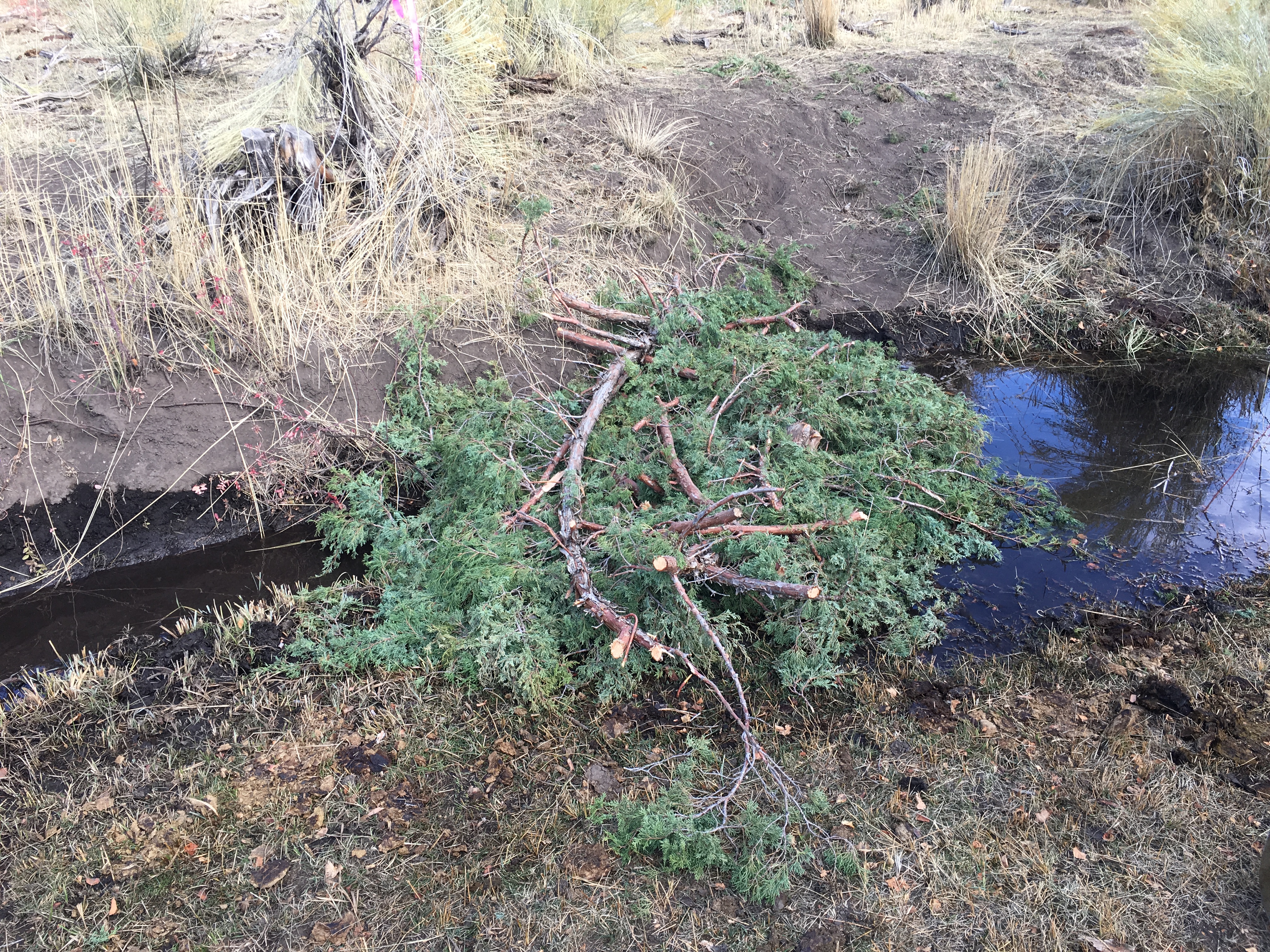
In-stream Habitat Structures: An in-stream structure build from juniper branches, cobble, gravel and mud. Courtesy & Copyright Shauna Leavitt, Photographer
An in-stream structure build from juniper branches, cobble, gravel and mud. Courtesy & Copyright Shauna Leavitt, Photographer
The largest structures are built with an excavator. The machine pulls up large junipers and drops them in the stream so the water can run over, around and through the juniper and its root wads.
Wheaton explains, ”By putting the [Juniper} in the channel we’re making habitat for fish and at the same time raising water tables, which support a whole range of riparian vegetation and wetland vegetation.”
Another structure is the Beaver Dam Analogues (BDAs), which is a simple, cost-effective method of using posts and juniper branches then adding rocks and mud to partially plug up the deliberately leaky dams, designed to be passable to fish.

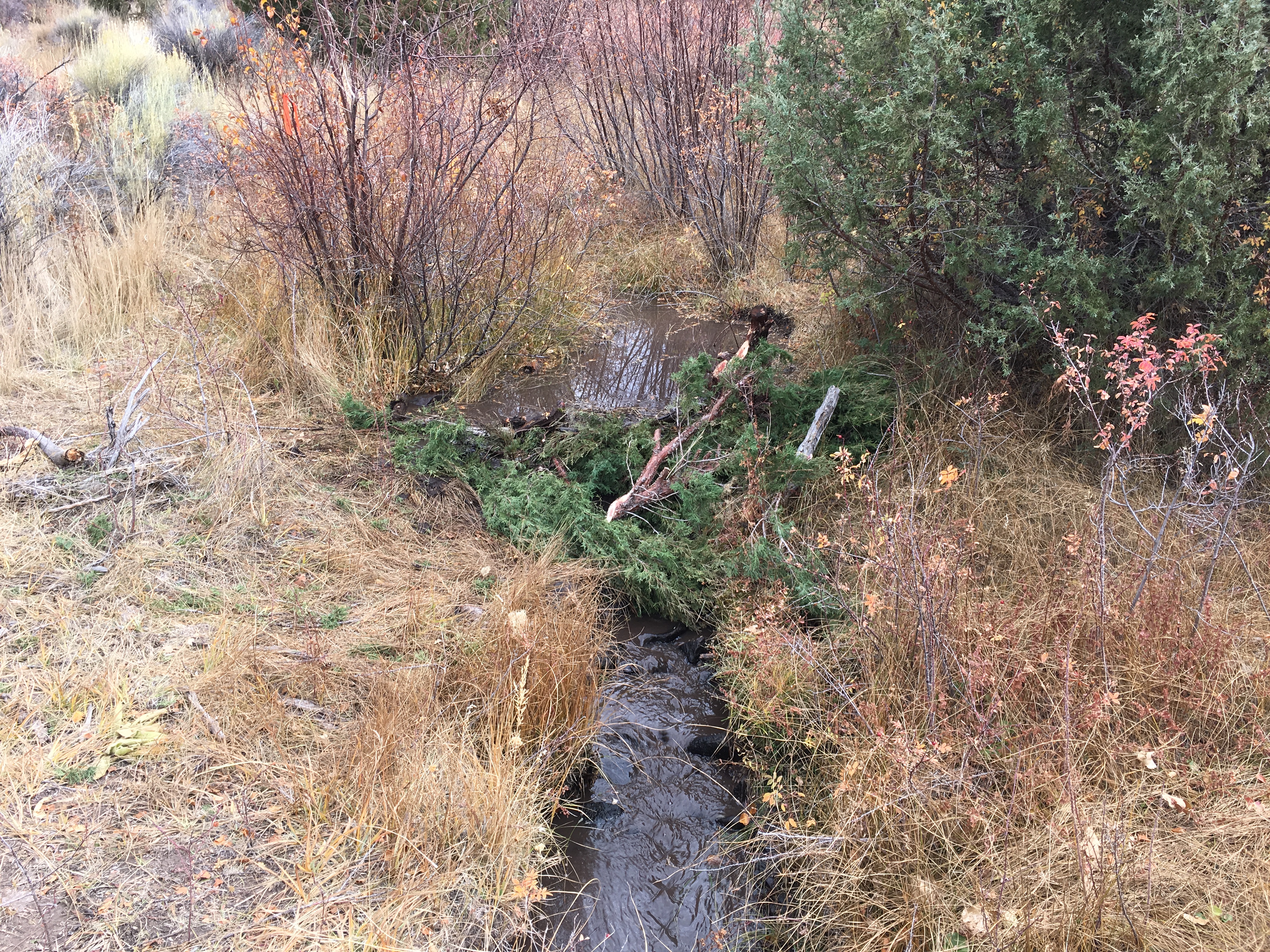
In-stream Habitat Structures: A pool forming behind a newly build in-stream habitat structure. Courtesy & Copyright Shauna Leavitt, Photographer
A pool forming behind a newly build in-stream habitat structure. Courtesy & Copyright Shauna Leavitt, Photographer
Crews see immediate improvements after each structure is built. New pools form, old-channels that haven’t seen water for decades begin to flow parallel to the main channel, and formerly dry floodplains become wet sponges and wetlands.

These wet sponges will release their water later in the season providing additional moisture in dryer times.
Justin Jimenez, Fisheries Riparian Program Manager with Bureau of Land Management explains why these pools are essential, “We’re working to improve the habitat for native fish by increasing the pool frequency and depth. The depth provides thermal cover.” Which is cooler for summer rearing habitat, and warmer for winter survival.
Before this project began, downstream water-rights holders were concerned about how these structures would impact water for irrigation.

In response to their concerns, Gary O’Brien, a Geomorphologist in the Fluvial Habitat Center at USU installed a common measuring device called a V-notch weir at the top and bottom the of the two-mile stretch to measure the discharge of the stream.

According to O’Brien, “once all the structures fill their pools and the system adjusts for infiltration, we expect the top and the bottom weirs to measure a relatively consistent discharge.”
By the addition of a pressure transducer in the pool behind the weirs, O’Brien will have continuous flow of data at every stage.

With these readings the ranchers can be kept up-to-date on the impact the structures are having on the water resources. The agencies have agreed to remove the structures if gaging shows the structures are negatively impacting downstream water users.

Throughout the project, UDWR, BLM and the USFS will be monitoring cutthroat trout response, and USU will be monitoring how the habitat responds and changes through time.

By monitoring the responses, managers and researchers will be able to make more informed decisions about which types and mix of structures can be most effectively used to restore similar streams cheaply across the state.

This is Shauna Leavitt for Wild About Utah.

Credits:
Photos: Courtesy and Copyright Shauna Leavitt
Text: Shauna Leavitt

Sources & Additional Reading

Streams & Rivers Restoration, Restoration Center, NOAA Habitat Conservation, National Marine Fisheries Service,
https://habitat.noaa.gov/restoration/techniques/srrestoration.html

White, Courtney, Thinking Like a Creek, originally published by The Carbon Pilgrim, March 6, 2014,
https://resilience.org/stories/2014-03-06/thinking-like-a-creek/

Stream Restoration, United States Department of Agriculture(USDA), Natural Resources Conservation Service(NRCS),
https://nrcs.usda.gov/wps/portal/nrcs/main/national/water/manage/restoration/

Rubenstein, Marcus, CPESC, Stream Restoration, Purpose Practice and Methods, Southeast Storm Water Association,
https://seswa.org/assets/Services/Annual-Conference/2010/11%20-%20stream%20restoration%20%20methods%20purpose%20and%20practices%20rubenstein.pdf