The Canyon

The Canyon: Grand Canyon of the Colorado Courtesy Pixabay, Public Domain
Grand Canyon of the Colorado
Courtesy Pixabay, Public Domain
Here it’s just called, The Canyon, like there is no other. It’s a place we go to get away from, or get into, it. It’s a place that still lets us trust each other’s word, and have plans on when we should be back. For those waiting on The Canyon, we practice patience and balance with our expectations.

For those of us in The Canyon though, we have entered a different, older world. Out here, once up and away from the road, we find what keeps us out late, what drives us home early, and why we go back.

Free from the paved groan, the threshold is passed, and the stories are all in front of us now. We hike old trails, finding new turns, flowers, and shades. We scout new paths blazed by others, leading to timeless vistas, stands, and grounds. We hear strange ancient birds. We smell new familiar fires. We taste life’s grit.

The repetition is not the kind that gets old, going out and discovering; getting dirty, thirsty, hungry, bit up, rained on, or suddenly freezing mid-stride when you hear a branch snap in the wood aside from you and you like that you still have some of that good instinct left, especially in this age.

The Canyon as we know it though did not begin as it now is, nor will remain. In its long winding life thus far, The Canyon has been sculpted by water, want, and what some call westward expansion.

For some of us, we know the story like it was passed down every winter. For others, we quickly learn that it’s worth the stillness.

Trees now grow on what was once an oceanic graveyard: the floor of a great sea. The very stone and rock that lifts dramatically upwards is an elaborate crosscut in geologic history taking place over millions of years. We find deposits of shells, fish, and other oddities as we ascend The Canyon, travelling through time as if in some wonder of which all museums aspire to be.

On and into this grand mountainous slab came Guinavah, The River. The Canyon’s deep V-shape has been carved from Guinavah flowing water over the forgotten seabed once more, finely eroding a channel through, giving The Canyon it’s great bends; perfect for catching an eddied trout or fleeing a pesky cell signal.

The River has been essential for humans as well for thousands of years. When the valley was settled, this time by Easterners in the mid-19th century, Guinavah became known to these settlers eventually as Logan River.

Historically, these lush environs once donned The Canyon’s many great iconic mammals, but the iconic do not easily survive in the limelight. 100 years after Eastern settlement, the once-abundant bison, bighorn sheep, and brown bears were gone. To mark their absence, we have Ephraim’s grave and the imagination.

This said, there is certainly no general void of wildlife in The Canyon. Seeing another traveler is always a blending of curiosity at what they’re up to, and of gratitude that they’re out here too. From here our paths diverge. Some of us continue the hike. Some of us continue the hunt. Some of us back away slowly and keep an eye on the company.

This is the world of The Canyon, a product of its many stories. For us who see the Canyon but have yet to venture in, there are ways in all seasons to experience it. Try a trail, Fork, or any number of Hollows, and visit one of the last quiet places in any one of the unnamed corners of your 1.6 million acre backyard.

It’s a good place out here. Many go out to experience how The Canyon is now, many go out to experience how it All once was, this is an invitation to go and experience of how It can all still be tomorrow.

I’ll see you at the trailhead.

I’m Patrick Kelly and I’m Wild About Utah.
 
Credits:

Images: Grand Canyon Image Courtesy Pixabay, Public Domain
Audio: Contains audio Courtesy & Copyright Friend Weller, Utah Public Radio
Text:    Patrick Kelly, Director of Education, Stokes Nature Center, https://logannature.org
Included Links: Lyle Bingham, Webmaster, WildAboutUtah.org

Additional Reading

Strand, Holly, A Grand Old River, Wild About Utah, July 9, 2009, https://wildaboututah.org/a-grand-old-river/

Strand, Holly, Last Blank Spots on the Map, Wild About Utah, Oct 29, 2009, https://wildaboututah.org/last-blank-spots-on-the-map/

Grand Canyon National Park, US National Park Service, US Department of the Interior, https://www.nps.gov/grca/index.htm
Twitter: https://twitter.com/GrandCanyonNPS

Ross, John F., The little-known story of how one man turned the Grand Canyon into an icon, AZ Central, Phoenix Newspapers, Inc., Gannett…, https://www.azcentral.com/story/opinion/op-ed/2019/01/27/grand-canyon-national-park-icon-john-wesley-powell-history/2651251002/

Hikes, Colorado Plateau Explorer, Grand Canyon Trust, https://www.grandcanyontrust.org/hikes/


Colorado Plateau

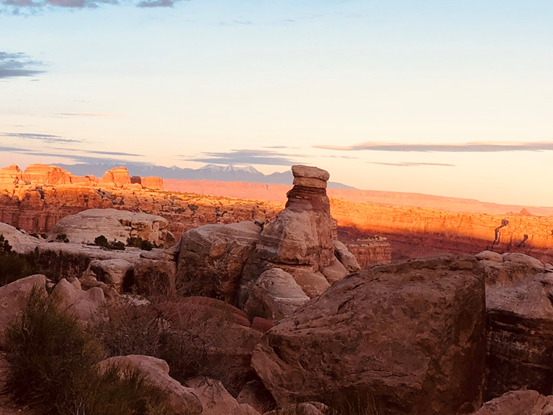
Colorado Plateau Courtesy and Copyright Jack Greene, Photographer
Colorado Plateau
Courtesy and Copyright Jack Greene, Photographer
Rivers and sandstone pretty much define the Colorado Plateau- perhaps my favorite landscape on our lovely planet. These past few weeks I’ve experienced some of its best in Dinosaur NM and Canyonlands NP with friends and students.

Those magnificent rivers- Green, Yampa, Colorado, San Juan- have worked their marvels slicing through thousands of feet of sandstone mixed with a bit of limestone and shale. To stand on a rim and look over a hundred miles of convoluted, tortured land form feasts the convolutions of one’s brain. And the contorted, gnarly juniper trees that adorn the rock seem to reflect those lands that nourish them, some nearing a thousand years of fire and storm.

“The landscape everywhere, away from the river, is of rock – cliffs of rock; plateaus of rock; terraces of rock; crags of rock – ten thousand strangely carved forms.” John Wesley Powell, July, 1869 on his first river trip through our Canyonlands.

I love the names assigned to the rock formations- Weber, Morgan, Cedar Mesa, Carmel, Navajo, Entrada, Kayenta, and so on, each associated with particular strange formations- arches, bridges, towers, turrets, endless. And the improbable snow covered peaks adding welcome contrast from the sun baked sandstone- Lasalles, Abajos, Henry’s- laccolithic bumps in the earth’s crust whose overburden of rock and soil stripped away by millions of years of storm and gravity.

Common Raven (Corvus corax)
Bryce Canyon National Park
Courtesy US National Park Service
And found on Wikipedia

Even more improbable are the myriad life forms that adorn these “waste” lands. Well over a thousand plant and insect species, hundreds of varied birds, mammal and reptiles. One bird in particular is a symbol of this wild, splendid country- they call it raven. Their intelligence and mischievousness are legendary. Last week I was the victim. I left a stack of Canyonlands books setting on a table. After an all day, epic hike I returned to a tattered book missing a few pages, and another small paperback gone. Can these enigmatic rascals read?

Another part of this magical country are the cultural leavings of the ancestral Pueblo and Fremont people. I always take pause when their startling presence appears. How could anyone survive, even a few weeks, let alone a few thousand years in this harsh, unforgiving environment? Only through an intimate relationship with their natural surroundings, especially plants. Who could grow a garden on poor sandstone generated soils with little rain and extreme temperatures? But they did. A wonderfully written book “Wild Plants and Native Peoples of the Four Corners” is a must read. It’s done with cultural sensitivity along with excellent details on preparing them for use- food, fiber, medicine and décor.

And finally, Ed Abbey and Terry Tempest Williams captured the spirit of these great lands in verse- “Desert Solitaire” and “Red, Passion and Patience in the Desert”, must reads.

Jack Greene, Getting wilder about Utah by the minute!

Credits:

Images: Courtesy Jack Greene
Audio: Contains Audio Courtesy and Copyright Friend Weller
Text:     Jack Greene

Sources & Additional Reading:

Abbey, Edward, Desert Solitaire, Touchstone (January 15, 1990), https://www.amazon.com/Desert-Solitaire-Edward-Abbey/dp/0671695886/

Williams, Terry Tempest, Red, Passion and Patience in the Desert, Vintage (October 8, 2002), https://www.amazon.com/Red-Patience-Terry-Tempest-Williams/dp/0375725180/

Stegner, Wallace, Beyond the Hundredth Meridian: John Wesley Powell and the Second Opening of the West, Penguin Books; Reprint edition (March 1, 1992), https://www.amazon.com/Beyond-Hundredth-Meridian-Wesley-Opening/dp/0140159940/

Filmore, Robert, Geological Evolution of the Colorado Plateau of Eastern Utah and Western Colorado, University of Utah Press; 1st edition (March 15, 2011), https://www.amazon.com/Geological-Evolution-Colorado-Plateau-Eastern/dp/1607810042/

Dinosaur National Monument, National Park Service, US Department of the Interior,
https://www.nps.gov/dino/index.htm

Canyonlands National Park, National Park Service, US Department of the Interior,
https://www.nps.gov/cany/index.htm

Composting

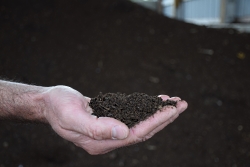
Composting: Compost Product Courtesy NRCS USDA Analia Bertucci, Photographer
Compost Product
Courtesy NRCS USDA
Analia Bertucci, Photographer
Autumn leaves are beginning to fall. Trees drop their leaves because of reductions in temperature, sunlight, and moisture. And if the leaves remained on deciduous trees during winter months, the added weight of snow could break entire branches down. So many people will be outside raking leaves off their lawns.

The simple thing to do is to throw all of it into the trash can. But that causes two problems: First, it is an unnecessary addition to landfills. But it is also a waste of natural products that can be used in gardens and fields. The best thing to do is to compost it to use next Spring and Summer. Of course, you can always purchase organic mulch from garden centers, but making your own is free and builds a sense of accomplishment.

So what is composting and how is it done?

Composting is a method to reduce trash in our landfills by allowing natural processes to help decompose plant materials into useful, natural products. Nature has been doing this since plants were first on Earth. And clever gardeners and farmers use that natural process to make rich, organic soils.

We’ve covered the “what and why” questions.
“How” to compost comes next.

  1. Collect brown, carbon-based materials such as dead leaves, tea and coffee grounds, wood chips, shredded paper, nut shells, etc.
  2. Add green-waste materials such as fruit peels, grass clippings, vegetable scraps, and garden waste to help in nitrogen production.
  3. Add water every week to hasten the breakdown of those materials.
  4. Build your compost pile no larger than 3’ wide, 3’ long, and 3’ high. And place it in a shady spot in your yard with easy access to a hose.
  5. This material can be placed in ready-made bins you can purchase, or you can build a simple square one out of old wood and chicken wire, or use the corner of your fence. I’m using an unoccupied dog kennel.
  6. The mixture is important. You should have 3 parts brown matter for every one part green matter.
  7. To speed up decomposition, mix the materials weekly with a shovel or pitchfork. During cold weather you may see steam coming from the pile. That’s a good sign.
  8. Now the best part. If you compost during warm weather, it can be ready to add to your lawn or garden in 1 to 3 months.

And it’s important that you do NOT add animal products like meats, dairy, pet waste and eggs. These are the things that will attract flies and create bad odors.

So, avoid adding to our landfills. Build a compost pile and enjoy free supplements to produce beautiful gardens, flower beds, and lawns.

This is Ron Hellstern, and I am Wild About Utah.
 
Credits:

Images: Courtesy
Text: Ron Hellstern, Cache Valley Wildlife Association

Additional Reading

Liberatore, Andrea, Natures Recyclers, Wild About Utah, November 11, 2011, https://wildaboututah.org/natures-recyclers/

Liberatore, Andrea, Earthworms, Wild About Utah, May 9, 2011, https://wildaboututah.org/earthworms/

Farrell-Poe, Kitt, Koenig, Rich, Backyard Composting in Utah, https://digitalcommons.usu.edu/cgi/viewcontent.cgi?referer=&httpsredir=1&article=1489&context=extension_curall (Reviewed October 2011 by Michael Johnson)

Basic Composting, USU Extension, https://extension.usu.edu/agwastemanagement/ou-files/pdfs/FSBasicsComposting.pdf

Young, Janice, Composting 101, Master Gardener Program, Thanksgiving Point,
https://digitalcommons.usu.edu/cgi/viewcontent.cgi?referer=&httpsredir=1&article=2425&context=extension_histall

Compost Fundamentals, WhatCom County Composting, Washington State University, WhatCom County Extension, https://extension.usu.edu/agwastemanagement/ou-files/pdfs/Compost_Fundamentals.pdf

Wildfires

Wildfires: Smoke roils from 2012 wildfire in Utah. Photo by U.S. Forest Service.
Smoke roils from 2012 wildfire in Utah. Photo by U.S. Forest Service.

Wildfires hit record highs this year in the Western U.S. There can be arguments blaming Climate Change or Forest Management. Were they caused by human carelessness or natural causes such as lightning? Take your pick. But the results were tragic.

Through August this year, Utah has had nearly 1,300 fires which burned nearly a quarter million acres and cost $100 million dollars.

Nationally, 90% of wildfires are human-caused from unattended campfires, discarded cigarettes, mismanaged debris fires and planned acts of arson. And the cost of those fires exceeded $5 billion dollars over the last 10 years. From January to August in 2018 there were nearly 39,000 different fires that burned over 5 million acres.

Much has been said about those tragic statistics that affect the loss of human life, the destruction of developed properties, the discomforts of evacuations, and the enormous costs and dangers of fighting fires as the horrible results of these runaway infernos. But, what about next year? Will the drought continue? Will the climate continue to set record temperatures?

Burned Stumps & Ashes Courtesy & Copyright Friend Weller, Photographer
Burned Stumps & Ashes
Courtesy & Copyright Friend Weller, Photographer

One of the consequences that has not been discussed much is the loss of millions of trees. What can we expect when living trees are turned into burned stumps and ashes?

The major greenhouse gas in our atmosphere is Carbon Dioxide. It is called a green house gas because it warms the earth’s temperature. Carbon dioxide is produced by the burning of fossil fuels or trees, chemical reactions such as the manufacture of cement, and the exhaling of animals. It is removed from the atmosphere when it is absorbed by land-plants and the ocean as part of the biological carbon cycle. The role the ocean plays in the carbon cycle is a topic for another program.

It is the loss of trees that we will consider now.
I will mention only a few of the many benefits trees provide.

You may recall from biology class that the trees take-in carbon dioxide and release oxygen. Forest fires require oxygen to burn, and we require oxygen to live. This year, we have already lost 5 million acres of oxygen production.

There are trees, such as the Lodgepole Pine, which have serotinous cones which release their seeds during the intense heat of forest fires. But it will take 40 years for those seeds to
grow into mature trees.

Another consideration is the loss of trees along hillsides and mountain slopes. When rain or snow hits those barren areas there can be massive soil erosion. This not only pollutes the streams and rivers below, but eliminates the top layer of soil where new seeds would best survive.

Besides the loss of human homes, there is the loss of wildlife habitat to consider. IF animals were able to escape massive fires, they must then find suitable habitat, which may encroach on human developments.

Then there is the loss of shade. Barren land will be more susceptible to collecting heat from the sun’s rays, which then will cause more heating of the atmosphere.

So, what can we do about this? First, be extremely careful with fire; Second, plant trees in your communities; Third, contact your local Ranger District or U.S. Forest Service to see if you can volunteer in tree planting projects.

This is Ron Hellstern, and I am Wild About Utah.
 
Credits:

Images: Courtesy USDA Forest Service,
https://www.srs.fs.usda.gov/compass/2013/05/28/climate-change-and-wildfire/
Audio: Contains audio courtesy
Freesound.org, Sound provided by Dynamicell
https://freesound.org/people/Dynamicell/sounds/17548/
Text: Ron Hellstern, Cache Valley Wildlife Association

Job & Volunteering

USDA Forest Service Offices:
Region 4: Intermountain Region
Federal Building
324 25th Street
Ogden, UT 84401
801-625-5605
[Job & Volunteering] Connections, https://www.fs.usda.gov/main/r4/jobs
Volunteer Opportunities, https://www.fs.usda.gov/main/r4/jobs/volunteer

Volunteer, TreeUtah, https://treeutah.org/volunteer/

Outka-Perkins, Lisa, Welcome to the Forest Service: A Guide for Volunteers, USDA Forest Service, Feb 2009,
https://www.fs.fed.us/t-d/pubs/pdfpubs/pdf09672813/pdf09672813dpi72.pdf

Additional Reading

Boling, Josh, Fire, Wild About Utah, August 13, 2018, https://wildaboututah.org/fire/

Strand, Holly, Investigating the Causes of Wildfires, Wild About Utah, Aug 15, 2013, https://wildaboututah.org/investigating-the-causes-of-wildfires/

Larese-Casanova, Mark, Wildfires in Utah, Wild About Utah, July 26, 2012, https://wildaboututah.org/wildfires-in-utah/

Preparing Home and Property for Wildlife, A Proactive Approach, Utah Living With Fire, Salt Lake City, UT, https://www.utahlivingwithfire.com/

Live Worldwide Network for Lightning and Thunderstorms in Real Time, Blitzortung, https://en.blitzortung.org/live_lightning_maps.php?map=30