Lichens

Click for a larger view of Lichens, Courtesy and copyright 2013 Andrea Liberatore, Photographer
Boulder covered in a
variety of lichen species
Copyright 2013
Andrea Liberatore, Photographer

Click for a larger view of Rosette Lichen, Courtesy and copyright 2013 Andrea Liberatore, PhotographerRosette Lichen
Physcia dubia
Lives in both Antarctica
and the Mojave Desert
Copyright 2013
Andrea Liberatore, Photographer

Click for a larger view of Rim Lichen, Courtesy and copyright 2013 Andrea Liberatore, PhotographerRim Lichen
Lecanora muralis
Has anti-cancer and
anti-microbial properties
Copyright 2013
Andrea Liberatore, Photographer
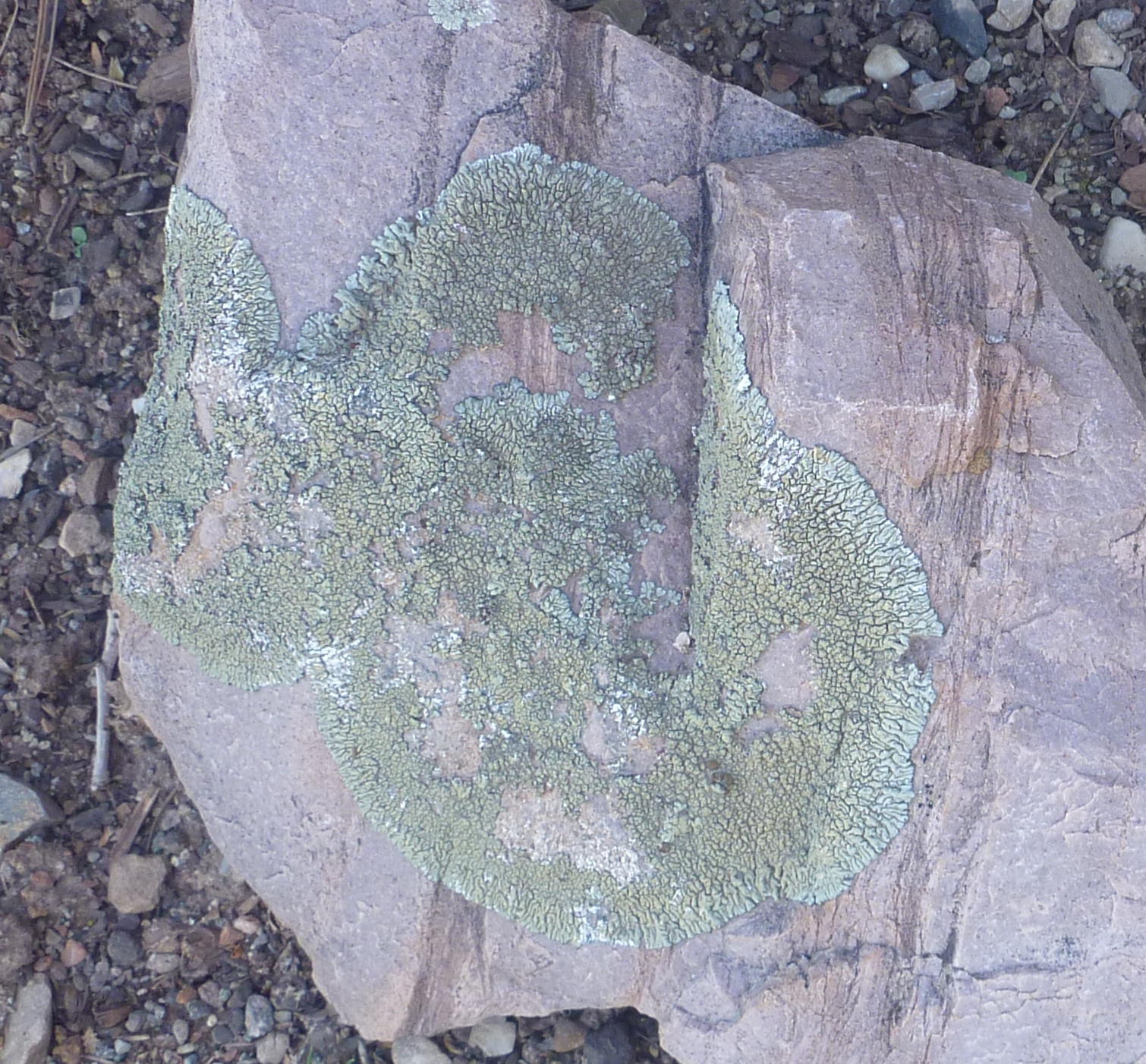
Click for a larger view of Lichens, Courtesy and copyright 2013 Andrea Liberatore, PhotographerGarovagis Rim Lichen
Leconara garovagii
Used in perfume & sunscreen
Copyright 2013
Andrea Liberatore, Photographer

This spring I visited Red Butte Gardens in Salt Lake City for the first time. My favorite part was a small and very non-descript garden, tucked alongside a walkway and devoted to an organism that isn’t a plant at all, but instead a very under-appreciated genera of life – the lichen.

Lichens are those colorful crusts found growing on rocks and trees, and while sometimes plant-like in appearance, they are not plants. Lichens have no leaves, stems, roots, or vascular systems. Even more strange, lichens are not a single organism, but instead a partnership between two organisms: a fungus and an algae or cyanobacteria. Because the fungus is generally the dominant partner, lichens are classified as members of the Fungus kingdom.

The partnership exhibited by these two organisms is an example of mutualism – a relationship where both parties benefit in some way through their interaction. In this case, the fungus provides a safe and secure home for the alga or cyanobacteria, which in return photosynthesizes and provides the fungus with nutrients. Cyanobacteria and algae are typically found in water and are prone to drying when exposed to sun and wind. The fungal partner provides shade and protection from desiccation by sheltering the algae within its body. As a result, lichens are incredibly drought-resistant and can be found in a wide variety of habitats including some of the most extreme environments Earth has to offer. In fact the Rosette Lichen or Physica dubia grows in both Antarctica and the Mojave Desert!

Lichens are not just interesting from a biological perspective, but also a chemical one. Lots of lichens create and exude a suite of chemicals, the roles of which aren’t entirely known. Some are thought make the lichen distasteful to predators, while others may help block harmful UV rays and increase membrane permeability to facilitate the movement of nutrients, water, and cellular byproducts between algae and fungi.

These chemicals have also attracted the attention of scientists, as some exhibit antimicrobial, antiviral, anti-tumor, and insecticidal properties. Many are being analyzed and tested for a variety of medicinal and household uses and may soon become a key ingredient in a physician’s arsenal. Already, these organisms are utilized by humans in a number of different ways, and have been for hundreds of years.

In some native cultures around the globe, lichens are a part of the traditional diet for both people and livestock. However, most lichens have little nutritional value, are bitter tasting, and some can be toxic. Lichen extracts are also used as natural dyes for wool and cloth with colors ranging from browns and purples, to yellows and oranges. Other uses include the manufacture of perfume, cosmetics and sunscreen, a substitute for hops in brewing beer, and as a key ingredient in litmus paper.

Lichens are also sensitive to air pollution, and for that reason don’t typically grow too close to human habitation. In fact, lichens absorb pollutants into their tissues and for that reason can play an important role as an indicator species for pollution problems. As air pollution becomes more widespread, lichen species could be in danger of being lost. And because we have only scratched the surface of what these amazing organisms can do, who knows what future medicine could be lost along with it.

I could go on, as I have only scratched the surface of what these organisms can do. And in the coming years, I think we’ll hear of even more lichen-based breakthroughs in science and medicine. The next time you pass a colorful, lichen-covered rock, take a closer look at these incredible organisms and pause for a moment to wonder about the mysteries, and possible answers, that lie within.

For the Stokes Nature Center and Wild About Utah, this is Andrea Liberatore.

Credits:

Photos: Courtesy & © Andrea Liberatore
Text:    Andrea Liberatore, Stokes Nature Center, logannature.org

Additional Reading:

Ivins, Robert Fogel (1998) Lichens are Fungi! Utah State University Herbarium. Available online at: https://herbarium.usu.edu/fungi/funfacts/lichens.htm

Center for Ecological Sciences, Indian Institute of Science. Lichen Chemistry. Sahyadri E-news. Issue 34. Formerly available online at: https://wgbis.ces.iisc.ernet.in/biodiversity/sahyadri_enews/newsletter/issue34/lichens_chemistry/lichen_chemistry.pdf See https://www.researchgate.net/publication/257213745_Sahyadri_Shilapushpa_Lichen_Chemistry [Link updated Dec 1, 2023]

US Forest Service (2013) Celebrating Wildflowers: Lichens. Available online at: https://www.fs.fed.us/wildflowers/interesting/lichens/


Cats vs. Wildlife

Rooster, the Stokes Nature Center Housecat
Felis silvestris catus
Copyright 2013
Andrea Liberatore, Photographer

This past winter we took on a new staff member at the Stokes Nature Center. In exchange for room and board, he lives in our building and is on call 24 hours a day. He’s arguably our most popular employee, but I’m not jealous. Rooster is, after all, cuter than me. He’s also a cat.

As one of the only buildings for miles around, we attract a lot of mice. Taking on a cat seemed like a fun and ecological answer to a frustrating long-term problem. Obviously, this isn’t a new idea. Cats and humans have been coexisting for thousands of years – probably since the time our ancestors were developing agriculturally-based societies in the Middle East 12,000 years ago. With agriculture came grain storage, and with grain storage came mice. Cats quickly became an important part of our food security system.

As humans spread around the globe, our newly domesticated feline friends came along too. But while most of us keep cats for reasons other than their hunting prowess these days, they have retained the skills that attracted us to them in the first place. Cats are predators. Even when they’re fed at home, and have no need for additional calories, their hunting instincts don’t dissipate. A recent study estimated that cats in the US alone kill around 2.4 billion birds and 12.3 billion small mammals every year. These statistics make cats the number one anthropogenic threat to wildlife.

Utah’s wildlife evolved in an environment void of small feline predators, and their behaviors reflect this. Ground-nesting birds such as quail, nightjars, and killdeer are especially prone to predation. Domestic cats are a non-native species against which many of our birds and mammals have few defenses.

So what can you do to help? The most straightforward answer is to keep your cat indoors. If however, you insist he goes out, there are still a few things you can do to keep neighborhood animals a little safer. Attaching a bell to your cat’s collar can warn wildlife that she’s around. If your yard is a haven for birds and mammals, provide dense vegetation for them to take refuge in. And of course, spay and neuter cats to avoid bringing any more unwanted felines into the world. There are already more stray and feral cats in the US than there are loving homes for them. Controlling cat populations can save the lives of millions of birds and small mammals.

If the welfare of birds and mammals isn’t enough to motivate you, consider that research shows your cat is safer, and will live longer, if kept indoors. An innovative study by the University of Georgia – dubbed ‘Kitty Cams’ – can give you a sense of what your cat might be up to during the day. Small cameras attached to the collars of housecats record not only wildlife kills, but also fights with neighborhood dogs and opossums, and trips into storm sewers, across busy roads, and into the undercarriages of parked cars.

So far, Rooster is earning his keep. We have noticed a wonderful decrease in nibbled-on file folders and tiny footprints in desktop dust. But we don’t want our outdoor critters to decrease in numbers, and so despite his (sometimes very vocal) desires, he will remain an indoor feline. For the sake of all our Utah wildlife, I hope you consider doing the same.

For a photo of Rooster, a link to the Kitty Cams site, and more suggestions on keeping wildlife safe from cats, visit our website at www.wildaboututah.org .

For the Stokes Nature Center and Wild About Utah, this is Andrea Liberatore.

Credits:

Photos: Courtesy & © Andrea Liberatore
Text:    Andrea Liberatore, Stokes Nature Center, logannature.org

Additional Reading:

Loss, S. R., Will, T., Marra, P. P. (2013) The Impact of Free-ranging Domestic Cats on Wildlife of the United States. Nature Communications 4, Article number: 1396 Accessible online at: https://www.nature.com/ncomms/journal/v4/n1/abs/ncomms2380.html

Angier, Natalie (2013) That Cuddly Kitty is Deadlier Than You Think. New York Times. Published January 29, 2013. Accessible online at: https://www.nytimes.com/2013/01/30/science/that-cuddly-kitty-of-yours-is-a-killer.html

The National Geographic & University of Georgia Kitty Cams (Crittercam) Project: A window into the world of free-roaming cats. Accessible online at: https://www.kittycams.uga.edu/

National Audubon Society. (2013) Reducing Threats from Cats. Available online at: https://web4.audubon.org/bird/at_home/safecats.html

Zax, David (2007) A Brief History of House Cats. Smithsonian Institution. Accessible online at: https://www.smithsonianmag.com/history-archaeology/brief_cats.html

Earthworms

Click for a larger view of an earthworm, Courtesy and copyright 2013 Andrea Liberatore, Photographer
Earthworm (Nightcrawler)
Lumbricus terrestris
Copyright 2013
Andrea Liberatore, Photographer
 

Click for a larger view of a worm, Courtesy and copyright 2013 Andrea Liberatore, Photographer3Red Garbage Eating Earthworm
Eisenia foetida
Copyright 2013
Andrea Liberatore, Photographer


Click for a larger view of a fossil, Courtesy FWS, Cara Schildtknecht PhotographerA child shows others the worm
she found while helping plant the
pollinator garden at the FWS National
Conservation Training Center Garden
Courtesy FWS
Cara Schildtknecht, Photographer


As we enter into May, the familiar old rhyme of ‘April showers bring May flowers’ is proving to be true. But April showers always seem to bring something else out worth noticing – earthworms! A walk in the neighborhood the morning after a spring rainstorm reveals pink, wiggling – or sometimes not wiggling – worms on the sidewalks, streets, and lawns. This behavior obviously makes the robins happy, but I can’t imagine it’s all that good for the worms themselves. So what’s going on?

While worms need to be moist at all times, it turns out that they can’t handle too much water. Worms have no lungs, and instead breathe directly through their skin. A little bit of moisture facilitates the exchange of air into and out of their bodies, but too much moisture inhibits this process, essentially suffocating them. Another hypothesis suggests that worms might take advantage of the moist environment to travel. When the air is dry, worms are restricted to underground movement, which takes considerable time and effort. After a spring rain, however, they can travel across the surface, moving faster than they otherwise would.

Not all earthworms are alike – there are upwards of 7,000 known species and counting. They can range in size from less than an inch to over six feet long, and are distinguished by size, body shape, color, and many other minute differences. For simplicity’s sake, worms can be divided into three broad categories based on where they are found in the ground. The first group – called the Epigenic species – are found very close to the surface of the soil, typically in the leaflitter layer. These are the worms used for vermicomposting because they rapidly break down large volumes of organic matter. The second group – the Endogenic species – are found in the upper soil levels and do not have permanent burrows. They are constantly moving, eating all the while and filling up their burrows with their waste – called worm castings – as they go. Lastly, there are the deep burrowing Anecic species, which contains the familiar nightcrawler. Anecic species create more permanent burrow systems that can be quite extensive and stretch several feet deep. They frequently visit the soil surface to locate and pull organic matter down below, leaving little piles of castings at the burrow entrance.

Contrary to popular belief, earthworms don’t in fact eat dirt, or even dead and decaying matter. Instead, they feed on the bacteria and fungi that live on the dead and decaying matter, breaking that stuff into smaller pieces in the process. This, of course, greatly aids decomposition, making new nutrients available to plants. In fact, worms are of great assistance to the average gardener. As they move through the soil in search of food, they increase the porosity of the ground which allows rainwater to seep in and stay there longer. Worms are constantly on the move – carrying nutrients from the surface down into the lower layers of the soil and vice versa as they go, all the while providing channels for plant roots to easily follow.

Any search for earthworm information uncovers a litany of amazing facts. Earthworms have five hearts. They are hermaphrodites – meaning they have both male and female characteristics. In one acre of productive land, there can be as many as one million earthworms. And perhaps strangest of all – the abundant earthworm is not native to any part of North America once covered by glaciers. But there is one common wives’ tale that is too good to be true. If you cut an earthworm in half, it will not create two worms. While worms can regrow parts of their bodies, a headless worm segment cannot grow a new head. If the damage is not too extensive, however, the tailless worm can grow a new tail. So be kind to the worms wiggling out onto your sidewalk after a hard rain. If you’re feeling extra generous, you might even relocate a few to a stretch of lawn or garden – perhaps saving them from the watchful eye of the ever-present robins.

For pictures of worms and a lesson plan on making mini worm habitats, visit www.wildaboututah.org.

For the Stokes Nature Center and Wild About Utah, this is Andrea Liberatore.

Credits:

Photos: Courtesy & © Andrea Liberatore
Text:    Andrea Liberatore, Stokes Nature Center, logannature.org


Additional Reading:

Appelhof, Mary (1997) Worms Eat My Garbage. Flower Press. Kalamazoo, MI https://www.amazon.com/Worms-Eat-My-Garbage-Composting/dp/0977804518

Edwards, Clive A. Soil Biology. Chapter 8: Earthworms. A publication of the United States Department of Agriculture. Available online at: https://soils.usda.gov/sqi/concepts/soil_biology/earthworms.html

Ransford, Matt (2008) Science of the Everyday: Why Earthworms Surface. Popular Science. Available online at: https://www.popsci.com/scitech/article/2008-03/science-everyday-why-earthworms-surface

Utah LessonPlans (2007) Making a Mini Worm Habitat. Utah State Office of Education. Available online at: https://www.uen.org/Lessonplan/preview.cgi?LPid=18886

Sullivan, Kaitlin, Invasive ‘Jumping’ Worms Are Now Tearing Through Midwestern Forests, Audubon Magazine, January 2, 2020, https://www.audubon.org/news/invasive-jumping-worms-are-now-tearing-through-midwestern-forests

Weston, Phoebe, ‘A poor man’s rainforest’: why we need to stop treating soil like dirt, The Guardian, April 16, 2021, https://www.theguardian.com/environment/2021/apr/16/poor-mans-rainforest-stop-treating-soil-like-dirt-aoe

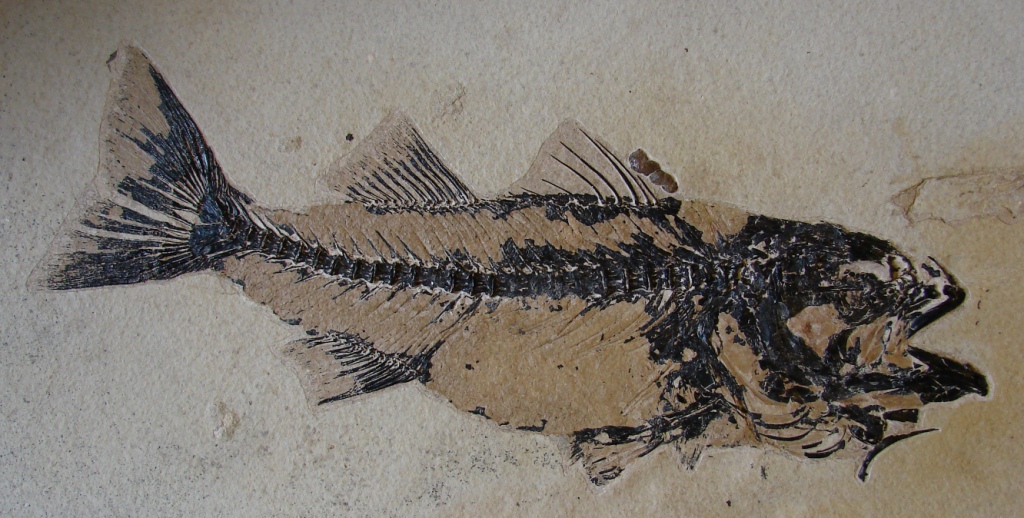
Fossil Formation

Fossilized fish
Mioplosus labracoides
Copyright 2013 Stokes Nature Center
Andrea Liberatore, Photographer

Fossilized fish
Copyright 2013 Stokes Nature Center
Andrea Liberatore, Photographer

Horn Corals from Logan Canyon
Copyright 2013 Stokes Nature Center
Andrea Liberatore, Photographer

Fossilized leaf
Copyright 2013 Stokes Nature Center
Andrea Liberatore, Photographer

Fossilized shells
Copyright 2013 Stokes Nature Center
Andrea Liberatore, Photographer

The most popular school program that the Stokes Nature Center offers is a geology lesson for second grade. I’m not sure what happens between second grade and adulthood to make our general perception of geology go from exciting to boring, but you would be amazed at how excited second graders get over rocks, and especially, over fossils.

Fossils are really quite rare – a very specific set of conditions have to be met in order to create one. Most living things decompose fairly rapidly upon death, leaving no trace of their existence behind. In order to create a fossil, this process of decomposition needs to be halted fairly rapidly, which typically means that the body is quickly covered by some kind of sediment – like sand, or soil or mud. For this reason, most fossils are found embedded in sedimentary rock. If pressure and moisture levels are just right, over the course of millions of years the organism’s molecules will slowly be replaced by minerals from the surrounding sediments – eventually turning bone into stone.

Only somewhere around one in a billion bones will make it through this process. From there the fossil has to remain intact and identifiable through eons of tectonic plate movement, earthquakes, and mountain uplift. Then, in order to be found it has to be located near enough to the earth’s surface, and in such a place where a human might come across it. Some geologists estimate that only 1 in 10,000 species that have ever lived have made it into the known fossil record, which makes me wonder what discoveries still await us.

Fortunately for us, prehistoric Utah was a place where fossilization happened with some regularity, as evidenced by places like Dinosaur National Monument and the Escalante Petrified Forest. Did you know that Utah has a state fossil? That distinction goes to the allosaurus, a predatory dinosaur that thrived during the Late Jurassic period. Numerous skeletons found in east-central Utah range in size from 10 – 40 feet in length, meaning this fearsome creature may have rivaled it’s more famous cousin Tyrannosaurus Rex for top predator status.

With such a rich fossil history, it’s not out of the question that you might stumble onto something truly amazing during a routine hike. Can you keep your find? Well, that depends on two things: the type of fossil, and whose land it was found on. On public lands in Utah, fossils of vertebrates cannot be collected, while fossils of invertebrates and plants can be. Private land owners have full rights to the fossils found on their property. With all fossils, it’s a great idea to report your find to the US Geological Survey so that your discovery can be documented for public or scientific research, display or education.

Fossil creation is an incredible phenomenon that has allowed us to glimpse the earth’s history in ways that would otherwise be completely hidden. Thanks to fossils, we can envision a prehistoric landscape filled with giant ferns, enormous dragonflies, long-necked allosauruses, and flying pterodactyls. Without the evidence in the fossil record, I doubt that even the most imaginative person among us could have envisioned such an amazing array of life.

For the Stokes Nature Center and Wild About Utah, this is Andrea Liberatore.

Credits:

Photos: Courtesy & © Stokes Nature Center, logannature.org
Text:    Andrea Liberatore, Stokes Nature Center, logannature.org

Additional Reading:

State of Utah, Utah Geological Survey, Dinosaurs & Fossils (2011) https://geology.utah.gov/utahgeo/dinofossil/index.htm

McCalla, Carole and Eldredge, Sandy (2009) What should you do if you find a fossil? Utah Geological Survey. Accessible online at: https://geology.utah.gov/surveynotes/gladasked
/gladfossil_collecting.htm

Trefil, James (1996) 101 Things You Don’t Know About Science and Nobody Else Does Either. Houghton Mifflin Company: New York, NY, https://www.amazon.com/Things-Dont-About-Science-Either/dp/0395877407

Bryson, Bill (2003) A Short History of Nearly Everything. Broadway Books. New York, NY, https://www.amazon.com/Short-History-Nearly-Everything-Illustrated/dp/0307885151