Nature’s Recyclers

Courtesy and copyright Andrea Liberatore, Stokes Nature Center, https://logannature.org/
Fungi Decomposing Fall
Leaves Outside the
Stokes Nature Center
Courtesy & © 2011 Andrea Liberatore
Stokes Nature Center
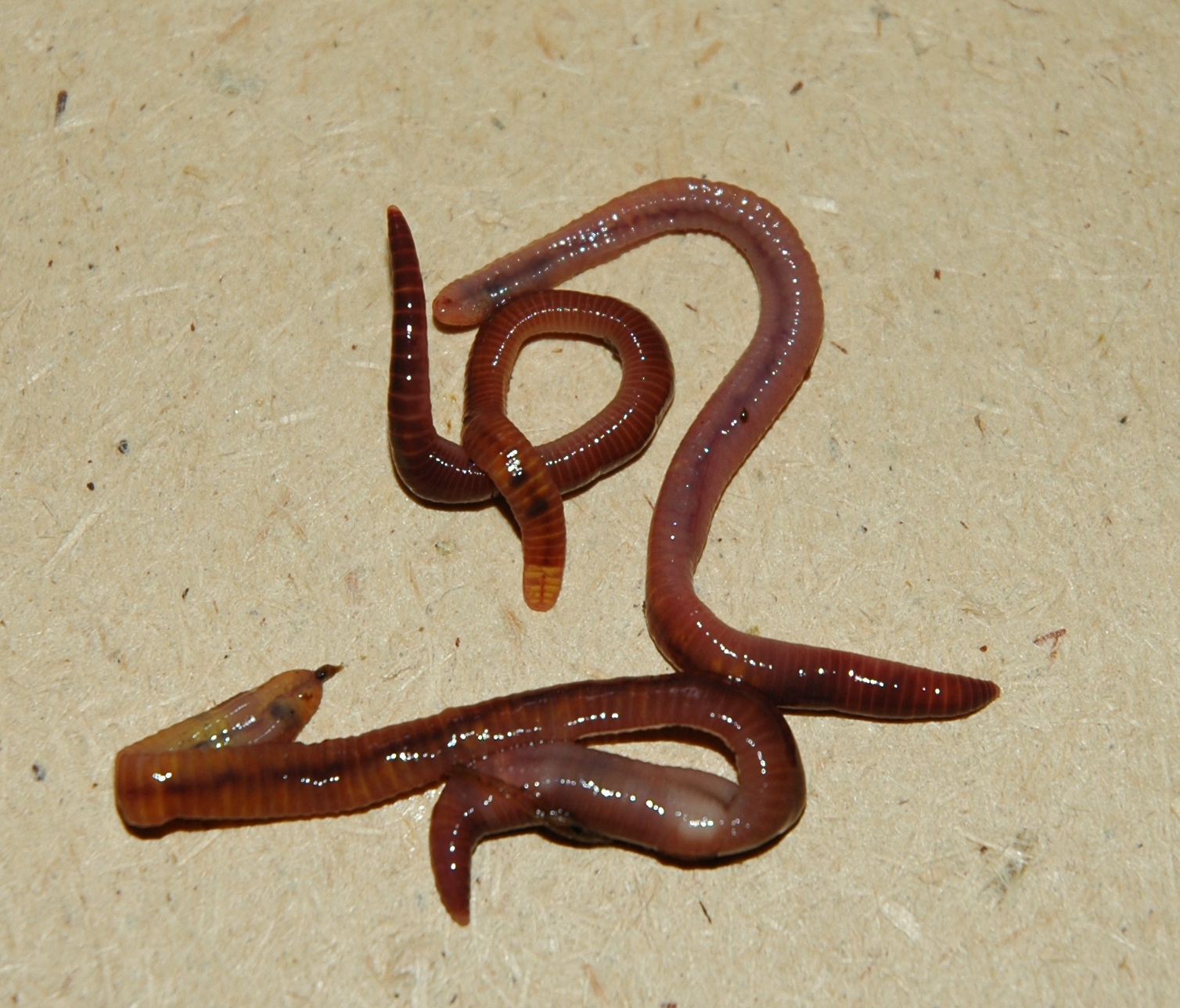
 

Courtesy and copyright Andrea Liberatore, Stokes Nature Center, https://logannature.org/Redworms Eisenia fetida
from Stokes Nature Center’s
vermicomposting system
Courtesy & © 2011 Andrea Liberatore
Stokes Nature Center

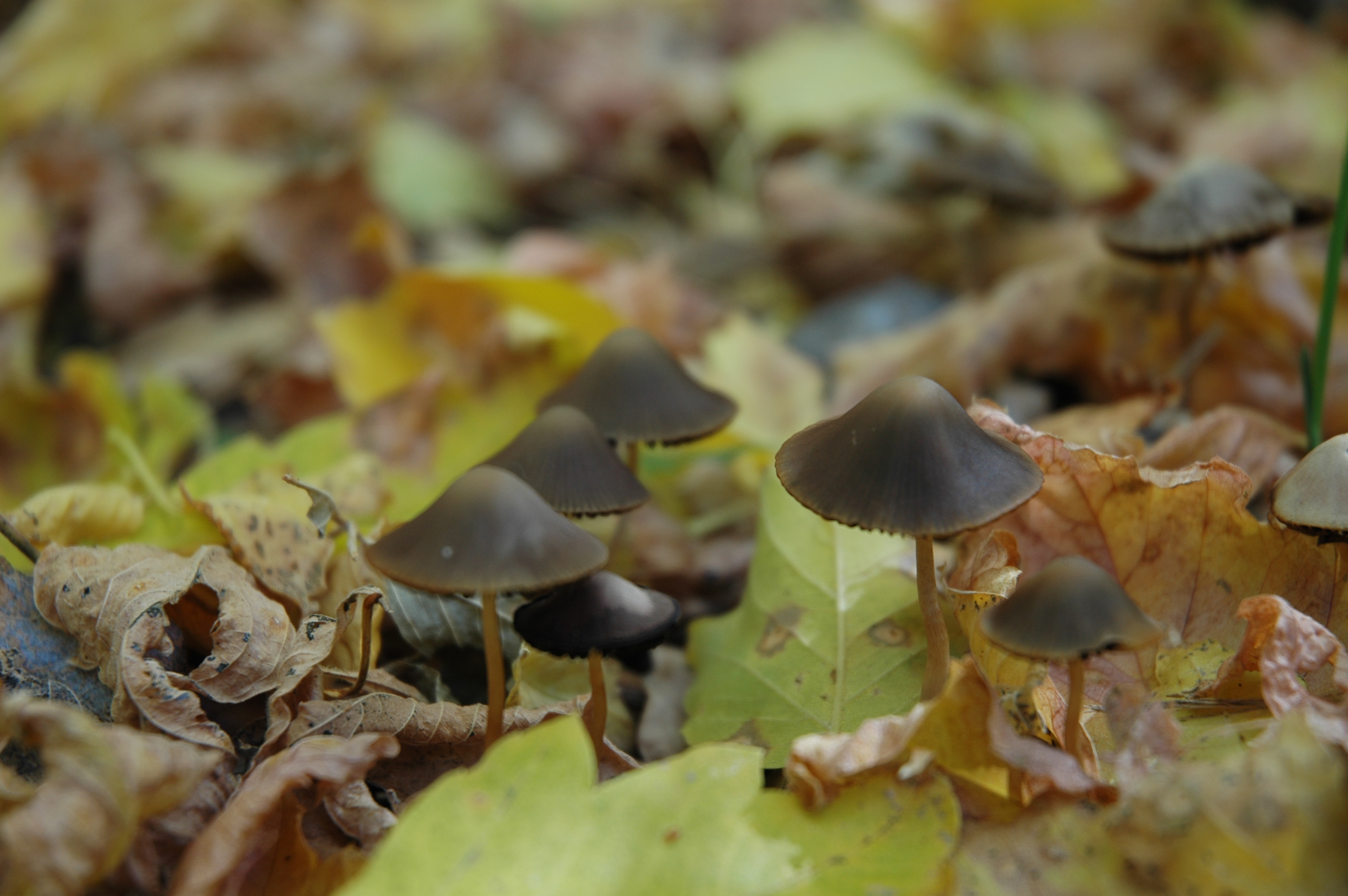
On November 15th, our nation celebrates America Recycles Day. While the day itself tends to focus on human recycling activity, I thought we should also give a nod to nature’s recyclers. Worms, maggots, fungi, beetles, and bacteria – it sounds like a list of leftover Halloween horrors. But in reality, we should be more afraid of what our world would look like without these creepy-crawlies, for these are nature’s recyclers. Scientists call these organisms saprophytes, and as important as their role in life is, they are more likely to evoke a shudder than any feeling of gratitude.

What decomposers actually do is break dead things down into smaller and smaller pieces, until all that is left are the basic molecular components that make up all living things such as nitrogen, phosphorous, carbon, and potassium. Once broken down, this material is then free to be taken up again by plants and animals that use them to live and grow. This cycle of nutrients is vital to life on Earth, and our saprophytic friends make it all possible.

While decomposition would occur even without the help of the decomposers, it would take much, much longer. In some landfills, newspapers have been unearthed that are more than 20 years old, and still quite readable. This is because landfills often create anaerobic environments, where oxygen-loving insects, fungi, and bacteria cannot live and therefore cannot aid decomposition. If without decomposers, a newspaper can last 20 years, what would happen to much larger and hardier items such as tree trunks and roadkill? I shudder to think about it.

Did you know that the U.S. throws more than 33 million tons of food waste into landfills each year? This organic material goes to waste there – taking up valuable space and taking longer than normal break down. So this year, celebrate America Recycles Day by employing some of nature’s recyclers in your yard. Consider starting a compost pile where your fall leaves and food scraps can get broken down into nutrient-rich all-natural fertilizer for next year’s garden.

For composting tips and more information about nature’s recyclers, visit Wild About Utah online at www.wildaboututah.org. Thank you to the Rocky Mountain Power Foundation for the research and development of this Wild About Utah topic. For the Stokes Nature Center and Wild About Utah, this is Andrea Liberatore.

For the Stokes Nature Center and Wild About Utah, this is Andrea Liberatore.

Credits:

Photos: Courtesy & © 2011 Andrea Liberatore, https://logannature.org/
Text:    Andrea Liberatore, Stokes Nature Center, logannature.org

Composting Tips & Information:

Farrell-Poe, K. and Koenig, R. (2010) Backyard Composting in Utah. Utah State University Cooperative Extension. https://extension.usu.edu/files/publications/factsheet/HG-Compost-01.pdf

U.S. Environmental Protection Agency: Composting. https://www.epa.gov/epawaste/conserve/rrr/composting/index.htm

Additional Reading:

Fogel, R. (2002) Waste Not, Want Not: Fungi as Decomposers. Utah State University Herbarium. https://utahpests.usu.edu/ipm/ornamental-pest-guide/diseases/wood-decay-fungi

Hoff, M. (2009) Young Naturalists: Nature’s Recyclers. Minnesota Conservation Volunteer Newsletter. July-August 2009. https://files.dnr.state.mn.us/publications/volunteer/young_naturalists/natures_recyclers/natures_recyclers.pdf

U.S. Environmental Protection Agency (2011) Basic Information About Food Waste. https://www.epa.gov/osw/conserve/materials/organics/food/fd-basic.htm

Turkey Vultures

Swainsons Thrush
Turkey Vulture in flight
Cathartes aura
Courtesy Utah Division of Wildlife Resources
Scott Root, Photographer
Licensed under CCL

Turkey Vulture Kettle above LoganTurkey Vulture Kettle above Logan
Cathartes aura
Courtesy and Copyright
Andrea Liberatore, Photographer

Turkey Vulture Kettle above LoganTurkey Vulture Kettle above Logan
Cathartes aura
Courtesy and Copyright
Andrea Liberatore, Photographer

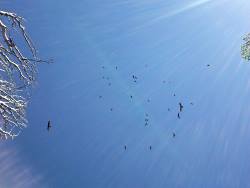
On certain days in the spring and fall, the sky above my neighborhood looks like a scene from Alfred Hitchcock’s ‘The Birds’. As many as 60 large black birds swarm the sky, circling above the rooftops. On the busiest of days, people will stop their cars in the middle of the road to gawk at the sight. Some give a visible shiver when told that the birds are turkey vultures. But we have nothing to fear from these birds – in fact they should be embraced for the absolutely vital role they play in our environment.

There are lots of myths surrounding vultures, which in turn creates a misunderstanding about them. So let’s set the record straight on a few things. Vultures circle for two main reasons, neither of which involves waiting for a sick or wounded animal to die. The first reason is to take advantage of rising columns of air, called thermals, which generally occur in the mornings as the sun warms the air closest to the earth. Vultures are soaring birds and flapping their 6-foot wingspans takes a lot of effort, so they rarely do it. In fact these birds can fly for hours without a single flap. Circling within a thermal helps them travel higher and farther on much less energy.
The second reason vultures circle is to hone in on a food source. Turkey vultures are one of the few birds that have a highly developed sense of smell. Working together with their excellent eyesight, the birds soar and circle to pin down the location of their next meal.

Continue reading “Turkey Vultures”

Insect Mimicry

American Hoverfly, Courtesy National Park Service, nps.gov/long/naturescience/insects.htm
American Hoverfly
Courtesy National Park ServicePeach Tree Borer, Courtesy Cooperative Extension, Copyright 2009 Clemson UniversityPeach Tree Borer
Courtesy USDA Cooperative Extension
© 2009 Clemson University

Katydid, Courtesy Stokes Nature Center, Scott Biggs, Photographer Katydid
Courtesy Stokes Nature Center
Scott Biggs, Photographer

Monarch Butterfly, Courtesy Utah Division of Wildlife Resources, J. Kirk Gardner, Photographer Monarch Butterfly
Courtesy Utah Division of Wildlife Resources
J. Kirk Gardner, Photographer
Licensed Under CCL 3.0

Click for a closer view of a Tiger Swallowtail Butterfly, Courtesy Utah Division of Wildlife Resources, J. Kirk Gardner, Photographer Tiger Swallowtail Butterfly
Courtesy Utah Division of Wildlife Resources
J. Kirk Gardner, Photographer
Licensed Under CCL 3.0


Insects are the most diverse class of organisms on earth, with more than 900 thousand known species. With that many different kinds of bugs, it’s no wonder that they take on such a vast array of shapes, sizes, and colors. From Luna moths to fruit flies to millipedes, the diversity of this class of life is immense. Some insects have developed a shape and coloring so deliberate that it’s almost astounding. These insects are mimics – bred to look like something they aren’t, in an attempt to get a leg up on the survival game.

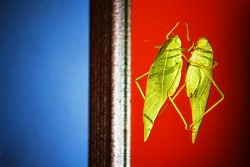
Insects can mimic all kind of things – stick bugs, for example, make such convincing twigs that you’ll never know they’re around until they move. Katydids look just like bright green leaves, and there are some species of caterpillar that in their youngest stages look just like splatters of bird droppings. But the mimics that I find most interesting are those who mimic other insects.

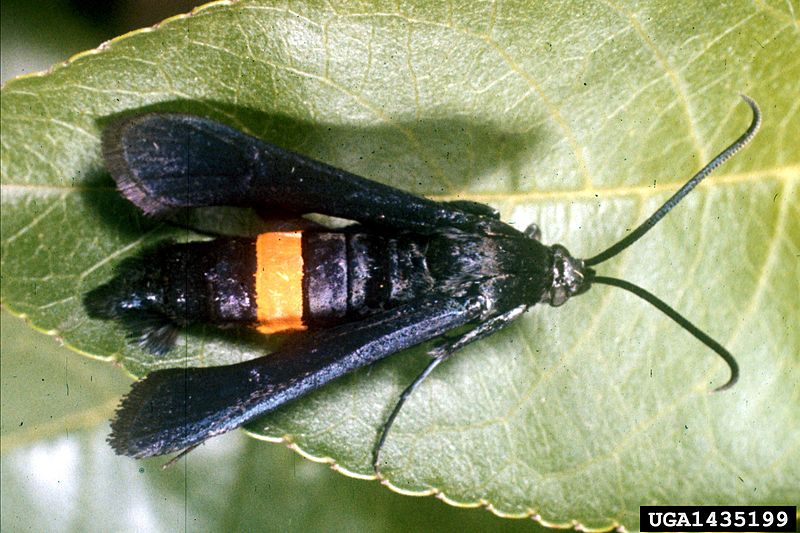
There are two main types of insect-to-insect mimicry. Batesian mimicry occurs when one harmless species mimics another dangerous one. Species that look like something fierce can capitalize on that insect’s dangerous reputation and potentially be safer from predators because of it. A common Utah pest, the peach tree borer, is a moth that very closely resembles a wasp in both its morphology and behavior. Harmless, nectar-eating hoverflies exhibit the black and yellow body stripes of a bee. Apparently, it’s not just humans who want to stay away from the business end of a wasp or a bee – many insect predators, too, give them a wide berth.

Ants also have a fierce reputation in the animal world, and so attract a lot of mimics. A number of spider species not only mimic ants in morphology and behavior, but some also give off ant pheromones, making them smell like friend rather than foe. While many ant-mimicking spiders go undercover as a way to hide from their own predators, some do use their disguise as a way to access the nest of their prey.

Batesian mimicry is a delicate balance. Predators need to catch a wasp or two before they associate that color pattern with dangerous prey. If there are too many tasty mimics around, the predators will stop associating black and yellow stripes with a dangerous object and the mimic’s ploy would fail to work.

A slight variation on Batesian mimicry are insects with false faces and false eyes. Tiger swallowtails – those large yellow and black butterflies – have red and blue spots on each of their hind wings at a place farthest from their body. These spots, combined with the skinny black ‘tails’ from which the species gets its common name, are meant to look like the eyes and antennae of another, possibly larger and more fierce, insect. This imagery is meant to frighten off predators, but also in the case of an attack, to spare the most important part of the butterfly’s body.

The second, less common, form of insect-to-insect mimicry is called Müllerian mimicry. This occurs when two equally distasteful insects come to resemble one another. Most of us are familiar with the monarch butterfly. As caterpillars, they feed exclusively on toxic milkweed. The caterpillars take the toxins into their bodies and retain them as adults, making them not only bad-tasting but also poisonous. Predators have learned to associate that distinct orange and black wing pattern with a bad experience, and therefore leave them alone. Viceroy butterflies look incredibly similar to monarchs – the only difference being an extra line of black on the hindwings of a viceroy. While once thought to be Batesian mimics, recent studies have shown that viceroys are equally unpalatable. Their similarity in looks to monarchs, then, serves to reinforce the distasteful nature of both species.

Mimicry is of course, not restricted to the insect kingdom. Some plants have gotten into the mimicry business in order to trick insects. The hammer orchid, which grows in Australia, has a flower that mimics a female bee. Male bees, in mistakenly trying to mate with the flower, collect pollen that they then carry with them to the next, ensuring pollination of this sneaky plant. So this ingenious tactic some insects use to gain a leg up in the game of survival can also be used against them to the advantage of others. Isn’t life amazing…

For more information and photos of some insect mimics, visit our website at www.wildaboututah.org. For the Stokes Nature Center and Wild About Utah, this is Andrea Liberatore.

Many thanks to Don Viers for his input on this piece.

Credits:

Photos: Courtesy and copyright as marked

Text: Andrea Liberatore, Stokes Nature Center

Additional Reading:

Imes, Rick (1997) Incredible Bugs: The Ultimate Guide to the World of Insects. Barnes & Noble Books. New York, NY

Pyle, Robert Michael (1981) National Audubon Society: Field Guide to Butterflies, North America. Alfred A. Knopf. New York, NY

Viers, Don (2013) Personal conversations

Ritland, David B., Brower, Lincoln P. (1991) The Viceroy butterfly is not a Batesian mimic. Nature, vol. 350, 497-8. Available online at: https://www.nature.com/nature/journal/v350/n6318/abs/350497a0.html

Cushing, Paula E. (2012) Spider-ant associations: An Updated Review of Myrmecomorphy, Myrmecophily, and Myrmecophagy in Spiders. Psyche, vol. 2012. Available online at: https://www.hindawi.com/journals/psyche/2012/151989/

NRCS Partners with Farmers, Ranchers to Aid Monarch Butterflies, Posted by Jason Weller, Chief, Natural Resources Conservation Service, on November 12, 2015, USDA Blog, https://blogs.usda.gov/2015/11/12/nrcs-partners-with-farmers-ranchers-to-aid-monarch-butterflies/

Utah’s Water Future

70% of our planet is covered in water, but you certainly wouldn’t know it by looking around Utah in August! It’s been hot and dry for about 3 months now and my yard and garden are really starting to feel the pinch.

Water can be a touchy subject in the West, and will become increasingly so as we look to the future.

Already our water resources are overextended, and all projected forecasts show an increasing need for water in the years ahead. Continued population growth combined with higher summer temperatures and drought conditions mean that this all important resource is only going to get more precious. Utah’s municipal water comes from either underground sources such as wells and springs or surface water including our many man-made reservoirs. Utah relies heavily on mountain snowpack to fill reservoirs and recharge springs, which leaves us wanting after weak winters. Many state reservoirs are predicted to drop to as low as 30% of their storage capacity this fall.

So how much water do we actually use? The average Utah household passes 650 gallons through its pipes each day, the vast majority of which goes towards bathing, toilets, and laundry. Household water use is of course only a fraction – about 13% – of our overall state consumption. Nearly 83% of the water used in Utah goes towards crop irrigation. Agricultural use plus household and industrial water add up to an astonishing 5 billion gallons of water used in the state of Utah each and every day. Per capita, Utah ranks 2

Utah is also the second driest state in the nation, again behind Nevada, though the amount of precipitation varies widely among our deserts and mountain ranges. On average, we receive around 13 inches of water each year across the state with some areas receiving less than 10 and others upwards of 50. All of that water has to be shared among the plants, animals, and humans living in each watershed. There are, of course, lots of ways to conserve water in the home: take shorter showers, run the washing machine or dishwasher only when full, and turn off the faucet while brushing teeth. Outside, water your lawn and garden only in the late evening, overnight, or early morning hours, but check the forecast first. In order to address our widespread and long-term water issues, however, bigger solutions are needed in addition to standard household water conservation. Last year, for example, the Bill & Melinda Gates Foundation sponsored a contest to reinvent the toilet in an attempt to save water and increase sanitation for people worldwide.

Governor Gary Herbert is also asking questions about Utah’s water this summer. He has convened a handful of meetings around the state to contemplate Utah’s Water Future, and is asking for public comments and suggestions on how to address the complicated issues that will face our state with regards to water use in the coming years. The last of these public meetings are being held in Salt Lake on August 13 and in Logan on August 15 can still add your comments and ideas to the record by visiting utahswaterfuture.org. Humans are an incredibly creative and adaptable species, and it will take our best efforts to overcome this daunting challenge. The future of this great state, and all the species who call it home, depend upon it.

Find links to the Governor’s water forum as well as more information on Utah’s water resources at our website: www.wildaboututah.org.

For the Stokes Nature Center and Wild About Utah, this is Andrea Liberatore.

Credits:

Photos: Courtesy & © Andrea Liberatore
Text:    Andrea Liberatore, Stokes Nature Center, logannature.org

Additional Reading:

Utah Division of Water Resources. https://www.water.utah.gov/

Utah Division of Water Resources (2010) Municipal and Industrial Water Use in Utah: Why do we
use so much water when we live in a desert? Available online at https://water.utah.gov/M&I/PDF/State/2010%20M_I%20Statewide%20SummaryCH.pdf

Governor Herbert’s forum: Utah’s Water Future: www.utahswaterfuture.org
Utah State University Water Quality Extension: https://extension.usu.edu/waterquality/

O’Donoghue, Amy Joi. (2013) Record Breaking Heat and Drought Sear Utah and the West. Desert
News, June 30, 2013. Available online at: https://www.deseretnews.com/article/865582439/Recordbreaking-heat-drought-sear-Utah-the-West.html?pg=all