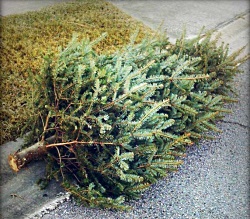
Christmas Tree on the curb Courtesy University of Illinois Extension
As a word, “repurposing” grates a little on my ear, but the concept is laudable. At my home, we reuse items in new ways for birdfeeding. Our main bird feeder hangs from the trunk of a venerable old apple tree in our backyard. In winter, the apple offers fruits and perches aplenty, but no cover for hungry juncos, chickadees and finches.
What they want are the thick boughs of a conifer. After every Christmas, there is just such a tree, all decorated, standing in our living room. Rather than hurling that tree on the municipal heap straightaway — a rather abrupt fall from grace, if you ask me — we prop it up beneath our feeder, giving it new purpose as a shelter for feeding birds. They duck in and out of its needled boughs all day long. Some even roost there at night. Beneath it, ground feeding birds can safely clean up the seeds that rain down from the feeder above. A ring of upturned tomato cages beneath the feeder — that otherwise lie idle in our vegetable garden — are given a winter purpose of impeding any stray cats interested in the birds beneath our seed feeder. For no cost and scant effort, we provide our feeder birds with shelter from winter storms and protection from feline predators.
Don’t forget water for the birds in winter. Open water can be a scarce commodity. In areas with freezing temperatures, there are heating elements to put in an existing birdbath or baths with a heating element encased in the base. In our yard, the birdbath is as popular as the seed feeders.
Birds appreciate the simple gifts: shelter from a discarded Christmas tree, a feeder full of seed and water to drink.
This is Linda Kervin for Bridgerland Audubon Society.
Hi, I’m Holly Strand from Stokes Nature Center in beautiful Logan Canyon.
There’s a large paper wasp nest on display on a bookcase at the Nature Center. Last week, Anna and I noticed some strange noises emanating from it. It even seemed to move a little on the shelf. We carefully –and a bit nervously–approached to investigate. I picked up the nest and it began to shake vigourously. Then a live missile shot out of the opening. It was a chubby little squirrel with huge dark eyes. He jumped from the bookcase and went scurrying across the floor with Anna and I in hot pursuit. Then he scampered up to the top of a door frame. We tried to catch him with a cardboard box, but he spread his little legs out wide and went sailing over our heads, landing smoothly on floor across the room. And then he ran under the couch. We stood there in amazement. He wasn’t your normal squirrel—he was a flying squirrel!
The northern flying squirrel is one of two flying squirrels found in United States, the other being the southern flying squirrel . Northern flying squirrels occur in many of Utah’s mountainous areas, primarily in mature coniferous forests and riparian zones.
According to Mike Wolfe at the Utah State University’s College of Natural Resources, they aren’t exactly rare in Logan Canyon. In fact, they are active here throughout the year, but they’re completely nocturnal. So many people never see them and are surprised to find that we have them.
Flying squirrels don’t really fly. They glide. They have a loose fold of skin known as a patagium which runs along each side of the body from the ankle of the hind leg to the wrist of the foreleg. When they stretch this membrane and launch they instantly become a furry paraglider, capable of covering great distances using a small fraction of the energy it would take to run.
Rocky, as we called the nature visitor, proved very difficult to catch. In the end, we used a live trap baited with apples and sunflower seeds. On Thanksgiving morning, my husband and I found him sitting in it, wishing he were somewhere else. We took him up the canyon and released him. He scampered up a tree and seemed to regard us thoughtfully. On the way back to the car, I looked back once more and was lucky enough to see one last beautiful 20 ft glide from tree to tree.
Thanks to the USU College of Natural Resources for supporting research and development of this Wild About Utah topic.
For Wild About Utah and Stokes Nature Center, I’m Holly Strand. Credits:
Images: Courtesy Washington Department of Fish and Wildlife and Phil Myers (photographer, copyright holder), Museum of Zoology, University of Michigan, licensed under CCA-Noncommercial-Share Alike 3.0 Unported License.
Text: Holly Strand, Stokes Nature Center
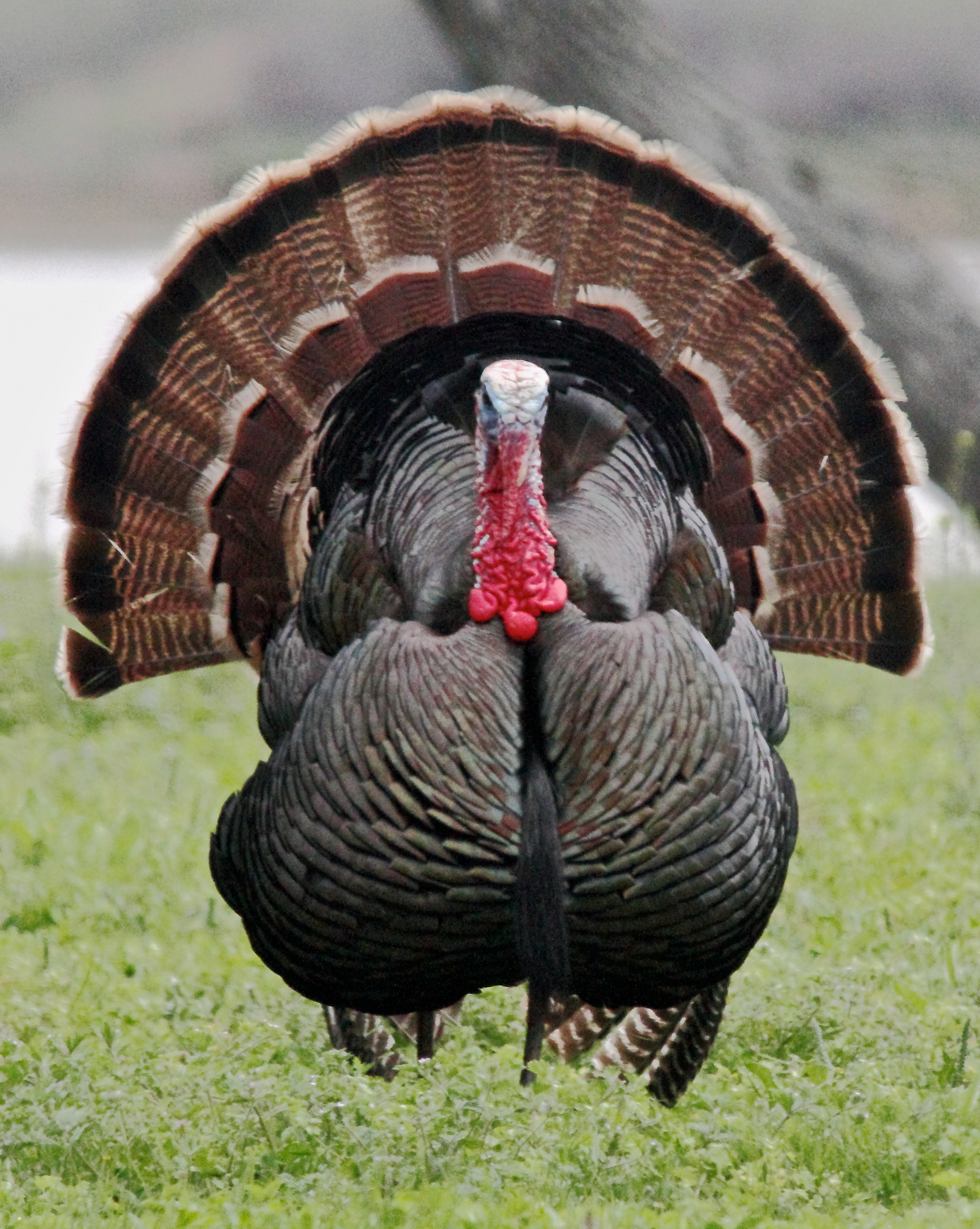
Rio Grande Turkey Tom Meleagris gallopavo Courtesy US FWS https://images.fws.gov Robert H. Burton, Photographer
The pilgrims had turkeys for the first Thanksgiving*, but the likelihood that turkeys roamed Utah at that time is small. Archaeologists have found turkey bones in pueblos in the south-eastern corner of the state. But, it is not known if they were domesticated or wild birds. However, like the ring-necked pheasant, and chukar partridge, more than 20,000 wild turkeys now roam Utah thanks to hunters and wildlife professionals.
Turkeys are the largest upland game bird in Utah. Toms stand 4 feet high with tails fanned. Hens stand 3 feet tall. First year birds are called Jakes and Jennies.
Three of the five sub-species of wild turkey were introduced to Utah. Eastern turkeys lived on Antelope Island from 1925 through the 1950s. The Merriam’s, from the ponderosa pine habitat of Arizona, New Mexico and Colorado were introduced in 1952. And Rio Grandes, native to cottonwood river bottoms of Texas, were introduced in 1984.
Merriam’s turkeys are blacker than the eastern turkey, with reflections of blue, bronze and purple. Tail coverts, the feathers of the lower back that cover the tail feathers, are white on a Merriam’s turkey; and buff or tan on a Rio Grande.
For protection, turkeys roost in trees, but descend to feed under or near trees during the day. Except when nesting, they prefer protection in numbers and rarely wander alone.
In winter they roost in flocks, but disperse as far as 10 miles to nest. Hens lay 10-11 eggs near brushy cover and incubate them for 28 days. They eat pine nuts, acorns, seeds, insects and green vegetation.
The main predators are hawks, golden eagles, foxes, coyotes, dogs, cats, skunks, raccoons, ravens, and magpies. Fortunately, the numbers hatched usually overcome predation losses.
Thanks this holiday goes to the National Wild Turkey Foundation and Utah DWR for our Wild Turkeys.
This is Linda Kervin for Bridgerland Audubon Society.
Note: Turkeys were not featured at the first thanksgiving in 1621 as they are in present meals. References to the meal included venison and wild fowl, but the likelihood that turkey was featured is questioned. Although associated with the first thanksgiving by tradition, they are believed to have become commonly associated with the thanksgiving meal around 1800. The NWTF notes this in their History of the Wild Turkey in North America: Formerly at https://www.nwtf.org/resource-library/detail/history-turkey-north-america
Wild Turkeys, Project Wild, Utah Division of Wildlife Resources, Utah Department of Natural Resources, State of Utah, Formerly at https://wildlife.utah.gov/projectwild/newsletters/00fall-nc.pdf
[Updated February 12, 2026]
Eaton, Stephen W. 1992. Wild Turkey (Meleagris gallopavo), The Birds of North America Online (A. Poole, Ed.). Ithaca: Cornell Lab of Ornithology; Retrieved from the Birds of North America Online: formerly: https://bna.birds.cornell.edu/bna/species/022/articles/introduction
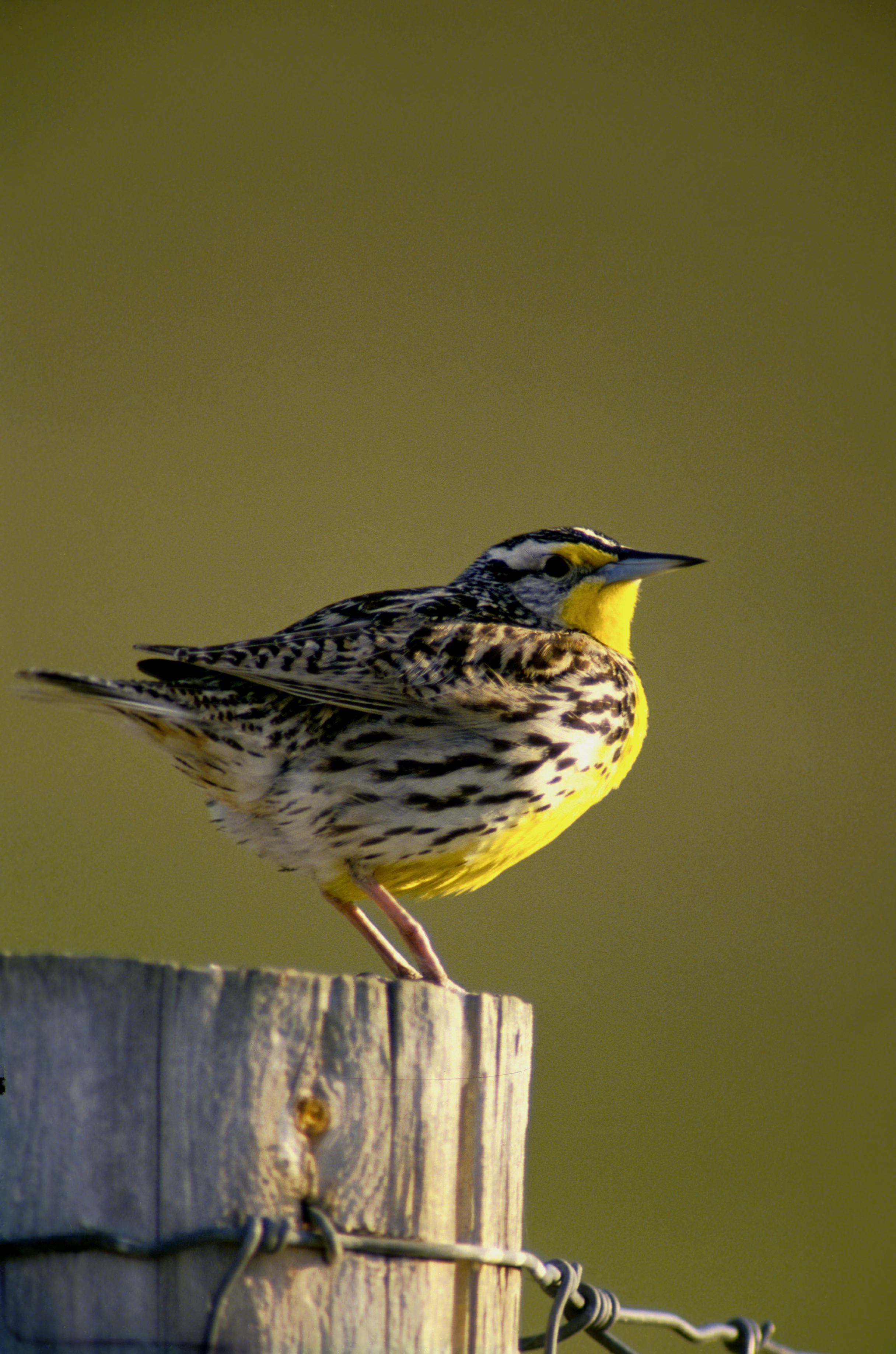
Western Meadowlark Sturnella neglecta Courtesy US FWS, John & Karen Hollingsworth, Photographers, images.fws.gov
Everyone recognizes bird-watchers by their binoculars. Bird-listening, on the other hand, takes nothing more than your ears, and attention to Nature’s sounds. Listening for bird songs, then, may require your concentration at first, but soon it will become second nature. Some common birds of Utah are more easily found and known by their song than their appearance.
The Canyon Wren is one of my favorites. Its song is unique in North America. This tiny cinnamon-brown bird weighs little more than a marshmallow, but it belts out a cascading song big enough to reverberate off the rocky cliffs and slopes that are its home. You may not see the canyon wren, but try conversing with it by whistling its song in reply. I listen year-round for its song throughout Utah and our neighboring states, particularly in mid-elevation canyons.
Bird song can help you distinguish related bird species too. On the Great Plains, both Eastern and Western Meadowlarks co-occur. The plumage of these two starling-sized species is nearly identical, but their songs differ dramatically. The eastern species sings but a few clear notes, but our western meadowlark sings a beautiful musical warble.
Meadowlarks reside here year-round, typically in grassy areas, pastures and foothills. Their backs are brown, but the male’s chest is a brilliant yellow the color of fall aspen leaves. Males are frequently seen singing atop a fence post. Hearing a meadowlark always makes me smile, they seem so cheery. And that is another reason for listening to birds, for the sheer enjoyment of their song.
In the months to come, we will bring you more of Kevin Colver’s fine bird recordings to enjoy, interpret and learn. These are music lessons that everyone can enjoy!
This is Linda Kervin for Bridgerland Audubon Society.
Credits:
Photos: Western meadowlark, Courtesy US Fish & Wildlife Service (USFWS)