Utah’s Recent Pinyon Migrations and the Prospects for Climate Change

Packrat Fossil Midden City of RocksCourtesy and Copyright 2009 Julio Betancourt - All Rights Reserved
Packrat Fossil Midden
City of Rocks
Copyright © 2009 Julio Betancourt

In the late 1970’s, springtime in the American West warmed abruptly by 2 degrees Fahrenheit in the valleys, double that higher up. Our average onset of Spring now comes a week earlier across the West. If these are the first signs of climate change, even longer growing seasons will trigger not just earlier blooms but also northward plant migrations.

The past provides us with lessons about plant migrations. A thousand years ago, one-needle pinyon hopped from the Raft River Mountains in Utah to City of Rocks, Idaho. Across Utah, two-needle pinyon leaped over the Uintas to Flaming Gorge. We know this from radiocarbon dates on pinyon pine needles taken from ancient nest heaps of packrats preserved in caves. According to Dr. Julio Betancourt of the U.S. Geological Survey, who uses these packrat middens and tree rings to reveal past plant migrations, these recent advances by Utah’s two pinyon pines followed the Medieval Climate Anomaly, a period from 900 to 1300 AD marked by warming in Europe and severe drought in Utah.

Packrat 7000 year old Midden Joshua Tree Natl Park, Courtesy and Copyright © 2009 Julio Betancourt - All Rights Reserved
Packrat 7000 year old Midden
Joshua Tree Natl Park
Copyright © 2009 Julio Betancourt

Droughts figure prominently in Dr. Betancourt’s view of tree migrations. Droughts trigger bark beetle infestations, wildfires, and tree dieoffs, opening up niches for regeneration. When the drought abates, the resident tree species typically return. With long-term warming, however, other species can move in from lower elevations or further south. Dead trees now abound on Utah’s landscape, and Dr. Betancourt thinks that we are on the verge of a new spate of tree migrations.

This go around, which species retreat or advance will depend on new factors, including human fragmentation of the landscape and accelerated dispersal of native and non-native species that hitch rides with us. To conserve ecological goods and services associated with some species, Dr. Betancourt argues, we will have to manage for these plant migrations.

This is Linda Kervin for Bridgerland Audubon Society.

Credits:

Photo: Courtesy and © Copyright 2009 Julio Betancourt

Text: Julio Betancourt USGS NRP Tucson: Biotic Response to Climate Variability

Faculty and Staff > Julio Betancourt

Additional Reading:

USGS National Research Program: Tucson AZ
https://wwwpaztcn.wr.usgs.gov/home.html

Climate Change and the Great Basin, Jeanne C. Chambers, USDA Forest Service, Rocky Mountain Research Station, Reno, NV, 2008,

A Database of Paleoecological Records from Neotoma Middens in Western North America, USGS/NOAA North American Packrat Midden Database, https://esp.cr.usgs.gov/data/midden/ (Accessed 27 August 2009)

Don’t Tread on Me!

Don't tread on me! Great Basin Rattlesnake Courtesy & Copyright © 2009 Holly Strand
Great Basin Rattlesnake
Courtesy & Copyright © 2009 Holly Strand
Holly: Hi, I’m Holly Strand from Stokes Nature Center in beautiful Logan Canyon. Don’t Tread on Me!

Rattlesnakes are pit vipers with heavy bodies and broad heads. There are about 30 species and 40 more subspecies found in North and South America. They aren’t found anywhere else. All possess rattles and all are venomous.

Here in Utah we have 5 species plus 2 subspecies. The Great basin rattlesnake is the most widespread, living all across Western Utah at elevations up to 9000 feet. Another subspecies of western rattler–the midget faded rattlesnake –is dominant in the eastern part of the state. The Hopi rattlesnake and the greenish colored prairie rattlesnake are found in southeastern Utah. And the Mojave rattlesnake, speckled rattlesnake, and sidewinder are found only in the extreme southwest corner of Utah.

The rattle itself is a unique biological feature. It’s a loose, but interlocking series of nested segments—actually modified scales– at the end of the tail. When vibrated, the rattle produces a hissing sound. Kevin Colver– an expert in natural sound recordings –provided this clip of a Mojave rattlesnake.

A snake gets a new rattle segment every time it sheds—and it sheds from one to four times a year. 15 or 16 rattles are common in captive snakes, but in wild snakes six to eight are more common. In wild snakes, rattles are subject to a lot of wear and tear. So they break off before they get very long.
The rattle sound is the reaction of a startled or threatened snake. You’ll often see the rattling snake in a defensive S-shaped coil—but not always!

Aggression and venom in rattlesnakes vary by both species type and by individual. The western diamondback rattlesnake is the archetypal large, aggressive and very dangerous species, responsible for the majority of human fatalities in America. But it’s northern range limit is south of the Utah border. However, the Mojave rattler found in southeastern Utah is extremely toxic, excitable and its venom attacks both the nervous system and circulatory system.

But rattlesnakes aren’t out to get us—mainly they just want to be left alone. You’ll generally be fine if you stay aware of what might be in or around rocks, and don’t walk barefoot or in open-toed shoes in their habitat. Also, use a flashlight after dark –most rattlesnakes are active at night too!

Thanks to the Rocky Mountain Power Foundation for supporting the development of this Wild About Utah topic.
And to Kevin Colver for the sound of the rattlesnake. Additional nature sound recordings can be found at westernsoundscape.org

For Wild About Utah and Stokes Nature Center, I’m Holly Strand.

Credits:

Sound: Courtesy and Copyright 2006 Kevin Colver
Image: Courtesy and Copyright 2009 Holly Strand
Text: Holly Strand, Stokes Nature Center

Sources & Additional Reading

Klauber, Laurence M. 1982. Rattlesnakes. Their Habits, Life Histories, and Influence on Mankind. Berkeley: University of California Press, https://www.amazon.com/Rattlesnakes-Habits-Histories-Influence-Mankind/dp/0520210565 (1997 Version)

Utah Division of Wildlife Resources. Utah Conservation Data Center. https://dwrcdc.nr.utah.gov/ucdc/ (Accessed July 17, 2009)

The Eyes Have It

The Eyes Have It: Deer Eyeshine Courtesy of National Park Service, US Department of the Interior
Deer Eyeshine Courtesy of National Park Service
US Department of the Interior

Hi, this is Holly Strand for Stokes Nature Center located in beautiful Logan Canyon.

A few years ago, I was working for World Wildlife Fund in eastern Montana. One night, we were doing a nocturnal survey of the black footed ferret, the most endangered mammal species in North America. We were counting reintroduced ferrets by riding around in a truck with a large spotlight mounted on top. When the spotlight hit a ferret, we could see the emerald green glow of its eyes as the animal looked back at the light. We’d stop the truck, walk toward the green points, and confirm the presence of a curious ferret for our census count. If the glowing eye color was something other than green we kept on driving. It was during this nocturnal safari that I learned about animal eye-shine and how it can be used by hunters as well as naturalists in finding target species.

Eyeshine occurs when light enters the eye, passes through the rods and cones strikes a special membrane behind the retina, and is reflected back through the eye to the light source. This special mirror-like membrane, called the tapetum (ta-PEA-tum), is not present in the human eye. The light-capturing system allows light to pass through the eye twice, and it is one way a nocturnal animal increases its ability to see in dim light. It’s the tapetums cause the eerie glow that we see in a housecat’s eyes caught in a light or when our car headlights surprise a deer, or badger.

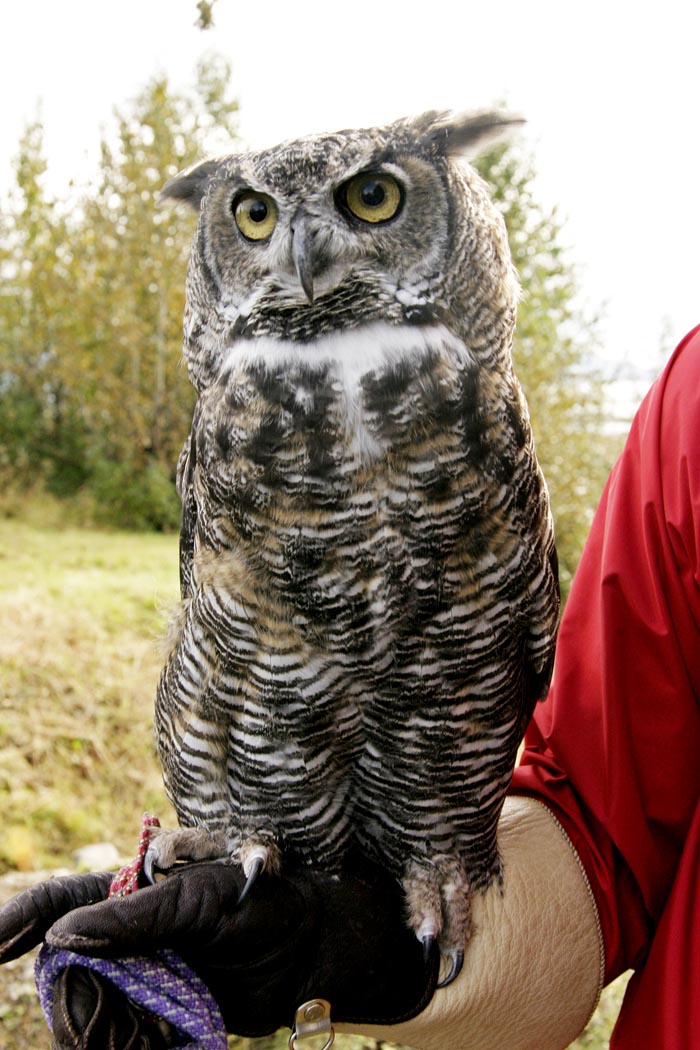
The color of eyeshine varies from species to species. Most owls have red eyeshine. Coyotes as well as mountain lion shine greenish-gold. Elk and deer – varies from silver white to a light silvery green or light silvery yellow. Desert cottontails’ are red. Tiny pricks of light may signify the presence of wolf spiders or moths. Even certain fish have eyeshine.

To see eyeshine in the wild, just take a walk on a relatively dark night, and hold a flashlight on top of your head so that you are looking down the beam. Direct the beam at bushes or low vegetation. Chances are, you’ll see the pink-tinted eyeshine of spiders. Near water, look for the greenish glow of frogs’ eyes. Keep the beam directed at the eyeshine and move closer until you can spot its owner. Bigger animals like deer or raccoons will be farther away so you may want to use binoculars in combination with a light, lining up the field of view with the light beam, and then moving the two in unison. Searching for eyeshine is the perfect summer night activity, so grab your flashlight and go out and experience some real Utah night life.

This is Holly Strand for Wild About Utah.

Credits:

Photo: Courtesy of National Park Service, US Department of the Interior Wind Cave Resource Ramblings 2007 – 11

Text: Stokes Nature Center: …

Sources & Additional Reading

2001, Corben, Chris and Gary Fellers. A Technique for Detecting Eyeshine of
Amphibians and Reptiles. Herpetological Review, 32(2): 89-91.
https://www.werc.usgs.gov/pt-reyes/pdfs/spotlighting.pdf

Eyeshine. Electronic Naturalist. Roger Tory Peterson Institute of Natural History. https://www.enaturalist.org/unit/171/qr (accessed June 2008)

Texas Parks and Wildlife. Eyeshine in Young Naturalist Series. https://www.tpwd.state.tx.us/publications/nonpwdpubs/young_naturalist/animals/eyeshine/ (accessed June 2008)

Thanks to Eric Gese, USDA National Wildlife Research Center, Department of Forest, Range, and Wildlife Sciences, for his expertise.


USA National Phenology Network

Courtesy USA National Phenology Network

The study of recurring plant and animal life cycle events is phenology. It is the calendar of nature. This includes when plants flower, when birds migrate and when crops mature. Phenology is relevant to interactions between organisms, seasonal timing and large-scale cycles of water and carbon. Phenology is important to us for many reasons. Farmers need to know when to plant and harvest crops and when to expect pests to emerge. Resource managers use it to monitor and predict drought and assess fire risk. Vacationers want to know when the best fall colors will be or when the wildflower blooms will peak. Timing varies but we can discern patterns.

The USA National Phenology Network monitors the influence of climate on the phenology of plants, animals and landscapes. They encourage people to observe phenological events such as flowering, migrations and egg laying. The Phenology Network provides a place to enter, store and share these observations, which are then compiled and analyzed nationwide. Participants range from individual observers in their own backyards to professional scientists monitoring long-term plots. My husband and I monitor leafing and flowering of lilacs, a key species in the program.

These observations support a wide range of decisions made routinely by citizens, managers, scientists and others. This includes decisions related to allergies, wildfires, pest control, and water management.

I urge you to participate. The National Phenology Network has many public, private and citizen partners. It is a great way to become involved in a nation-wide effort to better understand our environment. All this information and much more is available at the National Phenology website, to which there is a link from our Wild About Utah website.

This is Linda Kervin for Bridgerland Audubon Society.

Credits:

Text: Linda Kervin, Bridgerland Audubon Society
Additional Reading:

Linda Kervin’s pieces on Wild About Utah

Phenology Tools for Community Science
USA National Phenology Network, https://www.usanpn.org/
Nature’s Notebook Education Program, US National Phenology Network, https://www.usanpn.org/nn/education

North American Bird Phenology Program, USGS Patuxent Wildlife Research Center, https://www.pwrc.usgs.gov/bpp/BecomeAParticipant.cfm

eBird, https://www.ebird.org/

iNaturalist, https://www.inaturalist.org/