Old Ephraim, The Infamous Northern Utah Grizzly

Old Ephraim, the Infamous Northern Utah Grizzly: Old Ephriam's Grave Marker, The height of the the old grizzley Courtesy & Copyright Josh boling
Old Ephriam’s Grave Marker,
The height of the the old grizzley
Courtesy & Copyright Josh boling
It took all of Frank Clark’s seven steel-ball cartridges to bring down Old Ephraim, the infamous Grizzly Bear that, for many years in the early 20th century, plagued the shepherds of the Northern Wasatch Mountains. The date was August 21st, 1923, when Clark, a Logan Canyon sheepman, was roused from his slumber by the gruffs and bellows of the half-ton brown bear stuck in a trap that Clark had set down in the wallows the bear frequented. Hours later, after a thrilling chase and several charges from the massive, male Grizzly, the hunt was over and the last of Utah’s Great Bears had departed.

The Land of Deseret was once home to a robust population of Grizzly Bears. Indeed, present-day Utah sat very near the geographic center of their historical home range which once extended as far south as Central Mexico and eastward into the prairies of Minnesota and other midwestern states. When the Mormon Pioneers arrived in Salt Lake Valley, the surrounding mountains- and a majority of other ranges throughout the West- still harbored many Grizzlies. In fact, Brigham Young himself, along with early LDS leader Heber C. Kimball, was once chased up a cliff by an angry mother Grizz protecting her cubs.

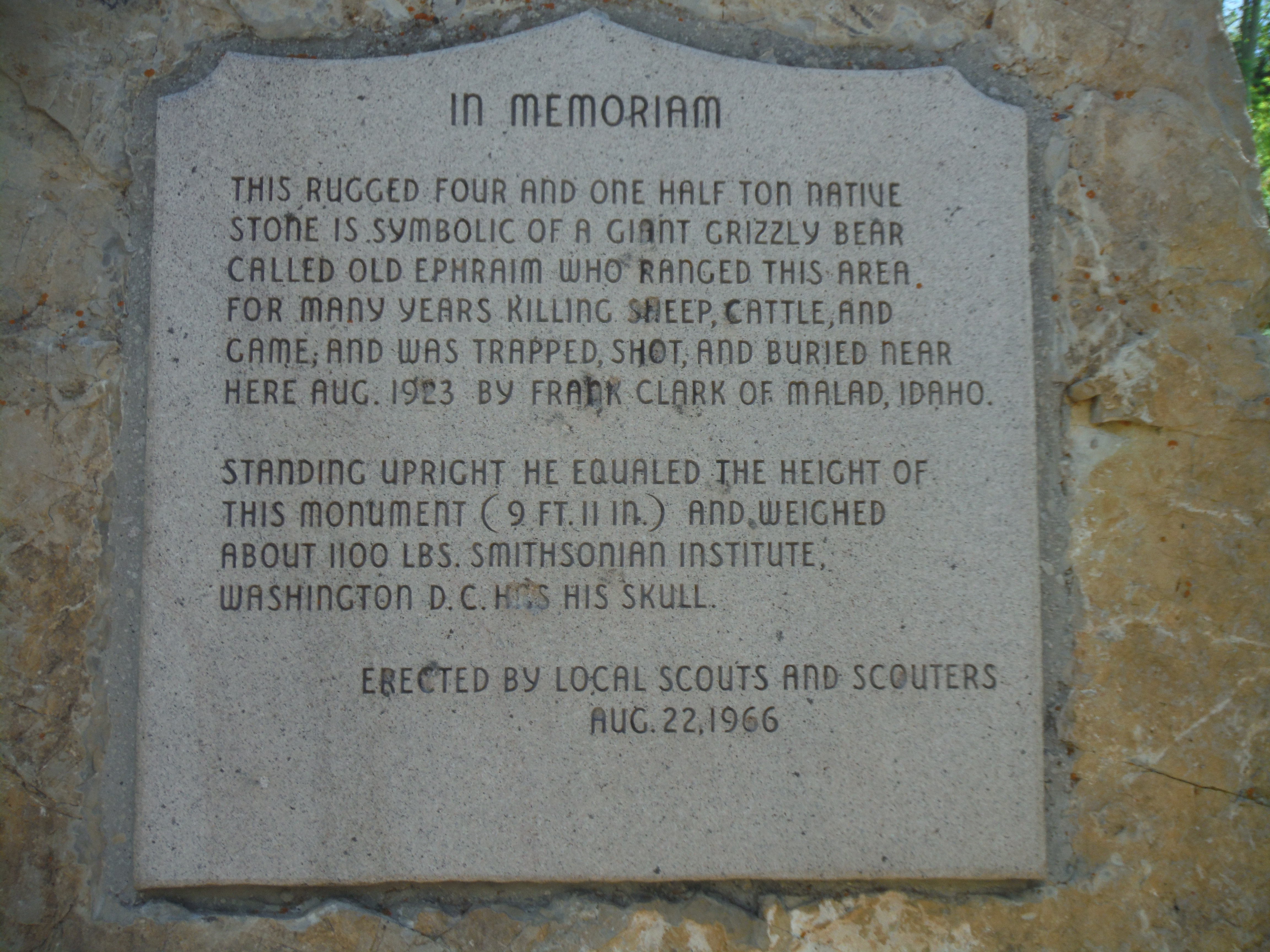
Marker Detail Old Ephriam's Grave Courtesy & Copyright Josh boling
Marker Detail
Old Ephriam’s Grave
Courtesy & Copyright Josh boling
However, between the Saints’ arrival to the Salt Lake Valley in 1847 and Frank Clark’s killing of Old Ephraim in 1923, the Grizzly Bear was eliminated from 95% of its original home range, including Utah. Today, grizzlies roam a mere 2% of their historical range in the contiguous United States, driven from all but a few remote wildernesses in the far reaches of the Northern Rockies. As more and more settlers moved westward across the New Frontier in the latter decades of the 19th century into the early 20th century, competition for resources became stiff between humans and their ursine counterparts. As apex predators, grizzly bears pursue many of the same foods we humans do, including domestic stock, like sheep. For this reason, it’s clear why local stockmen held Old Ephraim in such contempt. What made him so notorious, though, was his remarkable intelligence.

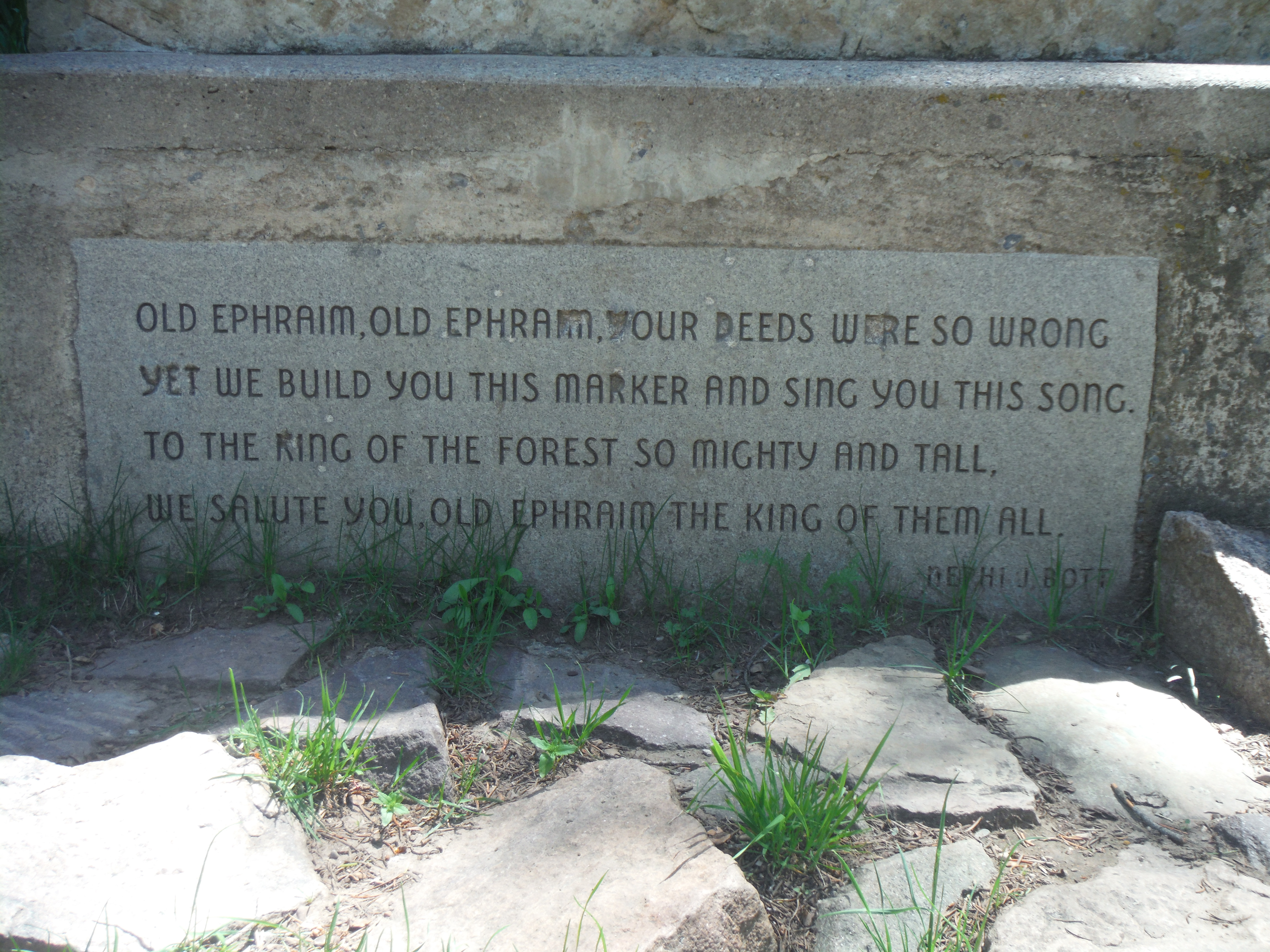
Nephi J. Bott's Poem At Old Ephriam's Grave Courtesy & Copyright Josh boling
Nephi J. Bott’s Poem
At Old Ephriam’s Grave
Courtesy & Copyright Josh boling
Grizzlies are famously smart and are even thought to possess self-awareness. Their potential for understanding is comparable to that of the higher primates in the Animal Kingdom, which stands to reason why they are such cunning hunters. Grizzly Bears have even been known to cover their own tracks or conceal themselves with trees and rocks when either hunting or hiding, giving biologists reason to believe that these incredible animals are even capable of forethought. Perhaps, that’s why it took Frank Clark over a decade to even get a good look at Old Ephraim, much less a clear shot at him. The mighty grizzly had time and again removed Clark’s traps from his wallowing holes, discarding them elsewhere without even setting them off. However, despite his amazing intelligence and ability to adapt- or, perhaps because of them- Old Ephraim ultimately met his end that August morning in 1923.

Even after having, quote, “sworn eternal vengeance on bears,” Frank Clark ultimately professed regret for having to kill Old Ephraim; and it’s a sentiment that’s well-circulated and gaining steam here in the west, now nearly a century removed from Ephraim’s death. In 1975, as a result of their dismal population levels in the contiguous United States and high mortality rates even in protected areas such as Yellowstone National Park, the Grizzly Bear was listed as “Threatened” under the Endangered Species Act. As of June 2017, however, that listing was revoked for the populations in and around Yellowstone National Park due to the Bear’s remarkable recovery from a mere 136 individuals in 1975 to approximately 700 today. It seems we have begun to amend our relationship with these animals; but there is more to be done in the interest of Grizzly Bears. Several recovery and reintroduction plans are currently being considered, and reflect a brighter future for Grizzly Bears in the lower 48. But, what about here in Utah?

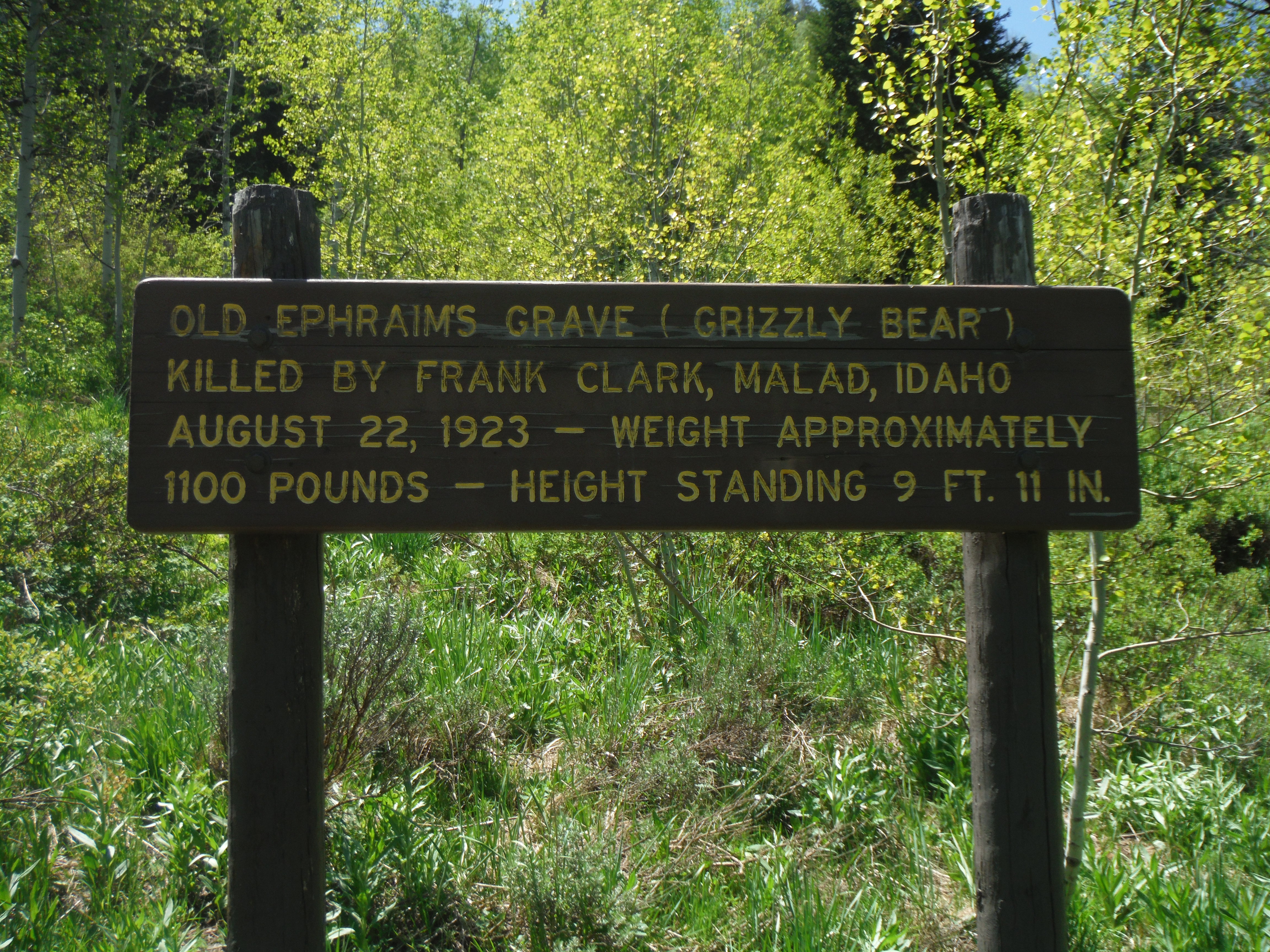
Forest Service Marker Old Ephriam's Grave Courtesy & Copyright Josh boling
Forest Service Marker
Old Ephriam’s Grave
Courtesy & Copyright Josh boling
The Great Bear’s return to the Beehive state is entirely possible but, as the Ogden Standard Examiner reported early last year, not very likely. “Although grizzlies are established in Montana, Idaho and Wyoming,” the article states, “Utah is not a part of the government’s recovery plan for the animal.” There are probably many reasons for this, not least of which is the relatively high population densities adjacent to the best of Utah’s potential Grizzly habitat. Right now, there are just too many people for the bears to be able to ramble unimpeded by the things and interests of humans. “But that’s not to say that some rogue bear might not roam across state lines one day,” states the Standard’s article.

I, for one, hope they make their way back.

Writing and reading for Wild About Utah, I’m Josh Boling.

Credits:
Photo: Courtesy & Copyright 2017 Josh Boling
Text: Josh Boling

Sources & Additional Reading

The Bear Facts Old Ephriam, Holly Strand, June 17, 2008, https://wildaboututah.org/the-bear-facts-old-ephriam/

Old Ephriam, Utah State University, University Libraries, Digital Collections, https://digital.lib.usu.edu/cdm/landingpage/collection/Ephraim

Old Ephraim: Utah’s most legendary bear, Lynn Arave, Standard Examiner, July 16, 2015, https://www.standard.net/Ogden-Area-History-Bin/2015/07/16/July-17-history-bin

Final resting spot of legendary grizzly ‘Old Ephraim’ worth a trip, Kate DuHadway, Herald Journal, Jul 9, 2011, https://news.hjnews.com/news/final-resting-spot-of-legendary-grizzly-old-ephraim-worth-a/article_0e974452-a9d3-11e0-8c09-001cc4c002e0.html

Build a Certified Wildlife Habitat at Home

Build Community Wildlife Habitats Ron Hellstern See also: https://www.nwf.org/Home/Garden-For-Wildlife.aspx
Build Community Wildlife Habitats
Ron Hellstern
See also:
https://www.nwf.org/Home/Garden-For-Wildlife.aspx
Most people appreciate viewing impressive forms of wildlife, such as Desert Bighorn Sheep in Zion, or Wolves and Grizzlies in Yellowstone, but they may not completely understand the quiet contributions that are being made to earth’s ecosystems every day by the small creatures around our own neighborhoods. These little ones help us in many unseen ways.

It is estimated that one third of the food that humans eat has been provided by small pollinators such as Hummingbirds, Butterflies, and Bees. Having these creatures in our own yards can produce hours of entertainment, and education, as we observe them working feverishly among our flowers, shrubs and trees.

Many citizens, and cities, are diligent in providing beautiful landscaped areas for these pollinators to gain nourishment as they work to increase the production of flowers and fruits.

A couple of quick tips as you decide to help these workaholic animals:
You can make your own hummingbird food by mixing one cup of sugar to four cups of water. Never put food coloring in hummingbird feeders. It can be harmful to them, and the red color of the feeder will automatically attract them. You should also use native, fertile plants in your landscaping design. And, unless you have a severe allergic reaction to bee stings, be assured that they are far more interested in gathering pollen than sacrificing their life to sting someone. Most people can work right alongside bees in their flower gardens. Wasps are another story.

So, as you design, or alter, your property to be more usable by pollinators and songbirds you can be rewarded by the National Wildlife Federation through their Wildlife Habitat Certification program. If you provide food, water, shelter and a place to raise young…you are eligible to have your yard certified. Remember, we’re not talking about Mountain Lions and Elk, just pollinators and songbirds. If you have a birdfeeder, birdbath, and shrubs or trees you qualify.

Nobody inspects your property. Go to their website at (www.nwf.org) and complete the simple application listed under Garden for Wildlife and, for a one-time fee of only $20, they will send you a personal certificate for your home, and a one year subscription to the National Wildlife magazine. They also have metal signs that you can post to show others that you care about wildlife. Once you see the value in this, encourage neighbors to do the same. In fact, you can have portions of your entire community certified as wildlife habitat as did Nibley City in Cache County. They were the first city in Utah to do so by certifying 100 properties, and they are ready to help others around the State to join them in this rewarding effort.

Next time you’re in the grocery store, or harvesting from your own garden, remember that a lot of that food would not exist without our diligent pollinators.

This is Ron Hellstern for Wild About Utah


Credits:

Images: Courtesy & Copyright Ron Hellstern
Text:     Ron Hellstern, Cache Valley Wildlife Association


Additional Reading

Certify Your Wildlife Habitat, National Wildlife Federation, Accessed 20 July 2017, https://www.nwf.org/Home/Garden-For-Wildlife.aspx
Certify: https://www.nwf.org/Garden-For-Wildlife/Certify.aspx

Creating Landscapes for Wildlife… A Guide for Backyards in Utah, Written by Sue Nordstrom and Illustrated by Kathlyn Collins Department of Landscape Architecture and Environmental Planning, Utah State University with Margy Halpin, Utah Division of Wildlife Resources; Second Printing 2001,
Updated for the Utah Division of Wildlife Resources, by Frank Howe, DWR Avian coordinator; Ben Franklin, DWR–Utah Natural Heritage Program botanist; Randy Brudnicki, DWR publications editor; and landscape planning illustrations by Stephanie Duer.,
Published by:
State of Utah Natural Resources, Division of Wildlife Resources,
Utah State University Cooperative Extension Service and
Utah State University Department of Landscape Architecture and Environmental Planning;
1991 updated 2001 https://wildlife.utah.gov/pdf/landscapingforwildlife.pdf


Securing Utah’s Moose Population

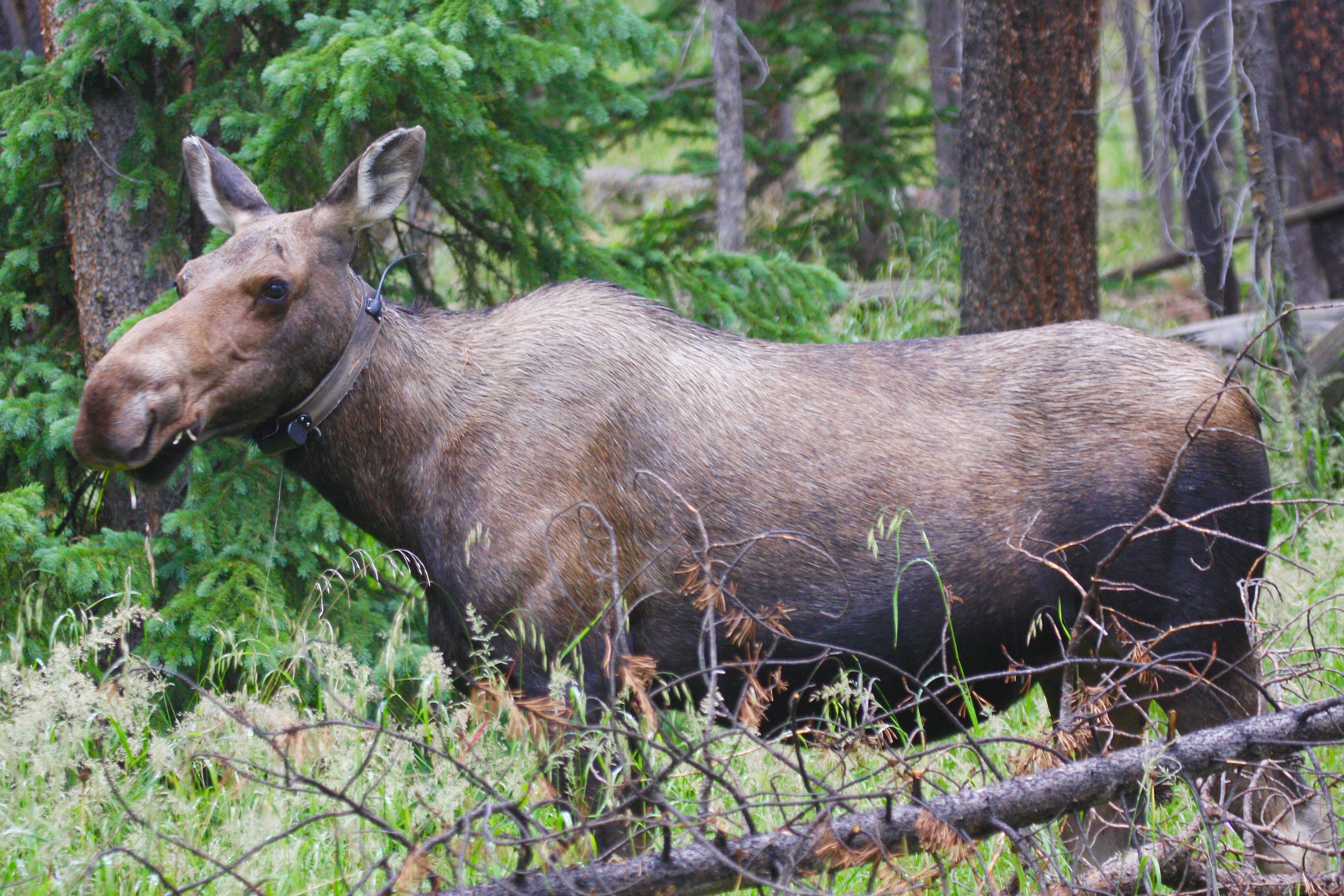
Moose with radio collar Courtesy & Copyright Sam Robertson, Photographer
Moose with radio collar
Alces alces
Courtesy & Copyright Sam Robertson, Photographer
Historically, the settlers and hunters of Utah didn’t find moose when they were exploring the state.
It wasn’t’ until 1906-07 when the first recorded moose sighting occurred in Utah.

Ironically, at this same time the population of Shiras moose also known as Wyoming moose (the subspecies found in Utah today) was dangerously close to extinction due to overhunting.

Settlers in nearby states had preferred hunting moose because the large animal was easy to catch, and was an efficient way to obtain a few hundred pounds of sweet venison.

To prevent their extinction, western states discontinued moose hunting for a time. Until 1950, hunters agreed to hunt other deer species to provide time for the moose population to replenish.
Searching for moose became a challenging spectators sport.

Moose are active during the day and loners most of the year (except mothers with their young) and since they prefer habitat where they can easily hide – finding one was a rare occasion.

By 1957, Utah’s moose had a resident herd in the Uinta mountains and the population continued to grow.
Dan MacNulty, associate professor in the Department of Wildland Resources in the Quinney College of Natural Resource at USU has been studying the state’s moose. He explains, “Utah’s moose population reached an estimated high of over 3,500 in 2005. The population subsequently declined to a current estimate of 2,600 moose. The reasons for this drop were unclear.”

To determine the factors causing the fluctuation in the moose population, Utah Division of Wildlife Resources (DWR) joined with MacNulty’s research lab to investigate the drivers of moose population growth. MacNulty says, “The first priority of the research was to determine the current status of the moose population. Is it increasing, decreasing or stable?”

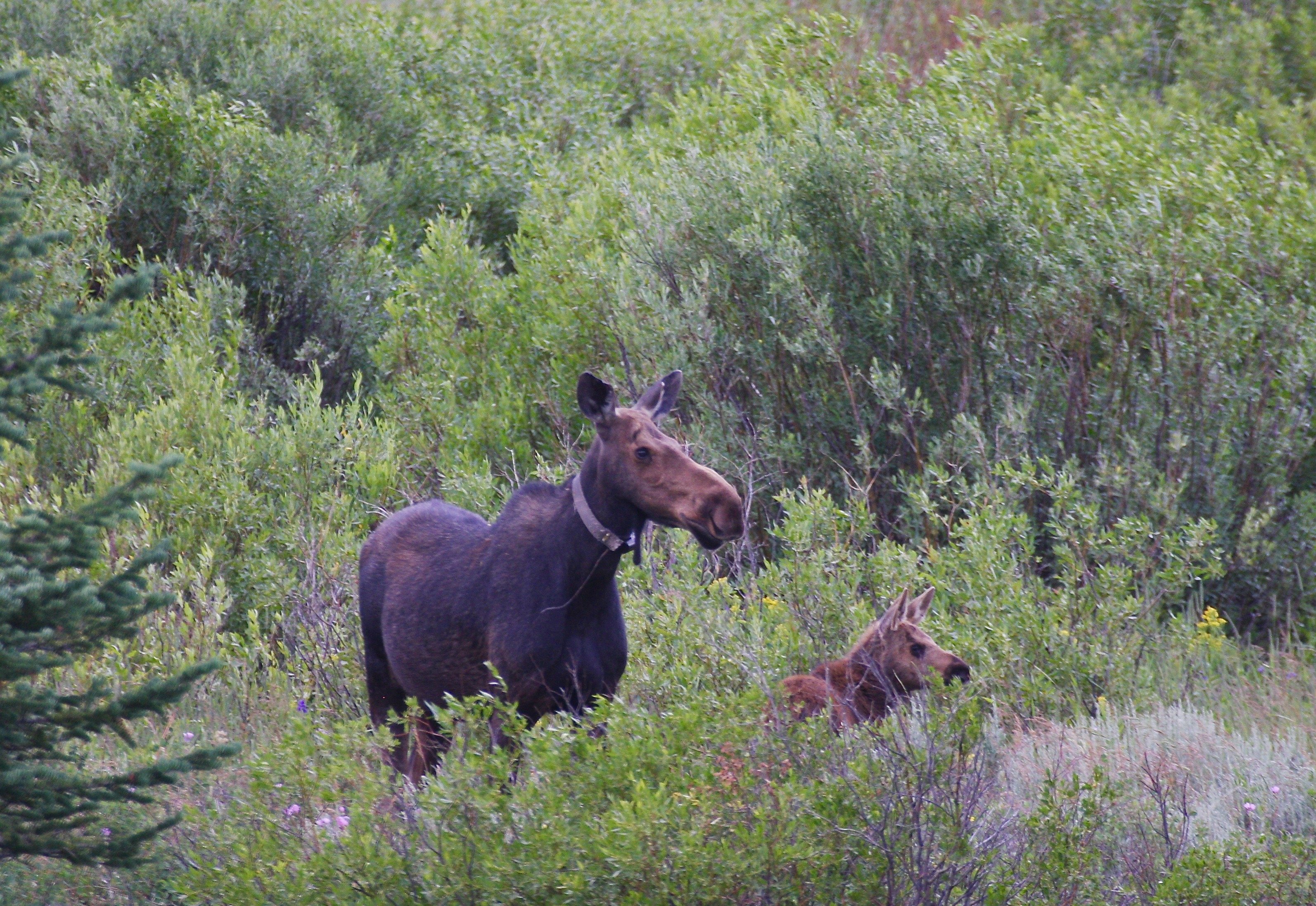
Moose Cow & Calf with radio collars Courtesy & Copyright Sam Robertson, Photographer
Moose Cow & Calf with radio collars
Courtesy & Copyright Sam Robertson, Photographer
To do this, the researchers collared 120 female adult moose in two established herds – 60 in the Wasatch Mountains and another 60 in the North Slope of the Uinta Range.

Female moose are the best indicators of the health of the herd. The females provide the data to determine the health of both the adults and calves. By tracking them, the research team can see the number of females that calve, the number of calves who survive their first winter to join the population, and the survival rate of the adults during the four-year project.

When the first year of data was gathered they found in both herds, 80-90 percent of the collared females survived. Kent Hersey, Big Game Project Leader for DWR adds, “Compared to other moose herds, Utah moose tend to have average or below average survival rates.”

Joel S. Ruprecht, USU graduate student in MacNulty’s lab discovered one reason this may be occurring. He found the maternal fat stores of the female directly impact the reproductive and survival success in Shiras moose.
When midwinter fat stores of the expecting moose were measured Ruprecht found it predicted whether the female moose would successfully give birth to her young and also whether her young would live long enough to become a healthy long-term member of the herd.

If a solution for the population drop could be to increase nutrition levels of the mothers, then DWR may be able to improve habitat conditions for adult moose and increase their health, which would in turn increase calving rates.
DWR plans to use these research findings to help stabilize Utah’s moose population.
The results may have come at an ideal time since the state’s 7-year Statewide Moose Management Plan expires later this year.

This is Shauna Leavitt for Wild About Utah

Credits:
Photos: All photos copyright and courtesy of Sam Robinson.
Text: Shauna Leavitt, Utah Cooperative Fish and Wildlife Research Unit, Quinney College of Natural Resources, Utah State University

Additional Reading

Moose, Alces apces, compiled by Anthony Bell, Vertebrate Zoology Collections Assistant, Utah Museum of Natural History, https://nhmu.utah.edu/sites/default/files/attachments/Alces%20alces.pdf

Moose entering water, Jeff Rice, Western Soundscape Archive; University of Utah, https://collections.lib.utah.edu/details?id=1117822

Moose in Utah, Jason Pietrzak, Wild About Utah, Bridgerland Audubon Society/Utah Public Radio, 30 Sept 2008, https://wildaboututah.org/moose-in-utah/

Moose, Wild Aware Utah, Hogle Zoo & Utah Division of Wildlife Resources, https://www.wildawareutah.org/utah-wildlife-information/moose/

Utah Moose Statewide Management Program, Utah Division of Wildlife Resources, https://wildlife.utah.gov/hunting/biggame/pdf/moose_plan.pdf

Beaver–Helping Keep Water on Drying Lands

Beaver, Castor canadensis, Courtesy US FWS, Steve Hillebrand, photographer
Beaver
Castor canadensis
Courtesy US FWS,
Steve Hillebrand, photographer
Beginning as early as the 17th century, beavers have struggled to find safe places to build their homes.

Initially, hunters trapped beaver extensively to keep up with the popular beaver fashions in Europe.

Then as settlers began moving west, they considered the beavers annoying because of their tendency to cause flooding and damage trees – so the trapping continued.

However, today in many parts of the American West, the beaver’s 400-year-old struggle is fading, because of their ability to keep water on dry land in an efficient manner.

While beavers may not be welcome in most city limits, ranchers and wildlife managers are re-introducing them to rural areas where the benefits of their dams far outweigh the inconveniences.

Tanner Ranch Courtesy and Copyright Eric Thacker, Photographer
Grouse Creek Area
Location of the Tanner Ranch
Courtesy and Copyright Eric Thacker, Photographer
One such place is the Della Ranches in west Box Elder County, where the Tanner family has been ranching for six generations. The ranch is located in a remote part of the state and has some of the best intact sagebrush habitat in Utah with strong populations of sage grouse and mule deer.

Most of the precipitation on the ranch, which averages less than 12 inches a year, comes as snow during winter and rain in April and May. By the end of the summer, the majority of the streams have dried up.

Having a sustainable water supply is an ongoing concern for the Tanners. They are searching for ways to keep water on the land throughout the summer.

Jay Tanner explains, “I considered building a reservoir or pond but it would be expensive, require quite a bit of maintenance, and permits. Beaver dams on the other hand are inexpensive, sustainable, and self-maintained.”

Kent Sorenson, habitat biologist from the Utah Division of Wildlife Resources described the financial benefit of the beavers, “[When beaver manage the dams] our operation and maintenance costs go to zero — they do all the work. They are 24/7 – 365-day maintenance crews that do not require a Corps of Engineers 404 permit.

Installing a pressure transducer (inside the white pvc pipe) which is used to measure flow. Restoration treatments are assessed through monitoring water flows. Courtesy and Copyright Scott Shahverdian, Photographer
Installing a pressure transducer (inside the white pvc pipe) which is used to measure flow. Restoration treatments are assessed through monitoring water flows.
Courtesy and Copyright Scott Shahverdian, Photographer
When Jay Tanner learned of the potential benefit of beavers, he drove to Utah State University and met with scientists and researchers who had experienced success in restoring beavers in the west.

Eric Thacker, Rangeland Management Extension Specialist at USU said, “A beaver dam provides a buffer or mitigation for drought.”

Once the dams are established, they keep the water on the land. This is beneficial to fish, wildlife and livestock.

Sage-grouse hens like to gather with their chicks in the wet meadows by beaver dams, where they can find plenty of insects and vegetation for their chicks.

After further discussions with USU, the Tanners entered into a multi-year partnership with the Quinney College of Natural Resources and Utah Division of Wildlife Resources to reintroduce beaver to their ranch.

Currently, all involved are working to make the streams and surrounding area appropriate for new beaver families. Once the areas are ready and the correct permits are in place, UDWR will capture a beaver pair, keep them in quarantine for the appropriate amount of time then introduce the beavers to a stream on the Tanner Ranch

Reintroducing a beaver couple instead of a single beaver is essential for the success of the project. They are social critters. Beaver will leave the location and go searching for a partner if they are not re-introduced with one.

In an established beaver dam, you will likely find monogamous parents with their babies called “kits”, their yearlings, and extended families.

Joseph Wheaton, Associate Professor in the department of Watershed Sciences and Principal Investigator on the project said, “If [this] project is successful, the implications are huge for instream and riparian restoration throughout the state of Utah as beaver are potentially an extremely cost-effective form of restoration…”

This is Shauna Leavitt for Wild About Utah.

Credits:
Photo: Courtesy US FWS, Steve Hillebrand, photographer
Photo: CCourtesy and Copyright Scott Shahverdian, Photographer
Photo: Courtesy and Copyright Eric Thacker, Photographer
Text: Shauna Leavitt, Utah Cooperative Fish and Wildlife Research Unit, Quinney College of Natural Resources, Utah State University

Additional Reading

North American Beaver, Castor canadensis, Utah Division of Wildlife Resources, Wildlife Notebook Series No. 24,
https://digitallibrary.utah.gov/awweb/awarchive?type=download&item=56529

UTAH BEAVER MANAGEMENT PLAN 2010–2020, Developed with the Beaver Advisory Committee, DWR Publication 09-29, Utah Division of Wildlife Resources, 2010, https://wildlife.utah.gov/furbearer/pdf/beaver_plan_2010-2020.pdf

WATS 6860 – Partnering with Beaver in Restoration Design, University Catalog 2017-2018, Utah State University, https://catalog.usu.edu/preview_course_nopop.php?catoid=12&coid=93002

Beaver: Restoration liaison between riparian and upland systems. Joe Wheaton, Assistant Professor, Utah …, https://www.youtube.com/watch?v=62A3RqL7Xp8

WEBINAR: Cheap and Cheerful Stream Riparian Restoration with Beaver. Joe Wheaton …
https://www.youtube.com/watch?v=m1uysDrOI_w

Beaver Restoration Workshop, Partnering with Beaver in Restoration, https://beaver.joewheaton.org/

Webinar: Cheap & Cheerful Stream Restoration – With Beaver? https://beaver.joewheaton.org/beaver-news/webinar-cheap-cheerful-stream-restoration-with-beaver

Science Unwrapped Talk by Joe on Beaver
https://beaver.joewheaton.org/beaver-news/science-unwrapped-talk-by-joe-on-beaver

Videos & Movies
https://beaver.joewheaton.org/videos–movies.html

Joe Wheaton – Beaver: Restoration liaison between riparian and upland systems
https://beaver.joewheaton.org/

Dr. Joseph Michael Wheaton, Watershed Sciences, Associate Professor, https://qcnr.usu.edu/directory/wheaton_joseph
Utah Water Watch, Beaver Monitoring App, https://extension.usu.edu/utahwaterwatch/citizenscience/beavermonitoringapp/

Beaver Dam Mapping App Now Available for Citizen Scientists, https://www.exploreutahscience.org/science-topics/environment/item/148-citizen-scientists-can-now-use-an-app-to-help-map-beaver-dams-in-utah

Goldfarb, Ben, Eager: The Surprising, Secret Life of Beavers and Why They Matter, Chelsea Green Publishing, March 8, 2019, https://www.amazon.com/Eager-Surprising-Secret-Beavers-Matter/dp/1603589082/ref=asc_df_1603589082/