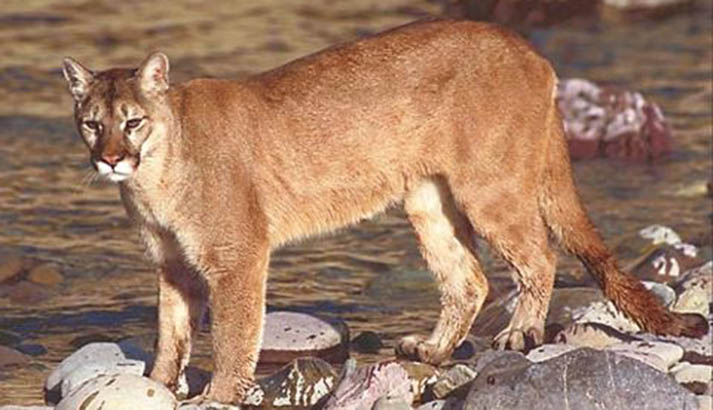
Photographer: Larry Moats Courtesy US FWS Digital LibraryThere are those moments in one’s life when time stops and moments become hours. So it was while trail running in the Wellsville mountains of northern Utah
Deep in the forest shadows materialized a form- a coyote! Well, that was the initial thinking. I stopped for closer inspection and began talking in a soft, welcoming tone so as not to frighten away my favorite song dog.
The animal form persisted- no frenzied running up the steep slope just beyond. Interesting.
I walked toward the figure to find the fright distance and for closer encounter. Eight steps in crunchy leaves and the animal began to move. Wow! A long tail emerges. The canine face transforms to feline. MOUNTAIN LION!!!
After 50+ years of trapesing through wild, rugged country in the western U.S., dream becomes reality- that of seeing this shadow being in real form.
Mesmerized, I continue a cautious approach. The cat holds its ground. Our distance closes to 50 yards when it begins a leisurely retreat. I continue singing praises to its magnificence. At one point I find myself emitting “Here Kitty, Kitty, Kitty” to which fortunately it doesn’t respond.
Mountain Lion Courtesy USDA Forest ServiceA large tom with striking colors- its lithe, fluid, soundless movement- poetry in motion, a marvel of artistic expression. It stops frequently, looking back to lock eyes with wonderment- perhaps its first close encounter with this strange being.
Eventually it gains the steep slope and picks its way upward. Occasional sunburst accents the rich tawny gold and well-muscled body. Eyes strain to follow its progress, fading into the dream it once was.
Cougars are solitary animals, making them a rare sight for humans. They usually hunt alone and at night, ambushing their prey from behind. Typically, cougars kill their prey with a bite to the lower neck. After making a kill, a cougar often will take the carcass to the base of a tree and cover it with dirt, leaves or snow, saving it to eat later.
Their main prey is deer, so cougars are often found close by. They can live up to 12 years in the wild but have lived up to 25 years in captivity.
Only 20 people in North America have been killed by cougars during the past 125 years, including six in California and 8 in Canada. No deaths have ever been reported in Utah. It is far less likely than dying from snake bites, avalanches, lightning strikes, hypothermia, or bee stings, or just about any other means. Children are particularly vulnerable when alone.
If approached by one, intimidation by intense eye contact, loud shouting, and any other actions to appear larger and more menacing is warranted.
This is Jack Greene writing and reading for Wild About Utah.
Credits:
Images: Courtesy US FWS Digital Library
Text: Jack Greene
Sources & Additional Reading:
Mountain Lion, Wildlife Notebook, Utah Division of Wildlife Resources,
Urban Mule Deer in Central Utah Courtesy & Copyright Lyle BinghamA small herd of deer bounded away over the manicured grounds of the Logan Cemetery, tumbled through its faux wrought-iron gateway, and hurdled across empty campus streets. I watched the deer disappear into alleyways between ocher-bricked University buildings, contemplating their explosion of wild life as my city woke to a quiet dawn.The Urban Ecotone
I’ve spent the majority of my life in cities. They have a human element to them I have not yet been able to forgo, but one I sometimes find myself running away from, toward the wooded hinterlands to hide. This experience, though, with the deer in the cemetery, startled back into my memory a truth inherent to our humanity. Our domestic metropolises are just another type of ecosystem for wild beings to populate. After all, we are wild beings ourselves.
An ecotone exists where differing ecological systems meet; and along their shared border, a great wealth of biodiversity abounds- the edge effect ecologists call it. I bore witness to a variation of this phenomenon along the Northern Wasatch urban ecotone on a chilly October morning as a half-dozen deer escaped my advance.
The urban ecotone wears a wardrobe of many styles, the most obvious being the type I’ve described wherein a conspicuously wild ecosystem-my home range of Bear River Mountains in this case- meets a decidedly civilized humanscape- the small city of Logan, UT. We call Logan the “city on the edge” for good reason. It’s the last great bastion of the Wasatch Front’s human imprint before wilderness takes over. From here, our Bear Rivers bear northward into an unobstructed wall of mountains all the way to the Greater Yellowstone Ecosystem. These mountains are, in fact, one of the last intact ecological corridors connecting the northern and southern Rocky Mountains, and Logan sits on the edge of it all, reaping all the wild benefits thereon.
The subtler iterations of this sort of ecological spectacle may be smaller but are no less exciting. Ripping out a conquering crowd of last season’s mint crop in my garden this spring produced a surprised garter snake from an abyss below pungent leaves. The thin serpent slithered quickly away only to find himself upon a barren concrete expanse of patio. It paused for a moment to assess the situation, looked back at me and its former dwelling, then skipped on its belly across a freshly mown lawn and into the bushes adjacent to the creek that runs beside my home. More weeding produced several wolf spiders, a praying mantis, and a plethora of earthworms. I look forward to next year’s garden cleanup now.
Then there are the green spaces: parks and natural areas that make a city worth living in beyond what we humans may more or less bring to it. Indeed, the scientific evidence is clear; those cities, towns, and villages whose urban ecotones are active and robust produce not only a slew of diverse wild species but a slew of wildly content people as well. It seems happy people go hand in hand with happy critters and their accompaniments.
A 17-year study conducted by the University of Exeter Medical School in the UK concluded that, quote, “Findings show that urban green space can deliver significant benefits for mental wellbeing.” In an interview with the UK’s renowned Guardian Newspaper, another researcher is quoted: “We’ve only really had mass urbanisation for the last 200 years, say, out of our hunter-gather experience of 100,000 years.” End quote. Perhaps we have not grown as far from the natural world as we sometimes fear. Even in our cities, these brightly lit harbingers of our species’ growth and accomplishment, we are reduced to our elemental selves by a flash of fur through dawn’s fog. In those moments, we are just animals again.
This is Josh Boling writing and reading for Wild About Utah.
Van Woerkom, Erik, Urban Legends–Trophy mule deer in city limits, Muleyfreak.com, June 30,2016, https://muleyfreak.com/2016/06/30/urban-legends/ [Broken link removed 1 Aug 2020]
Mule Deer Working Group. 2003. Mule Deer: Changing landscapes, changing perspectives. Mule Deer Working
Group, Western Association of Fish and Wildlife Agencies. https://wildlife.utah.gov/pdf/mule_deer_wafwa.pdf
Mule DeerOdocoileus hemionus Courtesy US FWS Ryan Moehring, Photographer As I look out my front window, 7 mule deer are cavorting, feeding, with some lying down for a mid-day siesta. With the final week of the regular season deer hunt winding down, some have taken sanctuary from the nimrods to join the urban herd.
For our 30 years in Smithfield canyon, deer have been regulars, disappearing for the most part from mid-May to mid-June to give birth, as do the bucks, perhaps somewhat embarrassed with strange bumps forming on their crowns.
Spotted fawns begin adorning our lawn in mid-July. With enough speed to outrun all but the fastest predator’s, mom drops her guard a bit. Bucks begin parading their new, fully formed head gear.
As fall and winter approach, the neighborhood herd grows, with a few dozen hanging out when winter finally sets in. Their snow trails through the yard become conspicuous, further defined with sprinkles of fecal material. Out back the steep hillside across Summit Creek becomes a winter playground as small groups run repeatedly up and down and around. Apparently, their abundant stores of energy allow them to break winter’s lethargy. This is generally not the case for deer in the wilds where every calorie is conserved for winter hardships as snow deepens and temperatures plunge.
We’ve witnessed a few humorous behaviors during our 3 decades of observation. Deer are very curious which occasionally works against their best interests. We had an especially aggressive rooster who became our “feathered” watchdog. A small deer herd passing through the front yard noticed the stocky cock guarding the front door and decided on closer inspection. The lead deer approached stretching his neck and tender nose to get a closer whiff. Old roaster rooster gave her a welcoming sharp jab to the nose which sent the herd bounding off.
On another occasion, our tomcat found itself taking refuge under the trampoline as 4 deer approached from a patch of forest. The cat’s movement piqued the deer’s curiosity. They surrounded the trampoline, bent down on front knees with noses poked underneath for a close-up. Poor tom was terrified- to be munched by a deer- what a horrible end!
Of course, we realize that not everyone is enamored with deer in their space. Deer can be a nuisance causing damage to landscapes and gardens. With proper fencing and plant selection, this can be managed. A greater concern is safety, vehicle-deer collisions. Here again, with proper signage, this can be minimized. I’ve experienced close encounters on my bike, so always go slow when deer appear near or on the roadway.
An excellent resource for landscaping is found at wildlife.utah.gov/habitat/deer-browse.php Blending a variety of native and ornamental plants into a home landscape can create a highly attractive environment for family, friends, mule deer and other wildlife species. Enhancing the home environment and replacing some of the lost wildlife habitat can be enjoyable and beneficial.
Redhead Ducks Courtesy US FWS Nate Rathbun, PhotographerHere comes Autumn, especially noticed in the northern parts of Utah: the colors, the cool air, the absence of many insects, the falling leaves, and the occasional dusting of snow in the mountains.
In these weather-changing conditions, wildlife species have four options: adapt to colder weather, migrate to better conditions, hibernate…or die. Today, we’ll consider migration.
As recorded by the National Geographic Society, Entomology Professor Emeritus, Hugh Dingle, mentions five basic characteristics of migration:
Prolonged movements that carry animals outside familiar habitats.
They tend to be linear, not zig-zag patterns.
They involve special behaviors of preparation and arrival (such as overfeeding).
They demand special allocations of energy.
They maintain attention to the greater mission. Meaning they are undistracted by temptations, and undeterred by challenges, that would turn other animals aside.
They feel they can eat, rest, or mate later.
The entire migration movement involves body shape, physical processes, and genetics of each species.
For ten years, scientists have been documenting one of the largest aerial mass migrations on earth. According to Science Magazine, three and one half trillion insects were recorded on radar traveling from southern England to Africa and back. They represented 3,200 tons of biomass (living tissues), which was more than seven times that of the thirty million songbirds that make that same annual flight.
Movements don’t have to be monumental to be considered migratory. For instance, some consider the daily changes in depth of ocean zooplankton to be a form of migration. They spend the day near the surface benefiting from the food provided by sunlight, then sink to darker depths at night to hide.
Some rattlesnakes in Western Canada are also considered migratory as they have been tracked to relocate anywhere from 5 to 33 miles each year. This movement is spurred by cold temperatures which reduce food, and a scarcity of good den sites below the earth’s surface, which must be warm enough and at times capable of holding up to 1,000 snakes. In contrast, Arizona rattlers travel far less because they don’t require that need.
Pronghorns, which are not really antelopes, travel far and fast, around 60 miles per hour. One group travels hundreds of miles from north-central Montana up into Alberta for breeding in the Spring. Another group of nearly 20,000 goes from Grand Teton National park south to the sagebrush plains near Pinedale, Wyoming for the winter. The routes of both groups do not vary, which can be hazardous if they are blocked by snows.
Biodiversity of ecosystems and processes, which enable each species to survive, is critical. But Conservation scientists also try to preserve migrational behaviors.
Monarchs in Mexico Courtesy FWS Pablo Leutaud, Photographer Licensed under Creative CommonsNo doubt, there are fragile creatures which travel south to avoid cold temperatures as well as lack of food. The Monarch butterfly comes to mind. The disappearance of flowers, and freezing cold would spell doom for them in northern climates. So they embark on a 3,000 mile journey to Mexico, or southern California. Let’s consider some other long-distance, roundtrip travelers:
*Salmon and Caribou also migrate 3,000 miles.
*Dragonflies will go 10,000 miles.
*Leatherback turtles swim 12,000 miles.
*Elephant seals and Humpback whales swim over 13,000 miles.
*For birds, Northern Wheatears and Pectoral Sandpipers fly 18,000 miles.
*Sooty Shearwaters fly from the Falkland Islands to Arctic waters, a roundtrip of 40,000 miles.
*The champion distance migrant, the Arctic Tern, flies 44,000 miles from the Arctic north of Greenland to Antarctica every year!
*And the longest nonstop flight goes to the Bar-Tailed Godwit at over 7,000 miles from Alaska to New Zealand in nine consecutive days!
An entire program could also be dedicated to human migrations including various Native American tribes, the Nenets who herd reindeer 400 miles in the Russian Yamal Peninsula, and the ancient people who crossed the Bering Strait to settle in the Americas.
As we close this session of Fall migrations, consider the words of George Eliot who wrote
the following in 1841: “Delicious Autumn. My very soul is wedded to it. And if I were a bird I would fly about the earth seeking the successive Autumns.”
This is Ron Hellstern for Wild About Utah
Credits:
Images: Readhead Ducks, Courtesy US FWS, Nate Rathbun, Photographer; Monarchs in Mexico, Courtesy US FWS but licensed under Creative Commons, Pablo Leutaud, Photographer
Text: Ron Hellstern, Cache Valley Wildlife Association