Zion National Park Human-Ringtail Interactions

Human-Ringtail Interactions

Human-Ringtail Interactions: Ringtail (Bassariscus astutus), Photo Courtesy US FWS, San Andres NWR
Ringtail (Bassariscus astutus), Photo Courtesy US FWS, San Andres NWR
Within Zion national park, there is a small, little known creature named the ringtail.It is related to the raccoon and is completely nocturnal. With big eyes, bigger ears, and a black and white striped tail, they seem like a fairy tale critter. However, they are very real, albeit elusive and extremely smart. They are about the size of a house cat and spend their time hunting for mice, lizards, bird eggs, and insects while also foraging for berries and seeds. They are quite adaptable mammals, changing their diet to suit their surroundings. They can be found throughout the southwest and western coastal states from Oregon to Texas, in all sorts of habitats. However, they are rarely seen, so their presence in the desert of southern Utah usually goes unnoticed. Many residents of southern Utah don’t even know that ringtails exist, let alone live in their back yard.

A relatively large population of ringtails exist in Zion National Park, one of the most heavily traveled national parks in the US. Last year, alone, over 3.6 million people visited the park. Those tourists and visitors often eat packaged and pre-cooked foods while in the park, disposing of their trash in proper receptacles or, rather irresponsibly, along trails and campgrounds. This creates ample opportunities for ringtails to gain access to human food, such as trashcans, and may encourage them to forage for food around campsites and visitor lodging. This behavior is a problem for the guests and employees of Zion National Park, but it is also extremely problematic for the ringtails in this area.

Ringtail (Bassariscus astutus), Photo Courtesy US BLM
Ringtail (Bassariscus astutus)
Photo Courtesy US BLM
© Lee Dittmann, Photographer
The consumption of human foods and trash items are creating a significant shift in the composition of the diets of ringtails in this park. Researchers at Utah State University collected scats from ringtails in the park to analyze what they were eating. While the scats collected far from human buildings and activity showed the diet that is expected for wild ringtails in this area (e.g. insects, plant material, and some small rodent remains), the scats collected around and inside human buildings told a much more disconcerting story. There was trash and non-digestible food items present in over a third of the scats collected. These items perhaps could be due to the wrappings of human food, such as napkins, or they could be a byproduct of trying to gain access to the food, such as eating foil candy bar wrappers. A lot of human food is accessed through improperly sealed trash containers, poor food storage in campsites and cabins, and potentially hand feeding, all of which put the ringtails at risk for dietary problems, behavioral problems, and possibly death.

The ringtails are also coming towards buildings in the communities around Zion National Park, such as Springdale and Rockville, to seek easy shelter in the colder months, something that is not necessary for their survival. Properly sealing homes, particularly attics, in the areas where ringtails occur will prevent the ringtails from entering the living spaces of humans, and gaining access to food items dangerous to them. It will also prevent the homeowner from dealing with the aftermath of having a ringtail take up residence in an attic or crawlspace. Any hole larger than 2″ in diameter is enough to allow an adult male ringtail to enter. Surveying a house’s foundations and siding each fall to identify any such holes, and fill them in, can go a long way toward preventing ringtails from entering a home; helping ringtails practice healthy, wild behavior.

Ringtails are a certainly a wildlife sighting to remember, but make sure you only see them on their terms. Always properly store, prepare, and dispose of food items when in areas with wildlife. It protects you and it protects them, making sure your experience in natural areas remains a positive one.

Human-Ringtail Interactions-Credits:
Human-Ringtail Interactions
Images:   Courtesy US FWS
               Courtesy US BLM & Copyright © Lee Dittmann, Photographer
Text:        Adrian Roadman, Nicki Frey and Mary-Ann Muffoletto
Read by:  Mary-Ann Muffoletto, Utah State University College of Natural Resources
Credits:    Adrian Roadman and Nicki Frey

Human-Ringtail Interactions-Additional Reading:

Frey, S. Nicole & Godding, Heather, Ringtails (Bassariscus astutus), Resolving Human-Wildlife Conflicts – Southwestern Wildlife Series, Extension Utah State University, July 2013, https://digitalcommons.usu.edu/cgi/viewcontent.cgi?article=2218&context=extension_curall

Roadman, Adrian & Frey, S. Nicole, Detection and Relative Distribution of Ringtails (Bassariscus astutus) in Zion National Park, Utah
Extension Utah State University, July 2019, https://digitalcommons.usu.edu/cgi/viewcontent.cgi?article=3024&context=extension_curalll

Orphaned Cub Rehabilitation

Orphaned Cub: Bear Cubs in an Enclosure One of the facility’s natural climbing structures, and some of the conspecific interactions that took place in the pens. myers.patrick.rehab.bear.cubs.250x224
Bear Cubs in an Enclosure One of the facility’s natural climbing structures, and some of the conspecific interactions that took place in the pens.
New research reveals that orphaned cubs will likely avoid humans if properly rehabilitated.

Sadly each year, there are orphaned bear cubs in Utah. Some lose their mothers to forest fires, while others are orphaned by vehicle-bear collisions or other human-related conflicts.

If the orphaned cubs are too young to survive on their own and the Utah Division of Wildlife Resources (DWR) finds them before they perish they can be rehabilitated and have a good chance of surviving.

With the help of USU’s Dr. Julie Young a U.S. Department of Agriculture wildlife biologist and associate professor in the Quinney College of Natural Resources, who has expertise in managing carnivores in captivity, DWR was able to help build appropriate enclosures for the rehabilitation of the cubs.

Young helped built these temporary homes at the USDA National Wildlife Research Center’s Predator Research Facility in Millville, Utah.

To ensure the enclosures met the basic needs of cubs the researchers contacted approximately a dozen rehab facilities around the US and Canada to find out “HOW” to rehab bears.
Interestingly, there were large differences in responses.

According to Young, “A few consistent traits did emerge. Bears get easily bored, they like to play and investigate everything. So, we made sure the pens had lots of enrichment items and activities and everything was extremely sturdy since bears are very strong even as babies!

“Because they were being released back into the wild, we wanted to do as much as we could to give them natural surroundings – like logs, twigs, etc.

We scattered nuts and berries around so the cubs could learn to forage.”
One fun thing about bears – is they love water! The cubs spent a lot of time in their huge tubs or playing in the water fountain meant for drinking.

Dr. Young’s graduate student, Patrick Myers, recently completed a study of the orphaned cub rehabilitation which contributed to DWR’s Bear Management Plan to “maintain a healthy bear population…while considering human safety.”
Myers began his work in the summer of 2014 when DWR brought six orphaned cubs to the Millville bear rehabilitation site.
Throughout the rehabilitation, there was very little human contact to ensure the bears did not become familiar with humans. This was tough since cubs are cute and people wanted to see them. However, they remained firm and did not allow visiting hours. They removed as many human sights, sounds and odors as possible by keeping noise to a minimum, and since bears have extremely good noses they eliminated as many human smells as possible no perfumes or scented lotions were allowed.

At feeding time they fed the cubs from behind a blind, or put them in one pen while they cleaned and left food in the other. The researchers never went in the same pen as the cubs.

Loading two immobilized and recently collared cubs into their enclosures for transport to their release locations. myers.patrick.release.team.250x166
Loading two immobilized and recently collared cubs into their enclosures for transport to their release locations.
Myer’s research was unique. In addition to the regular food and development regiments, the cubs went through numerous behavioral tests to determine if they were bold, shy or somewhere in between when introduced to novel stimulus.

Consistent test results were the key in determining what type of animal personalities the cubs had.
One test included placing the cubs in a new enclosure with the same layout as their previous one. The shy cubs responded by hugging the walls and cautiously moving around while the bold cubs began exploring immediately with little signs of fear.

Once Myers classified the bears, and the cubs were old enough, the research team released the young bears to remote locations throughout Utah.

Patrick Myers has immobilized and extracted one of the bears from her den in early spring of 2016 to assess her health and the fit of her collar; this was in the Lake Canyon area, southwest of Duchesne. myers.patrick.den.check.250x188
Patrick Myers has immobilized and extracted one of the bears from her den in early spring of 2016 to assess her health and the fit of her collar; this was in the Lake Canyon area, southwest of Duchesne.
Myers monitored the bears throughout 2015 until they emerged from their dens in the spring of 2016.
“The bears were fitted with expandable GPS collars so they would grow when the cubs did and so Myers could watch their movement from a computer. Myers went to check out dens once they left them, to be sure their habitat choices were appropriate based on bear biology.

Young explains, “We went with UDWR and checked on the two females their second denning season in the wild –and they looked great!”

Myers and Young were pleased to see that even though the cubs had been in close proximity to the smell of humans for many months; neither the bold nor the shy bears sought humans once they released them. They all had healthy responses to their natural habitat and behaved much like young bears not orphaned. They searched for dens almost immediately, and remained in the remote locations.

Although this is a small study, the initial results show that orphaned cubs, whether shy or bold, will likely avoid humans and retain their natural instincts if property rehabilitated.

This may be a useful management practice for restoring bears where populations are dwindling and habitat is ideal.

This is Shauna Leavitt for Wild About Utah.

Credits:
Photo: Courtesy Utah Division of Wildlife Resources
Text: Shauna Leavitt

Sources & Additional Reading

USDA APHIS National Wildlife Research Center, https://www.aphis.usda.gov/aphis/ourfocus/wildlifedamage/programs/nwrc

Bear denning in the south Book Cliffs, Utah Division of Wildlife Resources, https://wildlife.utah.gov/blog/2013/bear-denning-in-the-south-book-cliffs/

“Can you help me? There’s a bear on my boat.”, Utah Division of Wildlife Resources, https://wildlife.utah.gov/blog/2013/can-you-help-me-theres-a-bear-on-my-boat/

My Cougar Encounter

cougar encounter
Photographer: Larry Moats
Courtesy US FWS Digital Library
There are those moments in one’s life when time stops and moments become hours. So it was while trail running in the Wellsville mountains of N. Utah

Deep in the forest shadows materialized a form- a coyote! Well, that was the initial thinking. I stopped for closer inspection and began talking in a soft, welcoming tone so as not to frighten away my favorite song dog.
The animal form persisted- no frenzied running up the steep slope just beyond. Interesting.
I walked toward the figure to find the fright distance and for closer encounter. Eight steps in crunchy leaves and the animal began to move. Wow! A long tail emerges. The canine face transforms to feline. MOUNTAIN LION!!!

After 50+ years of trapesing through wild, rugged country in the western U.S., dream becomes reality- that of seeing this shadow being in real form.

Mesmerized, I continue a cautious approach. The cat holds its ground. Our distance closes to 50 yards when it begins a leisurely retreat. I continue singing praises to its magnificence. At one point I find myself emitting “Here Kitty, Kitty, Kitty” to which fortunately it doesn’t respond.

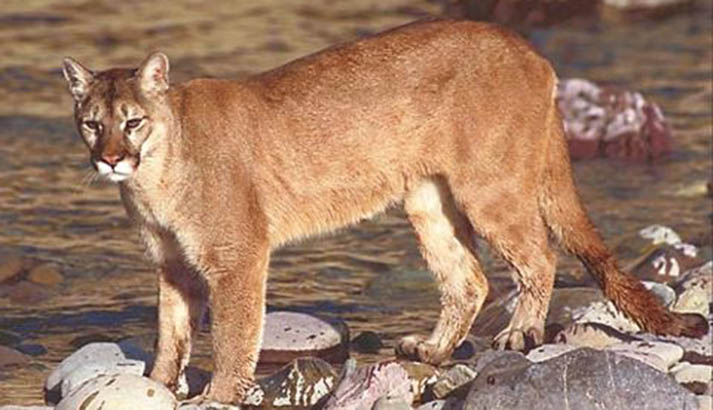
Mountain Lion
Courtesy US FWS
A large tom with striking colors- its lithe, fluid, soundless movement- poetry in motion, a marvel of artistic expression. It stops frequently, looking back to lock eyes with wonderment- perhaps its first close encounter with this strange being.

Eventually it gains the steep slope and picks its way upward. Occasional sunburst accents the rich tawny gold and well-muscled body. Eyes strain to follow its progress, fading into the dream it once was.

Cougars are solitary animals, making them a rare sight for humans. They usually hunt alone and at night, ambushing their prey from behind. Typically, cougars kill their prey with a bite to the lower neck. After making a kill, a cougar often will take the carcass to the base of a tree and cover it with dirt, leaves or snow, saving it to eat later.

Their main prey is deer, so cougars are often found close by. They can live up to 12 years in the wild but have lived up to 25 years in captivity.

Only 20 people in North America have been killed by cougars during the past 125 years, including six in California and 8 in Canada. No deaths have ever been reported in Utah. It is far less likely than dying from snake bites, avalanches, lightning strikes, hypothermia, or bee stings, or just about any other means. Children are particularly vulnerable when alone.

If approached by one, intimidation by intense eye contact, loud shouting, and any other actions to appear larger and more menacing is warranted.

This is Jack Greene writing and reading for WAU

Credits:

Images: Courtesy US FWS Digital Library
Text:     Jack Greene

Sources & Additional Reading:

Mountain Lion, Wildlife Notebook, Utah Division of Wildlife Resources,

https://wildlife.utah.gov/publications/pdf/newlion.pdf

Starving Cougar Attacks Vernal Man, Hans Moran, Deseret News Nov. 12, 1997, https://www.deseretnews.com/article/594408/Starving-cougar-attacks-Vernal-man.html

Mountain Lion, National Geographic, https://animals.nationalgeographic.com/animals/mammals/mountain-lion.html

Jack’s Urban Deer

Jack's Urban Deer: Click for a larger view of Mule Deer, Odocoileus hemionus, Courtesy US FWS, Ryan Moehring, Photographer

Mule DeerOdocoileus hemionus
Courtesy US FWS
Ryan Moehring, Photographer 
As I look out my front window, 7 mule deer are cavorting, feeding, with some lying down for a mid-day siesta. With the final week of the regular season deer hunt winding down, some have taken sanctuary from the nimrods to join the urban herd.

For our 30 years in Smithfield canyon, deer have been regulars, disappearing for the most part from mid-May to mid-June to give birth, as do the bucks, perhaps somewhat embarrassed with strange bumps forming on their crowns.
Spotted fawns begin adorning our lawn in mid-July. With enough speed to outrun all but the fastest predator’s, mom drops her guard a bit. Bucks begin parading their new, fully formed head gear.

As fall and winter approach, the neighborhood herd grows, with a few dozen hanging out when winter finally sets in. Their snow trails through the yard become conspicuous, further defined with sprinkles of fecal material. Out back the steep hillside across Summit Creek becomes a winter playground as small groups run repeatedly up and down and around. Apparently, their abundant stores of energy allow them to break winter’s lethargy. This is generally not the case for deer in the wilds where every calorie is conserved for winter hardships as snow deepens and temperatures plunge.

We’ve witnessed a few humorous behaviors during our 3 decades of observation. Deer are very curious which occasionally works against their best interests. We had an especially aggressive rooster who became our “feathered” watchdog. A small deer herd passing through the front yard noticed the stocky cock guarding the front door and decided on closer inspection. The lead deer approached stretching his neck and tender nose to get a closer whiff. Old roaster rooster gave her a welcoming sharp jab to the nose which sent the herd bounding off.
On another occasion, our tomcat found itself taking refuge under the trampoline as 4 deer approached from a patch of forest. The cat’s movement piqued the deer’s curiosity. They surrounded the trampoline, bent down on front knees with noses poked underneath for a close-up. Poor tom was terrified- to be munched by a deer- what a horrible end!

Of course, we realize that not everyone is enamored with deer in their space. Deer can be a nuisance causing damage to landscapes and gardens. With proper fencing and plant selection, this can be managed. A greater concern is safety, vehicle-deer collisions. Here again, with proper signage, this can be minimized. I’ve experienced close encounters on my bike, so always go slow when deer appear near or on the roadway.
An excellent resource for landscaping is found at wildlife.utah.gov/habitat/deer-browse.php Blending a variety of native and ornamental plants into a home landscape can create a highly attractive environment for family, friends, mule deer and other wildlife species. Enhancing the home environment and replacing some of the lost wildlife habitat can be enjoyable and beneficial.

This is Jack Greene for Wild About Utah.

Credits:
Image: Courtesy US FWS Ryan Moehring, Photographer
Text:     Jack Greene, Bridgerland Audubon Society


Additional Reading:

Copeland, H. E., H. Sawyer, K. L. Monteith, D. E. Naugle, A. Pocewicz, N. Graf, and M. J. Kauffman. 2014.
Conserving migratory mule deer through the umbrella of sage-grouse. Ecosphere 5(9):117. https://dx.doi.org/10.1890/ES14-00186.1
https://www.fws.gov/greatersagegrouse/documents/research/muledeer_mig_grouse_14-00186.pdf

Mule Deer, Utah Species, Utah Division of Wildlife Resources, Department of Natural Resources, State of Utah, https://fieldguide.wildlife.utah.gov/?species=odocoileus%20hemionus

Mule Deer, Utah Division of Wildlife Resources, https://wildlife.utah.gov/learn-more/mule-deer.html