Cat Courtesy Pixabay Genocre, photographerOur Homes, Our Pets, and Our Natural Environment: Supporting Coexistence through Responsible Pet Ownership.
Nature perseveres in even the most built environment. The cycle of life continues, in our parks, our backyards, and the green spaces in between. Hawks hunt for rodents, rodents forage for seeds, and both seek out mates, no matter how temporary.
We rarely pause to consider how the ‘wildlife’ we bring with us impacts the natural world around us. Our dogs, from stoic german shepherds to the fluffiest toy poodle, are descended from wolves. Our cats, distant relatives of the middle eastern wildcat, are arguably semi-domesticated, after only 12,000 years of human intervention. Perhaps in another 12,000 years the common house cat will be as perky and eager to please as the average golden retriever, but I doubt it.
No matter how loving, our pets are descendants of great predators and they have the ability to negatively impact the fragile ecological balance that persists around us. Some simple commitments allow us to continue to coexist. First, spay and neuter your pets. Unplanned litters contribute to animal shelter crowding and stray populations. Intact pets are also more likely to roam, and to disturb and harm wildlife.
Second, maintain control of your pets at all times. It may be adorable to watch your fox terrier romp unhindered through an urban park, but she is potentially searching for rodent burrows and bird nests to demolish with glee. Your cat is a fierce predator, with the unfair advantage of a delicious and reliable supply of cat food. The ready flow of calories you provide gives fluffy the energy to hunt with enthusiasm. Keep your dogs on a leash or under voice control and your cats indoors. If your feline demands fresh air, consider building her an enclosed catio. Generations of demanding cats have ensured that the internet contains instructions for easy and affordable catio construction.
And last, take a moment to observe and appreciate the vibrancy of life around you. All around your home, animals are hunting, eating, breeding, and dying. Nature has found a way, and we all have responsibility to respect and protect our local natural ecosystems and the essential biodiversity that relies on the interconnectedness of all it’s parts.
I’m Stacey Frisk with the Cache Humane Society and I’m Wild About Utah!
How cat advocates can allocate time and other resources for the biggest impact, Bays, Danielle Jo, Animal Sheltering magazine, Humane Society of the US, Winter 2018-2019, https://humanepro.org/magazine/articles/pointing-way-pyramid Inspired by diagrams for healthy diets, the community cat pyramid encourages a holistic approach to cat management and a strategic use of resources. Graphic by Patrick Ormsby/The Humane Society of the United States
Beaver swimming Courtesy NPS, J Schmidt, PhotographerWhen I first saw a beaver in Cache Valley I thought I’d seen an alligator. I was sitting in the front of a canoe when a large head shot past the bow followed by a black tail that flew into the air and came down on the water with a resounding slap
“What was that?” I asked
“I don’t know,” my friend answered
“I think it was an alligator,” I said
By then then creature had disappeared and we paddled on.
I found out later that tail slapping is a common beaver behavior. Its a warning shot before the beaver dives for cover.
Intrigued, I set out to learn more. It came as a surprise to me to find out that when a beaver builds a dam, it is actually building a home. Inside a sturdy wall of sticks, rocks and mud, the beavers build a living space above the water line. It’s dry – and its safe because it can only be entered by swimming through underwater tunnels. Not a problem for a beaver who can swim underwater for as long as 15 minutes.
When the surface of the pond freezes over, the females will give birth. Its an extended family life – an adult pair, the yearlings, and the new kits. When winter is long, and with so many mouths to feed, the beavers have perfected their food storage. Hauling their favorite food, aspen , back to the lodge, they jam it into the muddy bottom of the pond. There is stays, fresh and crisp like any refrigerated food, until its needed.
When fur trappers arrived in Northern Utah in the 1800’s, European hat makers had discovered that felted beaver wool made the very best hats. Bear Lake became a hot spot. The historical marker just north of Garden City tells us,
“Donald MacKenzie, Jim Bridger, and a host of famous beaver hunters operated here. Two major summer frolics and trade fairs brought plenty of excitement to Bear Lake in 1827 and 1828.”
Trappers were harvesting up to 500 lbs a year. But by 1840, the beavers had become almost extinct. European fashion in hats moved on to silk – a good thing for the hat makers as well because the mercury used in the felting of beaver wool caused all kinds of neurological disorders. Its no joke the Hatter in Alice in Wonderland is mad.
Back in northern Utah, the beaver population slowly rebuilt, but the human population also grew and conflicts arose. Recently a farmer in Benson became irate when beavers began to redirect the flow of water through his irrigation canals
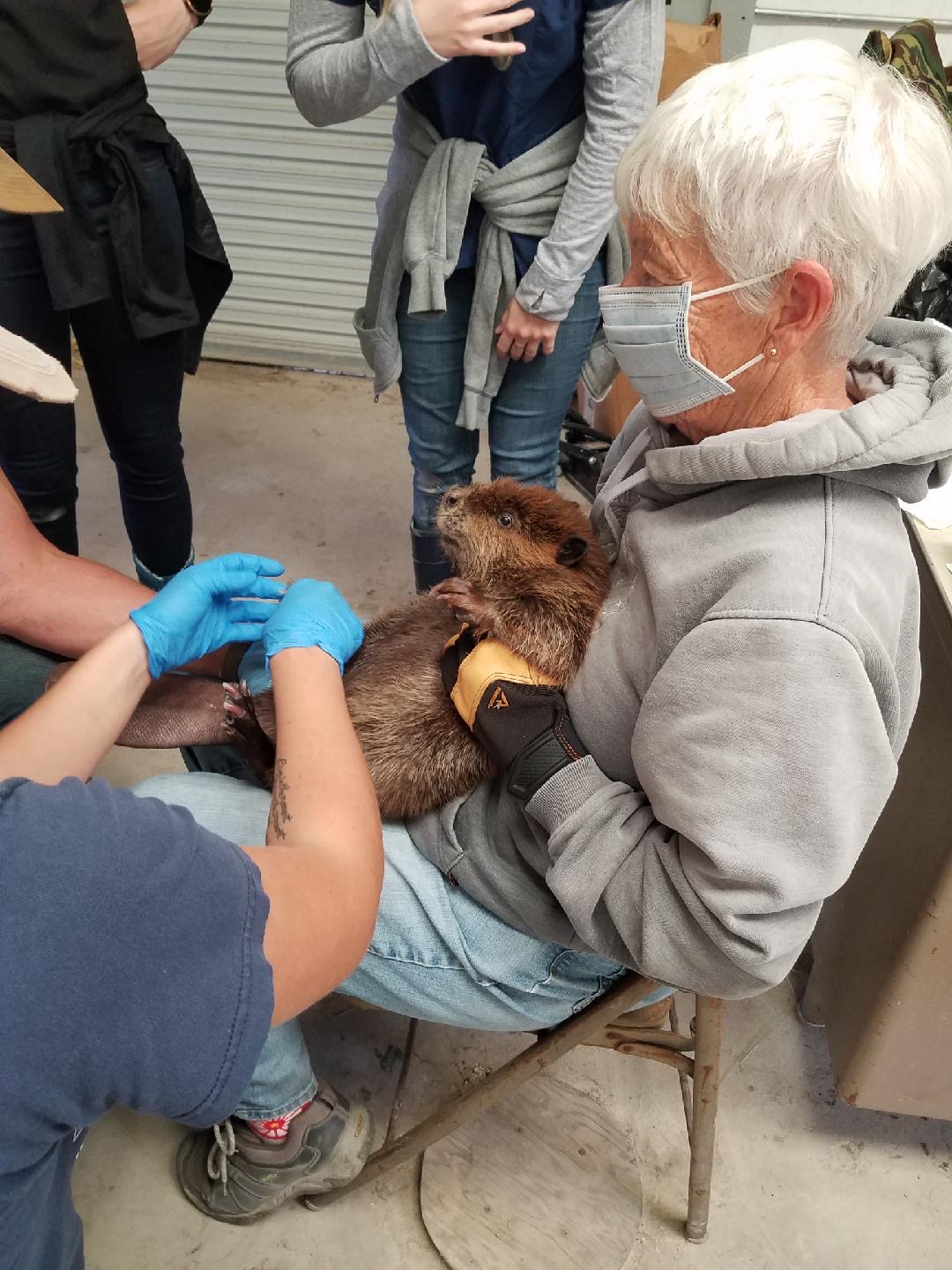
When I picked up one of the smaller beavers, I could feel its heart going a mile a minute under my fingers. But it settled down as I sat in a chair holding it against my chest while it got a quick physical checkup.
Holding the beaver close, I had a good look at the nibble fingers on its front feet, the webbing on its back feet that can paddle along at 6mph, and the marvelous flat tail, a good rudder for swimming, a prop for standing on land, and perfect for slapping the water’s surface.
Take my word for it, once you’ve seen this slap up close, you won’t forget it.
Lone Bear Courtesy and Copyright Patrick KellyWe call him Old Ephraim up here in Cache Valley. He's a tale known by just about everyone: one of the last brown bears in Utah, shot and killed by Frank Clark, in August, 1923. The account that's usually told spins the bear as both highly intelligent and dastardly, almost even sub-animal, of a creature who is the last because he is the most conniving and monstrous. His death came at the hands of a shepherd who had tracked the bear for nearly a decade, taking over 40 others in his pursuit, only to finally overcome the giant with luck and a repeating rifle. In Old Ephraim's death, he was skinned, burned, and buried. His hide was eaten by moths in the slope of Clark's barn. Today, his skull resides in an exhibit at Utah State University, and his bones have been long poached by treasure hunters. His grave holds no bear but that which we imagine.
What I take away from this story, though, is not what others have typically taken away when I read the accounts. For those long-past authors, it has always been of the glorification of Clark’s struggle; for overcoming the agent of a primeval, and thus incompatible, nature; for the noble easing of future fears by finally taking that monster bear. For me, I take away how Clark, years later, bravely chose to regret his choices, which at the time of their making were too far already decided by habit rather than concise intent. Clark stated about it, “Was I happy? No, and if I had to do it over, I wouldn’t kill him… I could see the suffering in his eyes…” That suffering had been passed on to him, it seems.
Blame for the end of Utah’s last great bear, though, cannot be placed upon the man, nor the firearm, nor the bear. Blame can only be attached to what bonded them as kin: that both man and bear had been dealt their hands by their being, and they played them the only way they had been shown, descendant of a long line of teachers whose most underlying motivation was honest survival. This is what connected the two in the moment of their struggle. They were united by fate because of what made them similar, not different.
Old Ephriam’s Grave Marker, The height of the the old grizzley Courtesy & Copyright Josh BollingIn his telling of his regret, Clark dared who he was, with who he strove to be, even in his later life. He was, after all, a self-professed lover of nature, and held holy the wild places where he spent dozens of summers. His regret was not a fault, but a truss of strength which honored this deeper value. He understood that, if you allow it, nature will take you to the great questions through flowers and birds and a strenuous life, if even for a small while, and even after you have erred. Nature is a hopeful place; an accepting place. Out there, “its” become “thous”, and the ego and all its fleeting impulsivities are surrendered to the ultimate authority of deep experiences within the land.
Hemingway said that, “The world breaks everyone and afterward many are strong at the broken places.” In this reflection, Clark’s story is not only about the fall of a great creature, nor a man who struggled to bring him down, but about how a man painfully earned the bravery and strength to see what he thought set him above, become reflected equal from him, in the knowing eyes of the last great Utah bear.
I’m Patrick Kelly, and I’m Wild About Utah.
Credits:
Images: Image Courtesy & Copyright Patrick Kelly, Photographer, all rights reserved
Audio: Contains audio Courtesy & Copyright J. Chase and K.W. Baldwin
Text: Patrick Kelly, Director of Education, Stokes Nature Center, https://logannature.org
Included Links: Lyle Bingham, Webmaster, WildAboutUtah.org
Beavers, native to both rivers, have far-reaching impacts on these waterways because of their ability to build dams which hold the water on the arid landscape – they are nature’s aquatic engineers.
One beaver dam can improve the living conditions for a host of fish, insects, plants, birds and mammals who live in and around the river.
Emma Doden, a graduate student in the Department of Wildland Resources in the Quinney College of Natural Resources at USU is working to understand the dynamics of beavers who are translocated to desert rivers for restoration purposes and how they compare to the naturally-occurring resident beavers who are already established.
Doden explains, “I help relocate nuisance beavers to desert river systems to give them a second chance, and help restore the river for the imperiled and endangered fish species…in this arid climate.”
Currently, Doden’s work is “passive desert river restoration” because there is no machinery manipulating the landscape or man-made structures impacting the research results. She is relying solely on beavers and their resources which have been part of the rivers’ ecosystems for millions of years. The beavers’ engineering teeth, tails, and paws build dams and lodges from riparian vegetation, gravel and mud.
Many of the translocated beavers come from the USU Beaver Rehabilitation and Relocation Center which captures nuisance beavers, quarantines them for three days to ensure they cannot spread disease, then passes them to Doden to be released in the desert system.
Nate Norman, a field biologist in the USU Ecology Center who helps operate the Beaver Rehabilitation and Relocation Center said, “Working with Paul Chase from the US Forest Service we have trapped and relocated approximately 8 to 10 beavers from around Cache Valley [in northern Utah, to the desert rivers in Doden’s research.“
Both the resident and translocated beavers in the study receive a radio-transmitter and PIT-tag in their tail.
Doden explains, “The PIT-tag is similar to the microchip [a] dog or cat gets at the vet for identification if it ever gets lost. We use radio-transmitters and PIT-tags to track the movements of our beavers so they do not become lost after release.”
To this point, 90% of the translocated beavers have moved outside Doden’s research area as they explored their new habitat. They were probably searching for a companion and a suitable place to build a home.
This travelling increases the beaver’s vulnerability to predators since they have no underground burrow or lodge for protection. During the 2019 field season, of the eight beavers released, three of the translocated beavers were taken by predators.
Many of the tributaries of the Green and Colorado rivers are wood-deprived because of changes in the river flow due to human extraction. To increase a translocated beaver’s chances of surviving and its likelihood of remaining where it’s placed, the research team has proposed building simple dam-like structures out of wood fence posts, which would encourage the beavers to stay where they’re released. Once they receive NEPA approval the structures will be built.
Doden adds, “Our project goals are already being met, as we are learning so much about the fate of translocated beavers in desert ecosystems. Restoration goals will also be met if even a few beavers stay in the study area and build dams, supplementing the resident beaver population and creating more complex habitat for imperiled desert fish to live.”