Some Canada geese arrived in Cache Valley in late February Courtesy Mary Heers, Photographer
Canada Geese at First Dam Courtesy Mary Heers, PhotographerAt the end of last February, I was delighted to see hundreds of Canada geese settling into the swampy fields by the Logan airport. There was still snow on the ground, but the message was clear: Spring was just around the corner. Soon the mated pairs would be building their nests and raising their families.
Interestingly, just as the goslings are starting to grow their first feathers, their parents are losing theirs. The adults will discard their frayed and somewhat battered flight feathers before growing a whole new set. This molting process takes 4-5 weeks, during which time the geese simply can’t fly.
This is when the folks at the Department of Natural Resources get out their airboats at Ogden Bay. It’s time to round up the flightless geese and slip a small aluminum band on their leg.
So, early morning on June 14, I joined a small group of volunteers at Ogden Bay. I was told to hop on Airboat #4. My job was to lie down on the front lip of the airboat ( just inches above the water line) and grab any geese we got close to.
The driver then punched the accelerator and we shot out across the bay. Soon we were gaining on a goose who heard us coming and picked up his paddling pace. Just as I tried to grab him, he dove down and out of sight in the muddy water. I reached down and came up with a handful of pond weed.
The driver suggested I hook my feet on the side rail and lean out further over the front of the boat.
“Don’t worry, he said. “If you fall out, just stand up. It’s pretty shallow.”
The airboat doesn’t have any brakes, but he promised to circle back and pick me up.
I got braver and caught the next goose. I think the goose was as surprised as I was. I was expecting a fight, but no. The goose settled quietly into a crate, and we were off and going after the next goose. It turns out the shallow water was key to our success. Under ordinary circumstances a goose can dive out of reach, 30 to 40 feet underwater
By the end of the round up the DNR will have caught, banded, and released about 2000 geese.
What we learned from this banding project is that the Canada geese now in Utah will not be going to Canada. Most of the geese banded in Cache Valley will spend the winter in Idaho along the Snake River between Idaho Falls and Twin Falls.
These geese are very adaptable. Where they see open space with a good supply of grass and water, they will move in. Some geese opt out of migration entirely, like the ones who spent last winter at Logan’s First Dam.
As for the ones who leave, we can expect to see the females back here next Spring with a lifetime mate in tow. As for the males – they will go where the females take them.
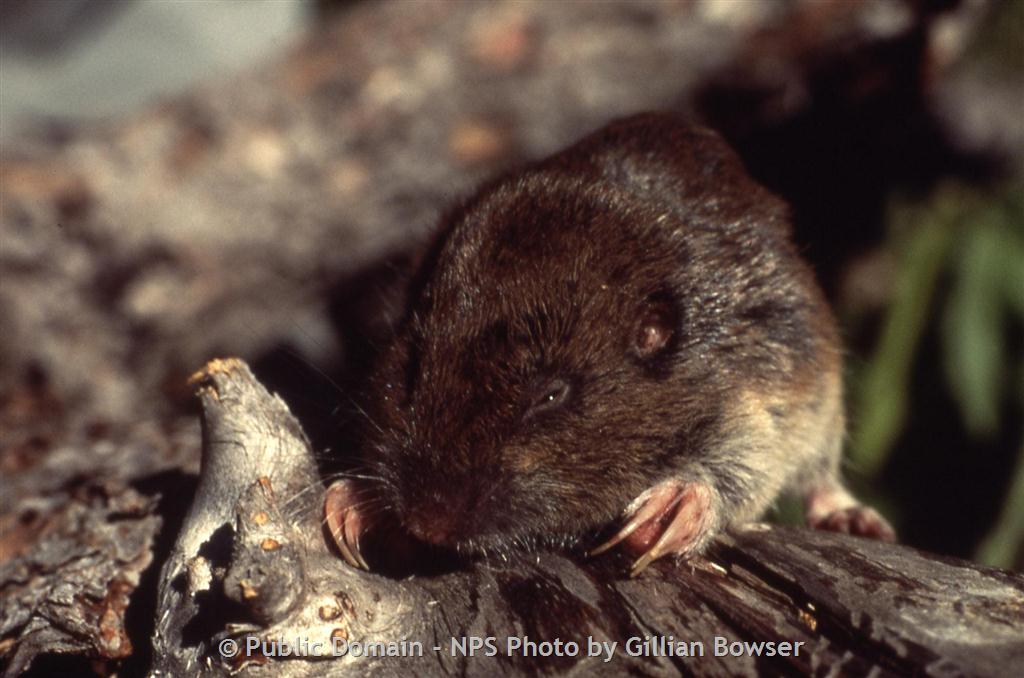
Muscrat Courtesy US FWS Jessica Bolser, Photographer
American Marten Courtesy US NPSWe all love pleasant surprises! I especially enjoy nature’s offerings, both pleasant and less so. I wish to share a few from a very long list!
Snakes may be at the top. I believe we have an innate fear of this special reptile, which has imparted indelible memories. Great Basin gopher snakes have repeatedly shown an uncanny
ability to find birds nests in implausible locations, climbing seemingly impossible vertical walls to consume both bird eggs and young. Rarely, rattlesnakes have crossed my path, their buzz always putting me on full alert- a spine tingling surprise.
Moose may be second to snakes. I’ve been charged a few times and revisit nearly every step taken toward me by these grand beasts, my own steps in fast retreat. But it was a sandhill crane – young bull moose memory, where the crane won the day which lingers fresh. As the young bull curiously extending his tender muzzle toward the nesting bird, it elicited a sharp beak response from the nester that sent the youngster scurrying away.
Golden eagles are a favorite bird for their beauty, intelligence, and undisputed apex predator status. I was stunned to find they may not be top bird after all. On two occasions, I have witnessed a peregrine falcon unleashing its powers of blazing speed and agility to usher a golden eagle well away from the falcon’s eyrie.
I associate the Clark’s nutcracker as a keystone species for nut gathering and caching, while inadvertently feeding grizzlies, squirrels, and planting innumerable five needled pines. It rocked my socks when a flock of songbirds were attacking a Clarks who had stolen a baby bird from a nest for a midday snack. This activity forever changed its strictly nut-eating narrative. I’ve had at least a hundred bear encounters in Yellowstone, Tetons, and Denali national parks, all with favorable outcomes. But only once have I crossed paths with a mountain lion in my thousands of miles hiking wild, remote country. I can recount nearly every second of that rare moment. Lurking in the shadows on a beautiful fall day, I mistake the lion for a coyote. As I approached it from about 30 yards distance, it slowly moved revealing a very long tail. Mixed emotions surged while I talked gently, walking slowly in its direction as it gradually moved away. A spellbinding, euphoric moment.
Beaver encircling boat
I experienced two unforgettable occurrences while exploring Zion’s Hidden Canyon. Being midday, I wasn’t expecting anything beyond a rock squirrel. Then came an unusual hoot, definitely not that of a great horned owl. Answering its call, it flew toward me alighting in a large Douglas fir- a Mexican spotted owl- my first and only sighting. Soon after, two furry critters scrambled up a 10 foot boulder, ringtail cats! Mostly nocturnal, a very rare moment indeed!
I’ll conclude with several surprise animal attacks I’ve suffered- a pocket gopher nipped the soul of my boot, a muskrat attacked my hip-waders, and a pine martin chewed on my well protected toe. Finally, I’ve been strafed by various bird species protecting their nests and young. All leaving surprised chuckles from the victim.
Jack Greene for Bridgerland Audubon Society, Wild for more of Utah’s nature surprises!
First Look Used with permission Courtesy & Copyright Joseph Kozlowski
The Whole Class with Binoculars Used with permission Courtesy & Copyright Joseph Kozlowski
Finding a Dead Nuthatch Used with permission Courtesy & Copyright Joseph Kozlowski
A Pine Siskin Courtesy & Copyright Joseph Kozlowski
A Crow Courtesy & Copyright Joseph Kozlowski
Two Nests Courtesy & Copyright Joseph KozlowskiA hot, sunny, May day was Christmas for my avid 2nd-grade birders, when 35 pairs of high-quality Vortex binoculars and chest harnesses were delivered to our Edith Bowen Laboratory School classroom. We had secured a grant from the Utah Division of Outdoor Recreation to purchase supplies to enrich our school’s outdoor education program, specifically my classroom’s integrated focus on birding. Kids cheered when the binos arrived, knowing that we’d be able to put these powerful tools to work in the field. They scrambled to set up the harnesses and prepare the equipment for use.
Although the adjacent Logan City Cemetery is one of our frequent birding locations, it was going to be our first outing where all students had their own set of binoculars to view the world in high definition. We left the school equipped with our new binoculars, and students were thrilled about the awaiting possibilities. Long before we arrived at the cemetery the binoculars were put to good use, “Everyone look!” a little girl yelled, “an American Crow!” The sighting stirred commotion as 25, 7-year-olds scrambled to get into position where they could see the large black bird with their binoculars, as it bounced around the USU sidewalks looking for morsels of college students’ neglected snacks. Then ensued a student debate over whether or not the bird of interest was an American Crow or a Common Raven; the victorious crow-supporters claimed victory only when the bird flew away, revealing a fan-shaped tail.
Once we arrived at the cemetery, it was clear students were experiencing this environment in an enriched way thanks to the binoculars. Students spent much more time in each location throughout the cemetery, and there was more advanced and technical dialogue between students about what they were seeing. Students would call each other over to their specific viewing area to show them a bird they had viewed, and they would describe to the person how to find it in their binoculars. This description facilitated incredible spatial language regarding the location and reference of the bird, such as “It is halfway up the largest pine tree on the right” or “Look on the ground next to smaller bush!” One exciting shared discovery was sparked by a high-pitched, upsweeping zreeeeeeeeeeet sound that the students kept hearing. Throughout the walk, students kept using their binoculars to look for the culprit of the sound, to no avail. Then near the end of the outing a student erupted in excitement, calling everyone over to see the bird making the noise. Eventually directing everyone’s focus on the bird, the students discovered a small, white and brown bird atop a sycamore tree, which they identified as a Pine Siskin due to the distinguishing yellow color on the wings.
Other special encounters on this outing included the finding of a dead, Red-Breasted Nuthatch aside the pathway, and the scientific reasoning about who could have been the engineers of two different bird nests found in the grass under trees –a large one with a mud base and a small one full of human hair!
Reluctantly, hot, sweaty, and ecstatic kids returned to school after their first ever birding outing with binoculars and experiences they’ll draw upon forever. No doubt, the binoculars that brought these students these magical discoveries will do so for many kids to come in the future.
This is Dr. Joseph Kozlowski, and I am Wild about Outdoor Education in Utah!
[Downy Woodpecker Male at] Bird Feeder Courtesy US FWS, Leah Schrodt, Photographer
Applying Anti-Strike Film to Window Courtesy US FWS Brett Billings PhotographerBirdwatching is a fun hobby for all ages and it is a great way to connect with nature and increase self-efficacy, so let’s discuss the benefits and the importance of a safe environment for feeding our backyard birds. First, the benefits of supplemental feeding, and second, preventable deaths from cats and window collisions.
Supplemental food and water are important ways we can reduce stress for backyard birds, especially through the winter months. Sites with bird feeders attract more birds over time than those without feeders, and the birds are in overall greater health than birds at sites without feeders. A higher percentage of chicks hatch at sites with bird feeders, and the survival rates are significantly higher, but supplemental feeding must be done in a safe environment.
Free ranging domestic cats and window collisions are leading causes of bird deaths in North America. The American Bird Conservancy estimates that outdoor cats kill approximately 2.4 billion birds every year in the United States alone. Approximately one billion birds are dying from window collisions each year in North America – that represents about ten percent of our birds dying from crashing into windows (1), and combined, that’s over three billion fewer insect eaters, fewer pollinators, fewer seed spreaders, and fewer parents for the next generation.
Cats should be kept indoors, and windows should be treated, especially if they reflect trees and shrubs. If you have seen a ghostly bird imprint or heard the sickening thump of a bird hitting your windows, then those are windows in need of treatments such as screens, translucent UV tape, or even tempera paint designs, because even birds that manage to fly away have potentially life-threatening internal injuries. Feeders less than 3 feet away don’t allow birds to build up too much speed before they collide, so it’s good to put feeders and birdbaths 3 feet or closer to a window or greater than 30 feet away.
Feeders placed on or near windows have the added benefit of being easy to access and monitor. In addition to a window suet feeder, one of my favorite window feeders is actually a clear plastic suction-cup toothbrush cup holder from the dollar store – it’s easy to clean and there’s no need for binoculars!
In addition to enhancing a backyard bird watching hobby and improving bird health and survival, the ripple effects of feeding birds, keeping cats indoors, and preventing window collisions include pest control in our gardens where birds feast on slugs, snails, aphids and grasshoppers. I for one particularly appreciate Black-billed Magpies when they remove wasp nests from my house! The Bridgerland Audubon website has tools, coloring pages, checklists, and science-based information on window collision prevention. Solutions can be as simple as the careful placement of bird feeders and keeping cats indoors. Find us at bridgerlandaudubon.org, that’s Bridgerland Audubon – A-U-D-U-B-O-N dot org.
Creating Landscapes for Wildlife… A Guide for Backyards in Utah, Written by Sue Nordstrom and Illustrated by Kathlyn Collins Department of Landscape Architecture and Environmental Planning, Utah State University with Margy Halpin, Utah Division of Wildlife Resources; Second Printing 2001,
Updated for the Utah Division of Wildlife Resources, by Frank Howe, DWR Avian coordinator; Ben Franklin, DWR–Utah Natural Heritage Program botanist; Randy Brudnicki, DWR publications editor; and landscape planning illustrations by Stephanie Duer.,
Published by:
State of Utah Natural Resources, Division of Wildlife Resources,
Utah State University Cooperative Extension Service and
Utah State University Department of Landscape Architecture and Environmental Planning;
1991 updated 2001 https://wildlife.utah.gov/pdf/landscapingforwildlife.pdf
Morse, Susan, To Feed or Not to Feed Wild Birds–Bird Feeders Can Be Sources of Joy — and Disease,, US Fish & Wildlife Service, U.S. Department of the Interior, https://www.fws.gov/story/feed-or-not-feed-wild-birds
Dragon, Sydney, (Student Conservation Association intern), Conservation in Urban Areas: Backyard Bird Feeding, US Fish & Wildlife Service Bird Walks (Texas), U.S. Department of the Interior, Apr 27, 2021, https://youtu.be/2bkliew6aj8