Wild Children

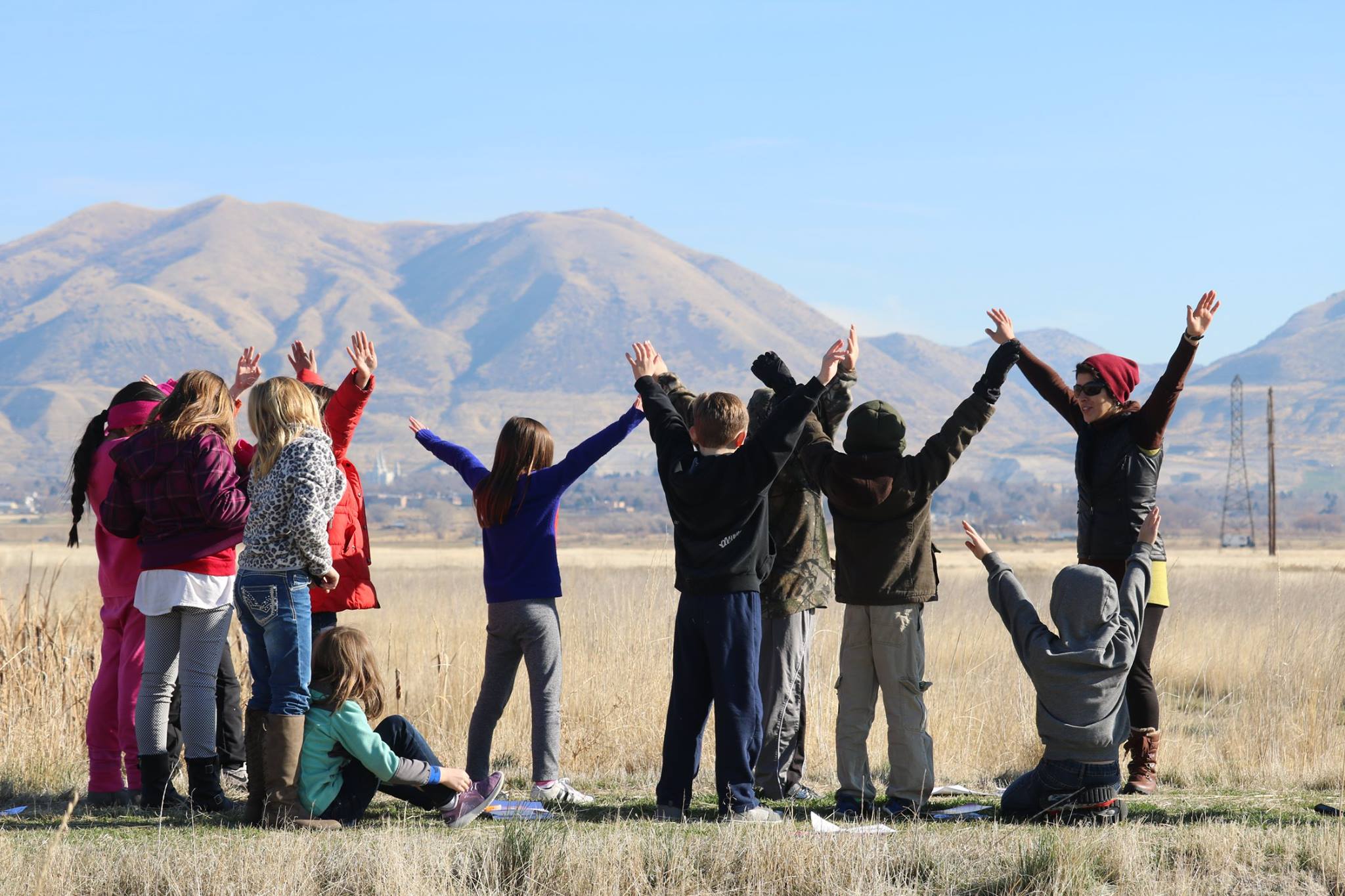
Isa and Students Imitating Raptor Flight Patterns at the Bear River Migratory Bird Refuge Courtesy & Copyright Edith Bowen Laboratory School(EBLS) Experiential Learning Eric Newel Director & Photographer
Isa and Students Imitating Raptor Flight Patterns at the
Bear River Migratory Bird Refuge
Courtesy & Copyright Edith Bowen Laboratory School(EBLS)
Experiential Learning
Eric Newel Director & Photographer
*Field Recording:
Isa Identifies Raptors


So eagles fly how?
Student:
Straight.
Isa:
How do buteos fly? Like a red tail? They are modified dihedral.
How do vultures fly? They are wobbly and in a V
How do Accipitors fly? Flap-flap-glide
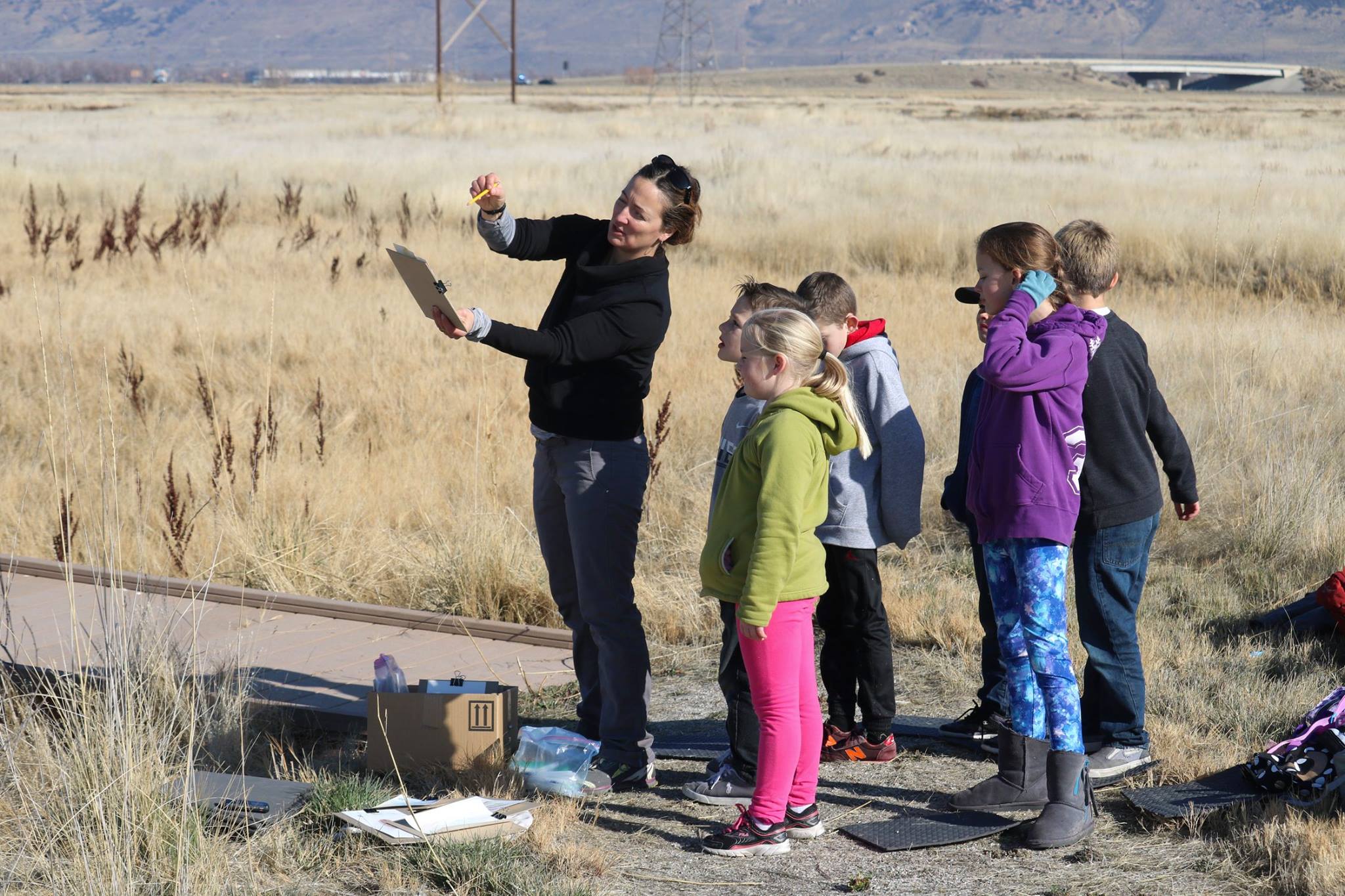
Lisa Saunderson teaching students to observe and ponder the landscape before rendering their horizons in watercolors at the Bear River Migratory Bird Refuge Courtesy & Copyright Edith Bowen Laboratory School(EBLS) Experiential Learning Eric Newel Director & Photographer
Lisa Saunderson teaching students to observe and ponder the landscape before rendering their horizons in watercolors at the
Bear River Migratory Bird Refuge
Courtesy & Copyright Edith Bowen Laboratory School(EBLS)
Experiential Learning
Eric Newel Director & Photographer
Edith Bowen third graders recently had the opportunity to visit the Bear River Migratory Bird Refuge in Brigham City. The day was chock a block full of exciting activities like the one we just heard meant to engage students’ senses and ground their understanding of core curriculum within the context of the place we were visiting.
[We] learn better when we’re immersed in the context of the thing we study. Courtesy & Copyright Edith Bowen Laboratory School(EBLS) Experiential Learning Eric Newel Director & Photographer
[We] learn better when we’re immersed in the context of the thing we study.
Courtesy & Copyright Edith Bowen Laboratory School(EBLS)
Experiential Learning
Eric Newel Director & Photographer
Place-based and experiential education are relatively new terms for old human evolutionary qualities. Basically, we humans learn better when we’re immersed in the context of the thing we study. Being in a place, engaging each of our senses in its character, and learning how that character and our own are interdependent builds powerful context. When educators can insert their core curriculum into that context each strand of understanding becomes deeper and richer.

So we had people like my friend Isa, who you heard at the beginning of the segment, racing with students through the grasslands, imitating the flight patterns of raptors to drive home an understanding of adaptive specificity in different bird species.

Art at the Bear River Migratory Bird Refuge
Courtesy & Copyright Edith Bowen Laboratory School(EBLS) Experiential Learning
Eric Newel Director & Photographer
Art at the Bear River Migratory Bird Refuge
Courtesy & Copyright Edith Bowen Laboratory School(EBLS)
Experiential Learning
Eric Newel Director & Photographer

Our art teacher, Lisa Saunderson, sat with students to observe and ponder the landscape before teaching them to expertly render their horizons in watercolors. For my small part, I sat with students- six or seven at a time- and introduced them to Aldo Leopold. As it was the final day of November, I read from the Chapter of A Sand County Almanac honoring the month.

In reading Leopold’s words, I wanted to model for my students how close, careful observation can deepen our experience of a place and even transcend time through the words we write down- fleeting thoughts becoming immediately eternal with the stroke of a pen. When I gave them time of their own to sit, observe, and write, what they came up with gave me goosebumps.

Field Recording: Avery’s reading
All Around Me by Avery F.
In front, water is weaving around a maze of marsh
Beside me there is a bench standing all alone.
Behind there is a wall of stalks, some almost as tall as me.
Beside there is an endless walk waiting for men to walk and talk.
Field Recording: Lila’s reading
November ends
The deep coolness flows through the cheeks and the nose
The water is as still as rock
Cattails are stuck in black tar
The birds whistle and sing
It spreads and spreads until you can’t hear
The grass flows as the wind blows
Where am I?
Recording Observations at the Bear River Migratory Bird Refuge Courtesy & Copyright Edith Bowen Laboratory School(EBLS) Experiential Learning Eric Newel Director & Photographer
Recording Observations at the Bear River Migratory Bird Refuge
Courtesy & Copyright Edith Bowen Laboratory School(EBLS) Experiential Learning
Eric Newel Director & Photographer

Awareness of a place produces powerful perspectives of it, especially among the tiny human sponges we call children. The day went on and on like this, students building deep contextual understandings of their place. What were once the far hinterlands of their home range became an intimate, familiar setting they knew and spoke of fondly. Eyes lifted to goose music and the whistle of flight feathers thereafter.

To finish our visit, we heard a welcome interpretation of the natural history of the bird refuge- a bit of geographical orienting for the kids to digest and incorporate into their understanding of the place.

Field Recording: Ranger Interpretor
You live in what is called, (And this is a 4th-grade concept, but your guys are so smart, you know it just like that.)
The Bear River Watershed.
Okay, it is the corridor, in this valley, through which the rivers travel.

“Hey,” Johnny cried suddenly, catching the Ranger off guard. He pointed 20 yards beyond her as a raptor cut quick and low across our field of vision. “Look! Flap, flap, glide! It’s an accipiter!” If awareness was what we were after, we had gotten it in spades!

This is Josh Boling, writing and reading for Wild About Utah

Credits:
Photos and Sound: Courtesy Eric Newell, 2017
Text: Josh Boling, 2017

Sources & Additional Reading

Leopold, Aldo, A Sand County Almanac, Aldo Leopold Foundation, Originally Published 1949, https://www.aldoleopold.org/about/aldo-leopold/sand-county-almanac/

Edith Bowen Experimental School, Utah State University, https://edithbowen.usu.edu/

Name That Raptor Quiz Birdscapes: News from International Habitat Conservation Partnerships, Division of Bird Habitat Conservation, National Conservation Training Center, US Fish & Wildlife Service, https://nctc.fws.gov/resources/knowledge-resources/birdscapes/sprsum03/Inaegg.html Source: Hawk Mountain https://www.hawkmountain.org/raptorpedia/how-to-identify-hawks/page.aspx?id=353Name That Raptor Quiz
Birdscapes: News from International Habitat Conservation Partnerships, Division of Bird Habitat Conservation, National Conservation Training Center, US Fish & Wildlife Service, https://nctc.fws.gov/resources/knowledge-resources/birdscapes/sprsum03/Inaegg.html
Courtesy US FWS and Hawk Mountain https://www.hawkmountain.org/raptorpedia/how-to-identify-hawks/page.aspx?id=353

Cache Valley Christmas Bird Count (CBC) and Climate Change

Cache Valley Christmas Bird Count Courtesy Audubon.org Camilla Cerea, Photographer All Rights Reserved
Christmas Bird Count
Courtesy Audubon.org
© Camilla Cerea, Photographer
All Rights Reserved
It might be worth checking one’s mental state if they were to spend many hours in frigid temperatures hoping to find a bird. There are many of those crazies in our valley here in northern Utah. Citizen Scientists they call us. After all, we do follow strict protocol that defines boundaries, time and what is legitimately called a bird siting or sounding. Yes, there are errors in counts when a flock of European starlings darken the sky, or when trying to identify a distant raptor, that is scarcely more than a black dot in the heavens.

Called the Christmas Bird Count, this event is the longest citizen science program in the world, where data has been collected since 1899. Here in Cache Valley it began in 1955. It occurs throughout the state and world with many countries participating. Visit your local Audubon chapters if you care to be involved. Wasatch, Salt Lake and St George all have chapters. Bear Lake, Vernal and Provo also do counts. And I am sure there are others in your area if you inquire.

Along with the fun it brings, the count has special significance for our changing climates’ impact on birds, which is disrupting populations and their spacial distribution are changing at an accelerating rate.
The data collected by observers over the past 118 years has allowed researchers to study the long-term health and status of bird populations across North America and Central and South America. When combined with other surveys such as the Breeding Bird Survey, it provides a picture of how the continent’s bird populations have changed in time and space. This long term perspective is vital for conservationists. It informs strategies to better protect birds and their habitat, and helps identify environmental issues with implications for people as well.

Audubon’s 2014 Climate Change Report is a comprehensive study that predicts how climate change could affect the range of 588 North American birds. Of the bird species studied, more than half are likely to be in trouble. The models indicate that 314 species will lose more than half of their current range by 2080.
Audubon’s Common Birds in Decline Report revealed that some of America’s most beloved and familiar birds have taken a nosedive over the past forty years.

142 species of concern are found in our state, including our state bird, the California gull and our national bald eagle.

If you aren’t up to braving the elements, Project FeederWatch and Great Backyard Bird Count are other options you may find by googling. I’m hoping for good visibility and temperatures above zero as I prepare my optical instruments and hot chocolate.

And please keep those bird feeders full as we enter the coldest month of the year!

This is Jack Greene writing and reading for Wild About Utah.

Credits:
Image: Courtesy Audubon.org, Copyright © Camilla Cerea, Photographer, All Rights Reserved
Text:     Jack Greene, Bridgerland Audubon Society


Additional Reading:

Project FeederWatch is a winter-long survey of birds that visit feeders at backyards, nature centers, community areas, and other locales in North America. FeederWatchers periodically count the birds they see at their feeders from November through early April and send their counts to Project FeederWatch. FeederWatch data help scientists track broadscale movements of winter bird populations and long-term trends in bird distribution and abundance. https://feederwatch.org/

Launched in 1998 by the Cornell Lab of Ornithology and National Audubon Society, the Great Backyard Bird Count was the first online citizen-science project to collect data on wild birds and to display results in near real-time. https://gbbc.birdcount.org/about/

Audubon’s 118th Christmas Bird Count will be conducted this coming season, with all counts held between the dates of Thursday, December 14, 2017 through Friday, January 5, 2018.
https://www.audubon.org/conservation/join-christmas-bird-count
https://www.audubon.org/conservation/science/christmas-bird-count

58th Cache Valley (Logan) Christmas Bird Count: 16 Dec 2017
https://bridgerlandaudubon.org/our-projects/cache-valley-christmas-bird-count/

Regional Christmas Bird Counts
https://www.utahbirds.org/cbc/cbc.html

Winter Bird Feeding

A suet feeder, individual cake and a box of cakes. To the right are three gravity feeders with black oil sunflower seeds as well as other seeds. Courtesy Ron Hellstern, photographer
A suet feeder, individual cake and a box of cakes. To the right are three gravity feeders with black oil sunflower seeds as well as other seeds.
Courtesy Ron Hellstern, photographer
Most people enjoy watching birds, except for their occasional deposits on cars or windows. In an earlier program, I mentioned at least fifteen benefits that birds provide to humans and planet Earth. But as human population and developments increase, the survival of many bird species becomes threatened. Now, as winter approaches, colder weather and lack of food adds to the life-threatening dilemmas birds face. Some birds migrate to warmer habitats, but for those that stay in the northern regions a helping-hand from humans is no doubt appreciated.

Presenting “gifts” of birdfeeders and seeds to others (and your own family) will help songbirds and fowls to survive so they can provide their songs and beauty in the Spring. Consider these tips:

  • Buy large birdfeeders so you don’t have to fill them so often. Wet seed can grow harmful bacteria, so use feeders with wide covers.
  • If deer, or other pests, invade your feeders, hang them up higher in trees.
  • Place feeders 10’ away from dense cover to prevent sneak attacks from cats.
  • Provide multiple feeders to increase amounts and diversity of foods.
  • “Favorite” winter foods depends on the species. Black Oil sunflower seeds are loved by most birds, but niger, millet, peanuts, corn, and wheat will attract a diverse range of birds. Experiment and see what comes to your feeders.
  • A combination of beef-fat, with seeds or fruit, is called suet. It is a high-energy food which helps birds stay warm. The 4” cakes are placed in small cages and are loved by flickers, woodpeckers and many other birds. Peanut butter is also relished by birds, but is more expensive than suet.
  • Once birds find your feeders, they will rely on them for regular food supplies. If your feeders become empty, especially during ice storms or blizzards, birds will have a hard time finding natural food. If you take a trip, have a neighbor keep your feeders filled.
  • Buy extra seed and store it in a cool, dry place like a covered plastic trash can which can be kept on a deck, porch, or in a garage.
  • Make sure the feeders are kept clean with hot water, and then dried, about once a month.
  • Some birds, like juncos, towhees, doves and pheasants prefer eating seed which has fallen to the ground. Compact the snow below your feeders so they can find that seed easier.
  • Unless you live near a natural water source, place a pan of water near a feeder on warmer days. Or you could consider a heated bird bath to provide drinking water.
  • If you have fruit trees or berry bushes, leave some of the fruit on the plants to provide natural foods.
  • You may wish to leave birdhouses and nest-boxes up all year for winter roosting sites.
  • Now the fun part comes. After your feeders have been discovered by some birds, word soon gets around the neighborhood and others will arrive. But do you know what they are? The Peterson Field Guidebooks are a great help for beginners because the illustrations are often grouped by color. Then you can become a citizen-scientist and submit your observations to Cornell’s Project Feederwatch or participate in the Great Backyard Bird Count each December. Look online for details.

    Time to get started with your own feeders, or as gifts to others, and begin enjoying the colorful company of finches, woodpeckers, towhees, juncos, sparrows, doves and many others.

    Credits:

    Images: Courtesy & Copyright Ron Hellstern, Photographer
    Text:    Ron Hellstern, Cache Valley Wildlife Association

    Additional Reading

    Feed the Birds, Jim Cane & Linda Kervin, Wild About Utah, Bridgerland Audubon Society, Dec 1, 2011, https://wildaboututah.org/tag/feeding-birds/

    Winter Song Birds, Jim Cane & Linda Kervin, Wild About Utah, Bridgerland Audubon Society, Feb 3, 2009, https://wildaboututah.org/tag/feeding-birds/

    Audubon Guide to Winter Bird-Feeding, Steve Kress, Audubon Magazine, Nov-Dec, 2010, https://www.audubon.org/magazine/november-december-2010/audubon-guide-winter-bird-feeding

    Backyard Birding, Bird Feeding, US Fish & Wildlife Service(FWS), Last Updated: February 19, 2016, https://www.fws.gov/birds/bird-enthusiasts/backyard/bird-feeding.php

    Backyard Birding, Helping our Feathered Friends, US Fish & Wildlife Service(FWS), Last Updated: June 1, 2016, https://www.fws.gov/birds/bird-enthusiasts/backyard/songbird-conservation.php

    Backyard Bird-Feeding Resources, Birds at Your Feeder, Erica H. Dunn, Diane L. Tessaglia-Hymes, Project Feederwatch, https://feederwatch.org/learn/articles/backyard-bird-feeding-resources/

    Farewell Autumn

    Cache Valley Autumn Colors Courtesy & Copyright Ron Hellstern
    Cache Valley Autumn Colors
    Courtesy & Copyright Ron Hellstern
    Many people enjoy Autumn as their favorite season of the year. Temperatures are comfortable, most pesky insects are absent, animal migrations are evident, and beautiful Fall colors on the trees and shrubs are stunning. But why do these deciduous plants change color? Consider daylight, temperature, and chemistry.

    Spring and summer growth and leaf production are due to photosynthesis, a process where plants use light to synthesize the cell’s chlorophyll into transforming carbon dioxide and water to carbohydrates such as sugars and starch. The cells containing chlorophyll also give the plant its green color. But there are other pigments, besides green, within the leaves all year. Xanthophyll produces orange and yellow colors, anthocyanin develops shades of red. When daylight decreases and temperatures drop in the North, the leaves stop their food-making and the green chlorophyll breaks down, leaving the other pigments to dominate the new Autumn colors.

    Soon after these vivid colors appear, the tree develops special cells where leaves are attached. Those cells allow the stems to break away from the tree, due to gravity or the wind, and creates a small leaf scar. Although we may not appreciate bare limbs all winter, heavy snows collected by leaves could cause massive breaking of branches due to the additional weight.

    In Southern climates, some broad-leaf trees may keep their leaves and only experience changes during wet and dry seasons. Many stay green all year. And, of course, conifers like spruce, pines and firs, retain their needle-like leaves all year.

    Now picture yourself in your favorite, quiet, outdoor setting in the Fall as I read a section from the beautiful writings of Aldo Leopold, found in his book “A Sand County Almanac”. It is titled November – If I Were the Wind.

    The wind that makes music in November corn is in a hurry. The stalks hum, the loose husks whisk skyward in half-playful swirls, and the wind hurries on.

    In the marsh, long windy waves surge across the grassy sloughs, beat against the far willows. A tree tries to argue, bare limbs waving, but there is no detaining the wind.

    On the sandbar there is only wind, and the river sliding seaward. Every wisp of grass is drawing circles on the sand. I wander over the bar to a driftwood log, where I sit and listen to the universal roar, and to the tinkle of wavelets on the shore. The river is lifeless: not a duck, heron, marsh-hawk or gull but has sought refuge from the wind.

    Out of the clouds I hear a faint bark, as of a far-away dog. It is strange how the world cocks its ears at that sound, wondering. Soon it is louder: the honk of geese, invisible, but coming on.

    The flock emerges from the low clouds, a tattered banner of birds, dipping and rising, blown up and blown down, blown together and blown apart, but advancing, the wind wrestling lovingly with each winnowing wing. When the flock is a blur in the far sky I hear the last honk, sounding taps for summer.

    It is warm behind the driftwood now, for the wind has gone with the geese.
    So would I—if I were the wind.

    Credits:

    Images: Courtesy & Copyright Ron Hellstern, Photographer
    Text:    Ron Hellstern, Cache Valley Wildlife Association

    Additional Reading

    Autumn Colors, Linda Kervin, Wild About Utah, https://wildaboututah.org/autumn-colors/

    Red leaves in autumn: What’s in it for the tree?, Holly Strand, Oct 18, 2012, https://wildaboututah.org/red-leaves-in-autumn-whats-in-it-for-the-tree/

    Autumn Leaf Color Change, Linda Kervin, Sept 23, 2010, https://wildaboututah.org/autumn-leaf-color-change/