Project FeederWatch

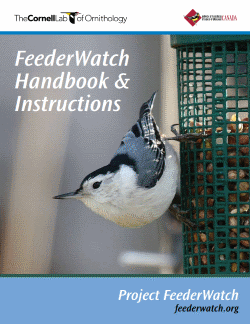
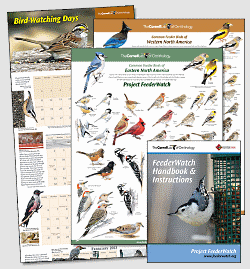
Feederwatch Handbook and Instructions Project Feederwatch, Cornell Lab of Ornithology, Click to view the .pdf
There are several programs where citizens can report their observations of nature to science organizations who need their data. Today, I refer to “Project FeederWatch” hosted by the Cornell Lab of Ornithology, the premier institute for the study of all kinds of wild birds.
View or download Project Feederwatch materials from feederwatch.org Courtesy Project Feederwatch
View or download Project Feederwatch materials from feederwatch.org
Courtesy Project Feederwatch, Cornell Lab of Ornithology
The main goal of the program is to combine the interests of backyard bird watchers with the needs of professional ornithologists. By making simple, standardized counts of the birds in their yards and reporting them to the database, citizens are contributing directly to the scientific understanding and monitoring of bird populations. Our observations help those scientists study changes in the distribution and abundance of feeder birds over time. And people of all ages and experience levels can contribute to actual research by participating in Project FeederWatch.

Observation sites can be as large as two tennis courts, or as small as a single feeder. Make sure the site is easily seen through your windows, then just use that same site all season. You simply observe the birds that come to that site for two consecutive days each week. And your counting time can be less than an hour, or more than eight hours, depending on your personal choices.

The scientists want data collected only during winter months, so in 2018 the reporting time ends April 13.

Record and report the largest number of each species you see at any one time during the two days to avoid double-counting birds.

When the observation season is completed, you can learn the numbers and distribution of various species and see how your yard compared to others who have been observing throughout the United States and Canada.

A couple of tips to get you started: Place your feeder in a quiet area where they are easy to see and fill. It is best to have them around 10 feet from natural cover such as trees and shrubs. This provides them cover and discourages cats and squirrels from leaping to the feeders. Buy fairly large feeders so you don’t have to fill them so often. The best all-around attractant is black-oil sunflower seeds due to its high fat content and it is easy for small birds to handle and crack open. Suet, or cakes of beef fat containing a variety of seeds, is another great choice for attracting insect-eating birds such as woodpeckers, chickadees, and nuthatches. The cakes are placed in small cages to hold the suet while birds enjoy the feast. If you can provide grit (sand, very small pebbles, or ground eggshells) the birds will appreciate it since they use that in their gizzard to basically “chew” the seeds. Water is essential for birds even in winter, but you may need to provide a birdbath heater to keep ice from forming. And NEVER use anti-freeze since it is poisonous to ALL animals. Keep your cat indoors. You can also prevent birds crashing into windows by breaking up the reflections on the glass with netting or other decorations.

And if, one day, while you’re enjoying a melodious chorus of bird songs that suddenly go silent, you may have a visiting Cooper’s or Sharp-Shinned Hawk hunting for lunch.

For more information, and how to register, go to feederwatch.org

This is Ron Hellstern and I’m Wild About Utah!

Credits:

Images: Courtesy & Copyright Project Feederwatch, feederwatch.org
Audio: Courtesy and Copyright Kevin Colver
Text:    Ron Hellstern, Cache Valley Wildlife Association

Additional Reading

Project Feederwatch, Cornell Lab of Ornithology, https://feederwatch.org/

Feederwatch Handbook & Instructions, Project Feederwatch, Cornell Lab of Ornithology, https://feederwatch.org/wp-content/uploads/2016/11/Handbook.pdf

Instruction summary, Project Feederwatch, Cornell Lab of Ornithology, https://feederwatch.org/about/how-to-participate/instructions/

Detailed Instructions, Project Feederwatch, Cornell Lab of Ornithology, https://feederwatch.org/about/detailed-instructions/

HOMESCHOOLER’S GUIDE TO PROJECT FEEDERWATCH, Cornell Lab of Ornithology, https://www.birdsleuth.org/398/

Beyond Penquins and Polar Bears, College of Education and Human Ecology, The Ohio State University, Funded by NSF, February 2009, https://beyondpenguins.ehe.osu.edu/issue/arctic-and-anarctic-birds/project-feederwatch-integrating-real-time-science-and-math

The Language of Ravens

Language of Ravens: Ravens in Bryce Canyon National Park
Common Raven (Corvus corax)
Bryce Canyon National Park
Courtesy US National Park Service
And found on Wikipedia

I was three days downriver and hadn’t seen a soul since shoving my canoe away from the boat ramp outside of town. The only sounds accompanying my solitude were the white noise of rapid water and the echoes of thoughts pin-balling around my mind—that is, until the third morning when, stooped over the small, blue roar of my cook stove, I was startled by an unfamiliar sound. It was a dry heave and the snap of a twig to my imagination at first, before I turned on my haunches to face the raven. But when I saw its eyes reflecting my own, set within a Victorian ruffled collar of frosted ebony feathers, the sounds became a gesture, an announcement of the bird’s presence.

At first, it was only the eyes I could track—deep, watery, and of a midnight hue, darker even than the feathery blanket they peered through. I didn’t respond quickly enough, I suppose. The raven blinked first, hopped toward the cold charcoal of last night’s fire and scooped a piece into his beak—not intending to eat it I’m sure; there was no tilting of the head as to swallow it. And after the first unpalatable bit was cast aside, another was scooped and cast in the same fashion. Then another. Four or five times before I realized what the raven wanted—my oatmeal, of course. As I turned back to my stove, there came the sound again, an ‘Urp!’ and a click of the beak.

The languages of birds in general are vastly complex and nuanced. And the language of ravens is supreme among them. In the unassuming journal Psychology Today, Avian Einsteins blogger and bird author John Marzluff dissects the reasons why. “A complex social lifestyle, long lifespan, and songbird brain provide the motive and machinery a raven needs to remain the most eloquent of avian orators,” Marzluff explains. The clucks, trills, haaas, and quorks common among all ravens are, in and of themselves, amazingly contextual and referential, used in varying sequences and settings to convey different meanings. And according to Marzluff, “New, useful, and intriguing noises can be memorized…and imitated as near perfect renditions,” to be “incorporated into a growing and individual repertoire.” This capacity for continued song learning not only makes raven language one of the most complex in the Animal Kingdom, but it also allows them to engage us humans.

My raven had given up scattering charcoal chips across the sand and had taken to watching me spoon oatmeal into my mouth as I stared back at him. Sat atop my cooler, hunched against the cold, January wind blowing up the canyon, I must not have been a menacing sight to the raven. Every few seconds, it hopped several inches forward toward me and clicked its beak, just as it had done when we first met. Then came the ‘Urp!’ again.

I would relay this experience several weeks later to a colleague and teacher of avian ecology. “It’s a begging behavior,” he would tell me. I was starting to figure this out for myself that morning—however late. I could tell the raven was getting frustrated with me, my relative intelligence coming into question within those midnight black eyes.

Our eyes kept finding each other. Only then did the ‘Urps’ and clicks stop. I was clearly not the first of its human encounters, but this was the first acquaintance I’d ever formally made with a raven. It was both thrilling and unsettling. I thought of Poe, shuddered, and looked away, back to my breakfast which was finally getting cold. I didn’t look at the raven anymore.

He left in disgust, I think, with a parting scoff. I turned at the gesture’s remarkable humanity, a familiar emotion translated between species. And I swear, as he banked into the river bend, he turned his head to glare back at me with those watery midnight eyes.

This is Josh Boling, writing and reading for Wild About Utah

Credits:
Photos: Courtesy US FWS, US NPS
Sound: Courtesy ESA and Popular Culture via YouTube
Text: Josh Boling, 2017

Sources & Additional Reading

Raven Sounds:

Max Ushakov, A huge raven making weird sounds in front of a crowd at the Tower of London., YouTube.com, July 14 2016, https://www.youtube.com/watch?v=l7jgjovK5lY

ESL and Popular Culture, Raven ~ bird call, YouTube.com, Dec 12, 2012, https://www.youtube.com/watch?v=DDv_PlrBg14

Common Raven, Animals, National Geographic, https://www.nationalgeographic.com/animals/birds/c/common-raven/

Bird Note, How to Tell a Raven From a Crow, Oct 22, 2012, Audubon, https://www.audubon.org/news/how-tell-raven-crow

https://video.nationalgeographic.com/video/raven_intelligence

Ravens, Arches National Park, National Park Service – NPS.gov, Last updated: February 8, 2017, https://www.nps.gov/arch/learn/nature/ravens.htm

Common Raven, Zion National Park, National Park Service – NPS.gov, Last updated: January 31, 2016 https://www.nps.gov/zion/learn/nature/raven.htm

South Canyon Sage-Grouse

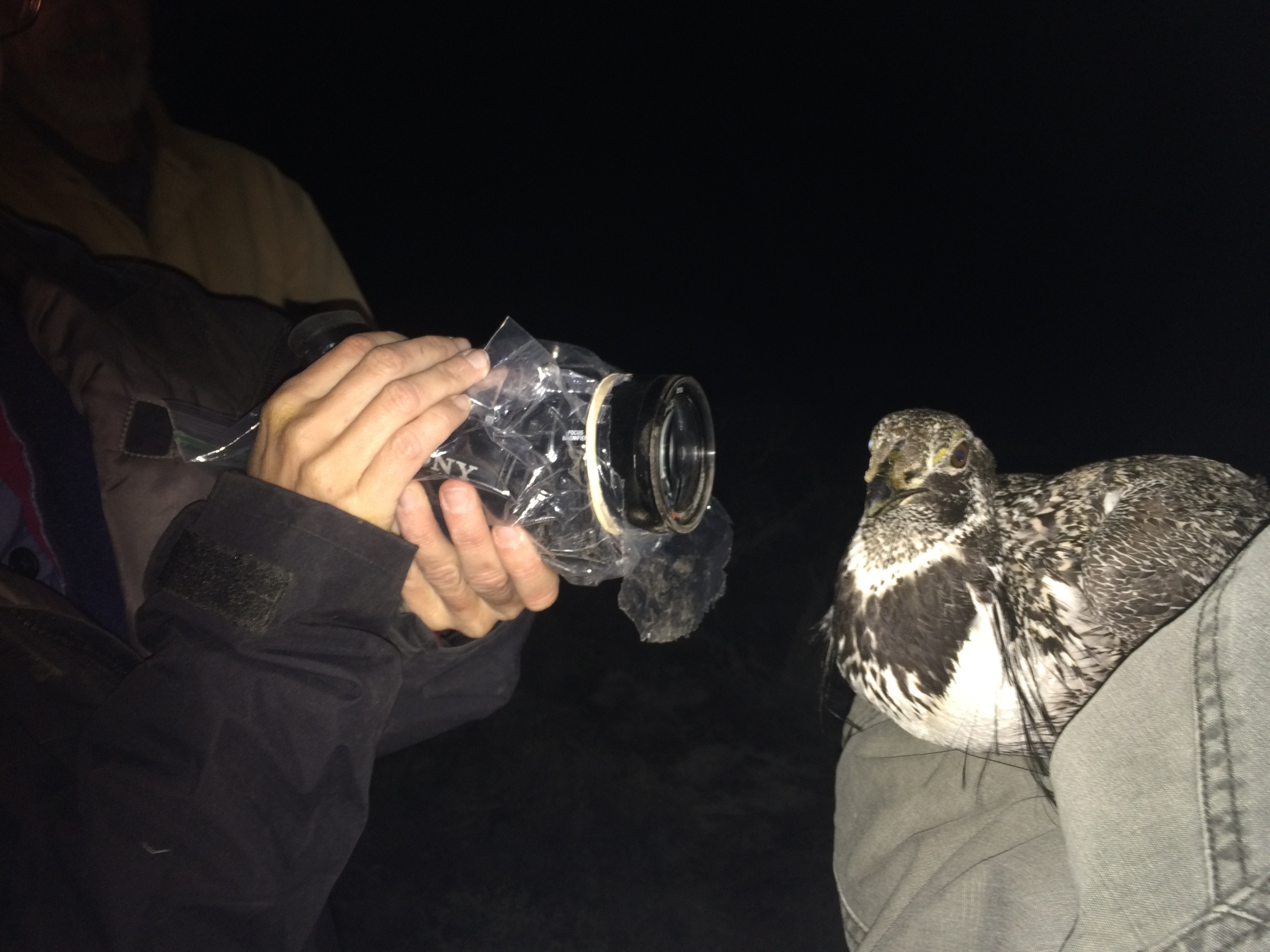
Male Grouse Closeup Courtesy & Copyright Nicki Frey, Photographer
Male Grouse Closeup
Courtesy & Copyright Nicki Frey, Photographer
At 3:00 a.m. on a frigid winter morning Nicki Frey, an Extension Associate Professor in the Department of Wildland Resources at USU, leads a group of new biologists who are trapping west of Bryce Canyon.

Cold, deep snow is all they can see on the valley floor.

The group is looking for the greater sage-grouse whose GPS transmitters are sending Frey signals – indicating they are nearby.

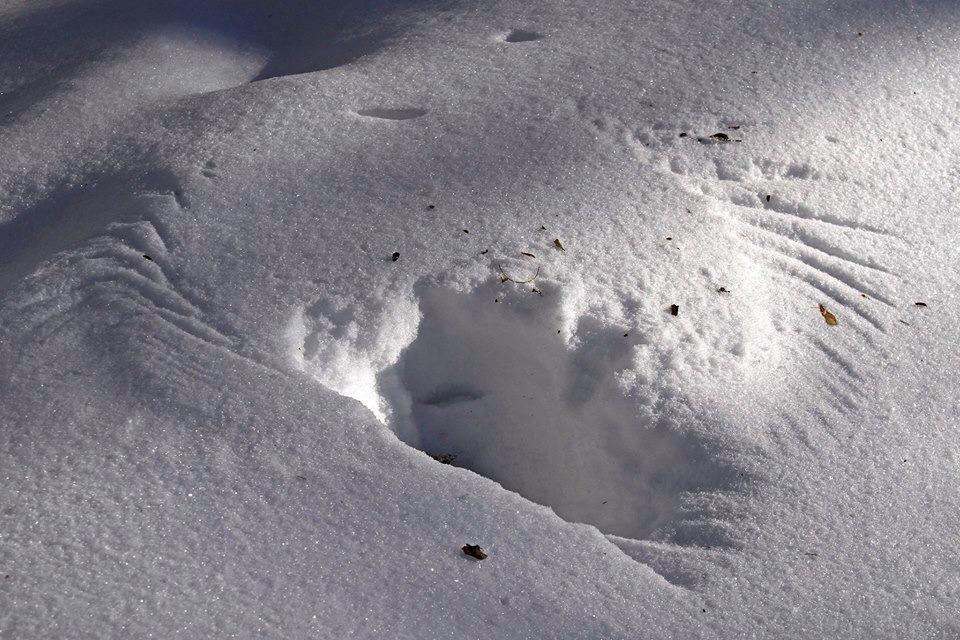
Grouse Tracks in Snow Courtesy & Copyright Nicki Frey, Photographer
Grouse Tracks in Snow
Courtesy & Copyright Nicki Frey, Photographer
For best results, researchers trap sage-grouse on moonless nights. The only light they have comes from the ATVs and headlamps.

Frey explains, “Southern Utah is the farthest southern location where greater sage-grouse live in the U.S. This valley is part of their winter habitat.”

In disbelief, one biologist responds, “It would be impossible for grouse to winter here.”

Documenting Grouse Trapping Courtesy & Copyright Nicki Frey, Photographer
Documenting Grouse Trapping
Courtesy & Copyright Nicki Frey, Photographer
The biologist’s statement is understandable, since research shows the winter habitat for greater sage-grouse is in areas where sagebrush is above the snow, so the grouse can hide underneath and receive protection from the brush and nutrition from its seeds.

Just as Frey begins to respond – 20 grouse burst out of the snow in front of them and fly away. “It scared us out of our skin.” Frey said.

“Everyone retreat! Everyone off of the snow!” Frey calls out.

Grouse Snow Angel and Cave Courtesy & Copyright Nicki Frey, Photographer
Grouse Snow Angel and Cave
Courtesy & Copyright Nicki Frey, Photographer
Then she and her colleague Lisa Church, a biologist from Bureau of Land Management get down on their hands and knees and begin searching for where the grouse were hiding. They see wing marks in the snow and a hole close by. With the use of a flashlight, they look down the hole and discover the birds came from a cave under the snow-covered sagebrush.

Going against the grain, the grouse have been living under the deep snow.

Sagebrush in this area only grow 1.5 to 3 feet, and since the snow can get up to 12 feet it’s not far into winter before the sagebrush is completely covered.

Surprisingly, the grouse have been able to adapt.

Frey explains, “They make these little snow caves and eat the sagebrush leaves inside the cave until they’re gone, then they pop out and pop back into the next sage brush cave and eat the leaves in there.”

Buried sagebrush isn’t the only obstacle the southern grouse have had to adapt to.

Grouse on Edge of New Treatment Courtesy & Copyright Nicki Frey, Photographer
Grouse on Edge of New Treatment
Courtesy & Copyright Nicki Frey, Photographer
Frey explains, “[In Northern Utah you have …nice rolling hills with lots of sage brush that seems to go on forever. In Southern Utah, we have little valleys of prime sage-grouse habitat, but they’re divided by rugged mountains and tree covered hills.”

This environment pushes the grouse to fly longer and further than they normally would.

They fly back and forth between the fragmented sagebrush habitats to find what they need to have a healthy population.

Having to constantly travel between these habitats takes a toll on the southern grouse.

This is an area Utah wildlife managers have helped the greater sage-grouse by removing pinyon-juniper forests which fragment their habitat.

According to Frey, “Anytime we [reconnect] habitat [in the southern region] the grouse use it immediately because they want to expand.”

The impact the Bureau of Land Management and Utah Division of Wildlife Resources projects have had on decreasing the forest barriers is astounding. “The numbers of sage-grouse have steadily increased every year.”

Frey’s research highlights this bird’s remarkable ability to adapt to southern Utah’s climate.

By using the research to assist with management planning, Utah can continue removing barriers for grouse survival and ensure their continued presence in our wildlands.

This is Shauna Leavitt for Wild About Utah.

Credits:
Principal Investigator: Nicki Frey
Photos: Courtesy and Copyright Nicki Frey
Text: Shauna Leavitt

Sources & Additional Reading

Wildlife In Winter & Climate Change

Wildlife In Winter & Climate Change: American Dipper Peter Hart, Photographer Photo credit: PEHart via Visual hunt / CC BY-SA
American Dipper
Peter Hart, Photographer
Photo credit: PEHart via Visual hunt / CC BY-SA
Last Saturday 3 intrepid young families joined us for a morning with the Stokes Nature Center slipping and sliding along a canyon trail to discover animal and plant adaptations to survive the winter. We marveled at the American dipper as it enjoyed plunging in icy water hoping to capture its prey. The dipper remains dry due to a super-sized uropygial gland used for waterproofing its feathers as it preens combined with a thick layer of super isolative fur like feathers. Its temperature actually drops in extreme cold reducing radiated heat loss.

Water reptiles and amphibians were in deep sleep in their mud cocoons. They manage winter through slowing metabolic processes which greatly reduces their need for oxygen, nutrition and waste elimination. What little oxygen needed can be absorbed through their skin without breathing.

Animals such as bears can go into an alternate, light hibernation state called a torpor. Torpor is like hibernation, but in this condition, the bear can be awakened easily. I was reminded of this fact from a friend tagging bear cubs in Book Cliffs of eastern Utah. She would enter the bear din very gingerly trying not to awaken a grumpy mom! Ground squirrels are also among animals who torpor, however they shift between hibernation, torpor, and being awake.

The common poorwill, an uncommon bird in Utah Mountains, is the only bird that goes into true hibernation. It hibernates during extreme temperatures — when it is either too hot or too cold — and at times of food scarcity. The common poorwill can even hibernate while they are incubating eggs, proving to be not only a true survivor, but also a riveting multitasking animal.

Grouse Snow Angel Exiting Subnivean Cave Courtesy US FWS & Wikimedia, Tamarac Refuge, MN
Grouse Snow Angel Exiting Subnivean Cave
Courtesy US FWS & Wikimedia, Tamarac Refuge, MN
Snow is an excellent insulator where many of our more active animals spend most of their winters in subnivean (beneath the snow) environments. Mice, voles, and shrews retreat here for protection from cold temperatures, bitter winds, and hungry predators. Food is right at hand: grass, leaves, bark, seeds, and insects are free and unfrozen. These tiny mammals create long tunnel systems complete with air shafts to the surface above. Perhaps you’ve seen the pocket gopher tunnels revealed as the snow retreats- a snaking ridge of soil creating some interesting, artistic patterns.

Short-tailed weasels, also known in winter as ermine, have a long, slender body shape that allows them to invade subnivean tunnels to prey upon smaller mammals.Photographer: Steven HintCourtesy WikimediaLicensed under Cc-by-sa-3.0
Short-tailed weasels, also known in winter as ermine, have a long, slender body shape that allows them to invade subnivean tunnels to prey upon smaller mammals.
Photographer: Steven Hint
Courtesy Wikimedia
Licensed under Cc-by-sa-3.0
It takes only six inches of snow for mice, voles, and shrews to have a sturdy roof over their heads and roomy living quarters below. Add another two inches and the subnivean zone remains within a degree or two of 32°F, regardless of the temperature and weather conditions in the outside world.

Living under the snow is not without risk. Owls can hear mice and voles running around underground from thirty yards away. With balled-up feet, they crash through the top crust and all the layers of snow to grab their prey. Foxes and coyotes detect by scent. With an acrobatic pounce, these predators will dive right in for their meal. Suffocation is a hazard for those left behind in a collapsed tunnel.

So what happens to these little critters in a low snow-no snow winter becoming more common in a changing climate? I’m guessing a much higher rate of mortality which may not bode well for those bigger critters- hawks, owls, fox, coyote, etc., who munch them.

This is Jack Greene and I’m Wild about Utah!!

Credits:

Images: Peter Hart, Photographer, Photo credit: PEHart via Visual hunt / CC BY-SA
Courtesy Wikimedia Steve Hint, Photographer, Licensed under Cc-by-sa-3.0
Courtesy US FWS Digital Library
Text:     Jack Greene

Additional Reading:

Larese-Casanova, Mark, The Shape of Wildlife in Winter, Wild About Utah, Jan 26,2012, https://wildaboututah.org/the-shape-of-wildlife-in-winter/

Mackay, Barbara, The Subnivean Zone: Shelter in the Snow, Northern Woodlands, Dec 29, 2014, https://wildaboututah.org/the-shape-of-wildlife-in-winter/

Peering into the secret world of life beneath winter snows, National Science Foundation,
https://www.nsf.gov/discoveries/disc_summ.jsp?cntn_id=136986

Snow Tracks, National Wildlife Refuge System, https://www.fws.gov/refuges/features/SnowTracks.html

Glacier National Park:
Winter Ecology Teacher’s Guide https://www.nps.gov/glac/learn/education/upload/Winter%20Ecology%20Teacher%20Guide%202010.pdf

Subnivean Samba: https://www.nps.gov/glac/learn/education/subnivean-samba.htm

4-6, Unit Five, Activity 1: “Snug in the Snow” https://www.nps.gov/glac/learn/education/4-6-unit-five-activity-1-snug-in-the-snow.htm

Winter Ecology, Preparing for your Trip, 3rd-5th Grade Field Trip, https://www.nps.gov/glac/learn/education/upload/3rd-5th-winter-field-trip_GNP.pdf

Rocky Mountain National Park:
Winter Ecology Teacher Guide, https://www.nps.gov/romo/learn/education/upload/Winter-Ecology-Teacher-Guide-for-web.pdf

Craters of the Moon National Monument & Preserve:
Lesson Plan, Prepare for Cold Air!, https://www.nps.gov/teachers/classrooms/prepare-for-cold-air.htm

Helping you share Utah’s natural world!, Utah Nature Explorers, Utah Master Naturalist Program, https://extension.usu.edu/utahnatureexplorers/index

Porpora, Alex, Butts, Neicca, Larese-Casanova, Mark, An Introduction to Nature Journals, Utah Master Naturalist Program, https://extension.usu.edu/utahnatureexplorers/pdflessonplans/generalnature/naturejournaling/Nature%20Journaling.pdf