Ron Imagines a World Without Trees

Whether you live in a desert, a city, a suburb or a farm, your life would change if you lived in a world without trees. You may be a person who appreciates their ecological connections, or have complete disregard for them. As William Blake said, “The tree, which moves some to tears of joy, is in the eyes of others only a green thing which stands in the way.1

So, take a moment and consider the way the world would look, and function, without trees. Currently, forests cover about 30% of the Earth’s land surface. But that’s a loss of 1/3 of all trees just since the beginning of the industrial era. The top five largest forests are located in Russia, Brazil, Canada, the U.S., and China.
Whether you think climate change is natural or human-caused, it affects forests by altering the intensity of fires, creating windstorms, changing precipitation, and enabling introduced species to invade. And the World Resources Institute estimates that tens of thousands of forested acres are destroyed every day.

Sometimes even fragmenting forests can produce harmful results as die-backs occur along the edges, and certain wildlife species will not breed unless they live in large tracts of forested areas. It has been said that roads, which are a cause of fragmentation, are the pathways to forest destruction.

Most people know that trees take in Carbon Dioxide for growth, and release Oxygen via photosynthesis. But trees also remove many air pollutants, provide cooling shade and protection from wind and the sun’s harmful Utra-Violet rays. They can be used as privacy screens, they prevent soil erosion, and are the foundation of wildlife habitat on land. Some provide food, can provide serenity and solitude, and have been proven to reduce stress levels. Their fallen leaves decompose into valuable soil. They reduce the Heat-Island Effect in cities, and are more resistant to climate change impacts. Research has shown they improve retail shopping areas, and speed recovery time for those in health care centers.

For the budget-conscious folks, a mature tree can raise home-property values by as much as $5000. And think about those beautiful Autumn colors.

Ron Imagines a World Without Trees: View of Argyre Basin on Mars Courtesy NASA/JPL Caltech https://wildaboututah.org/wp-admin/upload.php?item=8521
View of Argyre Basin on Mars
Courtesy NASA/JPL Caltech
Composed from images taken by the Mars Color Imager (MARCI) camera on NASA’s Mars Reconnaissance Orbiter
Although there seems to be a number of humans who would volunteer to live on planet Mars, would we really want planet Earth to mirror that treeless image?

Perhaps a re-evaluation of trees is warranted. Ponder these imaginative thoughts penned by well-known writers:
Ralph Waldo Emerson: At the gates of the forest, the surprised man of the world is forced to leave his city estimates of great and small, wise and foolish. The knapsack of custom falls off his back.

William Henry Hudson: When one turned from the lawns and gardens into the wood it was like passing from the open sunlit air to the twilight and still atmosphere of a cathedral interior.

Stephanie June Sorrrell: Let me stand in the heart of a beech tree, with great boughs all sinewed and whorled about me. And, just for a moment, catch a glimpse of primeval time that breathes forgotten within this busy hurrying world.

One way for us to resolve tree issues, is to plant them. And the best time to plant a tree was twenty years ago. But the next best time to plant them is today.

“Silence alone is worthy to be heard.” – Henry David Thoreau

This is Ron Hellstern, and I am Wild About Utah.

Credits:
Images: CourtesyCourtesy NASA/JPL Caltech
Audio: Contains audio courtesy and copyright Friend Feller, Utah Public Radio, UPR.org
Text: Ron Hellstern, Cache Valley Wildlife Association

Additional Reading

Upton, John, Could Common Earthly Organisms Thrive on Mars?, Pacific Standard, May 21, 2014, https://psmag.com/environment/mars-81952

Voak, Hannah, A World Without Trees, Science in School, https://books.google.com/books/about/The_Marriage_of_Heaven_and_Hell.html?id=YUa8AQAAQBAJ

Hudson, William Henry, The Book of a Naturalist, p4, https://books.google.com/books?id=NA4KAAAAMAAJ&pg=PA4&lpg#v=onepage&q&f=false

https://forestry.usu.edu/

Bird Feeding in Winter

Bird Feeding in Winter: A suet feeder, individual cake and a box of cakes. To the right are three gravity feeders with black oil sunflower seeds as well as other seeds. Courtesy Ron Hellstern, photographer
A suet feeder, individual cake and a box of cakes. To the right are three gravity feeders with black oil sunflower seeds as well as other seeds.
Courtesy Ron Hellstern, photographer
Most people enjoy watching birds, except for their occasional deposits on cars or windows. In an earlier program, I mentioned at least fifteen benefits that birds provide to humans and planet Earth. But as human population and developments increase, the survival of many bird species becomes threatened. Now, as winter approaches, colder weather and lack of food adds to the life-threatening dilemmas birds face. Some birds migrate to warmer habitats, but for those that stay in the northern regions a helping-hand from humans is no doubt appreciated.

Presenting “gifts” of birdfeeders and seeds to others (and your own family) will help songbirds and fowls to survive so they can provide their songs and beauty in the Spring. Consider these tips:

  • Buy large birdfeeders so you don’t have to fill them so often. Wet seed can grow harmful bacteria, so use feeders with wide covers.
  • If deer, or other pests, invade your feeders, hang them up higher in trees.
  • Place feeders 10’ away from dense cover to prevent sneak attacks from cats.
  • Provide multiple feeders to increase amounts and diversity of foods.
  • “Favorite” winter foods depends on the species. Black Oil sunflower seeds are loved by most birds, but niger, millet, peanuts, corn, and wheat will attract a diverse range of birds. Experiment and see what comes to your feeders.
  • A combination of beef-fat, with seeds or fruit, is called suet. It is a high-energy food which helps birds stay warm. The 4” cakes are placed in small cages and are loved by flickers, woodpeckers and many other birds. Peanut butter is also relished by birds, but is more expensive than suet.
  • Once birds find your feeders, they will rely on them for regular food supplies. If your feeders become empty, especially during ice storms or blizzards, birds will have a hard time finding natural food. If you take a trip, have a neighbor keep your feeders filled.
  • Buy extra seed and store it in a cool, dry place like a covered plastic trash can which can be kept on a deck, porch, or in a garage.
  • Make sure the feeders are kept clean with hot water, and then dried, about once a month.
  • Some birds, like juncos, towhees, doves and pheasants prefer eating seed which has fallen to the ground. Compact the snow below your feeders so they can find that seed easier.
  • Unless you live near a natural water source, place a pan of water near a feeder on warmer days. Or you could consider a heated bird bath to provide drinking water.
  • If you have fruit trees or berry bushes, leave some of the fruit on the plants to provide natural foods.
  • You may wish to leave birdhouses and nest-boxes up all year for winter roosting sites.
  • Now the fun part comes. After your feeders have been discovered by some birds, word soon gets around the neighborhood and others will arrive. But do you know what they are? The Peterson Field Guidebooks are a great help for beginners because the illustrations are often grouped by color. Then you can become a citizen-scientist and submit your observations to Cornell’s Project Feederwatch or participate in the Great Backyard Bird Count each December. Look online for details.

    Time to get started with your own feeders, or as gifts to others, and begin enjoying the colorful company of finches, woodpeckers, towhees, juncos, sparrows, doves and many others.

    Credits:

    Images: Courtesy & Copyright Ron Hellstern, Photographer
    Audio: Contains bird audio Courtesy & Copyright Kevin Colver
    Text:    Ron Hellstern, Cache Valley Wildlife Association

    Additional Reading

    Feed the Birds, Jim Cane & Linda Kervin, Wild About Utah, Bridgerland Audubon Society, Dec 1, 2011, https://wildaboututah.org/tag/feeding-birds/

    Winter Song Birds, Jim Cane & Linda Kervin, Wild About Utah, Bridgerland Audubon Society, Feb 3, 2009, https://wildaboututah.org/tag/feeding-birds/

    Audubon Guide to Winter Bird-Feeding, Steve Kress, Audubon Magazine, Nov-Dec, 2010, https://www.audubon.org/magazine/november-december-2010/audubon-guide-winter-bird-feeding

    Backyard Birding, Bird Feeding, US Fish & Wildlife Service(FWS), Last Updated: February 19, 2016, https://www.fws.gov/birds/bird-enthusiasts/backyard/bird-feeding.php

    Backyard Birding, Helping our Feathered Friends, US Fish & Wildlife Service(FWS), Last Updated: June 1, 2016, https://www.fws.gov/birds/bird-enthusiasts/backyard/songbird-conservation.php

    Backyard Bird-Feeding Resources, Birds at Your Feeder, Erica H. Dunn, Diane L. Tessaglia-Hymes, Project Feederwatch, https://feederwatch.org/learn/articles/backyard-bird-feeding-resources/

    Western Forest Grouse

    Western Forest Grouse: A dusky grouse chick, several weeks old. Captured up Logan Canyon. The chick was marked with an aluminum leg band with cotton glued to the inside of the band so the leg could grow into the adult-sized band. Photo Credit: Skyler Farnsworth
    A dusky grouse chick, several weeks old. Captured up Logan Canyon. The chick was marked with an aluminum leg band with cotton glued to the inside of the band so the leg could grow into the adult-sized band.
    Photo Credit: Skyler Farnsworth
    In the early winter, when most wildlife are migrating down the mountains, dusky grouse are heading up. The grouse rely on the evergreen needles for their sole food source during winter.

    The female’s feathers are more camouflaged, while males are a slate grey.

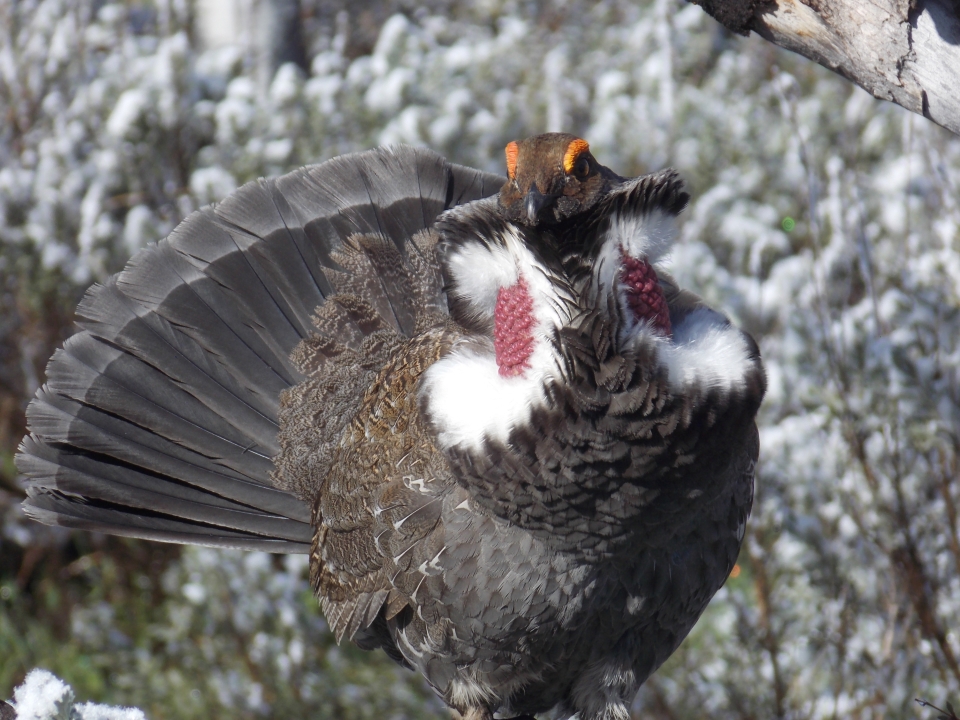
    In the Spring, during mating season, male duskies develop bright red air-sacs surrounded by pure white under-feathers on their necks. To attract the females, they make a deep hooting sound with their air sacs. This sound is made at the lowest decibel humans can hear. When close enough, researchers say they often feel the low vibrations of the hooting, before hearing it with their ears.

    Although duskies are forest grouse, they are more closely related to prairie grouse than other forest grouse. They often use habitats, such as sagebrush and serviceberry outside of the forest canopy and can move up to 20 miles or more in a given year.

    The other forest grouse species found in Utah, the ruffed grouse, prefer staying in a small area about 40 acres their whole life and are small, being slightly larger than a pigeon.

    Western Forest Grouse: A dusky grouse female marked with a solar-powered GPS radio using a rump-style attachment. This was a brood hen with several small chicks with her. She was captured in July and released after several minutes of marking and data collection. Photo Credit: David Dahlgren
    A dusky grouse female marked with a solar-powered GPS radio using a rump-style attachment. This was a brood hen with several small chicks with her. She was captured in July and released after several minutes of marking and data collection.
    Photo Credit: David Dahlgren
    They have a sole winter diet of aspen buds; and remain at a lower elevation during the winter. At night they burrow into snow caves to conserve body heat and energy.

    The feathers of the ruffed grouse form a black band on their tails and black “ruffs” on their neck. These features are more prominent on males. During the spring breeding season, males produce a loud “drumming” sound with their wings to attract the females. The rhythm begins slowly then quickens to a climax.

    Similar to their prairie cousins, forest grouse can be impacted by habitat fragmentation, human development, climate change, and improper grazing and may be a key species for these areas.

    Due to the lack of scientific data, managers do not know the full impact these risks have on the forest grouse.

    Western Forest Grouse: Researcher, Dr. Dwayne Elmore from Oklahoma State University, holding a male ruffed grouse after capture. The bag is used to contain the grouse while getting a weight. Photo Credit: David Dahlgren
    Researcher, Dr. Dwayne Elmore from Oklahoma State University, holding a male ruffed grouse after capture. The bag is used to contain the grouse while getting a weight.
    Photo Credit: David Dahlgren
    David Dahlgren, assistant professor in the Quinney College of Natural Resources was discussing this deficit with Jason Robinson, upland game coordinator, for Utah Division of Wildlife Resources. Both recognized the potential benefits of using modern research techniques with forest grouse.

    Dahlgren explains, “We wanted to get ahead of the ball.” If forest grouse, particularly duskies, are to be considered key species for our mountain ecosystems, we needed scientific information for management.

    Dahlgren began the research with DWR in Fall 2015, in an area where the forest grouse get the highest hunting pressure – the Bear River Range, [in northern Utah, between Cache Valley and Bear Lake].

    From 2015 to 2017, 120 grouse were leg banded. This provided data on harvest, habitat use, and survival.

    Skyler Farnsworth, the project’s graduate student, discovered pointing dogs would help him find and capture grouse during the research. He started the project dog-less and ended with two bird dogs of his own.

    Western Forest Grouse: An adult male dusky grouse in full breeding season display just after a snow in late April. Notice the red air sacs surrounded by white under-feathers, yellow eye combs, and the fanned tail with a grey band. Photo Credit: Skyler Farnsworth.
    An adult male dusky grouse in full breeding season display just after a snow in late April. Notice the red air sacs surrounded by white under-feathers, yellow eye combs, and the fanned tail with a grey band.
    Photo Credit: Skyler Farnsworth.
    Of the 120 bands, only three bands have been returned since 2015 and one of those was found by a hiker after the bird had been caught by a predator.

    Dahlgren explains, “With such a small return, the chance of [hunter harvest] impacting the population is very low, which is comforting and provides real data for forest grouse management.”

    The research on the forest grouse is expanding. Dahlgren explains, “we recently started a similar project focused on dusky grouse in Nevada, working with the Nevada Department of Wildlife.”

    Many partners have supported these forest grouse research projects including, Utah Division of Wildlife Resources, Nevada Department of Wildlife, Sportsman organizations and individuals. USU’s Agricultural Experiment Station provided the bulk of funding support.

    This is Shauna Leavitt and I’m Wild About Utah.

    Western Forest Grouse-Credits:
    Photos: Courtesy & Copyright © Skyler Farnsworth and David Dahlgren
    Text: Shauna Leavitt, Utah Cooperative Fish and Wildlife Research Unit, Quinney College of Natural Resources, Utah State University

    Western Forest Grouse-Additional Reading

    Additional Grouse Articles on Wild About Utah:

    Leavitt, Shauna, Greater Sage-Grouse in Utah, Wild About Utah, July 2, 2018, https://wildaboututah.org/greater-sage-grouse-in-utah/

    Leavitt, Shauna, South Canyon Sage-Grouse, Wild About Utah, Jan 22, 2018, https://wildaboututah.org/south-canyon-sage-grouse/

    Leavitt, Shauna, Greater Sage Grouse Recovery, Wild About Utah, Sep 25, 2017, https://wildaboututah.org/greater-sage-grouse-recovery/

    Leavitt, Shauna, Decreasing the Habitat Risks of Utah’s Southern Sage-Grouse, Wild About Utah, June 12, 2017, https://wildaboututah.org/greater-sage-grouse-in-utah/

    Greene, Jack, Sage Steppe, Wild About Utah, Jun 15, 2015, https://wildaboututah.org/sage-steppe/

    Liberatore, Andrea, Ruffed Grouse and the Christmas Bird Count, Wild About Utah, Dec 8, 2014, https://wildaboututah.org/ruffed-grouse-christmas-bird-count/

    Kervin, Linda, Sage Grouse, Pronghorn Antelope and Fences, Wild About Utah, May 5, 2011, https://wildaboututah.org/sage-grouse-pronghorn-antelope-and-fences/
    Western Forest Grouse

    Migration

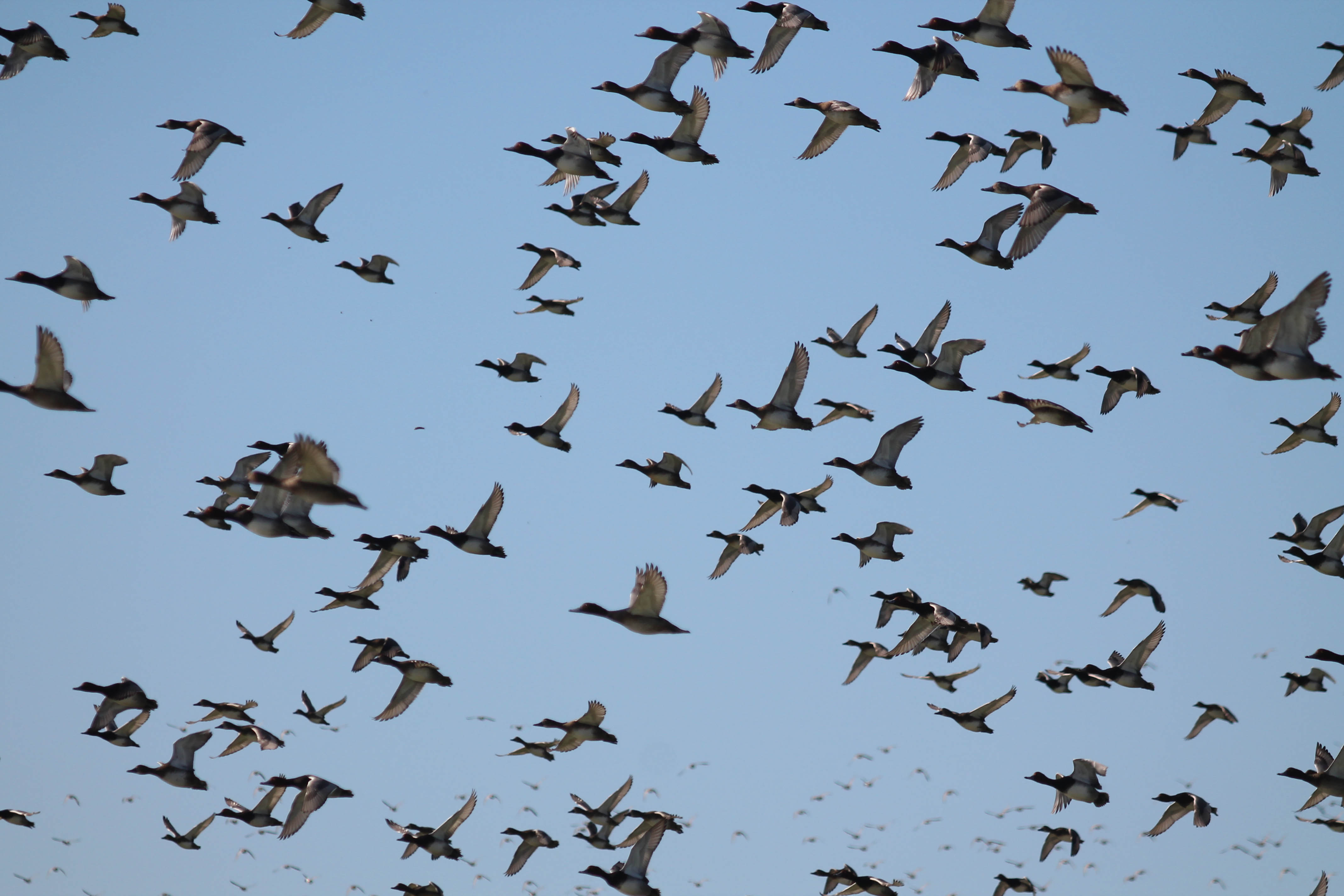
    Migration: Redhead Ducks Courtesy US FWS Nate Rathbun, Photographer
    Redhead Ducks
    Courtesy US FWS
    Nate Rathbun, Photographer
    Migration has begun, or did it ever end? Even in our little Northern Utah valley its happening. We normally think of migration during the great flocks of birds that pass through during swing months of fall and spring, or the deer and elk coming down for the winter, or swarms of salmon swimming to their death when spawning. But that’s only a small part of the story.

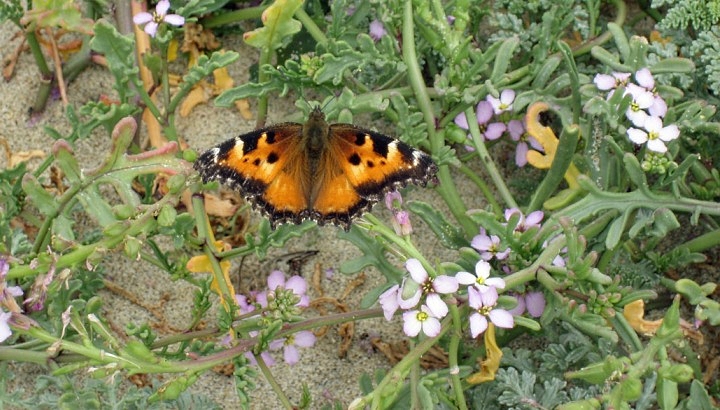
    Migration: California Tortoiseshell Butterfly, Nymphalis californica, Courtesy US FWS Salinas River NWS
    California Tortoiseshell Butterfly
    Nymphalis californica
    Courtesy US FWS
    Salinas River NWS
    A high elevation trek in our Bear River range in July where cloudbursts of lovely California tortoiseshell butterflies surrounded me provided testimony as they worked their way to unknown destinations. With the iconic monarch butterfly populations plummeting, it’s comforting to have other species holding their own- most likely due to their lives being spent in high elevation wild lands, well away from farms and lawns where pesticides and habitat loss present major challenges to monarch survival.

    The California tortoiseshell, overwinters as an adult and can sometimes be seen sunning itself in midwinter on mild days. It is generally common in lower canyons in early spring, ovipositing on the young, tender growth of Ceanothus shrubs. The spiny, black-marked-with-yellow larvae feed gregariously, without a web, and in big years can defoliate whole stands of these plants. They often pupate on the bare, leafless stems en masse, the grayish-violet pupae looking like some strange kind of leaf and twitching in unison when disturbed. Adults emerge in late May to early June and almost immediately emigrate, going north and upslope. Breeding localities in summer vary widely from year to year.

    In late July they migrate to estivating grounds often in the high country. Estivating tortoiseshells do little but “hang out,” and many high-altitude hikers have described their encounters with millions of them in mystical terms. In late September these butterflies scatter downslope to hibernate–they are the late-winter butterflies of the new year, living 9 or 10 months as adults.

    They visit flowers of many kinds, aphid and scale honeydew, damaged fruit, sap–and mud: a mud puddle in a mass migration is a memorable sight, often with hundreds or thousands packed side-by-side on the damp surface.
    Close to home the yellow warbler is yet singing- one of the last of our neotropical birds to hang it up. These tiny warblers will soon head south to Central and South America.

    Even our native people would migrate to follow the plant and animal populations spending time in high mountains during summer months for camas lily, mountain sheep, and berries, then retreating to low elevations as the winter season approached for milder weather and more available food. And here in Logan we have a swarm of “Summer Citizens” who show up in May to occupy the nests vacated by USU students, who will soon migrate south as our student return.

    And I retreat to our canyons for skiing once the snow is on.

    This is Jack Greene- and I continue to be Wild About Utah!

    Credits:

    Images: Courtesy USDA Forest Service, Photographers noted for each image
    Text:     Jack Greene

    Sources & Additional Reading:

    Hellstern, Ron, Autumn Migrations, Wild About Utah, Oct 16, 2017 https://wildaboututah.org/autumn-migrations/

    Snake Migration, On the road in Shawnee National Forest, National Geographic Society, https://www.nationalgeographic.org/news/snake-migration/

    Elk, Wild Aware Utah, Utah’s Hogle Zoo & Utah Division of Wildlife Resources, https://www.wildawareutah.org/utah-wildlife-information/elk/

    Butterflies of Malheur National Wildlife Refuge, US Fish & Wildlife Service (FWS), Malheur National Wildlife Refuge, https://www.fws.gov/uploadedFiles/Region_1/NWRS/Zone_2/Malheur/Sections/What_We_Do/Science/reports/id_butterflies_guide.pdf

    NRCS Working Lands for Monarch Butterflies, https://arcg.is/0TjueO