Morning Routine

Morning Routine: Patrick Kelly Courtesy Patrick Kelly, Photographer
Morning Routine Patrick Kelly Courtesy Patrick Kelly, Photographer
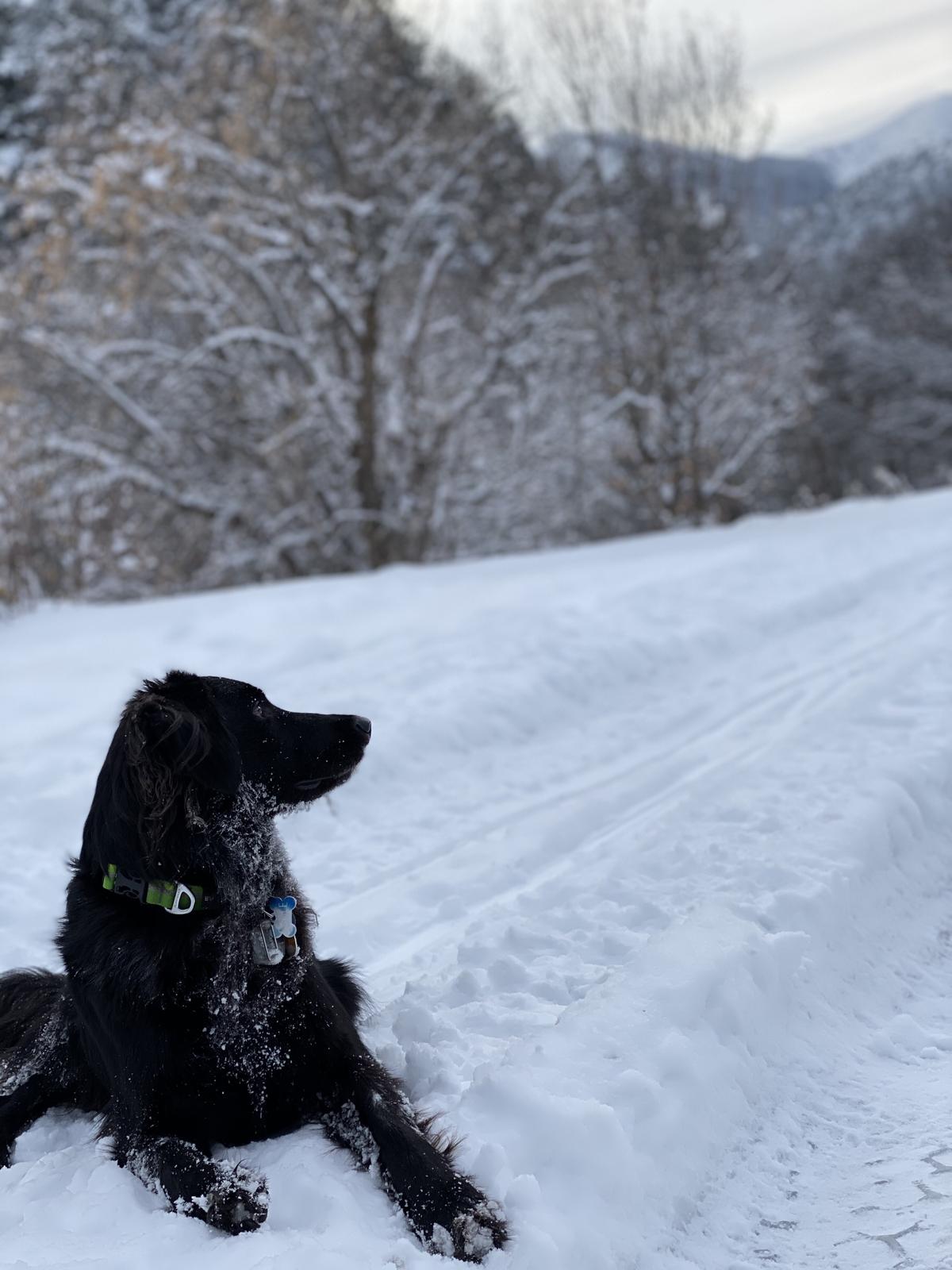
Every morning, me and my dog Sable go on a hike. It’s not a trek, but just an early morning walk up our favorite hidden canyon which lies in plain sight. We set off from our house right about 8 o’clock and drive up the hillsides to the canyon mouth. We weave out of our little town and into the next, winding up and up, past the houses that weren’t here 15 years ago, then 10 years ago, then 5. We rise higher than any business, home, or other building as we approach our morning trailhead. It’s good, that above all of the buildings we’ve constructed over the years, still lies the land eternal. I like that.

As we get out of the car, Sable springs and sprints immediately, starting up the berm just past the parking lot. She lives for the forest and the canyons. Up here, as nowhere in our small town’s limits, she can let loose off leash, be wild, go running after squirrels (which tree and evade her each time,) smell the logbook rocks of dogs before us, and be a very happy free dog. And if you believe that dogs smile as I know, then she beams radiant like the sun as she runs like the wind. I like that most of all.

At the top of the berm lies a retention dam, just in case anything should happen up our little canyon as to not damage the new homes below. But on top of this lies our first view of our valley floor home. Only from the edge of things can we first see them truly. The valley and the mountains on her other rim are a sweeping view in every season, in every weather, in every light or dark. I stand, breathe deep seeing the world below like an astronaut, and turn my back on this beauty, for that is the only way up the canyon.

We begin our journey up, up, up. We meander along the trail past picnic tables and illegal fire rings. We move past small open fields where Sable leans into full sprint, and into the maple and juniper thickets, dense with the quieting effect of treestands, allowing our canyon to cease being just at the edge of town, and to become the morning wilderness heartbeat we both seek. If we hear a branch snap, we’ll both stop dead in our tracks, hold our breath, and listen long. I love these moments. A man and a dog, two species in one moment sharing how we approach the world of the unknown. Then, in our united journey, we set off again through the morning wild.

On our morning walks, we do not go far, certainly less than a mile. It usually takes us just 15 minutes to get to our turnaround point, a Forest Service gate meant to keep cattle from running into the retention dam and the town below. Sometimes when I am feeling slow or want to soak up the canyon a bit more, there is a small cavelet just off from the gate. I’ll go and sit on the rocks within, observing how the mosses grow on the seeping water and listen to the invisible birds around me.

From our turnaround gate, I always stop and let Sable run a bit further up trail before she comes back. She’s good at checking in, even after some of her more worrisome decisions of scaling the canyon sides into its cliffed faces in search of ground squirrel chatter. After she comes back, we turn back towards town in knowing silence, descending to the world in which we live.

Going down always takes less time, too little time it seems sometimes. On the descent, Sable is like a bobsledder: an unstoppable force of energy hugging the luge of the trail. It’s truly beautiful to see such athleticism paired with boundless joy in running. It must be the greatest fun to be a dog in the forest.

When we both finally pop out of the trees back at the retention dam, the town below opens into view. I don’t stop this time. I keep on trodding to the car with Sable. It’s not that I don’t appreciate the view of town on the way down, it’s that I don’t need to dip my toe in in order to be brave enough to plunge by now. Back to life’s duties and hullabaloo.

Driving down, I drop Sable off at home to sleep in the sunny backyard or chew on an elk bone for the day, and I head off to my own work. All day though, I can keep thinking back to our shared morning walk, not even half an hour, but worth its more than its weight in sunrise gold. All day I feel good and alive, and I know Sable does too from just a short jaunt. I know that she loves living in a beautiful, wild place just as much as I do. We both know the goodness in such places and in living in such places. Two species, one shared love for this land and our favorite hidden canyon which lies in plain sight.

My name is Patrick Kelly and I am Wild About Utah.
 
Morning Routine-Credits:

Images: Image Courtesy & Copyright Patrick Kelly, Photographer, all rights reserved
Audio: Contains audio Courtesy & Copyright Kevin Colver
Text:    Patrick Kelly, Director of Education, Stokes Nature Center, https://logannature.org
Included Links: Lyle Bingham, Webmaster, WildAboutUtah.org

Morning Routine-Additional Reading

Cache County Trails, Cache County, https://trails.cachecounty.org/ [updated November 6, 2024] https://www.cachecounty.gov/gis/offline-recreation-mapping.html

Hiking Trail Guide, Cache Valley Visitors Bureau/Logan Ranger District, Wasatch-Cache National Forest, https://www.explorelogan.com/assets/files/brochures/hiking.pdf

Cache Trails, A hiking guide for the trails of the Cache Valley, Bridgerland Audubon Society, https://bridgerlandaudubon.org/our-projects/publications/

Christmas Bird Count 2019

Christmas Bird Count 2019: Mourning Dove Pair Courtesy Pixabay www.pixabay.com
Mourning Dove Pair
Courtesy Pixabay
www.pixabay.com
On December 14th, I will join several others for an exciting day of counting bird species and numbers in our lovely, snowy valley. The numbers will be entered on a database that will be shared globally.

Count Data:
The data collected by observers over the past 120 years has allowed researchers to study the long-term health and status of bird populations across North America. When combined with other surveys such as the Breeding Bird Survey, it provides a picture of how the continent’s bird populations have changed in time and space. This long term perspective is vital for conservationists. It informs strategists to better protect birds and their habitat, and helps identify environmental issues, with implications for people as well.

The count has special significance for our changing climate’s impact on birds which is disrupting populations and their spacial distribution that are changing at an accelerating rate.

The report:
Audubon’s 2014 Climate Change Report is a comprehensive, first-of-its kind study that predicts how climate change could affect the ranges of 588 North American birds. Of the bird species studied, more than half are likely to be in trouble. The models indicate that 314 species will lose more than half of their current range by 2080. Adding to this, a recent study by the Cornell Laboratory of Ornithology reported a 29 percent decline in North American bird populations since 1970.

142 species of concern are found in Utah including our state bird, the California gull and our national symbol, the bald eagle. Averaging the most recent 10 years, Cache valley has seen 16 species increase and 11 species decline. Of course we would need a much broader sweep to know the true story of these species, but our data may play a significant part in the overall analysis.

Audubon’s Climate Initiative, encourages its members to take steps to address the climate change threat in their backyards and communities. Visit their website at audubon.org for how to take action.

Many Citizen Science programs exist for families to participate in- https://www.birds.cornell.edu that have generated reams of data over many years showing the species diversity and abundance of birds in North America and globally. Our valley Christmas Bird Count occurs next Saturday, December 14th. Contact bridgerlandaudubon.org for details. Always a good time gathering important data!

And please, keep those bird feeders full as we enter the coldest month of the year!

This is Jack Greene for Wild About Utah.

Christmas Bird Count 2019: Credits:

Images: Courtesy Pixabay: https://pixabay.com/service/license/
Audio: Contains Audio Courtesy and Copyright Kevin Colver
Text:     Jack Greene

Christmas Bird Count 2019: Additional Reading:

Sat, Dec 14, 2019 Logan, Utah Christmas Bird Count, https://bridgerlandaudubon.org/save-the-date-sat-dec-14th/

Bridgerland Audubon Society Christmas Bird Count Page, https://bridgerlandaudubon.org/our-projects/cache-valley-christmas-bird-count/

Utahbirds.org, 2019 Christmas Bird Count Schedule, (Local) https://utahbirds.org/cbc/cbc.html

National Audubon, Christmas Bird Count, https://www.audubon.org/conservation/science/christmas-bird-count

Greene, Jack, Cache Valley Christmas Bird Count (CBC) and Climate Change, Wild About Utah, December 11, 2017, https://wildaboututah.org/cache-valley-christmas-bird-count-cbc-climate-change/

Kervin, Linda, The Christmas Bird Count, Wild About Utah, December 16, 2008, https://wildaboututah.org/the-christmas-bird-count/

Cane, James, Kervin, Linda, The Christmas Bird Count, Wild About Utah, December 9, 2010, https://wildaboututah.org/christmas-bird-count/

Liberatore, Andrea, Ruffed Grouse and the Christmas Bird Count, Wild About Utah, December 8, 2014, https://wildaboututah.org/ruffed-grouse-christmas-bird-count/

Greene, Jack, Climate Change and the Christmas Bird Count, Wild About Utah, December 12, 2008, https://wildaboututah.org/climate-change-and-the-christmast-bird-count/

Winter Songs

Winter Songs: American Dipper Courtesy US FWS Dave Menke, Photographer
American Dipper
Courtesy US FWS
Dave Menke, Photographer
Most of our songbirds have taken their songs and headed south. Even robins and meadowlarks have ceased their lovely melodies that carried well into the fall months. But there are a few noteworthy choristers that have remained- Townsend solitaires and N. American dippers. Not only do they sing beautifully (anthropocizing here) but they vocalize for different reasons than most. The breeding/nesting season has long since passed, which is the primary reason birds sing- attracting a mate and defending their breeding territory from other males.

So one might ask why sing? Both of the species mentioned are defending their feeding, not breeding territory. Townsends switch from insects to berries during the winter months, including juniper berries (actually cones) which they have a special penchant for. I’ve witnessed many instances of them doing battle while defending their tree from intruders. They often perch on the highest branch daring others of their kind to pick a berry. Females defend as well.

In my cozy little canyon they begin migrating down from their high mountain nesting territory in October filled with song, which is supposedly different from that used during courtship. Townsends keep good company as members of the thrush family which include bluebirds, robins, and various other thrush species- all known for their enchanting refrains. A flock of thrushes is known as a hermitage, interesting considering there is one named hermit thrush, quite common in our mountains.

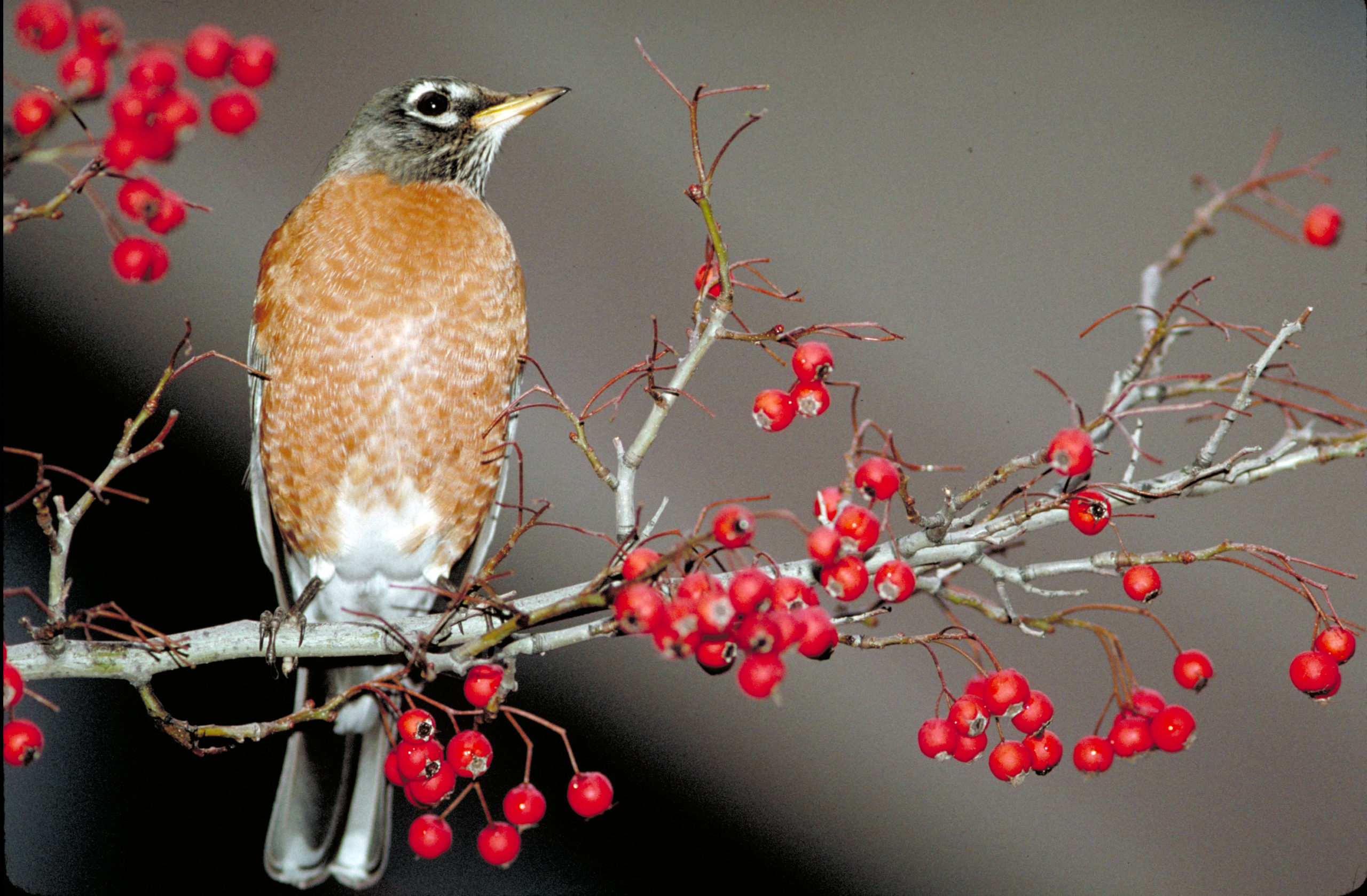
Winter songs: American Robin Turdus migratorius Courtesy US FWS Dr. Thomas G. Barnes, Photographer
American Robin
Turdus migratorius
Courtesy US FWS
Dr. Thomas G. Barnes, Photographer
Robins, also berry eaters, are welcome guests, and often share the same tree with the solitaires. Considerably larger than their cousins, they feed unmolested.

The dipper sings its river song as it flits along streams. The varied notes are complicated and loud, possibly to compete with the rushing waters where it resides, including water falls. They will lay claim to a stretch of stream and like the solitaire, daring another of its kind to trespass. I’ve witnessed this amazing songster singing full tilt during white-out blizzards, challenging the storms intensity with its brazen refrains. “The dippers song is strong and sweet, made up of a great variety of trills and flute-like passages, delivered with great spirit and brilliance.”

I’ve not attempted to measure the length of its feeding domain, but assume it varies depending on food abundance. This little “penguin of the Rockies” as I call it, will dive underwater using its wings to stroke along the stream bottom while capturing its prey, which may include small fish. Constant preening with oil from near the base of its tail keeps it dry, and high density feathers provide excellent insulation. The cold waters must bring relief from comparatively frigid winter air.

I once observed a most unusual mating behavior when a pair of lovers suddenly spiraled up well over a hundred vertical feet from the stream, where they are otherwise tethered. Is this usual during courtship? I’ve only seen in on one occasion. Nature is full of mysteries and shock factor. Never say never! The Audubon Climate/bird reports Solitaires lose 92% of their summer range and an 88% loss for dippers by 2080, and their songs as well. This means more miles on my bike and less in my car.

This is Jack Greene- most fortunate to be part of this Wild Utah!

Credits:

Images: American Dipper, Courtesy US FWS, Dave Menke, Photographer
Images: American Robin, Courtesy US FWS, Dr. Thomas G. Barnes, Photographer
Audio: Contains Audio Courtesy and Copyright
Text:     Jack Greene

Sources & Additional Reading:

Bengston, Anna, Robins in Winter, Wild About Utah, March 13, 2014, https://wildaboututah.org/robins-in-winter/

Cane, James, Winter Song Birds, Wild About Utah, Feb 3, 2009, https://wildaboututah.org/winter-song-birds/

Porter, Diane, Learning Bird Songs in Winter, 2009, https://www.birdwatching.com/tips/earwatching_winter.html

Hungry Hummingbirds

Hungry Hummingbirds: Hummingbird at Feeder Courtesy and Copyright Ron Hellstern, Photographer
Hummingbird at Feeder
Courtesy and Copyright Ron Hellstern, Photographer
Having witnessed people in poverty, as well as starving animals, I can never condone the fascination some Americans have with Hot Dog Eating Contests. Yet humans are poor competitors when compared to some members of the animal kingdom.

Hungry Hummingbirds: Hummingbirds at Feeder Courtesy and Copyright Ron Hellstern, Photographer
Hummingbirds at Feeder
Courtesy and Copyright Ron Hellstern, Photographer
To simplify the math, let’s say you weigh 100 pounds. Imagine eating 150 pounds of food every day just to maintain your energy level! I have about twenty guests at my home near Logan right now that eat one and one-half times their body weight every day, and they’ve been doing it for months. Hummingbirds!

Hungry Hummingbirds: With a length of 9.5 cm, the rufous hummingbird has the longest migration in the world in relation to its size. Photo courtesy and Copyright © 2010 Michael Fish
With a length of 9.5 cm,
the rufous hummingbird
has the longest migration
in the world in relation to its size.
Photo courtesy and
Copyright © 2010 Michael Fish
We have a good mix of Broad-Tailed, Black-Chinned, and Rufous Hummingbirds that are busy at our feeders from early morning until 9:00pm. Those three are the most common species in Utah although others, like the Anna’s, Costa’s and Calliopes are seen in our Southern regions. And even though we have plenty of feeding stations at our home, it’s interesting how they will usually try to scare each other off each time they approach a feeder. I keep telling them to share, but they won’t listen to me.

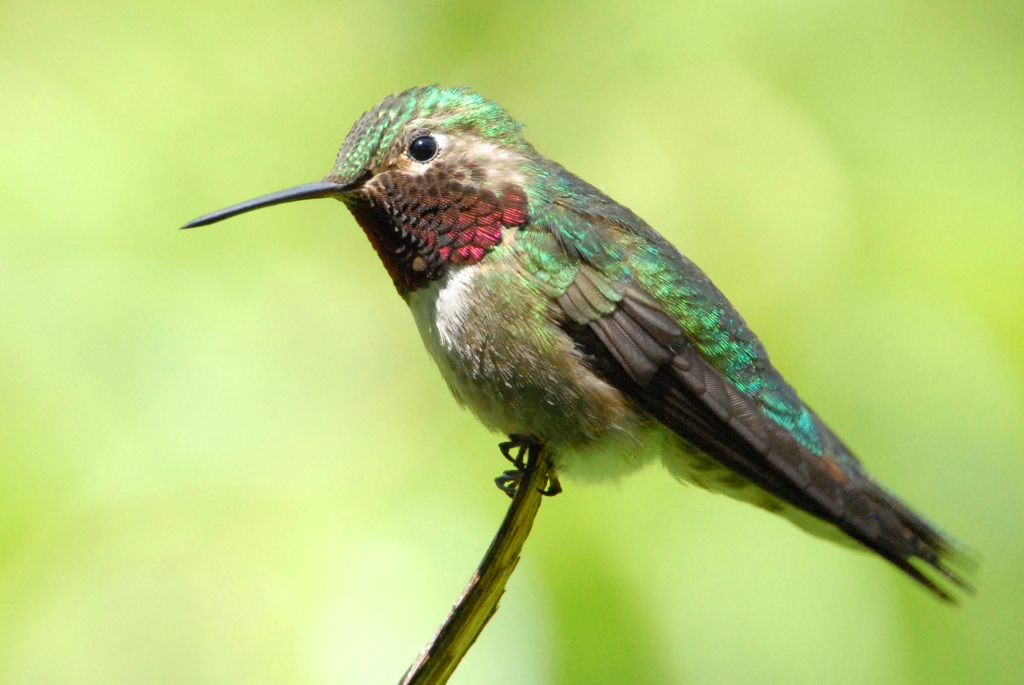
Male Broad-tailed Hummingbird Selasphorus platycercus Copyright © 2010 Michael Fish
Male Broad-tailed Hummingbird
Selasphorus platycercus
Copyright © 2010 Michael Fish
Their need for food makes sense due to their tremendous expenditure of energy. Their heart rates are the fastest of any bird species at about 500 beats per minute…when resting, and 1,200 beats when flying. And their wings beat up to 90 times…per second. Even their breathing is race-paced at 250 breaths per minute. They basically need to refuel constantly.

Adult Black-chinned Hummingbird incubating eggs in nest Archilochus alexandri Copyright © 2010 Lyle Bingham (cell phone through spotting scope)
Adult Black-chinned Hummingbird
incubating eggs in nest
Archilochus alexandri
Copyright © 2010 Lyle Bingham
(cell phone through spotting scope)
Speaking about flying, they can go forward, backward, and even upside down. And while their speed can approach nearly 50 miles per hour, they don’t shirk at long distances. They winter in the tropics, but some will travel up to 2,500 miles one way to breed in Canada and Alaska.

Some scientists are concerned about rising temperatures because flowers are blooming earlier in northern areas, which means that food source may be gone when the hummingbirds arrive.
While they also eat insects, you can attract hummingbirds to your yards with the right plants. They like nectar plants like Columbines, Honeysuckle, Penstemon, Paintbrush, Bleeding Hearts and Trumpet Vines. You can also supplement those nectar sources with feeders.

Young Black-chinned Hummingbird with beak hanging out of nest Archilochus alexandri Copyright © 2010 Lyle Bingham
Young Black-chinned Hummingbird
with beak hanging out of nest
Archilochus alexandri
Copyright © 2010 Lyle Bingham
They are attracted to the color red, but don’t buy commercial food mixes that have food coloring in them because it is harmful to them. And never use honey or artificial sweeteners. Just boil 4 parts water to one part white-granulated sugar. Let it cool and fill your feeders. And in most cases, if you fill it, they will come.
If you’re lucky, the little guys may like your wildlife habitat so much they may even nest there, although those are difficult to see since they aren’t much larger than a quarter. They generally lay two eggs about the size of navy beans, but please don’t disturb the little nest or chicks.

Plant the correct flowers, nesting habitat, and put up feeders, and you may experience one of nature’s flying wonders…the Hummingbird.

This is Ron Hellstern, and I am Wild About Utah.
 
Credits:

Images: Courtesy & Copyright Ron Hellstern
Audio: Courtesy and Copyright Kevin Colver
Text: Ron Hellstern, Cache Valley Wildlife Association

Additional Reading

Greene, Jack, Rufus Hummingbird, Wild About Utah, Aug 3, 2015,
https://wildaboututah.org/rufous-hummingbird/

Kervin, Linda, Gardening for Hummingbirds, June 5, 2014, https://wildaboututah.org/gardening-hummingbirds/

Liberatore, Andrea, Hummingbird Nests, Wild About Utah, Jun 14, 2012,
https://wildaboututah.org/hummingbird-nests/

Strand, Holly, Hummingbirds in Utah, Wild About Utah, Sept 3, 2009,
https://wildaboututah.org/hummingbirds-in-utah/

Strand, Holly, Heading South, Wild About Utah, Oct 28, 2010,
https://wildaboututah.org/heading-south/