Finding the Black Rosy-Finch

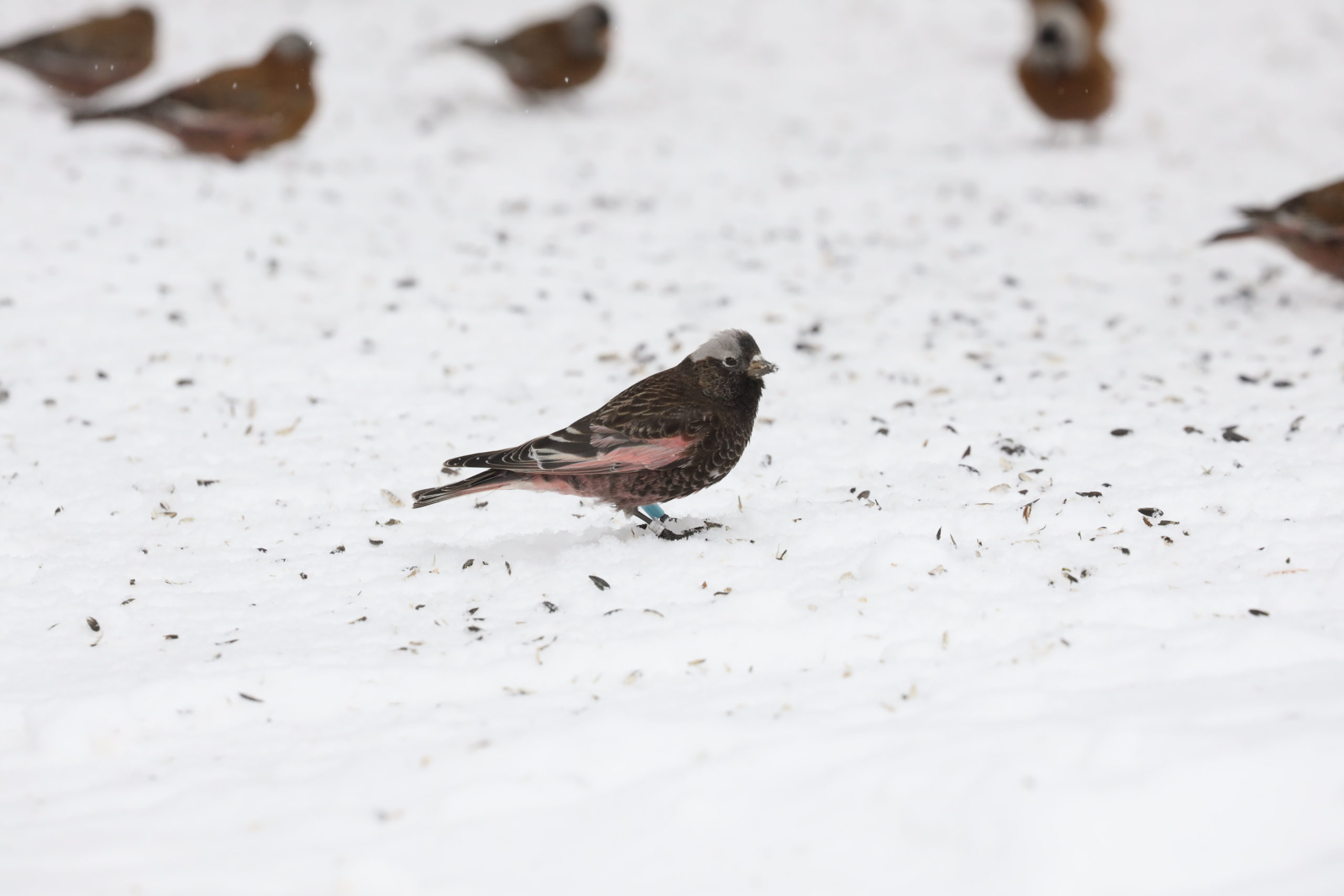
Black Rosy-Finch Courtesy & © Janice Gardner, Photographer
Black Rosy-Finch (cropped)
Courtesy & © Janice Gardner, Photographer

Newly Banded Adult Male Black Rosy-Finch Courtesy & © Kim Savides Newly Banded Adult Male
Black Rosy-Finch
Courtesy & © Kim Savides

Rosy Finch Study Wild Utah ProjectRosy-Finch Study, Wild Utah Project

High in the snow-covered mountains of Northern Utah, Kim Savides, a graduate student in the Department of Wildland Resources at Utah State University waits for the daily avalanche report during winter months. If favorable, she ventures out to remote bird feeders in hopes of finding black rosy-finches.

The finches thrive in bad weather. When it’s a clear, sunny day Savides knows her likelihood of seeing a finch is slim. But on nasty, snowy, windy days she can count on seeing hundreds of the finches around the feeders.

Most of the bird feeders are on Utah’s beautiful ski resorts such as Alta and Powder Mountain. On blizzard-like days when skiers are choosing to staying home, Savides is heading up the slopes.

Clark Rushing, assistant professor in Department of Wildland Resources in the Quinney College of Natural Resources and principal investigator on the project explains, “To catch these black rosy-finches, we’re travelling to locations when the weather is at its worst. They are extremely hardy birds, how they survive in those conditions is pretty astounding. They are small birds weighing only a few ounces.”

Due to the warming temperatures, the black rosy-finch populations may be at risk.

Scientists fear the finch numbers may be decreasing, based on the reports from bird watchers who say they are seeing much less of the attractive bird. Researchers are concerned it may be a result of climate change.

Rushing explains, “The black rosy-finch has a small breeding distribution confined to very high elevation sites. Climate change may drive this species to smaller and smaller population sizes and possible extinction because as climate warms these sites, where the finches can breed, they will get smaller and smaller. The birds could eventually get pushed off the tops of the mountains with nowhere to go.”

According to the Wild Utah Project, “The black rosy-finch is one of the least-understood birds in North America. We understand little about its reproduction, population status, survival rates, or migratory tendencies.” Without this information wildlife managers can do little to help conserve its population.

Savides’ goal is to assist in gathering enough data so wildlife managers may begin to understand the life cycle of the finch and plan for conservation efforts.

Her project began by setting up mist nets around the feeders to catch the birds. Once caught, the finches were gently held while a micro-chip bracelet was attached to their legs.

Each time one of the tagged finches approaches a feeder, equipped with a radio frequency reader, the bird’s visit is logged.

The finches tagged last year are now returning. The data is beginning to be gathered.

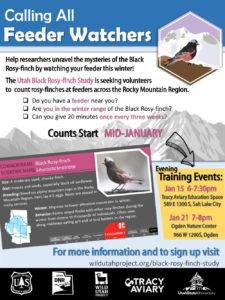
Recognizing the amount of data needed, researchers have expanded the data gathering to include citizen scientists. These are residents of Utah who volunteer to be trained to identify the black rosy-finches. In the winter when the birds come down to lower elevations, in certain parts of the state, residents can report when they see the finches.

Any resident interested in becoming a citizen scientist can go to the Wild Utah Project website and receive more information.

As more and more data are gathered, researchers and wildlife managers can begin understanding the phenology of when the finches come down to lower elevations, when they return to higher elevations to breed, and how likely they are to survive from one year to the next. This knowledge could help with conservation efforts.

This is Shauna Leavitt and I’m Wild About Utah.

Credits:
Photos: Courtesy & © Janice Gardner
      Courtesy & Copyright © Kim Savides,
      Courtesy & Copyright © Wild Utah Project
Lead Audio: Courtesy and © Kevin Colver
Text: Shauna Leavitt, Utah Cooperative Fish and Wildlife Research Unit, Quinney College of Natural Resources, Utah State University

Sources & Additional Reading

Greene, Jack, Rosy Finches, Wild About Utah, March 11, 2019, https://wildaboututah.org/rosy-finches/

Gardner, Janice, Rosy Finch Study, Wild Utah Project, Fall/Winter 2019/2020, https://sagelandcollaborative.org/rosy-finch/ [link updated January 2024 – note WildUtahProject.org transformed to SagelandCollaborative.org]

Strand, Holly, A Big Year in Utah, Wild About Utah, October 27, 2011, https://wildaboututah.org/a-big-year-in-utah/

Black Rosy-Finch Identification, All About Birds, Cornell Lab of Ornithology, Cornell University, https://www.allaboutbirds.org/guide/Black_Rosy-Finch/id

Gray-Crowned Rosy-Finch Identification, All About Birds, Cornell Lab of Ornithology, Cornell University, https://www.allaboutbirds.org/guide/Gray-crowned_Rosy-Finch/id

Black Rosy Finches, Utah Division of Wildlife Resources, Utah Department of Natural Resources, https://fieldguide.wildlife.utah.gov/?species=leucosticte%20atrata

Gray-crowned Rosy Finches, Utah Division of Wildlife Resources, Utah Department of Natural Resources, https://fieldguide.wildlife.utah.gov/?Species=Leucosticte%20tephrocotis

Black Rosy Finches, UtahBirds.org, https://www.utahbirds.org/birdsofutah/Profiles/BlackRosyFinch.htm

Gray-crowned Rosy Finches, UtahBirds.org, https://www.utahbirds.org/birdsofutah/ProfilesD-K/GrayCrownedRosyFinch.htm

Black & Gray Rosy Finches, Tim Avery Birding, http://www.timaverybirding.com/photos/thumbnails.php?search=black+Rosy-Finches&album=search&title=on [Link updated January 2024]

Phenology Tools for Community Science
USA National Phenology Network, https://www.usanpn.org/
Nature’s Notebook Education Program, US National Phenology Network, https://www.usanpn.org/nn/education

North American Bird Phenology Program, USGS Patuxent Wildlife Research Center, https://www.pwrc.usgs.gov/bpp/BecomeAParticipant.cfm

eBird, https://www.ebird.org/

iNaturalist, https://www.inaturalist.org/

A Pretty Decent Salve

A Pretty Decent Salve: [Watching a] Bird Landing Courtesy & © Rob Soto, Artist
Bird Landing
Courtesy & © Rob Soto, Artist
I saw a bird miss the line the other day. I had never seen that before. Truth is, birds sticking the landing was so ingrained in my very concept of a bird that I had not even considered it before. It was pretty funny. [A Pretty Decent Salve]
The small black bird flew in hot to the powerline that runs next to my house, and came in just a bit too low. He couldn’t recover his trajectory, and instead of giving up, chose to use the chin of his beak to hang on like a feathered J hook. He kept flapping to stay on the line, perhaps because he didn’t trust his balance, but eventually the effort was too much, and he let his beak slide off backwards, and flew on. The whole thing only lasted a few seconds. I can only assume he stuck his next landing attempt.

Fledging Bird Landing Courtesy & © Rob Soto, Artist
Fledging Bird Landing
Courtesy & © Rob Soto, Artist
What struck me about the whole thing, aside from the comedy of a bird having a moment of failure at being birdy, was that he decided that hanging on trepidatiously by his beak was better than missing altogether. Why did he decide to do this? Was the urge to land by any means stronger than the urge to land with his feet? Was he embarrassed and in a reflex decided that some contact was better than none? Or was it a game of horse, where he dared the other of his lot to match his silly feat?

Whatever it was, I can’t say. What I can say is that it was funny. Now I’ll forever see birds differently, too, knowing that making the landing isn’t as unconscious as I once thought, and so I can watch a once-passive act with a bit more suspense for slapstick.

I saw another funny thing recently, too. It also involved birds seen from my home. What I know is that I was watching a dance, but I couldn’t for the life of me tell if it was a warning display, or a proposition gone poorly.

There is a small tribe of house sparrows that lives in some shrubs adjacent to my home. I was working out on my porch in the sunshine one day when I heard an unfamiliar song in a familiar voice. I looked up to the top of a dead crabapple tree and saw a male sparrow doing a funny little jig. He was orbiting a female sparrow also perched in the tree, hopping and spinning from branch to branch, singing his flittery song. His back was flat, perpendicular to whatever branch he was on, and his wings were held in L-shapes which ran parallel to his flat back. It reminded me of the robot somehow.

I know that some birds dance, but I never thought it of the sparrows I see everyday and had never seen dance before. I’ve probably seen thousands of those little guys, but none apparently as gregarious before with me in the audience. I don’t know if the male was brave, indifferent, or if I was just lucky and this sort of thing happens all the time. Either way, his dance looked beautifully silly. It made me laugh to imagine myself dancing like this in the future, and when people looked at me quizzically, I could just say that I learned it from a sparrow. I could imagine the puzzled faces, tilted heads, and eye rolls: my personal humor at their gentle confusion.

After a few short minutes, the female sparrow being danced at, who had the whole time remained on a single perch just watching perhaps as perplexed as I was, flew off. In the end, I guess it did not matter if the male was dancing as a warning of territorial infringement, or as a suggestion of spring tangos. Whether the male was successful or failed cannot be told. He was though, I’ll say, the best house sparrow I’ve ever seen dance. So there’s that.

In all, it’s been a good challenge for me to look for everyday things with a lighter touch. It’s also been good to take time to look at what’s here, to challenge myself to enjoy some sunshine moments, to drive myself to look at average birds with interest, to upset my assumptions and learn why they’re not so average after all.

In this time, where a lot of what we are all doing is looking to a brighter future, imagining going back to familiar ruts, I’ve at least found that there is something that brightens the present in challenging yourself to be present: to take a minute in the sunshine, to take a minute to watch a bird you’ve seen a thousand times, to still find good humor in a still good world. While everything isn’t perfect, and we may feel like that bird who missed the line, confused and in a panic to say the least from being in uncharted waters, having a little laugh and finding the buoyant joy inherent in the natural world that’s always been there, and can always be there, is a pretty decent salve. I recommend it.

I’m Patrick Kelly and I’m Wild About Utah.
 
Credits:
A Pretty Decent Salve
Images: Images Courtesy & Copyright Rob Soto, Artist, all rights reserved
Audio: Contains audio Courtesy & Copyright Kevin Colver
Text:    Patrick Kelly, Director of Education, Stokes Nature Center, https://logannature.org
Included Links: Lyle Bingham, Webmaster, WildAboutUtah.org

Additional Reading

Kubota, Taylor, What makes birds so good at sticking their landings?, Stanford Engineering, Transportation & Robotics, Stanford University, August 09, 2019, https://engineering.stanford.edu/magazine/article/what-makes-birds-so-good-sticking-their-landings

Stokes Nature Center, https://logannature.org

A New Beginning

A New Beginning: Keep Your Social Distance and Keep Wildlife Wild Chart NPS/Matt Turner
Keep Your Social Distance and Keep Wildlife Wild Chart
NPS/Matt Turner

National Parks and Monuments in Utah

State Parks in Utah

Brigham City, UT Parks
Logan UT Parks
Ogden, UT Parks
Orem, UT Parks
Provo, UT Parks
Sandy City, UT Parks
St George, UT Parks
West Jordan, UT Parks
West Valley City, UT Parks

The snow is melting down from the high country; the rivers, creeks, and streams are swollen with runoff and sediment; wildflower blooms are hitting their stride; and schools are officially offline. Summer has arrived ahead of its solstice again. How do we begin to navigate this new beginning in a time of extremely abnormal circumstances?

The hashtag “#StayHome had its moment…[b]ut quarantine fatigue is real,” writes Julia Marcus, professor of population medicine at Harvard Medical School. Americans are going to head for the outdoors, now; and in places like Utah, we feel we’ve been isolated from our playgrounds and sacred spaces for far too long. But how do we venture safely into the back of beyond, or, for that matter, the hidden wild spaces of our cities?

Experts at the Cleveland Clinic tell us that “it’s important to remember that the same rules of social distancing that you follow indoors still apply while outdoors.” For the most part, this should be relatively easy to achieve. Personally, I follow the parking rule: if I can’t find a spot to park my car at the trailhead or my blanket at the park at least six feet away from others, I’ll head somewhere else.

The Guardian Newspaper recently surveyed a group of experts on the pros and cons of wearing masks outdoors. The answer was not a blanket “yes” or “no” to the question of outdoor mask-wearing; but there are considerations individuals should make when considering the outdoor space they will be using and whether or not they should wear a mask. First, it’s important to note that viral shedding is more prevalent when taking deeper, harder breaths—as one does climbing a steep switchback or running along a trail. More droplets; more virus, they say. Experts recommend at least doubling the social distance when exercising outdoors and forgoing the trail altogether if you’re feeling ill. Even for those without symptoms, considering a mask is important. Asymptomatic spread is a known possibility, and “the purpose of the mask is more to prevent you from spreading the virus as opposed to keeping you from getting it,” said one expert to The Guardian.

Preliminary studies have shown that if we follow these guidelines when recreating outdoors and use common sense strategies to limit exposure to those outside of our household, we’re at a relatively low risk of contracting the virus. The New York Times reports that “one study of 1,245 coronavirus cases across China found that only two came from outdoors transmission.”

As a backcountry enthusiast, the current pandemic has challenged me to rethink my recreation. I can no longer call up a buddy and set up a car shuttle for a 15-mile ridge walk or a leisurely paddle down the river. I’ve had to find the quiet spaces between neighborhoods while the snow melts and the curve flattens. But, in the process, I’ve been reminded of how to stretch a half-mile of trail into a half-day adventure, of the sounds of nature when man-made noise is absent, and of the care we have for one another’s safety when a family walks single file on the sidewalk past me.

I’m Josh Boling, and I’m Wild About Utah

Credits:

Photos: Courtesy NPS/Matt Turner
Sound: Courtesy & Copyright Kevin Colver
Text: A New Beginning: Josh Boling, 2018

Additional Reading

Coronavirus (COVID-19), Centers for Disease Control and Prevention, https://www.cdc.gov/coronavirus/2019-ncov/index.html

Coronavirus, State of Utah, https://coronavirus.utah.gov/

McGregor, Nick, Want to Get Outside During COVID-19? Here’s How To Do It Safely, University of Utah Health, https://healthcare.utah.edu/healthfeed/postings/2020/04/exercise-during-covid19.php

Sullivan, Peter, Evidence mounts that outside is safer when it comes to COVID-19, The Hill (Capitol Hill Publishing Corp., A Subsidiary of News Communications, Inc.), May 6, 2020, https://thehill.com/policy/healthcare/496483-evidence-mounts-that-outside-is-safer-when-it-comes-to-covid-19

Kaufman, Kenn, As Coronavirus Sows Turmoil and Fear, Seeking Solace in Nature’s Calendar, Audubon Magazine, March 30, 2020, https://www.audubon.org/news/as-coronavirus-sows-turmoil-and-fear-seeking-solace-natures-calendar

Evening Grosbeaks

Evening Grosbeak Courtesy Pixabay Alain Audet, Photographer
Evening Grosbeak
Courtesy Pixabay
Alain Audet, Photographer
The stunningly beautiful evening grosbeaks are mystery birds that come pouring from the canyons to invade our urban areas on a daily cycle- an eruptive population here in Cache Valley. I always hear their loud chirp notes high above, often beyond sight. They alight in towering trees where they feed and converse with chirps and trills all the while. Highly social, evening grosbeaks are unlike their four solitary grosbeak cousins.

Their behaviors leave me puzzled. – Why this daily ritual of flying back and forth from rural to urban? Where and when do they nest? Do they nest close together given their flock behavior? Are they urban or rural nesters? I was able to find some answers, but there are yet many gaps in on their behaviors and highly variable populations.

The Evening Grosbeaks were of much interest from the late 1800s to the mid-1900s, resulting from its eastward range expansion. Comparatively few recent studies have been conducted other than breeding ecology and behavior in Colorado during the 90’s. They were formerly restricted to the western United States but have expanded their range eastward across the country, perhaps a result of the establishment of box elder trees in eastern cities with abundant seeds that persist through the winter, and outbreaks of eastern forest insects which they feast on.

Evening Grosbeak Courtesy US FWS George Gentry, Photographer
Evening Grosbeak
Courtesy US FWS
George Gentry, Photographer
As is the case with many irruptive, nomadic species, it is difficult to determine their true population. Unfortunately, this bird has almost disappeared from the east once again, and has all but disappeared in the Appalachian Mountains and has suffered heavy declines elsewhere. A focus on understanding what is driving population trends is needed for developing conservation strategies to help it recover.

Potential causes of the Evening Grosbeak’s decline are tar sands mining, which has destroyed large swaths of its Canadian boreal forest breeding habitat. Pesticides used to control spruce budworm, an important food for Evening Grosbeak, may also be a factor. Large numbers are killed by window collisions, and cars during winter, when they gather on roadsides to pick up road salt and grit.

During the breeding season, their behavior is quite secretive, and courtship occurs without elaborate song or display. This secretiveness makes it difficult to study this species’ life history. They breed in high altitude and high latitude various forest types throughout North America. Nests are typically located high up in trees, on horizontal branches well out from the trunk. The female builds the nest, which is a loose saucer of roots and twigs lined with fine grass, moss, rootlets, needles, and lichen. Both parents, generally monogamous, help feed the young. They forage in treetops for insect larvae during the summer, buds in spring, and seeds, berries, and small fruits in winter. They sport heavy, strong beaks which can crack open the toughest shells, including cherry pits- a favorite. Evening Grosbeaks are known to snip off the twigs of Sugar Maple trees and sipping the sweet sap- yum!

As birders and citizen scientists, we must document all we can to supply the much needed dearth of data on this marvelous bird, and report it to www.ebird.org

This is Jack Greene for Bridgerland Audubon- and I’m wild about Utah and its evening grosbeaks!

Credits:

Pictures: Courtesy Pixabay, Alain
Courtesy US FWS,
Text: Jack Greene, Bridgerland Audubon Society

Additional Reading:

Evening Grosbeak, All About Birds, Cornell Lab of Ornithology, Cornell University, https://www.allaboutbirds.org/guide/Evening_Grosbeak

Evening Grosbeak, Coccothraustes vespertinus, Birdweb.com, Seattle Audubon Society, https://www.birdweb.org/birdweb/bird/evening_grosbeak

Evening Grosbeak, Coccothraustes vespertinus, eBird.org, https://ebird.org/species/evegro