Mormon Cricket female Anabrus-simplex Courtesy & Copyright Shannon Rhodes, PhotographerChildren’s author George Selden described the impact of a cricket’s chirping in the bustle of a subway station in his book “The Cricket in Times Square” like this: “Like ripples around a stone dropped into still water, the circles of silence spread out. …Eyes that looked worried grew soft and peaceful; tongues left off chattering; and ears full of the city’s rustling were rested by the cricket’s melody.” Combine this musical talent with Jiminy Cricket’s gentle reminder to always listen to my conscience, and it is no wonder that I would drift to sleep on summer evenings enamored with cricket songs. How, I thought, could such a beautifully-sounding insect be the villain in Utah’s legend we know as the Miracle of the Gulls, memorialized in Minerva Teichert paintings and Temple Square monuments?
Decades later, near Fremont Indian State Park, I met a Mormon cricket for the first time. I cringed as I watched thousands of these creatures hopping across the mountain path that afternoon, and I understood how merciful those California gulls must have seemed, swooping in to gobble up the insects, as the Mormon pioneers struggled to develop a defensive, crop-saving plan as newcomers to this land.
Mormon Cricket female Anabrus-simplex Courtesy & Copyright Shannon Rhodes, PhotographerUtah settler Mrs. Lorenzo Dow Young captures a bit of the incident in her 1848 journal entry: “May 27: …today to our utter astonishment, the crickets came by millions, sweeping everything before them. They first attacked a patch of beans…, and in twenty minutes there was not a vestige to be seen. They next swept over peas…; took everything clean.” These hordes of insects were not new to the area, however, as we know that explorer Peter Skene Ogden noted “crickets by millions” in his 1825 journal account over 20 years earlier.
Did you know that Mormon crickets are not crickets, grasshoppers, or cicadas, but large shield-backed katydids that walk or hop rather than fly? Their smooth, shiny exoskeleton can be a variety of colors and patterns, like the reddish-brown female I chased and studied this summer in Fishlake National Forest. They have long antennae, and each female has what looks like a long curving stinger extending from her abdomen. This ovipositor allows her to deposit 100 eggs or more that look like gray or purple rice grains just below the soil surface. The males, on the other hand, lack this structure, but they “sing” as a way to attract females, and reward their mates with protein-packed spermatophore prizes.
Katydid or bush cricket Courtesy & Copyright Shannon Rhodes, PhotographerThese insects can be solitary mountain-dwellers but make headlines when they swarm in huge bands, marching in one direction as omnivores, in search of anything to eat: cultivated crops, succulent forbs, sagebrush and other shrubs, other insects, and even their own kind. Researchers tracking migrations determined they can travel more than 50 miles in a summer, perhaps a mile a day, and for many, including those early Utah settlers and others hoping to shield crops from Mormon cricket devastation, it is a sign of relief to see the last one for the season. They do make for a great story, though.
It’s in the dark that you can live in the footsteps of local literatos. We can heed the words of Utah’s Ed Abbey, that: “There’s another disadvantage to the use of the flashlight: like many other mechanical gadgets it tends to separate a man from the world around him. If I switch it on my eyes adapt to it and I can see only the small pool of light it makes in front of me; I am isolated. Leaving the flashlight in my pocket where it belongs, I remain a part of the environment I walk through and my vision, though limited, has no sharp or definite boundary.”
It is also in the dark that we can allow our eyes a rest from glowing rectangles, and for the rest of our navigational senses to pick up slack. Our ears listen for how sound meanders in the landscape, detecting the clitter clatter of dogs on the deck, or chickens working their scratch. Our nose picks up the scent of a neighbor’s firepit to the east, and when the wind shifts the humidity from another neighbor’s evening watering to the west.
It is in the dark that we can also learn to see that we share spaces with corpuscularities and nocturalites. Those trilling owls, Western Screech Owls to be exact, who emerge from their deadstand cavities and prowl for rodenta. When one spots a human watching it, it watches back, then dances a shimmy-rumba-polka. I imagine that it’s waiting for us to communicate, too.
The dark also brings the insects galore which fill the nights making good on their pollination out of the heat of the day, playing odds with the primroses and their opening hours, and some finding the blood meal they need from undeeted legs, arms, head, feet, and neck. Friends will tell you when there’s a mosquito on your face. Good friends will smack your face for you.
Lastly, the dark gives us our stars. I often need to remind myself that it isn’t that they are out at night, but that they are just no longer obscured by the light of day. The stars are always there, but in day they are dimmed into the blue sky void, and in our city nights given mute by our love of lights which would make Lycurgus roll over in his simple, unmarked grave. That said, they are still there for us to see as we have for as long as life has existed on this earth, but only if we choose to see them. Long ago, looking up and wondering was our choice, and luckily it still is today.
So as your summer progresses and perhaps you find yourself in need of a sigh of relief from woe, I’d invite you to leave your flashlights, glowing rectangles, and worries inside. Step out of doors at dusk and stay into the evening. Hear the music and laughter of a party down the block. Smell the tapestry of worlds that is held in the wind. Feel the mosquitos live because you live. Choose to look up and see infinity in the stars. Know that the dark is not a scary place to be if you learn to see it for what it is and can be.
I’m Patrick Kelly, and I’m Wild About Utah.
Credits:
Images: Image Courtesy & Copyright Katarzyna Bilicka, Photographer, all rights reserved
Audio: Contains audio Courtesy & Copyright Friend Weller, Utah Public Radio
Text: Patrick Kelly, Director of Education, Stokes Nature Center, https://logannature.org
Included Links: Lyle Bingham, Webmaster, WildAboutUtah.org
John Muir at Glacier Bay Courtesy US NPS, Glacier Bay National Park & Preserve
Roosevelt and Muir at Glacier Point, President Teddy Roosevelt and John Muir standing on rock at Glacier Point, Yosemite, May 1903; Yosemite Falls and cliffs of Yosemite Valley in distance.
Note: Muir visited Glacier Bay in Alaska and the Unita mountains in Utah to explore how glaciers formed Yosemite valley. [RL012904] Courtesy US NPS
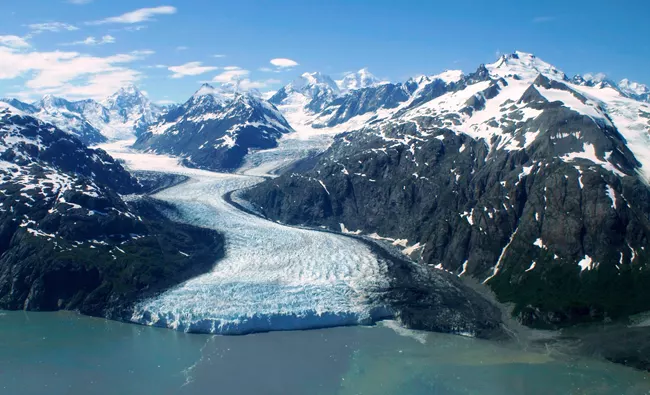
An aerial view of Margerie Glacier. The glacier begins high in the mountains and meanders down the valleys like a river of ice. Courtesy US NPS, Glacier Bay National Park & Preserve
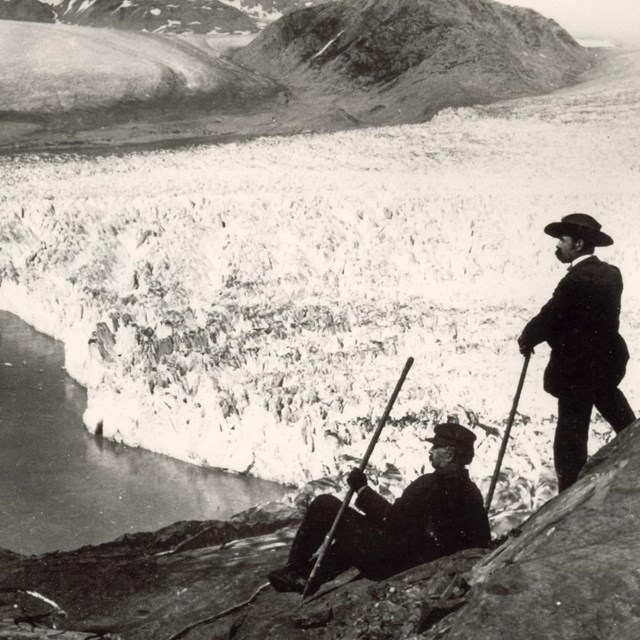
John Muir at Muir Glacier Courtesy US NPS, Glacier Bay National Park & PreserveI’ve known of John Muir much of my life. A recent kayaking trip to Glacier Bay in Alaska added to my appreciation for this remarkable early American naturalist, author, and Wilderness advocate. Muir first visited Glacier Bay in 1879, where he witnessed firsthand how glaciers transform the landscape, bolstering his prescient theory of glaciology. Upon returning home, I did a bit of research on his 1877 visit to Utah. Muir was taken by the wild beauty of the Wasatch Mountains as he so eloquently expressed.
“The glacial developments of these superb ranges are sharply sculptured peaks and rests, with ample wombs between them, where the ancient snows of the glacial period were collected and transformed into ice and ranks of profound shadowy canyons, while moraines commensurate with the lofty fountains extend into the valleys forming far the grandest series of glacial monuments I have yet seen this side of the Sierra.”
In addition to Muir’s contributions to understanding how glaciers sculpt landscapes, he used his political acumen to initiate the Wilderness movement, culminating with the 1964 Wilderness Act approved by the U.S. Congress. “A wilderness, in contrast with those areas where man and his own works dominate the landscape, is hereby recognized as an area where the earth and its community of life are untrammeled by man, where man himself is a visitor who does not remain.” – written by Howard Zahniser, the principle author of the Act.
The U.S. Congress has preserved 110 million acres of the fifty states since the Wilderness Act, 1.16 million of which are found in Utah. About half are on National Forest lands, the remaining residing with the Bureau of Land Management agency. Another 3.2 million acres are managed as Roadless lands titled Wilderness Study Areas.
Other Muir quotes which champion wilderness- “Thousands of tired, nerve-shaken, over-civilized people are beginning to find out that going to the mountains is going home; that wildness is a necessity.” and “Wilderness is a necessity… there must be places for human beings to satisfy their souls.”
I’ve spent many years as a seasonal Wilderness ranger and Wilderness advocate here in N. Utah in the Naomi and Wellsville Wilderness. Managing these precious spaces to retain its wilderness character has become ever more challenging with a warmer, dryer climate enhancing wildfire, flooding, and loss to massive insect outbreaks. As Glacier Bay and Glacier National park glaciers retreat ever deeper into bays and meadows, their names may become a misnomer.
Although John Muir’s famous “Muir Glacier” had receded several miles away from where it once met the ocean, I feel blessed the few tidewater glaciers we encountered yet remain. And I feel further blessed that the U.S. Congress has seen fit to protect Utah’s wildlands by deploying the Wilderness Act- “…where the Earth and its Community of Life will remain untrammeled by man…”
Jack Greene for the Bridgerland Audubon Society, and I’m wild about Utah!
Hansen, Wallace R, The Geologic Story of the Uinta Mountains, Geological Survey(USGS), US Department of the Interior, 1969, 1975, 1983, https://pubs.usgs.gov/bul/1291/report.pdf
Decreasing water levels in the southern arm of the Great Salt Lake expose microbialite communities that are normally underwater. Courtesy USGS, Hannah McIlwain, PhotographerI first met the Great Salt Lake in 1964 with two Central Michigan University college buddies on our way to Los Angeles. We heard you could float in its magical waters. Sure enough- it worked and we bobbed in its gentle waves oblivious to the many other virtues of this extraordinary water body.
This saltwater marvel is the largest wetland area in the American West. Its 400,000 acres of wetlands provide habitat for over 230 bird species traveling from the tip of South America, north to Canada’s Northwest Territories and as far west as Siberia. These wetlands and surrounding mudflats are vital habitat for 8-10 million individual migratory birds with many species gathering at the Lake in larger populations than anywhere else on the planet.
In 1991 the Great Salt Lake was declared a site of “hemispheric importance,” the highest level of designation given to a site by the Western Hemisphere Shorebird Reserve Network. The Reserve conserves shorebird habitat through a network of key sites across the Americas. Salt Lake receives the largest percentage of the world’s population of migrating Eared Grebes, nearly one-third of Wilson’s Phalaropes, more than half of American Avocets, and 37 percent of Black-necked Stilts. The lake’s shoreline, playas and mudflats also support 21 percent of the North American breeding population of Snowy Plovers, a species identified as one of greatest conservation needs by Utah’s Wildlife Action Plan.
These shorebirds are among nature’s most ambitious, long-distance migrants. But their numbers are dropping quickly. Shorebirds are showing the most dramatic declines among all bird groups. Species that undertake hemispheric migrations rely on specific habitats and food sources to survive, but these resources are increasingly under threat from human disturbance including habitat loss and degradation, over-harvesting, increasing predation, and climate change. As humans have continued to alter the landscape, shorebird populations continue to drop, with accelerated declines in recent decades.
Of 52 shorebird species that regularly breed in North America, 90% are predicted to experience an increase in risk of extinction. This includes 28 species already considered at high risk, and 10 imperiled species that face even greater risk.
At the base of Salt Lake’s food chain are microbialites, underwater reef-like rock mounds created by millions of microbes. These structures and their microbial mats form the base of the entire Great Salt Lake ecosystem, serving as a primary food source for brine shrimp and brine flies, which are the main food source for these aquatic birds. Falling water levels exposing the microbialites to air could trigger a collapse in the lake’s food chain according to a July study by the Utah Geological Survey.
So we humans aren’t the only one’s suffering from our disappearing Lake. Thank goodness we have awakened to this extraordinary resource found on our doorstep with many organizations and agencies attempting to save what remains for our health, wealth, and for the millions of threatened feathered friends that grace our skies, and our lives. Last May, Utah Governor Cox declared 2021 the year honoring shorebirds. We can do our part by taking action on conserving water and energy.
Jack Greene for Bridgerland Audubon Society and I’m wild about Utah and its magnificent great lake.
Written by Hall Crimmel & Dan Bedford, Filmed and Edited by Isaac Goeckeritz, iUtah EPSCor, Rachel Carsen Center Environment & Society,
Based on the book Desert Water; The Future of Utah’s Water Resources edited by Hall Crimmel and published by University of Utah Press, 2014



![John Muir and Wilderness: Roosevelt and Muir at Glacier Point President Teddy Roosevelt and John Muir standing on rock at Glacier Point, Yosemite, May 1903; Yosemite Falls and cliffs of Yosemite Valley in distance. [RL012904] Courtesy US NPS](https://wildaboututah.org/wp-content/uploads/nps.yosemite.roosevelt.and_.muir_.B15BD55C-155D-4519-3E97DDCE055E623F-large.jpg "Click for a larger view: Roosevelt and Muir at Glacier Point President Teddy Roosevelt and John Muir standing on rock at Glacier Point, Yosemite, May 1903; Yosemite Falls and cliffs of Yosemite Valley in distance. [RL012904] Courtesy US NPS")