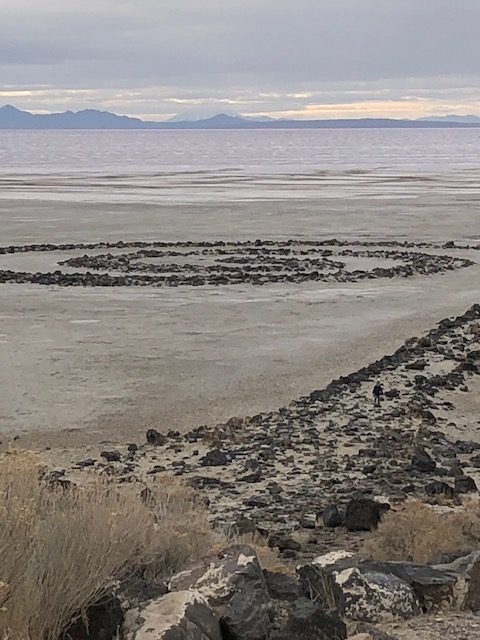
Suddenly I wanted to see the jetty again, so I hopped in my car and drove to the remote site. I saw the Spiral Jetty was now high and dry. Drifting sand had already started to bury parts of it. The water’s edge was now over 300 yards away. I thought of the millions of migratory birds that would be arriving in the spring to rest and feast on the tiny treasures of the lake, the brine shrimp. I hoped a smaller lake would still be enough for all of them.
The recent words of the director of Friends of the Great Salt Lake, Lynn de Freitas, rang in my head: “The Great Salt Lake is a gift that keeps on giving. Just add water.”
Case, William, GEOSIGHTS: PINK WATER, WHITE SALT CRYSTALS, BLACK BOULDERS, AND THE RETURN OF SPIRAL JETTY!, Survey Notes, v. 35 no. 1, Utah Geological Survey (UGS), Utah Department of Natural Resources, January 2003, https://geology.utah.gov/map-pub/survey-notes/geosights/spiral-jetty/
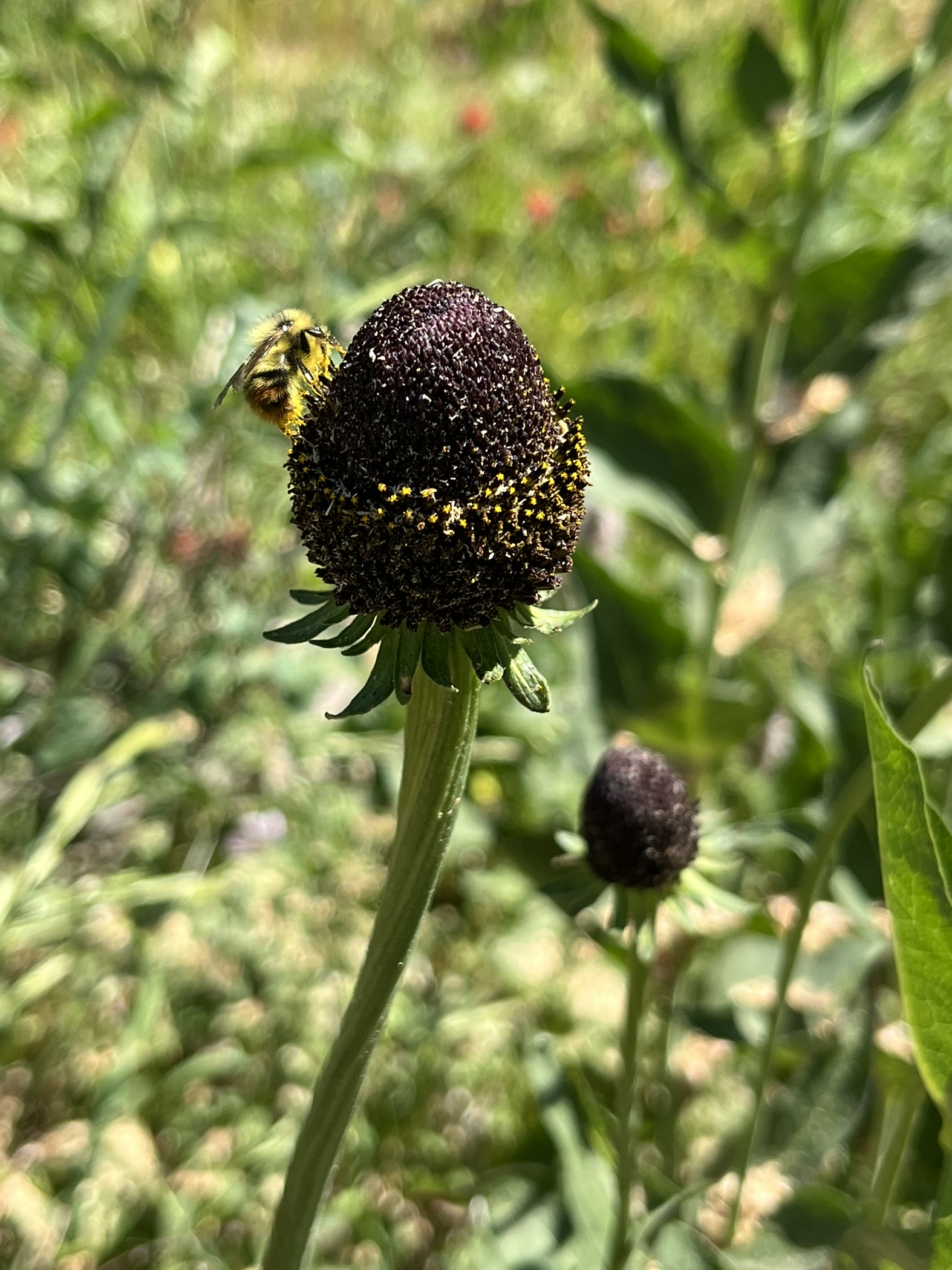
The Bee Courtesy & Copyright Shannon Rhodes, Photographer
The Bird [A Mallard Drake] Courtesy & Copyright Shannon Rhodes, PhotographerMarch is a thrilling month to be in an elementary school. Besides fifth grade maturation sessions, shamrocks pop up and many spotlight the impact of Dr. Seuss. Besides green eggs and ham eaten by children wearing tall red and white hats, we read and re-read books filled with fanciful characters and rhymes that roll off the tongue. I learned this year along with my students that Dr. Seuss’s father was the superintendent of parks in Springfield, Massachusetts, so naturally young Theodor took his sketchpad and pencil to observe and record whenever he could. When an animal lost an antler at the zoo, he would use it to craft a sculpture just as whimsical as the imaginative ones in his books. He called them pieces of The Seuss System of Unorthodox Taxidermy and placed them early in his career as promotional advertisements in bookshops. Kangaroo Bird with its teal stripes and pouch-perched hatchling and the Andulovian Grackler’s fur tufts and orange bill intrigue me. He also painted the stunning “The Birds and the Trees” featuring a white flock flying between red and pink palm trees that inspired the Dadake Day in “Oh the Thinks You Can Think.” As we studied Dr. Seuss’s “Did I Ever Tell You How Lucky You Are?” released 50 years ago this year, students noted how many birds appeared in the pages, leading us to do a Seuss bird scavenger hunt, our version of the birding counts chronicled in Mark Obmascik’s “The Big Year: A Tale of Man, Nature, and Fowl Obsession” (that’s f-o-w-l).
I do know I was lucky to teach once on a fifth grade team with a man students called Mr. J. Among many other things, he taught them how to recognize and identify birds. He preserved a time each day to review birds they had learned and add facts about a new species, how it looks, how it sounds, and how it behaves. He could display photographs and even silhouettes; students knew the shapes enough to identify them. He could play short audio clips, and students shouted out the corresponding birds too. I’ve discovered since The Bird Song Hero app that provides a spectrogram showing pitches visually that allow people like me another way to memorize those various bird songs. I remember I popped in the day they were discussing how our loggerhead shrike impales insects, rodents, snakes, and lizards on fences and really anything sharp and off the ground. When we took them on the bus through the Bear River Migratory Bird Refuge, I couldn’t believe my ears as kids with binoculars and without them were confidently shouting, “I see…” and tallying on their clipboards. For weeks that spring I would find students at recess peering up in the sky above the schoolyard doing the same thing. When I marveled at this phenomenon, Mr. J. smiled. “You know, Shannon, it isn’t about the birds. It’s about being aware.”
So often his “It’s about being aware” mantra pops in my head, like it did this week when my students huddled around our class pet cage housing a bee that emerged early from my Crown Bee tube “free-bee” from a recent science-teaching conference. Just like Dr. Seuss’s Bee-Watcher-Watchers, these six- and seven-year-olds eagerly missed romping in the fresh powder playground to watch a bee perched on a strawberry. I’ve done the same thing, standing mesmerized, lost in thought, watching a bee on a western coneflower, repeating the Seuss rhyme “Just tell yourself, Duckie, you’re really quite lucky.”
Newberry, Todd & Holtan, G. (2005). The Ardent Birder: On the Craft of Birdwatching. Random House LLC. https://www.amazon.com/Ardent-Birder-Birdwatching-Newberry-2005-10-01/dp/B01FGJKGUS?asin=1580087159&revisionId=&format=4&depth=1
Wow, I thought. These pelicans are working together to to drive the fish into the shallow water’s edge where they can easily scoop the up And then it got better. Fanning out, the pelicans regrouped in a circle Swimming towards the center, they tightened the noose. And bam! Dip, scoop, knock back some more fish
I was amazed at how soundless and seamless it all was and could have watched for hours, but I was on the one lane auto route at the Bear River Migratory Bird Refuge and the cars behind me were starting to honk their horns, so I reluctantly moved on.
As soon as I got home I plunged into research on this majestic bird, beginning with the bill. When the pelican dips its bill into the water, the lower portion expands into a flexible sac that allows the bird to to scoop up as much as 3 gallons of fish and water. When the pelican cocks back its head, the sac contracts, the water is expelled through a barely open bill, and the fish swallowed. The huge pelican bill, which at first glance looks like a formidable weapon, is actually an exquisitively designed fishing net.
Archeologists have found pelican skulls dating back 30 million years, so this unique bill has definitely passed the test of time.
Back at the refuge I was able to turn into a visitor pull out and pick up the rather stunning bit of information: these pelicans fly in from Gunnison Island in the Great Salt Lake, over the Promontory Mountains, daily to forage for fish. That’s a 30 mile trip each way!
Long before the Mormon pioneers arrived in Utah, pelicans were building their nest on Gunnison Island. They were briefly disturbed when an artist, Albert Lambourne, tried to homestead for a year in 1850, and a guano mining company dropped off a crew – a Pole, a Russian, a Scot and an Englishman- to mine the bird poop. But the operation wasn’t profitable, and when it closed down, the pelicans reclaimed the island. Each March the birds fly in from as far away as Mexico, build their nests, and raise their chicks. The rookery is the largest in the US. In 2017 the pop was estimated to be as high as 20,000.
Back in Cache Valley in 2010, Jordan Falslev built a viewing platform near Benson Marina, The Pelican Perch, as his Eagle scout project. There used to be hundreds of pelicans out there on the water, but when I stopped by last week I didn’t see a single one. Numbers are way down now largely because the dropping water level in the Great Salt Lake have exposed a land bridge to Gunnison Island that allows predators to ravage the nesting site.
You can still catch sight of a pelican in flight in Cache Valley. (Their wingspan is 10 ft. Rudy Gobert, in comparison, has a wingspan of 7 ft 9 in.) But for my money, the best show in town is watching packs of pelicans hunt for fish at the Bear River Migratory Bird refuge.
Cassin’s Finch, Carpodacus cassinii Courtesy US FWS, Dave Menke, Photographer
Male House Finch in Mating Plumage Haemorhous mexicanus Courtesy US FWS, Gary Kramer, PhotographerAudubon chapters everywhere invite volunteers to join the 123rd Christmas Bird Count, and that means it’s time to hone our bird watching skills for the longest-running community science project. Seasoned birders and beginners alike spend a few minutes or a full day on this annual census of birds. Those just starting to notice birds can be valuable spotters in the mobile sectors, and can quickly learn to observe the subtle differences between similar species seen from the comfort of home, where no bird feeder is required, and valuable contributions can be made with just a few minutes of counting birds.
The Bridgerland Audubon Society launched the Cache Christmas Bird Count watch circle in 1955, contributing to a tradition launched in1900 by ornithologist Frank M. Chapman who out of concern for dwindling bird populations managed to change the culture from annual Christmas bird shooting contests into bird counting contests. Bridgerland Audubon always schedules on the first Saturday on or following December 14th, and typically documents about 100 species of birds.
The Cache Valley watch circle is divided into eleven sectors, including a 4 a.m. owling sector, and includes all homes within a 7.5 mile radius from the center of the circle which is located at Main Street & Hyde Park Lane (Hwy 91 & 3600 N). The same 15-mile diameter watch circle is surveyed each December – that’s about 177 square miles, and we can use all the help we can get, especially from folks watching from home. Don’t worry if you can’t identify all of the birds you see – you will just report the ones you do recognize. You can also get help by posting photos to the Bridgerland Audubon Facebook group, where you’ll also see posts about the Dark-eyed Junco, a small dark bird with a white belly, and subspecies which include the Oregon Junco with a black hood and neck, the Pink-Sided, the Gray-headed, and the Slate Junco.
The Home Sector provides a lot of extra data on about 32 species, the most common of which are available on a one page photo-illustrated checklist on the Bridgerland Audubon website where you will also find links to the free Merlin App which identifies birds by their songs. The Visitors Bureau has a nice selection of Utah Bird field guides which are great for beginners.
Bird identification is all about learning to notice the little differences in size, coloration patterns, shape of the beak, the crown of the head, and the tip of the tail. For example a House Finch and a Cassin’s Finch may look the same at first glance, but the House Finch has streaks on the side of the body, a rounded tail tip, and the red over the eyes is more like a headband than a top hat. The Cassin’s Finch has a notched tail, red cap, and lacks those streaks on the breast and and sides. The Pine Siskin looks like a tiny House Finch but it has a hint of yellow on its wings and the beak is more delicate and pointed. Large flocks of birds can be counted by blocking off a group of individuals, counting them, and then extrapolating to the whole of the flock. Don’t forget that zero is a number to report!
Visit Audubon.org to find a Christmas Bird Count near you, and visit bridgerlandaudubon.org to join the local count sector leaders on Saturday, December 17th, 2022. Pre- registration is free but required.
I’m Hilary Shughart with Bridgerland Audubon and I am Wild About Utah!
Tips from eBird on How to count large flocks of birds:
“Big numbers of Moving Birds. Their are two ways to count large flocks of moving birds: either by blocking off a group of individuals, counting them, and then extrapolating to the whole of the flock; or by counting birds per unit of time.”
Team eBird, Bird Counting 101, eBird is a project of the Cornell Lab of Ornithology, https://ebird.org/news/counting-101/